

 Freedom Index

Listen to the article
Nearly six decades ago the world was allegedly in the midst of an apocalyptic “population explosion.” Today the fear among some economists is the opposite: that the world in this century is on track to experience a steep global population implosion.
When the Stanford biologist Paul Ehrlich wrote The Population Bomb in 1968, world population stood at just over 3.5 billion and the global total fertility rate was just under 5 children per woman. As a dire consequence of these trends, he declared, “The battle to feed all of humanity is over.” He further predicted that in “the 1970’s the world will undergo famines—hundreds of millions of people are going to starve to death in spite of any crash programs embarked upon now.” His solution was “population control,” to be imposed “by compulsion if voluntary methods fail.” Ultimately, Ehrlich asserted, “The birth rate must be brought into balance with the death rate or mankind will breed itself into oblivion.”
Although millions of people have indeed died of hunger, largely as a result of disruptions caused by civil wars, Ehrlich’s dire predictions of global scale famines caused by “overpopulation” failed entirely. World population today is just shy of 8.3 billion.
Population implosion is now the big worry, as can be seen in a new study by two economists, Jesús Fernández-Villaverde of the University of Pennsylvania and Patrick Norrick of Northwestern University. They claim that humanity’s total fertility rate may have already fallen below the population replacement rate and that there are no signs that it will rebound. (The replacement rate is conventionally defined as each woman having 2.1 children over the course of her lifetime.)
What is even more amazing and puzzling is that some the fastest falls in fertility that they document are occurring in low- and middle-income countries and among less educated women.
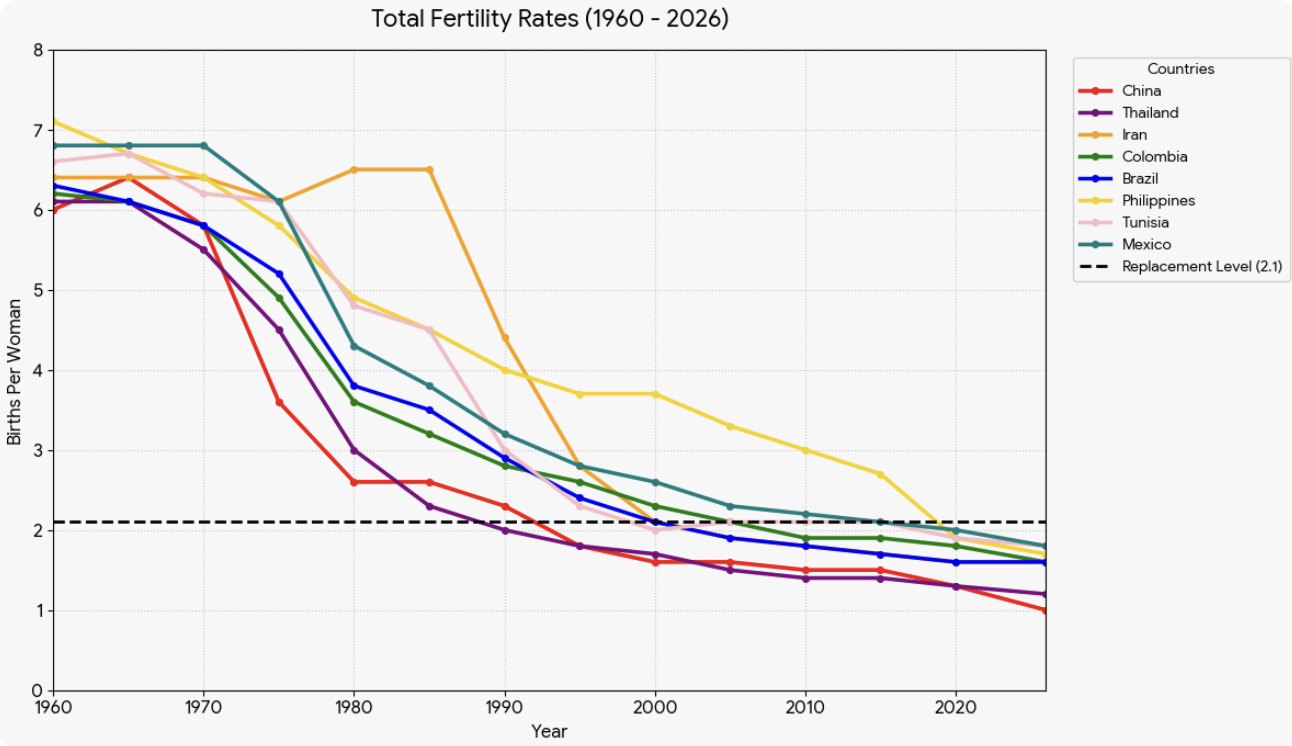
This cuts against the general demographic trend in which fertility falls as people’s incomes increase. If the falling trend is sustained and amplified, world population will begin shrinking—possibly very quickly—later in this century “That has never happened before, not in wars or pandemics,” write the study’s authors, describing this projected future as “Terra Incognita.”
The researchers note that reaching very low levels of fertility does not require extraordinary rates of childlessness or very small families. They illustrate this point by imagining the choices of a cohort of 100 women in which 15 are childless by choice or medically, 10 have one child, 60 have two, 10 have three, and 5 have four, yielding 180 children with a completed fertility rate of 1.8—which is still below the replacement rate. Now imagine a further relatively small shift in which 26 women are childless, 23 have one child, 46 have two, and 5 have three. Completed fertility falls to 1.3, the conventional threshold for lowest-low fertility, even though three quarters of the women did not switch their behavior. “Any explanation [for the fall in fertility rates] only has to account for the quarter of women who switch, not for the 75% who do not,” write the researchers. “A woman at two may easily switch to one, or from one to zero, in response to relatively small changes in relative prices or opportunity costs.”
So why are people having fewer children? The researchers review popular answers, such as rising housing prices, more education for women, shifts in preferences and social norms, the time demands of training in more skills-based economies, and smartphones’ effects on in-person interactions. They argue that all of these contribute marginally to falling fertility rates but cannot account for why the trend is so widespread across so many different countries around the globe.
Modernity itself, they speculate, is the chief explanation for falling fertility. “We live in a society built around large organizations and formal credentials, which makes a third child expensive and childlessness cheap, and that circumstance has created a mismatch between women’s position outside the home and men’s inside it,” they write. In the modern world, children do not produce income for the household, supportive kin networks have frayed, and an extra child is expensive to educate. “As modernity has spread everywhere, even to countries with low income per capita, fertility has also fallen everywhere.”
Fernández-Villaverde and Norrick also point to an intriguing correlation between mismatched gender norms and fertility rates. While women’s modern opportunities expand outside the household, male expectations about housework and child-rearing roles can remain stuck. Societies with highly unbalanced gender norms start with very high total fertility rates as men impose their preferences but fall quickly as educated women with outside incomes resist. This gender mismatch in rapidly modernizing societies may explain in part the current extremely low fertility rates in many East Asian countries.
The two economists cannot identify any self-regulating feedback mechanisms that encourage fertility rates to rebound to replacement level. They also point out that pro-natalist government policies—subsidies, generous parental leave, free daycare—boost fertility only marginally.
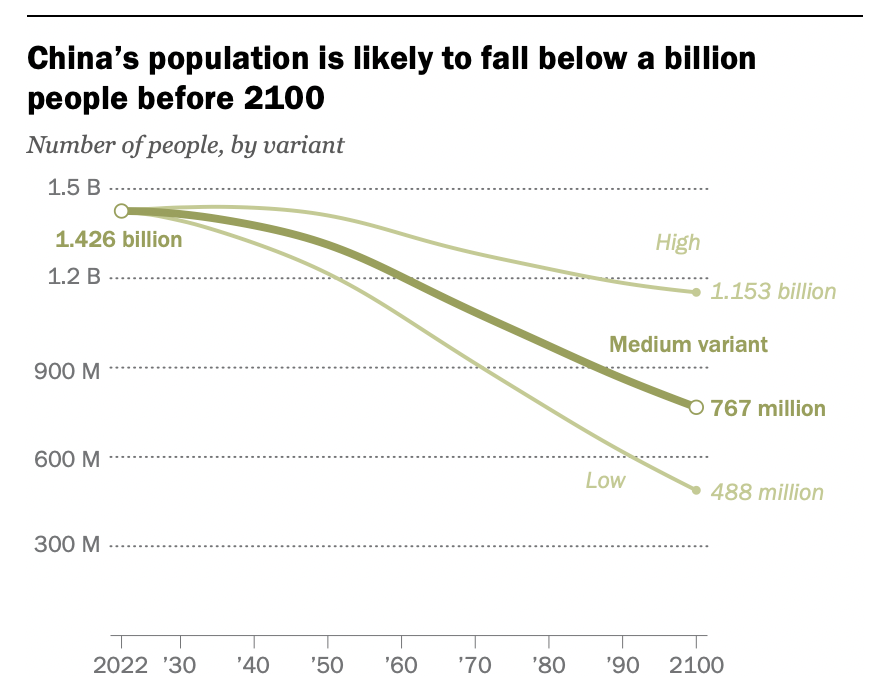
Sustained ultra-low fertility at 1 child per woman leads to a steep exponential decline in population. For example: On current fertility trends, China’s population would fall to about half of its current population by 2100.
In an admittedly unrealistic scenario, consider, for illustrative purposes, what the population would be in 2100 if at around 2040 that global fertility fell and remained at the East Asian rate of 1 child per woman, at current mortality rates:
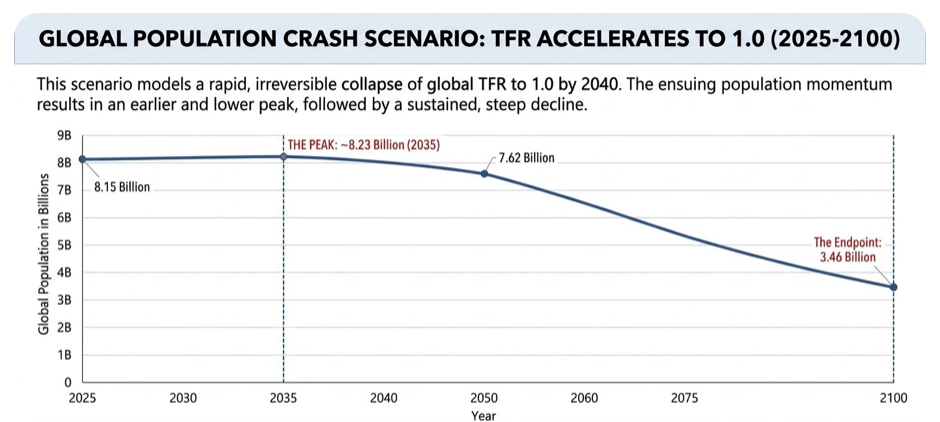
Basically, more people would be dying than are born over the course of this century. Consequently, world population at the end of this century would be back to the level it was when Ehrlich made his apocalyptic predictions.
Should we be concerned about a world of fewer people? Fernández-Villaverde and Norrick think so. They contrast the recent economic and demographic fortunes of the U.S. and Japan to make their point. As Japan’s working age population shrank, its annual GDP growth rate hovered about 0.8 percent; meanwhile, a rising working age population helped boost the average annual GDP growth rate to 2.6 percent in the U.S.
The two argue that a shrinking population will also tend to slow economic growth as the creation of new ideas lags (fewer researchers), entrepreneurial dynamism flags (stodgy incumbent firms), and older workforces resist new technologies. And of course, support for older and sicker citizens will impose heavy fiscal burdens on younger workers.
But there is a possible countervailing trend. The authors note that “one of the oldest regularities in demography” recently flattened in the United States. From 1980 through 2010, fertility rates turned upward in households whose incomes were in the top 20 percent, at a threshold of about $175,000. In addition, the fertility of highly educated American women increased. Why? Likely because such households can afford to outsource childcare and domestic labor. The authors concluded that “children are becoming a luxury good.”
I reported just a such trend nearly 30 years ago, in a 1997 article titled “Kids as Status Symbols”:
So, you’ve got the beach house compound on Nantucket, the 63-foot Hinckley sailboat, the corporate jet, the nanny, and the gardener; and your stay-at-home spouse with the advanced academic degree heads up the local United Way campaign. What other acquisition might serve your high economic and social status? How about having some more kids?
Assuming a 2.5 percent annual growth rate U.S. GDP in 2100 would rise to more than $200 trillion which divvied up among 350 million Americans would yield nearly $600,000 per capita GDP. With that amount of income, most Americans should be able to afford the luxury of a whole staff of robots to do chores and take care of any number of children.
Finally, recall Ehrlich’s prediction: “The birth rate must be brought into balance with the death rate or mankind will breed itself into oblivion.” If the trends identified by Fernández-Villaverde and Norrick are sustained, Ehrlich might have been right after all, but for the opposite reason: Oblivion would be achieved through the failure to breed.
Read the full article here
Fact Checker
Verify the accuracy of this article using AI-powered analysis and real-time sources.