

 Freedom Index
Listen to the article
As revolutionary inventions go, the elevator doesn’t seem to get its due.
Elevators aren’t as iconic as the automobile or as ostentatious as the airplane. They are simple, generally unfussy devices seemingly meant to be ignored. If you live in an apartment building or work in an office, you might take an elevator several times each day without a second thought.
But add up all those trips, and you start to get a sense of how important the elevator is. An estimated 1 billion people set foot in an elevator every single day. In the U.S., elevators travel more than 2.5 billion miles each year—more than all the miles traveled by train and airplane, combined. That’s enough to go back and forth to the Sun more than 27 times.
Elevators are essential technology. They have changed where people live and how we work. They make it easier for anyone with a wheelchair or a stroller to get around. Without elevators, skyscrapers would be worthless, and penthouse apartments would not be desirable. The modern city would be very different without the elevator.
So, why don’t we build as many of them anymore?
Yes, America still has a ton of elevators. More than 1 million of them, in fact. Compared to other countries, however, we are falling behind.
The U.S. has about 3.1 elevators per thousand people. On a per capita basis, France and Germany have about three times as many. New York City has roughly the same number of people as Switzerland—a place with far fewer tall buildings—but there are actually twice as many passenger elevators in Switzerland as in NYC.
The American elevator shortage is, in many ways, a policy problem.
Installing a brand new, four-stop elevator in New York City costs about $158,000, according to a 2024 report published by the Center for Building in North America, a housing policy think tank. That same elevator costs about $36,000 to install in Switzerland.
If something costs more, you’ll get less of it. The high cost of installing elevators is the major reason why there are fewer of them being built in America.
“The problem with elevators is a microcosm of the challenges of the broader construction industry—from labor to building codes to a sheer lack of political will,” wrote Stephen Jacob Smith, the center’s executive director, in a 2024 essay for The New York Times. “These challenges are at the root of a mounting housing crisis that has spread to nearly every part of the country and is damaging our economic productivity and our environment.”
In his research, Smith points to two major factors that inflate the cost of elevator construction in America.
The first is well-intentioned regulations that have backfired.
American elevators are required to be considerably bigger than those installed in new construction in Europe and elsewhere around the world. Rather than merely accommodating a wheelchair or a stretcher, as is common elsewhere, American regulations require additional room alongside. In some jurisdictions, elevators must be big enough to allow for turning a stretcher sideways, which is rarely going to be necessary.
Bigger elevators take up more space in buildings, of course. They are also heavier, which makes them more expensive to build and install. As a result, developers are less likely to include elevators in their floor plans. Regulations that were meant to make American buildings more accessible have actually done the opposite.
The second big problem is labor unions. Specifically, the International Union of Elevator Constructors (IUEC), which has a near monopoly on elevator installation and repair work in America.
Labor costs are the single biggest part of installing a new elevator, and the IUEC likes it that way. Elevator construction is the highest-paid speciality construction job in the U.S., with hourly wages in excess of $51 in 2024. The union keeps those costs high by strictly controlling how many members it has: In 2021, more than 1,500 people applied to join New York City’s local union of the IUEC. Only 115 were allowed to join.
The IUEC also fights attempts by state lawmakers to tear down nonsensical barriers to working across state lines. Elevators are the same everywhere, so a worker trained in New York should be able to safely install an elevator in Connecticut, but a local affiliate of the IUEC opposed an effort in 2021 to allow out-of-state licensees to work in Connecticut, for example.
As the Center for Building in North America points out in its report, probably the biggest impediment to cheap elevator construction is the union’s steadfast opposition to using prefabricated elevators.
In the rest of the world, factory-built elevators are standard practice. In America, however, union workers are paid to redrill holes and rewire electrical components that are built in a factory.
This makes very little sense. Imagine if you were not allowed to install a prefabricated oven in your kitchen. Instead, you have to hire mechanics to build one from scratch using sheet metal and various electrical components. That would make any kitchen renovation more costly and time-consuming—but wouldn’t accomplish much else.
That’s exactly what is happening with elevators.
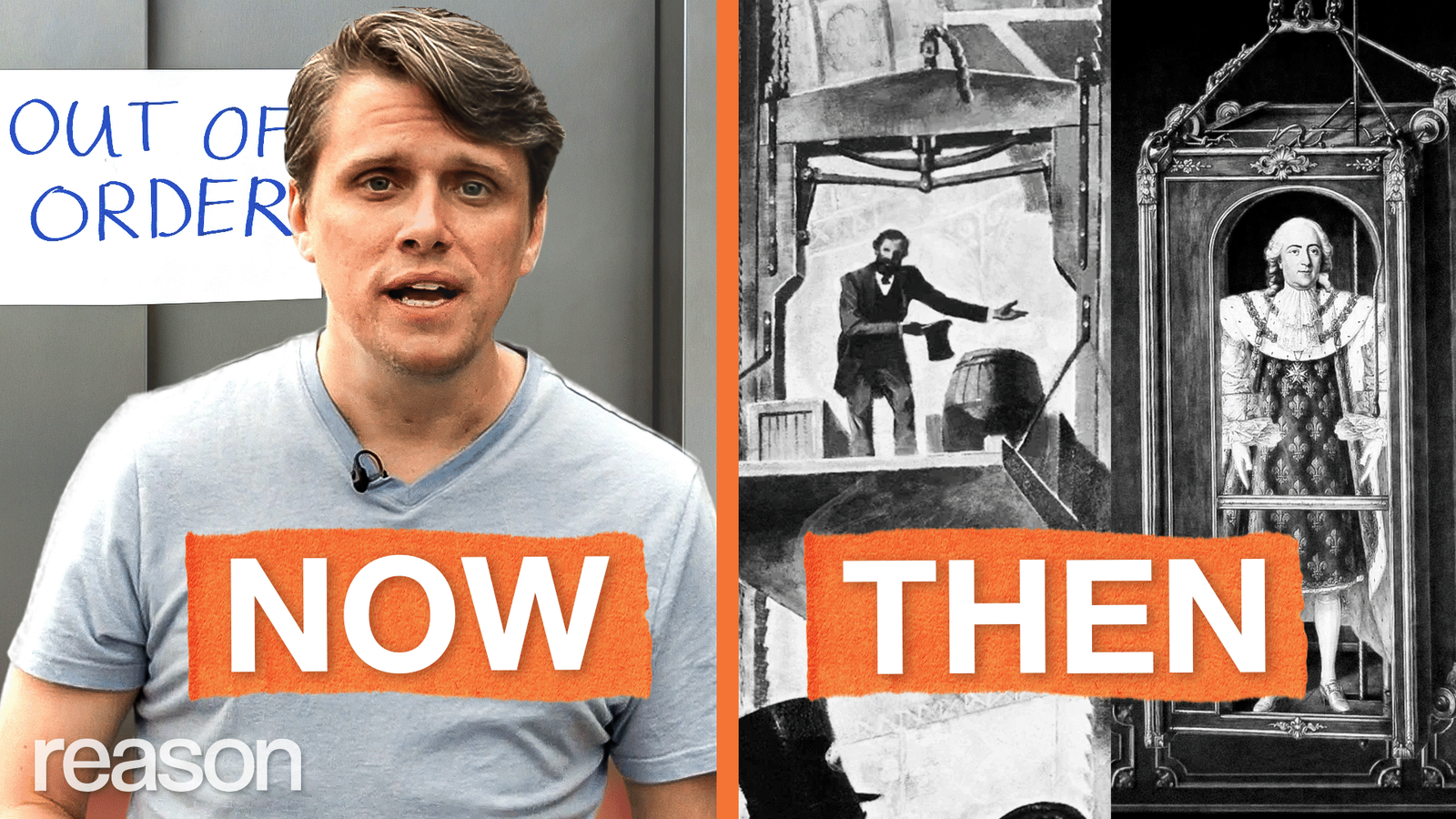
Of course, safety should be a paramount concern with elevator regulations. That’s been true ever since Elisha Otis demonstrated the first modern passenger elevator at an exhibition in New York City in 1854. The key part of Otis’ design was a safety catch. Previously, elevators had a reputation for being terribly unsafe. Once their safety was proven, people were more willing to use them, and builders were more willing to install them.
If the trade-off for higher construction costs was a greater degree of safety, then we should be happy to pay it.
Here’s the problem. Those cheaper, prefabricated, more efficient elevators in Europe and Asia are just as safe as the ones in America that cost three times as much to build (and also cost more to maintain, thanks to the shortage of elevator workers).
Americans are getting ripped off. We have fewer elevators and less mobility than people living in poorer countries—thanks to overly aggressive regulations and special interests’ profiteering.
Fewer, more expensive elevators mean housing is more expensive. It means that apartments and offices are less accessible for millions of Americans who have difficulty with stairs. And it makes life more difficult for just about everyone.
It doesn’t have to be this way. The elevator once revolutionized how cities look and operate. Americans should demand changes so that the elevator can once again hoist us into a brighter future.
Read the full article here
Fact Checker
Verify the accuracy of this article using AI-powered analysis and real-time sources.