

 Freedom Index

Listen to the article
Ethereum researchers just wanted to reduce staking incentives. Instead, they sparked one of the biggest debates over the network’s economics since the Merge.
Ethereum Improvement Proposal EIP-8363, or “Tapered Issuance Burn,” would gradually reduce staking rewards as more and more Ether is locked up to secure the network — eventually cutting new protocol issuance to zero once 50% of ETH’s supply is staked.
Its authors, including Ethereum Foundation’s Justin Drake and Ethereum Community Conference (ETHCC) co-founder Jerome de Tychey, argue that Ethereum has reached the point where additional staking provides diminishing security returns, while diluting holders who choose not to stake.
In other words: Ethereum should stop paying for security it no longer needs.
There’s just one problem, a lot of people hate the idea.
From DeFi builders to staking providers and institutional investors, critics argue it could weaken decentralization, disrupt Ethereum’s lending markets and undermine confidence in the network’s monetary policy. As Ether.fi founder Mike Silagadze puts it:
“This is so disappointing on every level. […] This is bad for decentralization, this is bad for Ethereum adoption, and this is bad for the credibility of the network.”
Dr. Steve Berryman, Bitwise’s head of client partnerships for Ethereum, tells Magazine:
“Institutional adoption requires certainty and playing with the issuance at the margin would cause uncertainty and institutions hate uncertainty.”
So is Ethereum really paying too much for security, or is EIP-8368 a solution in search of a problem?
Is Ethereum over-staked?
Ethereum currently has around 41.5 million ETH staked, earning 2.67%, and representing 34.07% of the entire supply, according to the Ethereum Validator Queue.
EIP-8363, Tapered Issuance Burn. Source: Jerome de Tychey
While more ETH locked up generally makes the network harder to attack, EIP-8368’s authors argue those security gains become increasingly marginal while Ethereum continues issuing rewards to validators.
EIP-8363 would gradually remove that incentive, and the authors argue Ethereum should stop subsidizing additional staking once the network is sufficiently secure.
Yet not everyone agrees that the problem even exists in the first place. It’s certainly true that the amount staked has increased substantially in 2026, up 15% since the start of the year.
Berryman argues that market forces are already slowing participation without the need to change Ethereum’s issuance policy.
“We will come to a natural ceiling probably by the end of this year,” he says, arguing that yields falling to around 2% are unlikely to attract significantly more ETH to be locked up in staking. “People need a certain amount of liquidity,” he says.
Related: Ethereum Foundation adds SEAL 911 co-founder to board as privacy focus grows
Berryman says recent growth has largely been driven by institutional entrants such as Bitmine and BlackRock, but argues that once those players complete their staking allocations, participation is likely to plateau again.
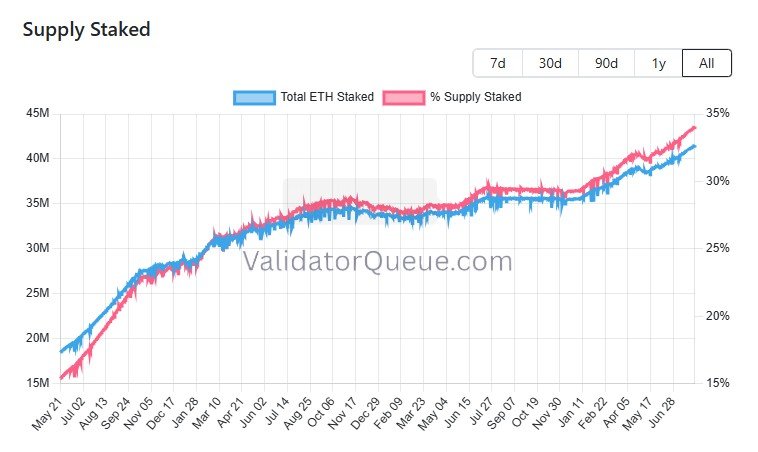
Source: Validatorqueue.com
Ethereum commentator Leo Lanza, who also opposes the proposal, challenges the core assumption that issuance on Ethereum represents a meaningful “stealth tax” on non-stakers.
Ethereum’s annual inflation remains below 1%, he says, arguing that even gold, widely viewed as the world’s premier monetary asset, expands its supply by roughly 1% to 2% annually:
“The free market already solves this […] Let the market adjust.”
Could the cure be worse than the disease?
Supporters of EIP-8368 argue the change would curb unnecessary issuance and discourage staking from becoming overly concentrated among large custodians and liquid staking providers. But critics say the proposal risks creating bigger problems than it’s trying to solve.
Greg Koumoutsos, technical research lead at the Lido Labs Foundation, says today’s staking ratio of around one-third of ETH supply does not appear unhealthy, though he agrees it is reasonable to think proactively about excessive staking.
More importantly, he argues the proposal oversimplifies what Ethereum’s issuance is actually paying for:
“Ethereum is not only paying for slashable ETH; it is paying for decentralization, operator diversity, censorship resistance, and network resilience.”
Koumoutsos says lower issuance is not automatically a better security policy unless those broader trade-offs are also taken into account.
Another factor to consider is that liquid staking is now deeply integrated into Ethereum’s DeFi ecosystem, and staking derivatives are widely used as collateral and in lending and yield strategies.
“It will obviously kill a huge chunk of DeFi which is built around the staking ecosystem,” Silagadze argues.
Stani Kulechov, founder of Aave, Ethereum’s largest decentralized lending protocol, says that reducing staking rewards risks undermining that broader ecosystem.
“My concern is… those who are fine with ETH beta and yield might also sell ETH for other yielding assets […] Ethereum should not be punished for its growth.”
Related: Ethereum, Solana led crypto hack losses in H1 2026: Blockaid
Smaller validators will bear the cost
Another concern with the proposal is that lowering staking rewards could actually increase concentration among the largest participants.
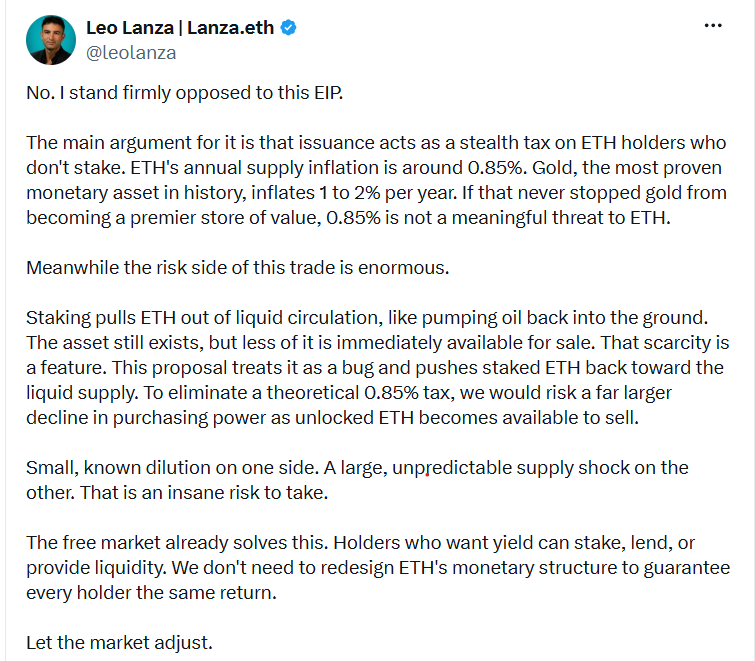
“I stand firmly opposed to this EIP.” Source: Leo Lanza
That’s because independent validators do not benefit from the economies of scale that larger staking businesses, exchanges or institutional operators do. Lower protocol rewards could make solo staking uneconomical while larger organizations continue operating. Koumoutsos says:
“A solo validator has real costs: some ideological solo stakers may remain, but many marginal solo validators will not, and fewer new ones will enter, if any.”
He adds that centralized platforms also stake for reasons beyond yield, such as customer retention, regulatory positioning and product integration, which makes them less likely to reduce their participation.
Koumoutsos also warns that even within delegated staking, lower rewards could favor centralized custodial products over onchain staking protocols, which face higher maintenance, governance and upgrade costs.
A debate over more than staking
Supporters say lower issuance would strengthen Ether’s long-term monetary profile. But critics argue that continually adjusting Ethereum’s monetary policy undermines its claims to be predictable and reliable.
Berryman argues institutions value predictability more than marginally higher yields, and that changing the curve creates yield governance risk. “Institutional investors will price accordingly,” he says.
He also says institutions value staking not because the yield is especially high, but because it provides a predictable return while they hold ETH:
“It’s not broken, why try and fix it?”
Silagadze agrees, saying, “Any nation state or large institution looking at this will justifiably have a dramatic loss of confidence in the governance and stability of Ethereum.”
The proposal’s rollout also drew criticism for being published just two days before the Aug. 6 deadline for proposals to be considered for the next Ethereum network upgrade.
Silagadze says that a change with “far reaching implications for all of DeFi” should not have been published on such a short timeline.
The fierce backlash has shown how difficult it has become to change Ethereum’s economics, especially when every adjustment creates winners and losers across staking, DeFi and institutional markets.
Magazine: Ethereum’s much-hated staking ‘tax’ may already be obsolete
Cointelegraph publishes long-form journalism, analysis and narrative reporting produced by Cointelegraph’s in-house editorial team with subject-matter expertise. All articles are edited and reviewed by Cointelegraph editors in line with our editorial standards. Some articles contain affiliate links, from which Cointelegraph may earn a commission. These relationships do not influence which products we review or our editorial conclusions. Content published in here does not constitute financial, legal or investment advice. Readers should conduct their own research and consult qualified professionals where appropriate. Cointelegraph maintains full editorial independence.
Read the full article here
Fact Checker
Verify the accuracy of this article using AI-powered analysis and real-time sources.