

 Freedom Index

Listen to the article
Ethereum co-founder Vitalik Buterin has criticized the European Union’s proposed “Chat Control” legislation, warning that it threatens the right to privacy in digital communications.
In a Saturday post shared on X, Buterin voiced opposition to mandatory surveillance measures that would require tech platforms to scan private messages for illegal content. “We all deserve privacy and security… for our private communications,” Buterin said.
“You cannot make society secure by making people insecure,” he wrote, arguing that backdoors built for law enforcement are “inevitably hackable” and undermine the safety of everyone.
The post was in response to another message by entrepreneur Pieter Levels, who urged Europeans to reject the regulation, warning that it could allow officials to access citizens’ personal messages.
Related: EU proposal to scan all private messages gains momentum
Vitalik calls out lawmaker hypocrisy
Buterin also called out the hypocrisy of lawmakers reportedly seeking to exempt themselves from the Chat Control legislation. “The fact that government officials want to exempt themselves from their own law is telling,” he said, linking to a report from EU Reporter.
Per the report, a leaked draft of the proposed law has revealed that interior ministers are seeking to exempt themselves, along with intelligence, police and military staff, from the mass surveillance provisions aimed at scanning private chats.
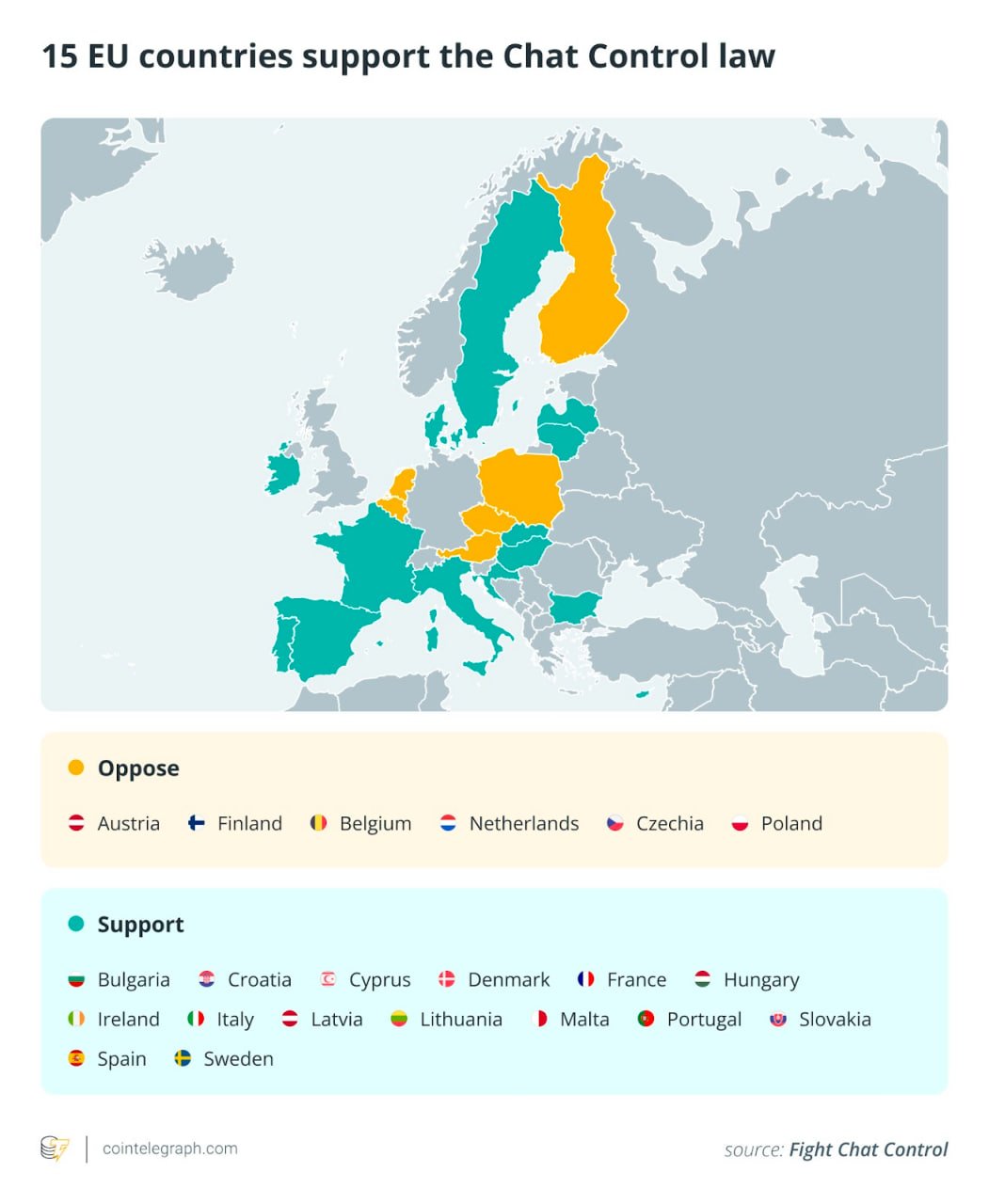
15 EU countries currently support the proposal but fall short of the 65% population threshold required for passage. Germany, which holds the pivotal vote, has yet to take a final stance. If Germany votes in favor, the law will likely pass; if it abstains or opposes, the legislation is expected to fail.
Related: US Treasury’s DeFi ID plan is ‘like putting cameras in every living room’
EU’s Chat Control could push users toward Web3
Crypto advocates like Diode CEO Hans Rempel and Brickken’s Elisenda Fabrega have said that the proposal may drive users toward decentralized Web3 platforms designed for privacy by default.
Rempel said Web3’s “not your keys, not your data” ethos resonates with users disillusioned by centralized systems. Fabrega cautioned that the shift could fragment the EU digital market and reduce its influence on global privacy standards.
Fabrega also noted that the legislation violates Articles 7 and 8 of the EU Charter, which protect private communications and personal data. Rempel warned that entrusting governments with backdoor access poses serious cybersecurity risks, given their history of data breaches.
Magazine: Astrology could make you a better crypto trader: It has been foretold
Read the full article here
Fact Checker
Verify the accuracy of this article using AI-powered analysis and real-time sources.