

 Freedom Index
Listen to the article
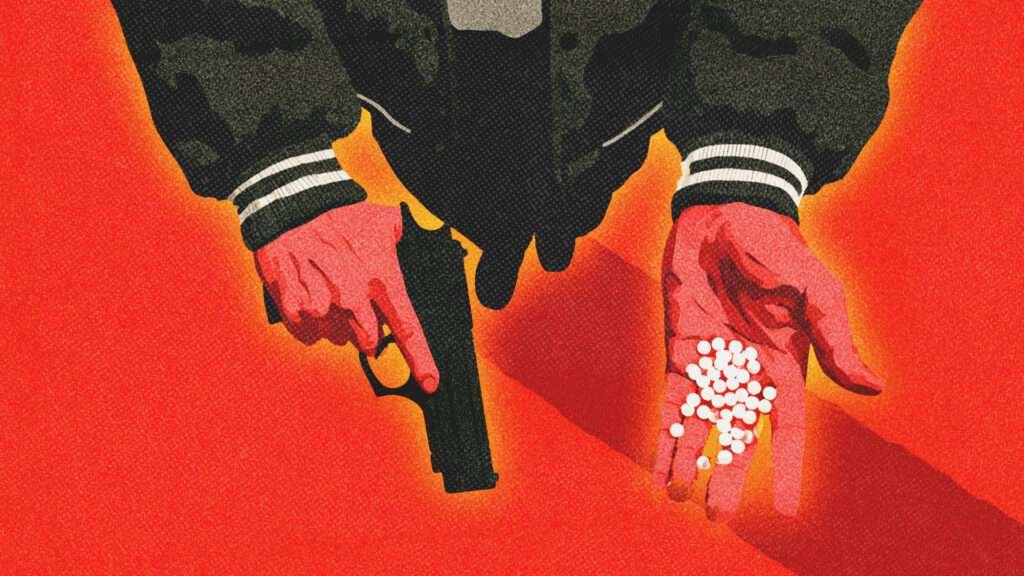
A New Jersey news outlet is asking a state appeals court to lift a judicial order censoring its coverage of an incident that led to a lockdown at New Brunswick High School on May 8. That extraordinary order, which New Jersey Superior Court Judge Thomas D. McCloskey issued on July 9, purports to bar New Brunswick Today and every other journalist in the United States from identifying the 16-year-old student who prompted the lockdown by bringing an airsoft pistol to school. It also prohibits them from sharing unexpurgated security camera video of the incident.
In a brief filed last week with the Superior Court’s appellate division, New Brunswick Today‘s lawyers, C.J. Griffin and Bruce S. Rosen, note that such prior restraints on freedom of the press are presumptively unconstitutional. The Supreme Court, which has never upheld such an order, has said prior restraints can be justified only when they “further a state interest of the highest order,” such as stopping the release of information that would “set in motion a nuclear holocaust” or “inevitably, directly, and immediately” imperil the safety of U.S. forces at sea. Griffin and Rosen say the state interest that McCloskey invoked, protecting the privacy of the student caught with an airsoft gun, does not come close to meeting that highly demanding standard.
“This case presents an extraordinary violation of the First Amendment—a prior restraint specifically prohibited by the United States Supreme Court,” Griffin and Rosen write. “Case law is clear that prior restraints are presumptively invalid. In all its history, the U.S. Supreme Court has never permitted a prior restraint on free speech, not even when newspapers published the stolen, highly classified Pentagon Papers that the government claimed threatened national security.”
McCloskey was responding to a lawsuit filed by the New Brunswick Board of Education, which objected to New Brunswick Today‘s publication of leaked surveillance camera footage showing the airsoft-pistol discovery, which contradicted the board’s false assurance to parents that the ensuing lockdown was “a routine security drill.” On May 29, McCloskey ordered New Brunswick Today to remove the video and refrain from describing it. He also enjoined New Brunswick Today from “any and all future postings of confidential school security/surveillance video” recorded at “any of the schools in the Plaintiff’s District.” He did all of that “without any analysis,” the appeal brief notes, and ultimately acknowledged that he had gone too far.
The revised order, which McCloskey issued about six weeks later, allowed New Brunswick Today to describe the video, provided it did not reveal the identity of the teenager who triggered the lockdown or any other students in the vicinity. McCloskey also allowed New Brunswick Today to repost the video itself, provided it first “modify the footage by redacting or blurring out the identities of all juvenile students depicted in it” and “present the modified footage to Plaintiff and its counsel for review and approval, with copy to the Court.” At the same time, McCloskey extended the targets of the order to include “the press” generally, meaning he aimed to restrict the journalism of news organizations that were not parties to the case.
As a result of the initial order, Griffin and Rosen note, New Brunswick Today was “unconstitutionally gagged for nearly six weeks.” The revised order “still imposes unconstitutional prior restraints,” they say, because the expurgation requirement makes publication of the video subject to the Board of Education’s approval, “effectively granting the government veto power over the press.” The restrictions on other coverage of the incident likewise prohibit New Brunswick Today “and the press” from identiying the teenager caught with with the airsoft pistol.
In his July 9 order, McCloskey said he was trying to to “appropriately balance” the “privacy rights” of students “against the prior-restraint doctrine.” But the Supreme Court has repeatedly held that the privacy interests of minors, including an 11-year-old murder defendant and a 14-year-old murder suspect, cannot justify barring news outlets from identifying them.
To support its request for censorship, the Board of Education cited federal and state laws that restrict the dissemination of information about minors. But the federal law applies to educational institutions, not news organizations, while the state law deals with “social, medical, psychological, legal and other records” held by courts, the probation division, or law enforcement agencies, which it says “shall be strictly safeguarded from public inspection.” In any case, the Supreme Court has rejected state laws that authorized prior restraints on the press in the name of preserving privacy.
The Board of Education said it had “reason to believe” that the security camera video “was recorded from a computer by an individual with access to the district’s surveillance system and disseminated without authorization.” New Brunswick Today‘s editor said the video was “lawfully obtained,” although he declined to identify the source—a decision that Griffin and Rosen say was protected by New Jersey’s Shield Law.
“Even if the video was unlawfully obtained, the claimed First Amendment protection for publication would generally remain intact,” McCloskey conceded in his July 9 order. “The Supreme Court and other courts have consistently held that the press may publish truthful information of public concern, even if the source obtained it illegally, so long as the press did not participate in the unlawful acquisition.”
The appeal brief cites several precedents to that effect, including the landmark 1971 case New York Times Co. v. United States, which involved the federal government’s attempt to block publication of the Pentagon Papers, a secret Defense Department history of the Vietnam War. Despite the government’s invocation of national security, the Court unanimously concluded, it had not met its “heavy burden of showing justification for the imposition of such a restraint.” The fact that the source of the documents, military analyst Daniel Ellsberg, had purloined and surreptitiously copied them did not figure in the Court’s analysis.
Seven years later in Landmark Communications v. Virginia, the Supreme Court addressed a state law that made it a crime to divulge or publish confidential information about judicial disciplinary proceedings. The Virginian-Pilot nevertheless published an accurate article about one such case, which included a judge’s name and photograph. “The newspaper’s source was unidentified individuals who violated the law by divulging the information,” Griffin and Rosen note. “After the newspaper was found guilty of violating the law, the Court struck down the statute and found that the First Amendment protected the newspaper’s right to publish the truthful information that had been leaked to [it].”
In the 2001 case Bartnicki v. Vopper, the appeal brief notes, the Supreme Court “squarely addressed whether the government may punish a publisher who obtained information ‘from a source who has obtained it unlawfully.'” That case involved an illegally intercepted “phone call between union leaders during contentious school district negotiations” in Pennsylvania. After union leaders invoked state and federal wiretapping laws to sue a radio host who had played the recording on the air, the Court held that the First Amendment protected his disclosure.
Griffin and Rosen also note the West Virginia Supreme Court’s 2021 decision in Yurish v. Sinclair Broadcast Group, which involved surreptitious audio recordings inside an elementary school for special education students. TV stations and online news outlets shared the recordings, which documented staff abuses. The court held that the news organizations had a First Amendment right to do that. It deemed West Virginia’s wiretapping statute unconstitutional to the extent that it authorized civil action against “an innocent third party who publishes information of public concern that was
obtained by the unlawful interception of wire, oral, or electronic communication” but who “did not participate in the unlawful interception of the communication.”
Given those precedents, McCloskey “was wrong to hold the First Amendment does not apply when the media publishes material that a source leaked or illegally obtained,” Griffin and Rosen say. In fact, McCloskey acknowledged that the First Amendment applies even when journalists publish information “unlawfully obtained” by their source. But then he contradicted himself by saying the source’s conduct was relevant in this case.
If New Brunswick Today had obtained the video by filing an open records request, McCloskey said, that would have been OK. But if it “obtained the surveillance footage through a leak or an independent source” or if the video was “illegally obtained by others without its participation or direction,” he said, “the juvenile’s statutory right to confidentiality” trumps “the severe constitutional presumption against censorship.”
In addition to criticizing McCloskey’s First Amendment analysis, Griffin and Rosen argue the he erred in holding that New Jersey’s Uniform Public Expression Protection Act (UPEPA), which allows defendants to recover attorney fees when they are sued based on constitutionally protected speech, does not apply in this case. UPEPA makes an exception when “a governmental unit” is trying to “enforce a law to protect against an imminent threat to public health or safety.” That exception, McCloskey concluded, precludes New Brunswick Today from obtaining compensation for its legal expenses. But as Griffin and Rosen note, the Board of Education was not “enforc[ing] a law,” and the main rationale for McCloskey’s order was protecting student privacy, not “public health and safety.”
McCloskey did express concern that footage revealing “the location of cameras, staffing responses, and screening procedures” could “compromise school security and endanger students and staff.” But those details can be readily observed by anyone passing through the school, the appeal brief notes, and knowledge of them hardly poses “an imminent threat to public health or safety.” In any event, McCloskey’s July 9 order, which focused on obscuring the identities of students in surveillance footage, did not address his avowed concern about school security.
Griffin and Rosen also object to the slowness of the process for addressing McCloskey’s prior restraints, given the “irreparable harm” such orders cause. They note how swiftly the Supreme Court historically has responded to prior restraints.
In the Pentagon Papers case, the brief says, “only fifteen days elapsed between the government’s motion for a preliminary injunction on June 15, 1971, and the Supreme Court’s reversal on June 30, 1971.” In the 1994 case CBS v. Davis, which involved footage recorded inside a meat packing plant, the Supreme Court “stayed the injunction just two days after it was imposed.” Justice Harry Blackmun noted that “indefinite delay of the broadcast will cause irreparable harm to the news media that is intolerable under the First Amendment.”
New Jersey’s courts showed no such alacrity in this case. On May 29, McCloskey “heard argument roughly two hours after the [Board of Education] filed suit and imposed sweeping prior restraints without conducting any First Amendment analysis,” Griffin and Rosen write. He “prohibited [New Brunswick Today] from even publishing a news article about the video, relief that the [Board of Education] had not even sought.” McCloskey “later conceded [he] should not have done so, but not until [New Brunswick Today] had been unconstitutionally gagged for six weeks.”
New Brunswick Today “twice sought a reversal or stay from our appellate courts but was told each time there was no irreparable injury because the restraints were only temporary to ‘allow the trial court to address these issues in the first instance’ and could be lifted on three days’ notice,” the brief says. “The appellate courts missed the point: imposing prior restraints without any First Amendment scrutiny is itself a constitutional violation, which appellate inaction sanctioned.”
After McCloskey declined to promptly consider New Brunswick Today‘s motion asking him to lift his initial order, the news outlet “again filed emergent applications for a stay, to have the trial court hear the motion sooner, or to have the motion assigned to a different judge,” Griffin and Rosen write. “Our appellate courts denied that relief purely due to deference to a trial court’s control of its own calendar. But neither the federal nor state [constitution allows] prior restraints to be imposed for weeks without any First Amendment review. To comply with the First Amendment, the prior restraints should have immediately stayed until a court could perform the correct review.”
When McCloskey issued his July 9 order, “the appellate courts again denied a stay, erroneously stating there was no ‘irreparable harm,'” the brief says. “That falls far short of the immediate, exacting review the First Amendment demands.”
Read the full article here
Fact Checker
Verify the accuracy of this article using AI-powered analysis and real-time sources.