

 Freedom Index
Listen to the article
Editor’s note: the following essay discusses Lars von Trier’s film Breaking the Waves in detail and contains spoilers throughout.
Tolling for the deaf and blind, tolling for the mute,
For the mistreated, mateless mother, the mistitled prostitute.
~Bob Dylan
I.
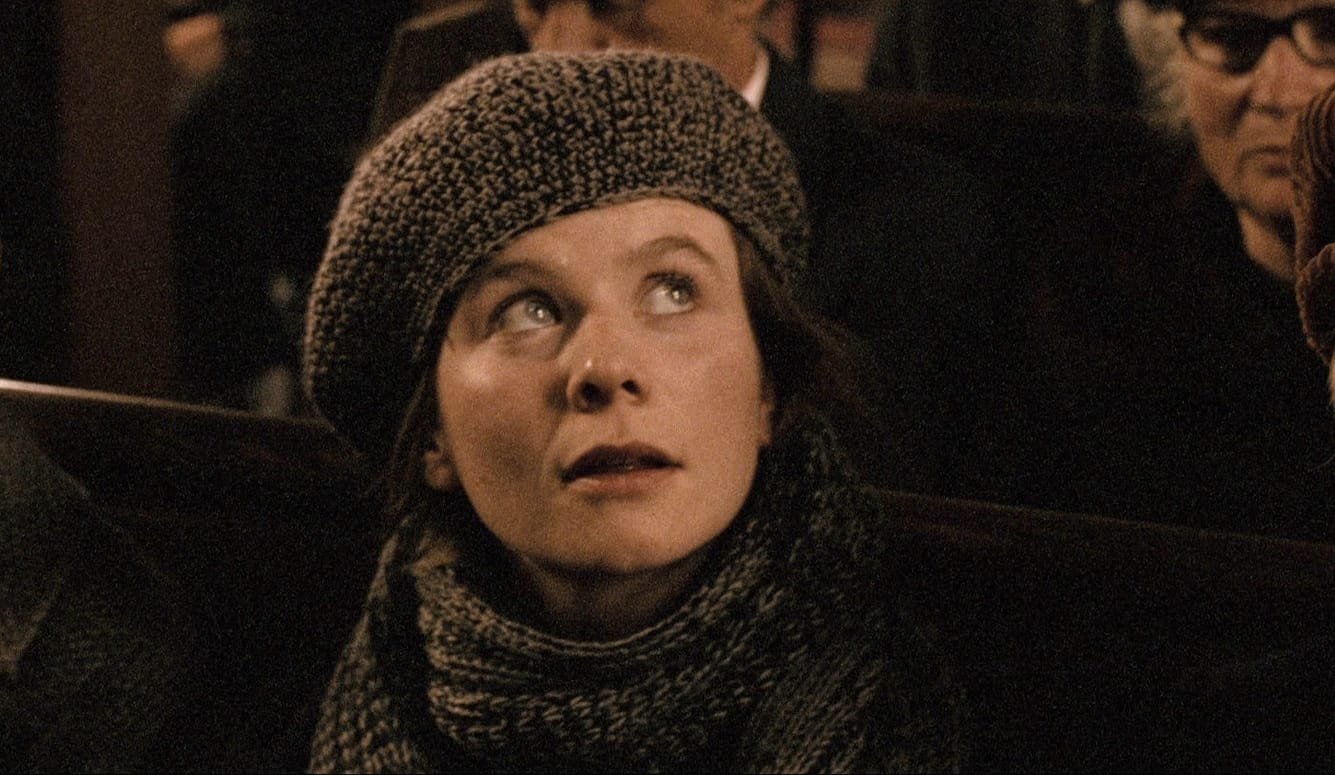
It has been thirty years since the release of Breaking the Waves, Danish director Lars von Trier’s film about the self-annihilation of a deeply religious but mentally damaged Scottish girl who loves not wisely but too well. Although hardly popcorn fare, and vehemently criticised by some feminists for creating a heroine defined by passivity and suffering, the film was an arthouse hit, grossing US$23 million on a US$7 million budget. It won the Grand Prix at the 1996 Cannes Film Festival, along with a number of awards on the festival circuit for von Trier’s direction and Robby Müller’s unusual photography. Emily Watson, who turned in an astonishing performance in her first feature-film appearance as tormented heroine Bess McNeill, was nominated for Best Actress at the 1997 Academy Awards (she lost to Frances McDormand in Fargo). In 2016, to mark the film’s twentieth anniversary, composer Missy Mazzoli and librettist Royce Vavrek turned von Trier’s movie into a three-act opera that garnered its own awards and acclaim. With its heroine who dies onstage, its themes of self-abnegating passion and villainous malice, and its melodramatic tests of faith and virtue, Breaking the Waves is certainly one of cinema’s more operatic creations.
But despite the awards and the modest box-office success, the film’s critical reception was decidedly mixed. Breaking the Waves certainly had its ardent supporters. It has, Roger Ebert enthused, “the kind of raw power, the kind of unshielded regard for the force of good and evil in the world that we want to shy away from.” And Sight and Sound’s capsule review, marking the film’s appearance on home video, described it as a work of “monumental quality” and “inspirational filmmaking.” But other reactions ranged from conflicted to scornful. At the New York Times, Janet Maslin praised the film’s “flabbergasting transcendence” but was also dismayed by a narrative that led the viewer “from the sincere to the ludicrous.” The Chicago Reader’s Jonathan Rosenbaum wrote: “I find [Breaking the Waves] simultaneously shameless, boldly original, contrived, highly affecting, transparent, cynical, hopeful, ironic, sincere, ugly, beautiful, and downright baffling.” The British film critic Mark Kermode is one of the film’s noisiest detractors, and never misses an opportunity to declare his disdain for a work he calls “hateful.” Encapsulating the polarised critical response was Peter Bradshaw’s 2023 reassessment for the Guardian, which described the film as “entirely ridiculous from beginning to end,” and then awarded it four stars out of five (largely for Watson’s “luminous” performance as Bess).
Breaking the Waves is set in a fishing village in the western Highlands (the film’s exteriors were mostly shot on the Isle of Skye and the near mainland) during the early 1970s, when the recent discovery of North Sea oil reserves was starting to bring prosperity to rural Scotland, although not quickly enough. Life in this remote part of the world was still raw and shabby, and we are offered glimpses of bleak pre-Thatcherite interiors with their tacky wallpaper and kitschy art. Everything looks primitive: the stony, treeless landscape; the dirt roads; the ponderous drilling machinery on the North Sea oil rigs; the archaic-looking medical equipment at the local hospital. Almost nobody in the film seems to have a telephone, and motor vehicles are occasional things. Von Trier had Müller shoot with handheld cameras and the footage was transferred from film to video and then back again, which gives the film the bleached-out and grainy appearance of a home-movie, as though the northern rain and bitter winds had swept away the colour of the environment.
The church that dominates the small island community is a particularly severe version of the Free Church of Scotland—a collection of rump congregations that splintered from Scottish Presbyterianism during the 19th century over (among other things) the established church’s perceived lack of Calvinist rigour. This is a congregation of unusual grimness (“Our church has no bells,” the minister explains to Jan. “We do not need them to worship God.”), and “sinner’s funerals” are held in public to shame disgraced reprobates: “You deserve your place in hell,” the minister declares as he consigns one such body to the soil. An austere life of religious severity and unforgiving weather has toughened the community’s inhabitants: at Bess’s wedding reception, her grandfather (Phil McCall), one of the church elders, crushes a glass of lemonade in his own bare hand until blood runs over his fingers.
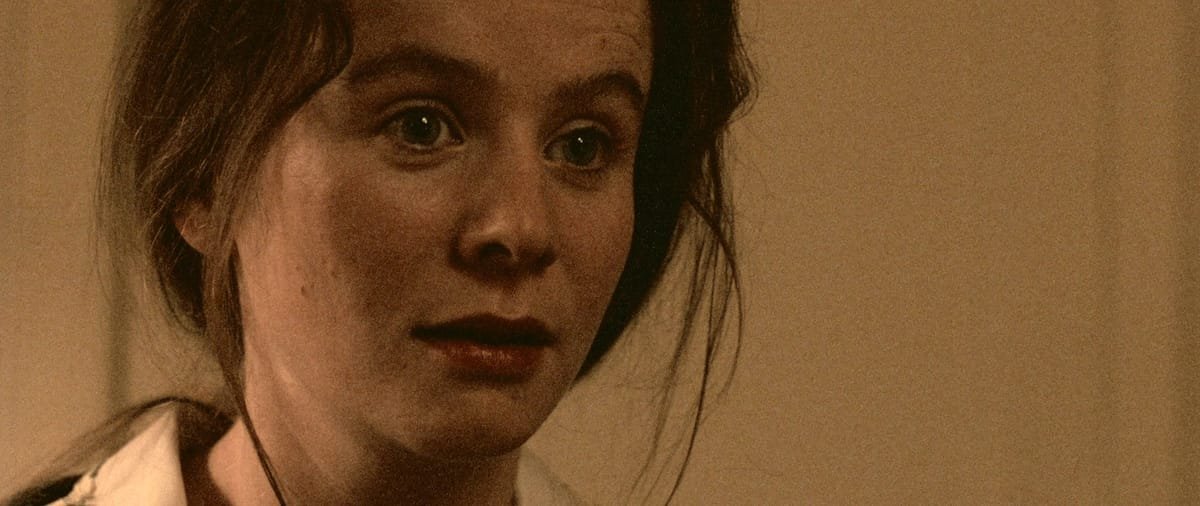
Bess is a naive and sweet-natured soul, although she can be obstinately courageous in her childlike way, standing up to the church elders’ disapproval after she decides to marry an outsider—a Scandinavian oil-rig worker named Jan (Stellan Skarsgård). Marriage, she informs the elders, is “when two people are joined in God.” It quickly becomes apparent, however, that Bess is also mentally fragile, dangerously impulsive, prone to extreme behaviour, and at the mercy of whatever violent emotion seizes her from moment to moment. We learn that when her brother was killed in an accident a few years earlier, she suffered a breakdown that sent her to a mental hospital in Glasgow. When the helicopter carrying Jan from the rig to the wedding is a little late in arriving, Bess furiously pounds her fists against his chest as though it were his fault. So eager is she to consummate their marriage that she drags him into the ladies’ room in the middle of the reception, her wedding dress crumpled up behind her on the sink counter. Bess loves Jan, and she loves having sex with him. Jan is large, good-looking, and open-hearted—he loves her devotion and he encourages Bess to talk dirty to him over the telephone when he’s working on the rig. “She’s stronger than you and me,” he tells Bess’s dubious sister-in-law and best friend, Dodo (Katrin Cartlidge).
Bess regularly cleans the church as an act of piety, and while she is on her knees, she talks to God—and then ventriloquises his stern responses in a low, masculine register. She becomes distraught when Jan has to return to the oil rig after the wedding and begs God to return him to her. Then, in a particularly nasty curl of the monkey’s paw, Jan suffers a shattering accident when a blow from the rig’s machinery leaves him paralysed from the neck down. Bess is tormented by the belief that she is responsible for Jan’s condition. So when Jan asks her to sleep with other men and report her experiences to him, she begins a harrowing slide into sexual degradation, social ostracism, and self-destruction, convinced that her self-sacrifice and unshakeable devotion will cure her ailing husband. When Dr Richardson (Adrian Rawlins), the young physician in charge of Jan’s treatment, asks Bess why she is sleeping with strange men at her husband’s behest, she replies: “I don’t make love with them. I make love with Jan, and I save him from dying.”
What seemed to enrage many critics is that she turns out to be right! Jan does indeed rise from his bed and walk, but the performance of this apparent miracle seems to require Bess’s brutal martyrdom. Bess is duly consigned to hell by the church she served at a sinner’s funeral, but Jan and his friends from the oil rig steal her body and give her a loving burial at sea. This act of compassion results in the film’s second miracle—the appearance of bells in the skies joyfully tolling to announce Bess’s induction into heaven. Is this magical realism or has the supernatural actually intruded into the hyper-naturalistic film we thought we were watching?
II.
During a 1996 interview with Swedish film critic Stig Björkman around the time of Breaking the Waves’ release, von Trier said that he had “wanted to make a film with a religious theme, a film about miracles.” Von Trier had converted to Catholicism a few years before, shortly after he divorced his first wife and discovered that his father was not his biological kin. But since his films have become notorious for their mix of graphic cruelty and explicit sexuality, it is difficult to discern the degree to which he ever really practiced or even believed in the tenets of his new faith. He told Björkman that his conversion had been mostly an act of rebellion against his mother and stepfather, who had been leftists, atheists, and self-professed antinomians who frequented nudist camps and let their children do whatever they liked. As a consequence of such an upbringing, von Trier told Björkman, “You either go to Tibet or seek out the most rigorous of all faiths. With total abstinence and the like.”
Breaking the Waves was the first of three successive films that von Trier made during the 1990s, which he calls his “Golden Heart” series (the other two were The Idiots in 1998 and Dancer in the Dark in 2000). According to von Trier, the title of this loose trilogy (the films are related only by general theme) was a reference to a Danish children’s book titled Guldhjerte (“gold heart,” literally) that his father had derided as “absolute rubbish” but which allegedly entranced him as a boy. In his interview with Björkman, von Trier recalled:
It was a picture book about a little girl who goes into the forest with some slices of bread and other stuff in her pockets. But at the end of the book, when she’s gotten through the forest, she’s standing there naked and with nothing left. And the last line in the book was: “‘But at least I’m okay,’ said Goldheart.” It seemed to express the ultimate extremity of the martyr’s role.
I say that this story allegedly entranced von Trier, because when I tried to find out more about it from WorldCat, the online international library catalogue, I drew a blank. There are several children’s books about generosity in Danish and English that bear the titles Guldhjerte and Golden Heart (or variants thereof), but none of these tells anything like the story to which von Trier referred. Other film historians who mention the book tend to simply quote or paraphrase von Trier’s own words. Given the director’s penchant for toying with interviewers and his generally mischievous nature, it would not be a surprise to discover that he had invented the book out of whole cloth. (The aristocratic “von” in his surname, for example, is an invention that he adopted when he was in his twenties, presumably to annoy his parents.)
Guldhjerte may well be a von Trier fabrication, but its themes of love, sacrificial death, and female self-abnegation are hardly foreign to the kind of children’s literature that von Trier might have read as a boy. In the perennially popular 1837 story The Little Mermaid (written by von Trier’s fellow Dane, Hans Christian Andersen), the eponymous heroine falls in love with a handsome human prince and trades in her fishtail and her immortality for human legs and feet so she can marry him. She discovers that walking on her new feet is excruciatingly painful—and then the prince marries someone else. She can reverse her transformation if she is willing to kill the young prince and drench her feet with his blood—but she chooses to die herself instead. (Disney’s animated version of this story, for those wondering, bore little relation to the original.)
Oscar Wilde embroidered an 1888 children’s tale titled “The Nightingale and the Rose” on these themes. A nightingale impales her breast on a thorn so that her blood will dye a white rose red, allowing an impoverished student to present it to his sweetheart, who fancies red roses:
And she pressed still closer, and the thorn pierced her heart and the blood flowed out and her song became fainter and her song became wilder, for she sang of the love that is perfected by death and the love that dies not in the tomb.
But the girl tosses the rose to the ground because she has found a richer suitor who can give her real jewels. And generations of American children have wept over E.B. White’s 1952 novel Charlotte’s Web: Charlotte the spider weaves magical words around her friend Wilbur the pig, which enables Wilbur to win a county-fair prize and avoid the slaughterhouse. All rush off to celebrate, but Charlotte, who is at the end of her short spider’s life, dies by herself on the deserted fairground.
These stories recapitulate the archetype of the sacrificed virgin—Iphigenia in Greek mythology, and Jephthah’s daughter in the Old Testament—who seems powerless in the iron realms of men, but who actually exercises absolute power over the imagination via her beauty and the selflessness of her devotion. These are young girls who go to their decreed fates willingly. “Love that is perfected by death” is a mesmerising motif in the cultural artefacts—poetry, tragedy, opera, visual art—of a range of civilisations. But von Trier’s use of the term “martyr” clearly indicates that he had something specifically religious in mind. Since at least the second century, Christian narratives have venerated young women who undergo harrowing tortures and suffer gruesome deaths in the name of their faith: Agnes, Lucy, Agatha, Eulalia, to name a few. According to their saints’ legends, they were sometimes sent to brothels to be degraded as part of their punishment—a version of Bess’s fate—although divine intervention always shielded their purity so they died intact.
During the Middle Ages, when the prospect of outright torture and death for one’s faith was no longer commonplace in an officially Christian society, female ascetics and mystics—“victim souls”—who chose to endure severe pain and bodily affliction began to occupy the martyr’s niche in the devotional practices of Catholics, in particular. Secular moderns—and even many Christians—tend to regard such hagiographic displays of female suffering as morbid, distasteful, and even misogynistic, exalting women for their very lack of agency in a patriarchal society. Von Trier told Björkman that Breaking the Waves had produced an outcry from “fairly agitated feminists” in Denmark and Sweden who would “probably have liked to see me castrated.” (Von Trier has often been accused of taking pleasure in the brutal ordeals to which he subjects his female protagonists, but these critics seldom acknowledge that the roles themselves are usually complex and allow the actresses cast in them to do some of their best work.)
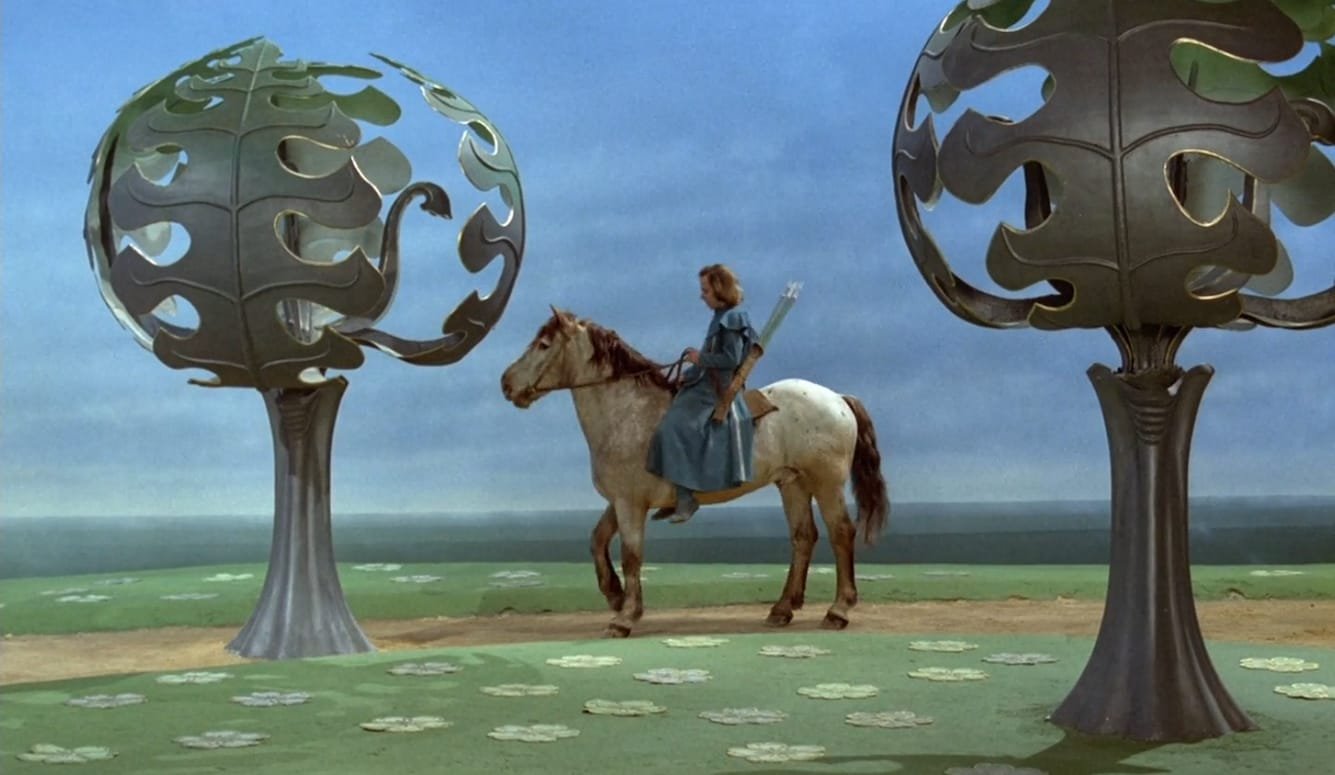
Rohmer at Camelot
Éric Rohmer’s Perceval le Gallois (1978) vividly recreates the imaginative world in which the people of the Middle Ages lived inside their heads.
The most obvious cinematic influence on Breaking the Waves is Carl Theodor Dreyer’s 1928 silent-movie masterpiece La passion de Jeanne d’Arc (“The Passion of Joan of Arc”). The historically documented martyrdom of this peasant girl from Lorraine occurred after she led the French in stunning military victories against the English during the Hundred Years War. She was eventually captured in 1431, tried as a heretic, and burned at the stake in English-controlled Rouen at the age of just nineteen. Dreyer, a fellow Dane who lived from 1889 to 1968, is one of the few directors that von Trier openly reveres, and he borrowed freely from La passion de Jeanne d’Arc while he was writing and directing Breaking the Waves. He is said to have instructed Emily Watson to watch Renée Jeanne Falconetti’s extraordinary performance as Joan in Dreyer’s film for inspiration and guidance. Dreyer consciously modelled Joan’s passion after Christ’s, and von Trier modelled Bess’s passion after that of Joan—so in Breaking the Waves, we get an allegory Christ’s self-sacrifice and redemption at one remove.
The resemblance between the two films is occasionally eerie: the huddle of grim-faced tonsured friars interrogating Joan at the beginning of Dreyer’s film is echoed by the huddle of black-clad church elders interrogating Bess about her upcoming marriage at the beginning of Breaking the Waves. In Dreyer’s movie, Joan is frozen with fear at the sight of the scaffold where she will be incinerated alive, and agrees to sign a confession that she later recants. Something similar happens in Breaking the Waves when Bess travels to a particularly dangerous boat that the other prostitutes on the island refuse to visit. She narrowly escapes with her life when things get out of hand, but once she makes her peace with the sacrifice that she believes is required of her, she returns there in the belief that it will cost her life and save Jan’s. Both of these episodes, in which martyrs tremble before their destiny and then gather the courage to face it, recall Jesus’s agony in the garden of Gethsemane as recounted in Luke’s Gospel, when he begs his divine Father to be spared his gruesome fate before finally accepting the cup of extreme suffering that God wills for him.
All of this helps to explain the eight formally titled chapters into which von Trier has divided the story, which function like Stations of the Cross charting Bess’s terrible journey towards death. The chapters are each announced with a heading (“Bess Gets Married,” “Faith,” “Doubt,” “The Funeral,” and so forth) and magnificent colour-saturated near-stills digitally created by the Danish painter Per Kirkeby to look like 19th-century Romantic landscape paintings. The images are a gorgeous and shocking contrast to the drabness that pervades the rest of the film, and they sit in front of us for minutes while the soundtrack plays long, throbbing excerpts from rock classics of the time, including Deep Purple’s “Child in Time,” Procul Harum’s “A Whiter Shade of Pale,” and Leonard Cohen’s “Suzanne” (surely the most haunting and beautiful ballad of that era). This is the only music that von Trier uses in the film (there is no orchestrated score), and the effect is at once beautiful and entirely mesmerising. “Can you think of anything of real value that the outsiders have brought with them?” one of the church elders asks Bess when she seeks permission for a church wedding. “Their music,” Bess replies.
Dreyer’s Joan was a more eloquent protagonist than Bess, whose childishness and impulsivity often make her seem almost simple. “Are you in a state of grace?” Joan’s inquisitors ask her, hoping to catch her in a blasphemous presumption. “If I am,” she replies, “God keep me there. If not, may God grant it to me.” Sceptics have sometimes wondered if the voices that Joan claimed to be hearing were evidence of psychosis. If so, she was psychotic like a fox. The authorities were never able to pin anything technically heretical on her, so they had to burn her for wearing men’s clothing, an abomination condemned in the Bible. In Breaking the Waves, Bess is unable to outwit anyone, and she ends up abandoned, forsaken, and despised by the elders of the church, her own mother, and even the children in the village who throw stones at her as she wheels her bike wretchedly along its dirt roads.
III.
So what exactly did von Trier intend with this spectacle of bloody female sacrifice followed by the ringing of celestial bells? Breaking the Waves is, among other things, a story of transformation. The miracle of Jan’s healing doesn’t end with his ability to walk again; he is also transformed in his perception of Bess. When the movie opens, he’s an affable sensualist, relating to Bess chiefly via her own intense sensual passions to which he can respond and relate, and her fierce attachment to him. The accident on the oil rig robs him of his body and leaves him emotionally and psychologically bereft.
In a thoughtful but ambivalent review for Sight and Sound upon the film’s theatrical release in the UK, Lizzie Francke offered this charitable explanation for why Jan asks Bess to sleep with other men:
[Bess’s] blithe, flighty spirit is grounded in the carnal only after Jan introduces her to the pleasures of the flesh. But after her prayer for his return, it is his immobile, paralysed hulk of a body that is returned to her. And so their pact begins. Jan’s well-meaning bid to free Bess into the sensual world, telling her to take a lover so that she can continue to enjoy sex, is misconceived. It turns into the strange dogma that Bess strictly follows out of love for him. Each is being altruistic, but each has, as Dodo says of Jan, “a head full of scars.”
Dodo is suspicious of Jan when she first meets him, and worried that he might be taking advantage of an impressionable and vulnerable young girl already recovering from a traumatic bereavement. After the accident, she tries to warn Bess that Jan’s mind has been disordered by his injury and the powerful drugs that the hospital is administering to him. “He’s the one who’s sick,” she tells Bess. “Look, what he’s doing to you is sick, and it’s getting sicker and sicker. He’s becoming more and more of a danger to you…” Dr. Richardson tells Bess that Jan seems “like a dirty old man who wants to play the Peeping Tom.” Jan eventually offers his own self-lacerating explanation for his behaviour: “When I told you to get a lover, it wasn’t for your sake,” he confesses. “It was for my sake, because I don’t want to die. I was afraid.” Each of these explanations is true, but none is satisfying by itself.

But Bess’s sacrifice changes everyone close to her. Jan is profoundly moved and awestruck by her gift of radical devotion. He finally understands the depth of her love and that she is far greater and more courageous than he is. And so, by spiriting her body out of the churchyard and taking her out of the realm of the damned, he makes her a gift in return. “Take care of her,” he says as he bestows a final kiss on her lifeless forehead and then commits her body to the water and the darkness. He may be addressing the ocean, or perhaps offering the first prayer of his life.
Dr. Richardson is also changed. If the church elders represent Christian theology and Christian morality at their most unyielding, Richardson is the face of a secular scientific rationality that can perceive human beings and their dilemmas only in bluntly materialistic terms. He is a kindly man, but when he first sees Jan’s intubated body at the hospital, he says: “Life shouldn’t always be preserved at any cost.” Likewise, he can only perceive Bess’s interior life and self-inflicted agonies as symptoms of spiralling mental illness. He is willing to wreak havoc with her emotions and with those of Jan in the name of therapy—shipping Bess off to Glasgow while informing Jan, who is presumably on his deathbed, that he will never see his wife again. (Dodo, as a member of the church congregation but also a nurse, is a bridge between these two antagonistic worlds.) Nonetheless, at the coroner’s inquest, Richardson asks that the words “neurotic” and “psychotic” be stricken from the report he has written on Bess’s mental condition: “I might just, um, use a word like ‘good.’” He finally sees her as something like a saint—a category that had never occurred to him before.

But that leaves the most troubling question of all: why was this ordeal necessary? Von Trier never makes it clear whether Bess is actually hearing the voice of an implacable divine figure when she talks to God or if it is just a delusional projection and a symptom of her indoctrination. Is she actually a religious mystic or is she just a confused young woman, deranged by religious guilt and grief? It is not until the very end of the film that the supernatural explicitly intrudes into the story—but that miraculous intervention of the divine in human affairs leaves us with (at least) two possible readings of the story and of the nature of God that it describes.
It may be that the deity presiding over von Trier’s universe and its hapless characters is a jealous and capricious Old Testament God, who punishes Bess’s anguished pleas to have Jan returned to her by spitefully delivering his smashed, impotent body. Then, by way of atonement and redemption, he demands that this pious young woman give her life in an unimaginably painful and humiliating fashion so that her husband may be restored to health. Von Trier evidently hates the elders of the austere church to which Bess belongs, but is his film also an indictment of a Christian deity who visits afflictions upon some human beings at will and forces others to pay with their lives for their misdemeanours? Bess’s imitation of Christ reminds us that God required his own son to be tortured and then crucified like an insect pinned to a board in an act of redemptive suffering.
“I had to test you,” God reproaches Bess when she begs him for guidance after Jan’s accident. “For you know, I giveth and I taketh away.” That language is lifted from the Old Testament Book of Job, the story of a dutiful and obedient servant of God who is afflicted with poverty, bereavement, and disease in order to test his faith. It is surely no accident that von Trier selected a particularly stringent form of Calvinism as the religion that shapes Bess’s inner life. Since at least the 4th century, Christian theologians have wrestled with the problem of “predestination”: Why does God create human beings who he knows in advance will be damned for eternity? If he sent his son into the world to die for all, why do only some receive the grace that will save them? To these questions, John Calvin provided a simple and terrifying answer: Because God’s will is absolute and sovereign, his designs are beyond human comprehension, his power transcends anything weak humans can accomplish, and his justice is not human justice. God glories in sacrifice because it magnifies his glory: “Prove to me that you love him, and then I’ll let Jan live,” God tells Bess. She does as she is instructed, Jan walks again, and heavenly bells peal in celebration.
This harsh interpretation may be what von Trier intended, but a more merciful and generous reading is also available. Von Trier was surely influenced by another of Dreyer’s minimalist masterpieces, Ordet (“The Word,” 1955), the themes of which seem to provide templates for those explored in Breaking the Waves: the austere and rigid Christian sect, the test of faith, the pious and lovable heroine who dies an excruciating death (in childbirth this time), the unbelieving husband, the rationalist physician, and the concluding miracle that affirms a God infinitely larger than its characters’ conception.
Notwithstanding the human wickedness and callousness on display throughout Breaking the Waves, it is ultimately not a cynical work intended to obliterate human hope. To the contrary, its conclusion is suffused with hopefulness: Jan and his goofy oil-rig buddies, Dr. Richardson, Bess’s mother, and Dodo are all transfigured. Bess has not died in vain. Even the film’s least sympathetic characters are more pitiable than anything else, including the minister pinioned by his own theological rigidity. And contrary to the most common—and unfair—criticism the film received, the film is not a sadistic work, even if it is understood to dramatise the actions of a sadistic God. This is not the trembling Justine with whom the Marquis de Sade toys for his own pleasure as well as that of his readers. Von Trier plainly loves Bess and wants us to feel the blows of injustice she suffers as keenly as those around her do, which is precisely what makes her story so punishing and painful. And then, there is the sheer visual and audial beauty of his film, with those haunting tableaux punctuating the narrative with their lovely snatches of period melody.
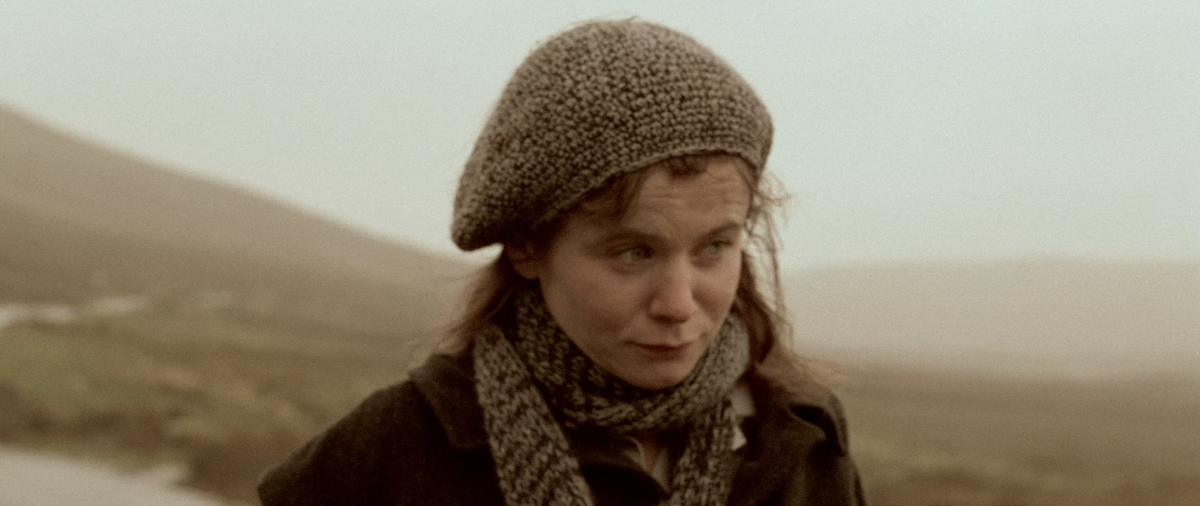
So persuasively does Emily Watson navigate her conversations with God that we almost forget just how mentally fragile Bess is. She is certainly not a reliable interpreter of the deity she believes is demanding her sacrifice as punishment and purchase price for Jan’s regained health. The voice she hears could just as easily be the voice of her own guilty and deluded conscience, brutally shaped by the pitiless version of Christianity with which she has been indoctrinated and that von Trier so clearly abhors. Of all the pitiable characters in Breaking the Waves, Bess in her guileless way is surely the most pitiable of all, as well as the most sublime in her extravagant self-giving. The other side of Christian predestination theology, as von Trier in his evanescent Catholic phase surely must have grasped, is unfathomably generous divine mercy for the sinners that most people are. Bess compares herself to Mary Magdalene, traditionally identified as the repentant woman in Luke’s Gospel, who bathes Jesus’s feet with her tears and dries them with her hair. “Mary Magdalene sinned, and she is among my dearly beloved,” Bess says in the voice of God. Jesus tells the Pharisee who has hosted the banquet: “Her sins, which are many, are forgiven, for she loved much. But to whom little is forgiven, the same loveth little.”
In this reading, Jan’s paralysis is not God’s vindictive reply to a helpless prayer, it is just a tragic accident, the coincidental timing of which ignites a terrible chain of events. Nevertheless, Bess makes a sacrifice for love that is essentially noble in itself, whether or not Jan is worthy of it, and von Trier wants us to understand that such sacrifices do not pass unnoticed by God. And so, once the flawed humans who populate this vale of tears have finished thrashing out their mistakes, God intervenes at last to ensure that Bess’s devotion finds its just reward. Bess’s purity has transcended both the bitter rigidity of her religious community and the merciless rationalism proposed by Dr. Richardson. She is “good,” as Richardson finally acknowledges, and she deserves to be honoured, on earth as above, which she is in the film’s resplendent finale.
In this reading, Bess is rescuing Christianity by example from its despotic Pharisaic stewards, who are obsessed with law and doctrine and who have forgotten the meaning of love. “I don’t understand what you’re saying,” Bess tells the church elders who chide her for defying God’s word. “How can you love a word? You cannot love words. You can’t be in love with a word. You can only love another human being—that’s perfection.” And like Christ, she is shunned and condemned for her impertinence. Bess certainly loved; indeed, she loved so much that it destroyed her. But in the final shot of Jan and his friends staring in wonder at the skies over the North Sea, she is vindicated nonetheless. That image recalls the New Testament: “Ye men of Galilee, why stand ye gazing up into heaven?” And it is drenched in grace.
Quillette invites thoughtful responses to its essays.
Selected responses are published once per week as part of a curated Letters to the Editor feature. If selected, letters appear under the contributor’s real name and may be edited for clarity and length.
To submit a letter for consideration, please email [email protected].
Read the full article here
Fact Checker
Verify the accuracy of this article using AI-powered analysis and real-time sources.