Close Menu
FSNN | Free Speech News NetworkFSNN | Free Speech News Network
  • Home
  • News
    • Politics
    • Legal & Courts
    • Tech & Big Tech
    • Campus & Education
    • Media & Culture
    • Global Free Speech
  • Opinions
    • Debates
  • Video/Live
  • Community
  • Freedom Index
  • About
    • Mission
    • Contact
    • Support
Trending

Trump FCC Hilariously Bungles Chinese ‘Drone Ban’

24 minutes ago

In Widow’s Bay, the Real Monster Is Utilitarianism

25 minutes ago

Indiana news media coalition raises concerns about delays in state public access office

38 minutes ago
Facebook X (Twitter) Instagram
Facebook X (Twitter) Discord Telegram
FSNN | Free Speech News NetworkFSNN | Free Speech News Network
Market Data Newsletter
Friday, July 31
  • Home
  • News
    • Politics
    • Legal & Courts
    • Tech & Big Tech
    • Campus & Education
    • Media & Culture
    • Global Free Speech
  • Opinions
    • Debates
  • Video/Live
  • Community
  • Freedom Index
  • About
    • Mission
    • Contact
    • Support
FSNN | Free Speech News NetworkFSNN | Free Speech News Network
Home»Cryptocurrency & Free Speech Finance»Bitcoin (BTC) is as hard to trade right now as it was in January
Cryptocurrency & Free Speech Finance

Bitcoin (BTC) is as hard to trade right now as it was in January

News RoomBy News Room3 hours agoNo Comments1 Min Read1,490 Views
Share Facebook Twitter Pinterest Copy Link LinkedIn Tumblr Email VKontakte Telegram
Bitcoin (BTC) is as hard to trade right now as it was in January
Share
Facebook Twitter Pinterest Email Copy Link

Listen to the article

0:00
0:00

Key Takeaways

Playback Speed

Select a Voice

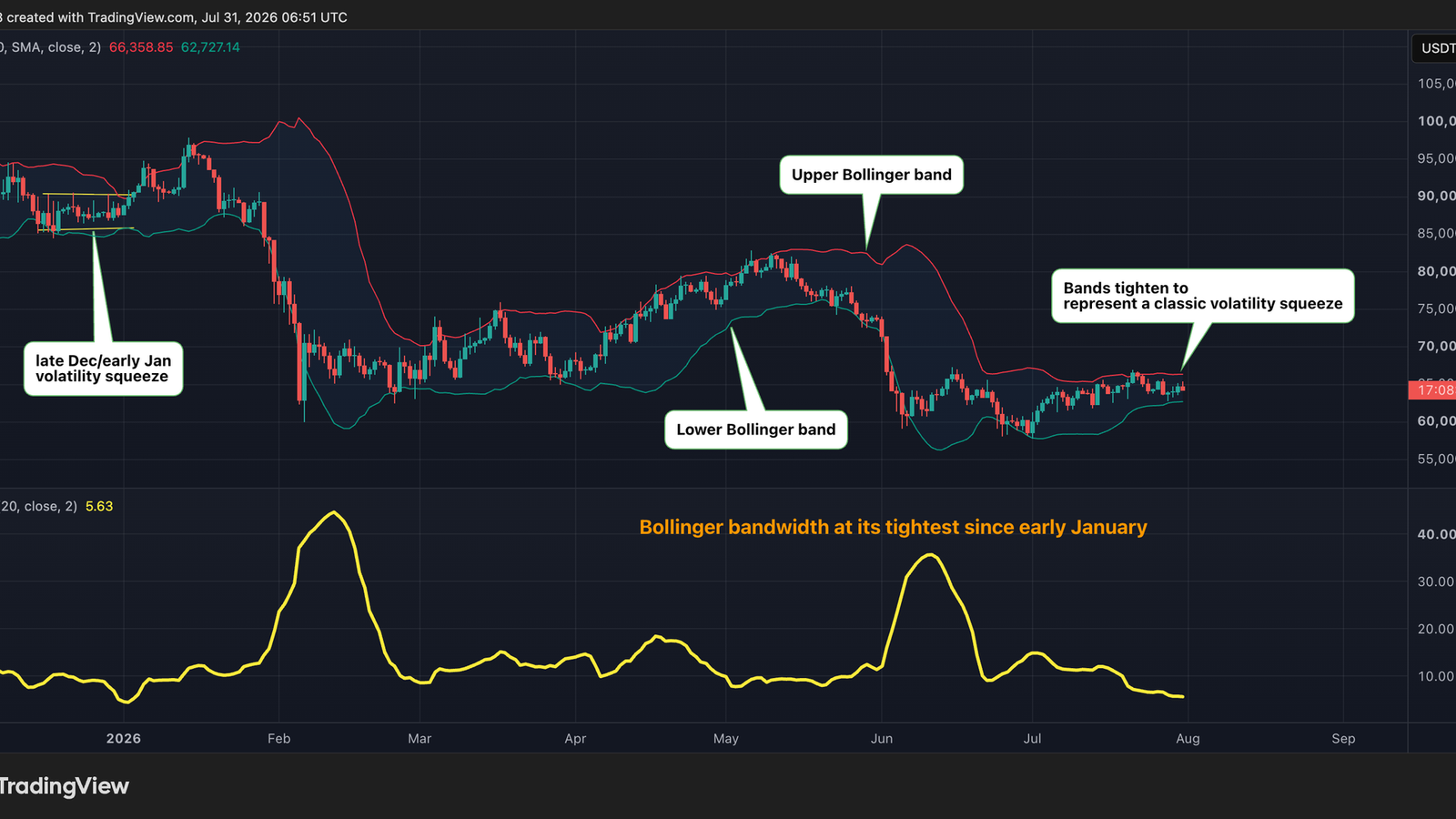
Trading bitcoin BTC$63,873.51 these days feels much as it did seven months ago, at the start of the year.

The price of the largest cryptocurrency is stuck in a tight range, with volatility at six-month lows, and traders are struggling to identify a break to bet on. Not surprisingly, transaction volume has slumped and is on track for the lowest since November 2023.

Back in January, the bitcoin price had been stuck in a narrow band, $86,000-$90,000, since the second half of December. Trading volume had dropped to an average of $5.1 billion a day, and has fallen to $2.2 billion this month, according to research from K33.

What happened next is interesting. Volatility picked up in the following weeks, the price rose to nearly $98,000 by mid-January and then slid down to around $60,000 by early February. Trading volume rose.

And that’s precisely the point. Volatility is cyclical: long stretches of quiet price action often precede a sharp move in one direction or the other. Like a coiled spring, the tighter the market compresses, the more forcefully it can unwind.

Read the full article here

Fact Checker

Verify the accuracy of this article using AI-powered analysis and real-time sources.

Get Your Fact Check Report

Enter your email to receive detailed fact-checking analysis

5 free reports remaining

Continue with Full Access

You've used your 5 free reports. Sign up for unlimited access!

Already have an account? Sign in here

Share. Facebook Twitter Pinterest LinkedIn Tumblr Email Telegram Copy Link
News Room
  • Website
  • Facebook
  • X (Twitter)
  • Instagram
  • LinkedIn

The FSNN News Room is the voice of our in-house journalists, editors, and researchers. We deliver timely, unbiased reporting at the crossroads of finance, cryptocurrency, and global politics, providing clear, fact-driven analysis free from agendas.

Related Articles

Cryptocurrency & Free Speech Finance

RWA perps will outpace tokenization

45 minutes ago
Cryptocurrency & Free Speech Finance

BIS Project Agorá settles $1 million in tokenized cross-border payment trials

46 minutes ago
Cryptocurrency & Free Speech Finance

Morning Minute: Coinbase Posts Surprise Loss as Crypto Trading Dries Up

48 minutes ago
Cryptocurrency & Free Speech Finance

U.S. sanctions Iran-linked bitcoin insurance scheme for Strait of Hormuz ships

2 hours ago
Cryptocurrency & Free Speech Finance

Citadel Buys Situational Awareness Stocks After July AI Market Rout: Reports

2 hours ago
Cryptocurrency & Free Speech Finance

Crypto Kiosk Scams Cost Texans $57M as Lawmakers Weigh a Ban

2 hours ago
Add A Comment
Leave A Reply Cancel Reply

Editors Picks

In Widow’s Bay, the Real Monster Is Utilitarianism

25 minutes ago

Indiana news media coalition raises concerns about delays in state public access office

38 minutes ago

RWA perps will outpace tokenization

45 minutes ago

BIS Project Agorá settles $1 million in tokenized cross-border payment trials

46 minutes ago
Latest Posts

Morning Minute: Coinbase Posts Surprise Loss as Crypto Trading Dries Up

48 minutes ago

Cooking Up A Blue Plate Special

1 hour ago

Supreme Court of the United Kingdom. Photo: Jay Galvin/CC BY 2.0 It was game, set and match for Bahraini dissidents Saeed Shehabi and Moosa Mohammed in their case against the Kingdom of Bahrain this week. The UK’s Supreme Court ruled in their favour, rejecting an appeal from Bahrain, which was claiming sovereign immunity from allegations it used spyware to infiltrate the computers of the pair in the UK back in 2011. We’ve been following the case and it’s hard to downplay this victory both for the men and for the broader ecosystem. The Kingdom had argued that section 5 of the State Immunity Act 1978, which creates an exemption to the act in the event of personal injuries and damage to property, was being misinterpreted and unduly broadened in this case. It said that a proper reading of the Act would afford immunity to states in cases where the actors or some of the acts causing personal injury were located outside the UK. But section 5 was enacted long before sophisticated spyware existed. The Supreme Court judges therefore rejected these arguments, stating that: “Modern technology enables acts of surveillance to be carried out in the UK remotely. Even if carried out by foreign state actors located outside the UK, such acts involve an infringement of UK territorial sovereignty.” Leigh Day, the law firm representing Shehabi and Mohammed, said that “the Supreme Court judgment has now settled the scope of section 5 of the State Immunity Act 1978. A foreign state cannot rely on state immunity to escape accountability for personal injury caused by acts within the UK, even where other causative acts take place abroad and the state’s agents are not present in this country. The court has recognised that a rigid distinction between the location of an act and its effects is artificial and unprincipled.” Shehabi said afterwards that “this is not just a victory for us, but for everyone targeted by authoritarian states beyond their own borders.” He’s right. We’ve been bleating on about transnational repression for years now because it’s prolific and getting worse. And when a dissident is attacked abroad, spyware is often a feature. This ruling makes clear that states can now be held officially accountable. As Shehabi also said after: “The hardest part of being targeted by alleged state-sponsored hacking is the feeling that nowhere is safe”. The UK arguably becomes a touch safer now. Mohammed said that the “victory changes the balance of power”. He spoke about being tortured by the Bahraini regime since he was a teenager and pursued across borders. “Today, the tables have turned,” he continued. “I am no longer the one being chased. I am chasing justice. I am chasing accountability. The era of abusing victims while hiding behind state immunity is over.” The UK has earned itself a reputation as a hunting ground for authoritarian regimes, and that’s partly because our response to counter it has been woeful. In some instances, police have told victims to keep a lower profile and that their cases are too hard to tackle because the assailants are overseas. So, it’s good to now have legal clarity on the question of proximity. Being abroad doesn’t grant you a get-out-of-jail-free card. READ MORE

2 hours ago

Subscribe to News

Get the latest news and updates directly to your inbox.

At FSNN – Free Speech News Network, we deliver unfiltered reporting and in-depth analysis on the stories that matter most. From breaking headlines to global perspectives, our mission is to keep you informed, empowered, and connected.

FSNN.net is owned and operated by GlobalBoost Media
, an independent media organization dedicated to advancing transparency, free expression, and factual journalism across the digital landscape.

Facebook X (Twitter) Discord Telegram
Latest News

Trump FCC Hilariously Bungles Chinese ‘Drone Ban’

24 minutes ago

In Widow’s Bay, the Real Monster Is Utilitarianism

25 minutes ago

Indiana news media coalition raises concerns about delays in state public access office

38 minutes ago

Subscribe to Updates

Get the latest news and updates directly to your inbox.

© 2026 GlobalBoost Media. All Rights Reserved.
  • Privacy Policy
  • Terms of Service
  • Our Authors
  • Contact

Type above and press Enter to search. Press Esc to cancel.

🍪

Cookies

We and our selected partners wish to use cookies to collect information about you for functional purposes and statistical marketing. You may not give us your consent for certain purposes by selecting an option and you can withdraw your consent at any time via the cookie icon.

Cookie Preferences

Manage Cookies

Cookies are small text that can be used by websites to make the user experience more efficient. The law states that we may store cookies on your device if they are strictly necessary for the operation of this site. For all other types of cookies, we need your permission. This site uses various types of cookies. Some cookies are placed by third party services that appear on our pages.

Your permission applies to the following domains:

  • https://fsnn.net
Necessary
Necessary cookies help make a website usable by enabling basic functions like page navigation and access to secure areas of the website. The website cannot function properly without these cookies.
Statistic
Statistic cookies help website owners to understand how visitors interact with websites by collecting and reporting information anonymously.
Preferences
Preference cookies enable a website to remember information that changes the way the website behaves or looks, like your preferred language or the region that you are in.
Marketing
Marketing cookies are used to track visitors across websites. The intention is to display ads that are relevant and engaging for the individual user and thereby more valuable for publishers and third party advertisers.