

 Freedom Index
Listen to the article
Clark Packard
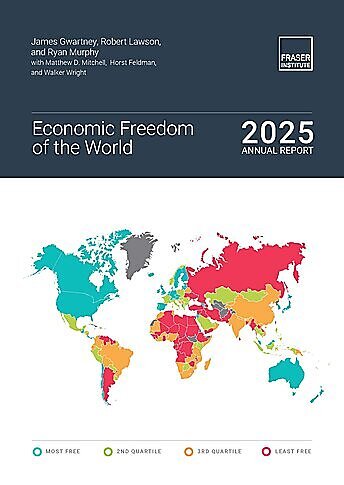
Earlier this week, the Cato Institute, the Fraser Institute in Canada, and a number of global think tanks published the annual Economic Freedom of the World report, which assesses and ranks economic freedom in 165 countries. Though the United States has historically fared well in the annual report—including in this year’s edition—the Trump administration’s aggressive protectionism is quickly eroding a key component of American economic freedom: the freedom to trade internationally.
Methodology
First published in 1996, the Economic Freedom of the World report aims to “measure the degree to which the institutions and policies of countries permit people to make their own economic choices.” To do that, its authors and contributors examined numerous factors and subfactors within five broad categories: the size of government; the reliability and independence of the legal system and the protection of property rights; the soundness of money; the freedom to trade internationally; and the regulatory environment. The data are available here.
As the authors note, “Individuals are more economically free when they are allowed to make more of their economic choices, with others imposing fewer and less severe constraints on those choices. They must, however, respect the rights of others.”
Economic Freedom Generally
The new report unequivocally confirms what history has long shown: freedom correlates with prosperity. Freer countries feature superior performance on a range of economic and social indicators, including higher GDP per capita, lower rates of poverty, longer life expectancy, lower levels of infant mortality, better environmental protection, and higher rates of life satisfaction.
The 2025 report acknowledges that economic freedom has expanded since 2000. More ominously, however, it warns that economies have generally become less free in the last five years. Sadly, the United States is no exception, particularly in the realm of international trade.
Freedom to Trade
The primary case for free trade is a moral one. A key part of freedom is the ability to trade and do business with whoever one desires—even across borders. Indeed, such exchanges predate government interventions. Absent a compelling national security justification (and no, imported kitchen cabinets don’t count), it’s not the government’s place to interfere in such transactions.
But beyond being both natural and morally superior, the case for free trade also rests on utilitarian merits that have stood the test of time. In 2022, my Cato colleagues Scott Lincicome and Alfredo Carrillo Obregon comprehensively documented the robust case for freer trade: it enriches us economically, expands choices, enhances national security by serving as a bulwark for peaceful relations between nations, lifts billions out of poverty, and tempers political cronyism.
Trump’s Protectionism Continues to Erode Americans’ Economic Freedom
All of that, however, is now under threat from President Trump’s galloping protectionism, which represents a dramatic reversal of nearly a century of American leadership in expanding economic freedom through trade liberalization.
The Economic Freedom of the World report notes that, following World War II and for roughly 70 years thereafter, the United States leveraged its dominant position in the global economy to push for lower barriers to international trade and investment. Beginning in 1934—following the disastrous Smoot-Hawley tariffs of 1930, which exacerbated and prolonged the Great Depression—Congress “empowered presidents to negotiate reciprocal tariff reduction agreements with other countries.”
As the authors point out, between 1933 and 2016 (before the first Trump administration), the effective tariff rate in the United States fell from about 20 percent to less than 2 percent. Trumpian protectionism, however, means that the effective US tariff rate now stands at 20.2 percent, well above the global trade-weighted average of 2.5 percent. Such is the magnitude of the increase in US tariffs that the United States now ranks a lowly 161 out of 165 countries examined in the report in the tariff subcomponent score, just behind Iran. The United States now keeps company with poorer, authoritarian regimes rather than wealthier, market-oriented democracies, a bloc it once led.
The recent surge of protectionism constrains Americans’ economic freedoms by limiting their choices as consumers, workers, and business owners. In imposing some of the world’s highest tariffs, the Trump administration is effectively erecting barriers between Americans and global markets. These government-imposed limits on peaceful, voluntary cross-border exchanges reduce access to foreign suppliers, customers, and investment opportunities.
The decline in Americans’ freedom to trade internationally is troublesome enough, but perhaps more distressingly, it could also herald further infringements of economic freedom.
Restrictions on international trade are often the canary in the coal mine for erosions of other economic freedoms. As the Economic Freedom of the World’s authors point out, “When countries move to restrict trade freedom, other areas of economic freedom such as size of government, sound money, and regulatory freedom soon follow.” According to the report, such erosion of economic freedom may already be underway.
Since dramatically increasing tariffs earlier this year, for example, President Trump has hectored the Federal Reserve to lower interest rates and insisted on unprecedented government control of US Steel’s business decisions as a condition of its sale to Japanese-based Nippon. The administration’s crony capitalist stakes in Nvidia, AMD, and others are similarly disquieting.
Protectionism has long been a powerful temptation for policymakers. While perhaps politically expedient, its consequences have proven ruinous, in stark contrast to the unprecedented wealth and prosperity that expanded trade has helped unlock. The stakes are high; it is time for Congress to take responsible action to tap the brakes on President Trump’s erratic tariffs. Hopefully, the 2025 Economic Freedom of the World report will serve as a wake-up call.
Read the full article here
Fact Checker
Verify the accuracy of this article using AI-powered analysis and real-time sources.