

 Freedom Index
Listen to the article
What follows is the thirtieth instalment of The Nations of Canada, a serialised Quillette project adapted from Greg Koabel’s ongoing podcast of the same name.
As we’ve seen, the 1630s were an eventful decade in the St. Lawrence/Great Lakes region. To recap this period: Quebec was briefly occupied by the English, who took over management of the interior fur trade from the French (as detailed in our 24th instalment); while, to the south, the Iroquois and other members of the Haudenosaunee Confederacy turned away from the St. Lawrence and focused their attention on the Hudson River to the east, in what is now upstate New York.
In last month’s instalment, we examined the wrenching transformations in Indigenous life that took place along the St. Lawrence and Ottawa rivers, as communities reeled from the population loss caused by European-borne diseases and northbound Haudenosaunee raids. In particular, we looked at how some disrupted Indigenous communities began adapting Christianity to their own social and spiritual needs.
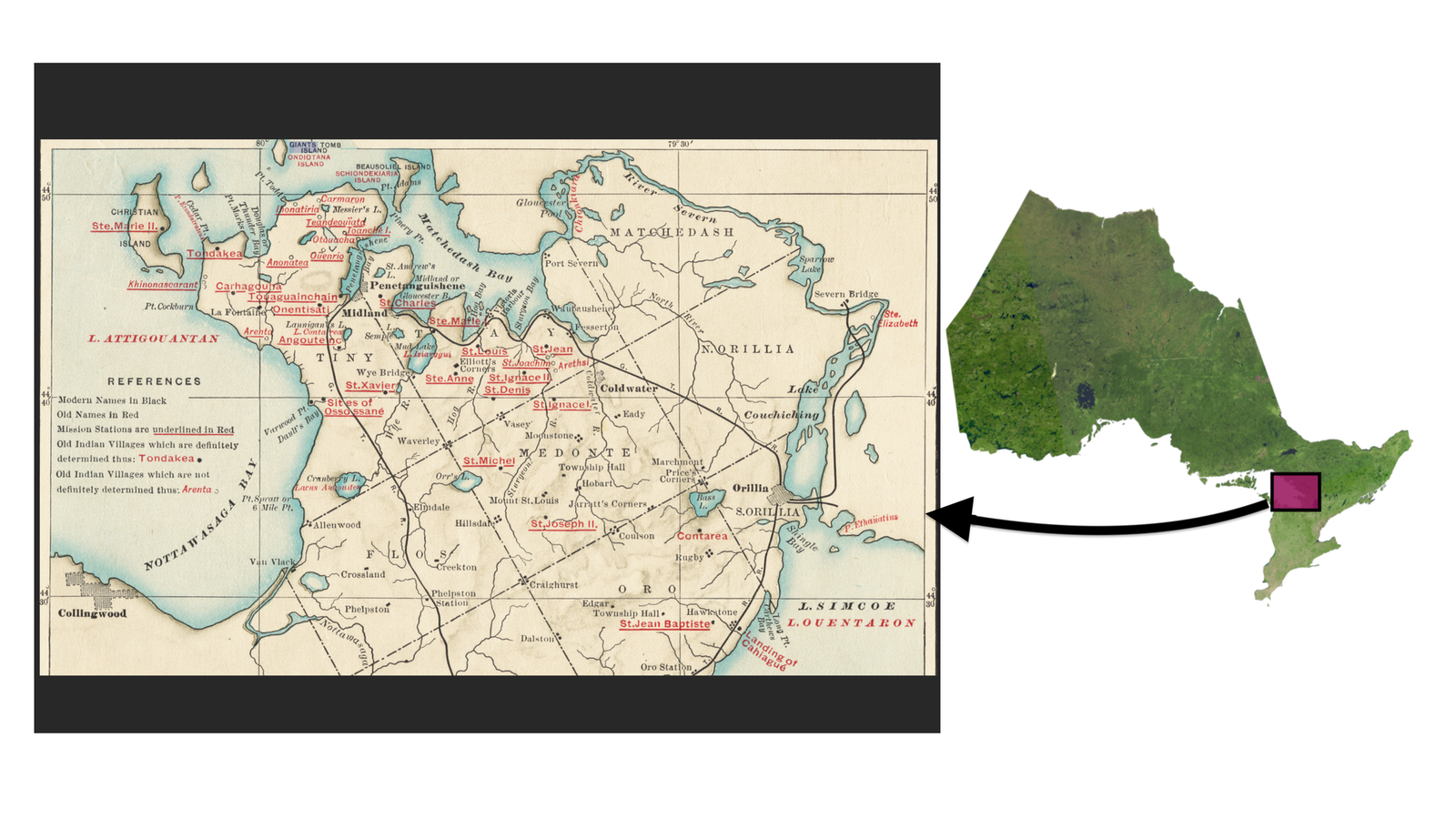
This was a story that played out in and around Quebec (modern Quebec City), Trois-Rivières, the newly created settlement on the island now known as Montreal, and the Indigenous communities upstream from Montreal along the Ottawa River. In this instalment, we will cover roughly the same period, but with a focus on the Wendat homeland of Wendake (which had served as France’s diplomatic lynchpin in the region), in an area of modern Ontario that lies between Lake Simcoe and Georgian Bay (the northeastern arm of Lake Huron).
The Laurentian Coalition Takes Root
In the 16th instalment of ‘Nations of Canada,’ historian Greg Koabel describes how Samuel de Champlain overcame a decade of frustration by finally establishing a successful French fur-trading monopoly.
Today, this region is known as cottage country to the wealthy inhabitants of Toronto. But when the French arrived in the seventeenth century, the Wendat were the economically dominant partner in a far-flung Indigenous alliance that included the Innu and the Algonquin communities that extended along the Ottawa River—an alliance that, once France joined, became known to historians as the Laurentian Coalition.
In part because of the elevated importance the Wendat enjoyed among their Indigenous allies, and their more geographically rooted village-based farming economy, Wendake became the early focus of French Christian missionaries. Here, much more so than in the new communities taking shape to the south, the priests still applied the same rigid top-down style of Catholic religious instruction they’d learned back at the Jesuit College of La Flèche.
Before diving into the (increasingly turbulent) religious and political dynamics of Wendake, however, let’s take stock of how the shifting geopolitics of the region had affected the Wendat—as it is impossible to understand the Wendat outlook without understanding the growing external threats they were now facing.
During the late 1630s, the primary goal of the Haudenosaunee Confederacy was to consolidate their hold over the territory surrounding the Dutch trading post at Fort Orange (modern-day Albany, NY). Securing access to European goods, they (correctly) believed, would be necessary to keep pace with France’s Wendat and Algonquin allies to the north.
As the decade progressed, the Laurentian Coalition and the Haudenosaunee Confederacy gradually returned to active warfare on the St. Lawrence. Meanwhile, as described in our 25th instalment, the protracted peace negotiations that followed the Anglo-French War of 1627-29 would result in Quebec and Acadia (in the area now known as Canada’s Maritimes) being returned to French control. The French immediately went back to work to rebuild their old networks.
The Algonquin coalition members who lived along the Ottawa River used this opportunity to re-negotiate their position as middlemen between the French hub at Quebec and the Wendat. In this regard, part of the Algonquin diplomatic strategy was a threatened alliance with the Haudenosaunee. But, as we’ve seen, that gambit back-fired when a group of Algonquins tried to make good on the threat and trade with the Dutch at Fort Orange—an adventure that ended with them being killed by Mohawk warriors.
Another obstacle to the re-affirmation of the Laurentian Coalition came in the form of the aforementioned epidemics that swept through the region. This was the result of European pathogens, to which North America’s Indigenous population had no developed immunity. As described in our 26th instalment, the Jesuit mission in Wendake had barely set down roots among the priests’ Wendat hosts when accusations of deadly witchcraft began swirling. How else to explain the sudden wave of disease?
Godly Missionaries—or Evil Sorcerers?
In the 27th instalment of ‘Nations of Canada,’ Greg Koabel describes the epidemics that ravaged Wendat communities in the 1630s, sparking suspicions that Jesuit preachers were practising deadly witchcraft.
In 1637, general warfare spread across the region. As described in our 28th instalment, the violence was fuelled by the complex feedback loop between grief and violence that existed in the affected Indigenous societies. The one strategic silver lining for the French was that Haudenosaunee raids pushed members of the Laurentian Coalition closer together in a spirit of common self-defence.
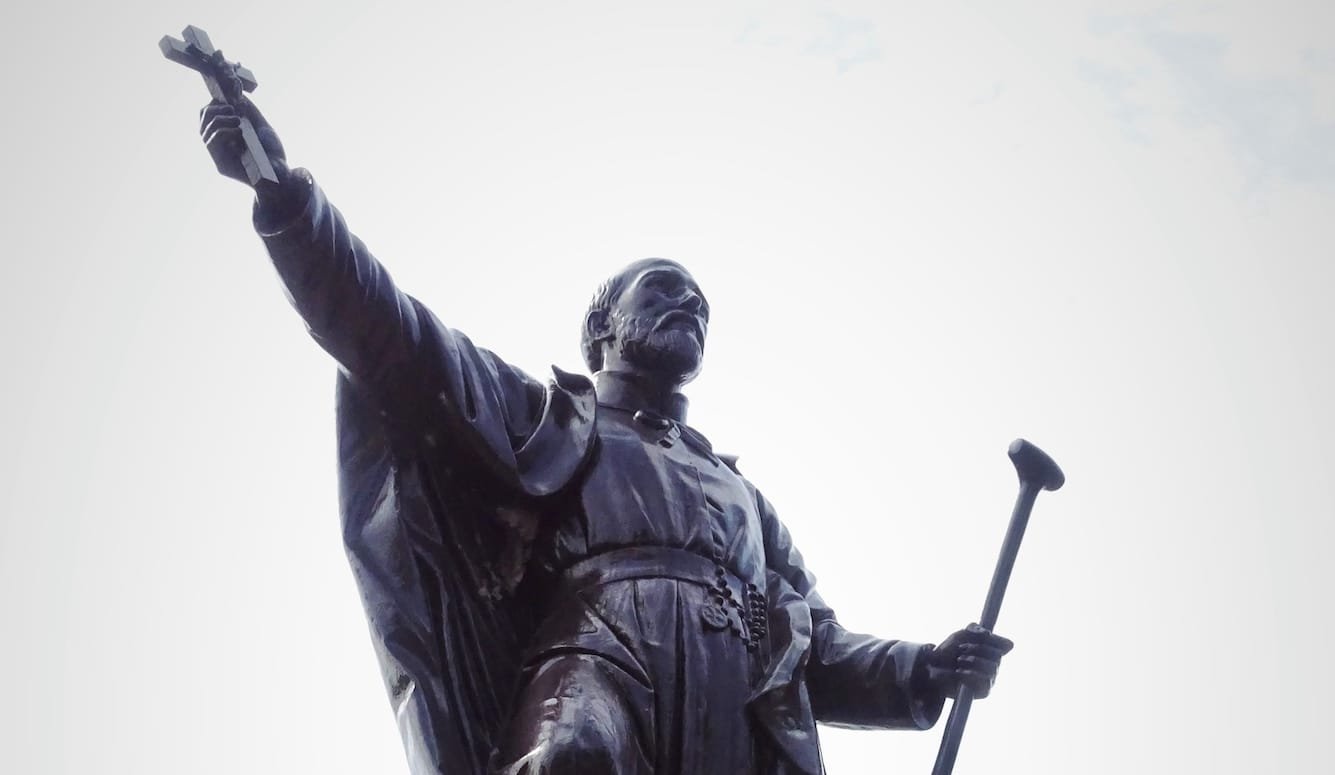
When the spread of disease abated in the late 1630s, the Jesuits’ reputation among the Wendat rebounded somewhat. By now, the French had managed to learn to communicate with the Wendat in their own language, thanks in large part to a brilliant linguist named Jean de Brébeuf, who was now leading the Jesuit delegation (and who will continue to be a major protagonist in our story).
As France’s officially designated representatives within the Wendat world, the Jesuits were seen by Indigenous allies as assurance that France’s military and economic support for the alliance would continue. This alliance was a two-way street, however—just as it always had been. Yes, France’s Indigenous allies coveted European trade goods (metal objects, in particular, such as axes and knives). But the French demographic footprint in Quebec was still tiny. And it depended entirely on Indigenous allies to procure the fur that was the economic raison-d’être of the entire project. The viability of that project now rested precariously on the goodwill extended to a small group of Jesuits living as guests almost 1,000 km upriver from Quebec.
Among the French themselves, there were divided loyalties at play to some extent: For their part, the Jesuits’ main goal wasn’t to advance French diplomatic interests, but rather to convert their Indigenous hosts to Christianity. And at times, their religious mandate could interfere with the commercial and imperial projects being advanced by other Frenchmen.
The Wendat had received the Jesuit religious lessons politely, but initially saw these visitors more as diplomatic representatives than holy men. It was only after Brébeuf and his fellow missionaries became established figures within Wendat society that the initial barriers of language and culture fell away.
The Jesuits were frustrated to find that they had little control over their Christian message once it entered Indigenous communities. The Wendat had their own pre-existing spiritual beliefs, which affected how they understood Christianity. And the Jesuits generally weren’t interested in creating some new syncretic type of Indigenous Christianity.
Back in Europe, the Thirty Years’ War had been raging for two decades by this point. As in the French Wars of Religion that preceded it (a subject we examined much earlier in this series), millions of Europeans had died (in part) for the proposition that there was only one proper way to worship the Christian God. This was the mindset the Jesuits had brought with them as they’d sailed west across the Atlantic. Indeed, one of the main arguments their backers had used to attract funding and political support among the Dévots of Paris was that any French delay would given an opening for the British and Dutch to spread Protestant heresies to the Indigenous population.
The Birth of Quebec
In the twentieth instalment of ‘Nations of Canada,’ Greg Koabel describes how Samuel de Champlain and Récollet missionaries established a fledgling French colony in what we now call Quebec City.
That said, the Jesuits were willing to tolerate some degree of inter-cultural adaptation as a temporary means to get their message across. Unlike earlier missionary groups such as the Récollets (whom we encountered in our twentieth instalment), the Jesuits believed that a kernel of true religious truth (which, to them, naturally meant Christianity) existed within Indigenous spiritual life. They weren’t so much imparting new knowledge, they believed, so much as they were unlocking a pre-existing faith that had been obscured by generations of (as the Jesuits saw it) ignorance in this North American backwater.
Complicating matters logistically for the French was that communications in this region could be slow, even by the standards of the seventeenth century—especially during the winters, when there weren’t trading convoys bringing news up and down the major rivers.
In Spring 1638—which is where we now pick up the narrative afresh—the French hadn’t heard from the Jesuits for months. And the last they’d learned was that Brébeuf and his fellow Jesuits were under suspicion of witchcraft in the aftermath of the latest epidemic, and so might well be murdered. It was possible that the Jesuit mission needed a new leader, not because Brébeuf wasn’t up to the task, but because he was dead.
As it happened, Brébeuf was still very much alive. But the prospect of his death seems to have motivated the French to think about who might be fit to replace him. By this time, it was clear that what was needed in this evolving role wasn’t a linguist, but an able administrator.
The man chosen to take over from Brébeuf (or perhaps rebuild the mission atop Brébeuf’s martyred remains—no one in Paris knew at the time) was his fellow Jesuit, Jérôme Lalement, a 45-year-old newcomer to Quebec who’d spent the previous twenty years holding teaching and administrative posts at Jesuit colleges back in France. By reputation (both among historians and his contemporaries), Lalement was a by-the-book disciplinarian. His mandate in Canada was to turn the Jesuit mission into a structured and professionally run institution.
Brébeuf (if he was still alive) was not to be recalled. Rather, he was to continue spreading the gospel among the Wendat and focusing on his strengths—immersing himself in Wendat culture, mastering the language, and furthering the Christian cause on a day-to-day basis through positive social and spiritual interactions.
Upon his arrival in Summer 1638, Lalement got straight to work, organising a thorough survey of the Wendat Confederacy. He sent his fellow missionaries to every corner of Huronia (as the French called Wendake) and recorded their findings. By Jesuit accounting, the Confederacy had a population of about 12,000, spread out over 32 villages.
This represented a dramatic decrease in numbers. A mere five years earlier, before the ravages of disease arrived, there were probably more than twice as many people living in the same area. The crisis atmosphere of 1636 and 1637 had passed. But the demographic, economic, and psychological repercussions of the epidemics remained acute.
For Lalement, however, the survey wasn’t just about studying Wendat demographics. He wanted to map out the future of the Jesuit mission in a systematic way. This represented a contrast to the more personal style of the itinerant Brébeuf, who’d led the French operation from whatever village he happened to be preaching in at the time.
Lalement divided the Confederacy into four sub-divisions, each with its own centrally-located base in a Wendat village. Missionaries permanently anchored at these sites could then go on regular tours of the surrounding area, giving the Jesuits a national reach.
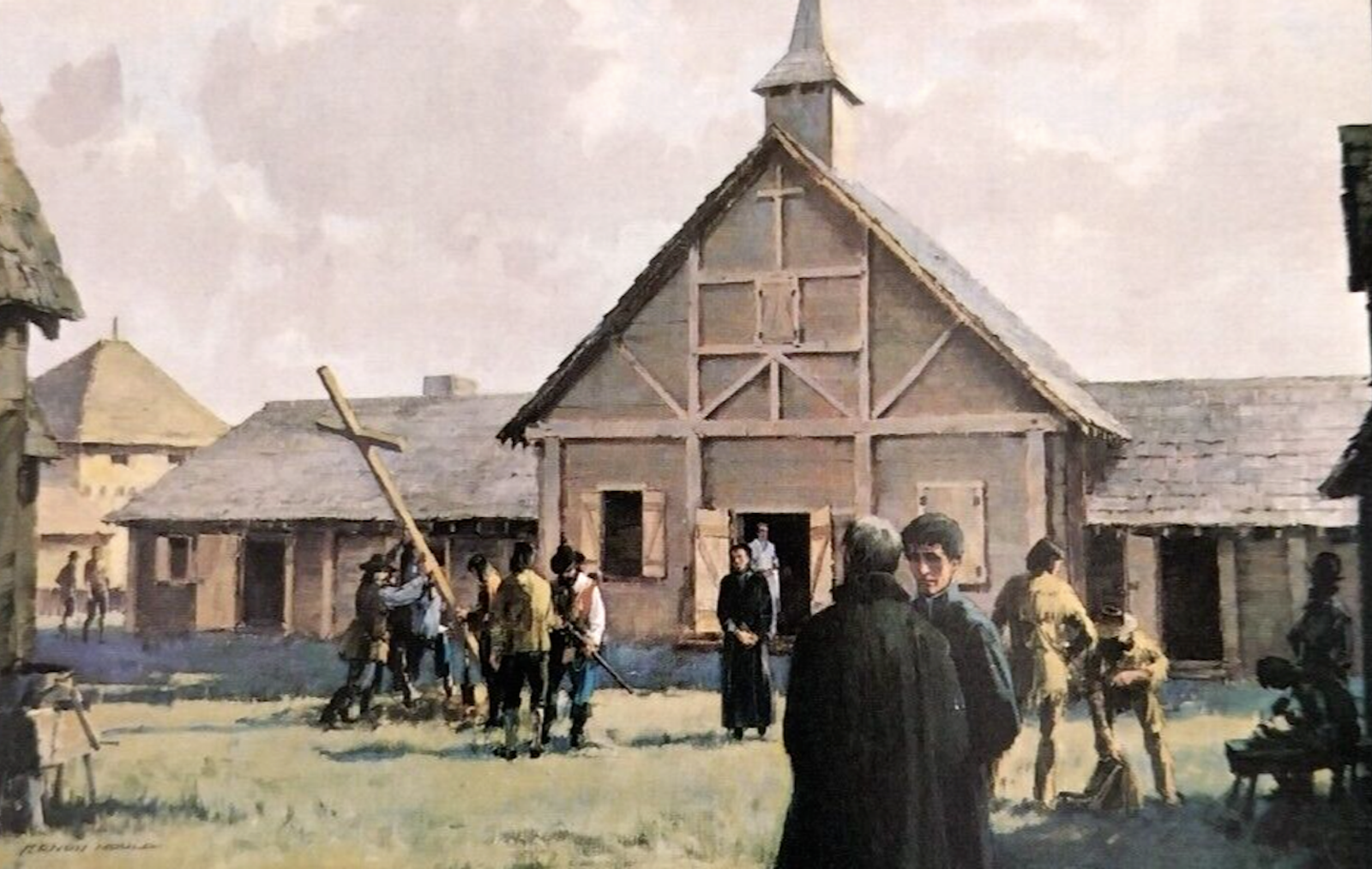
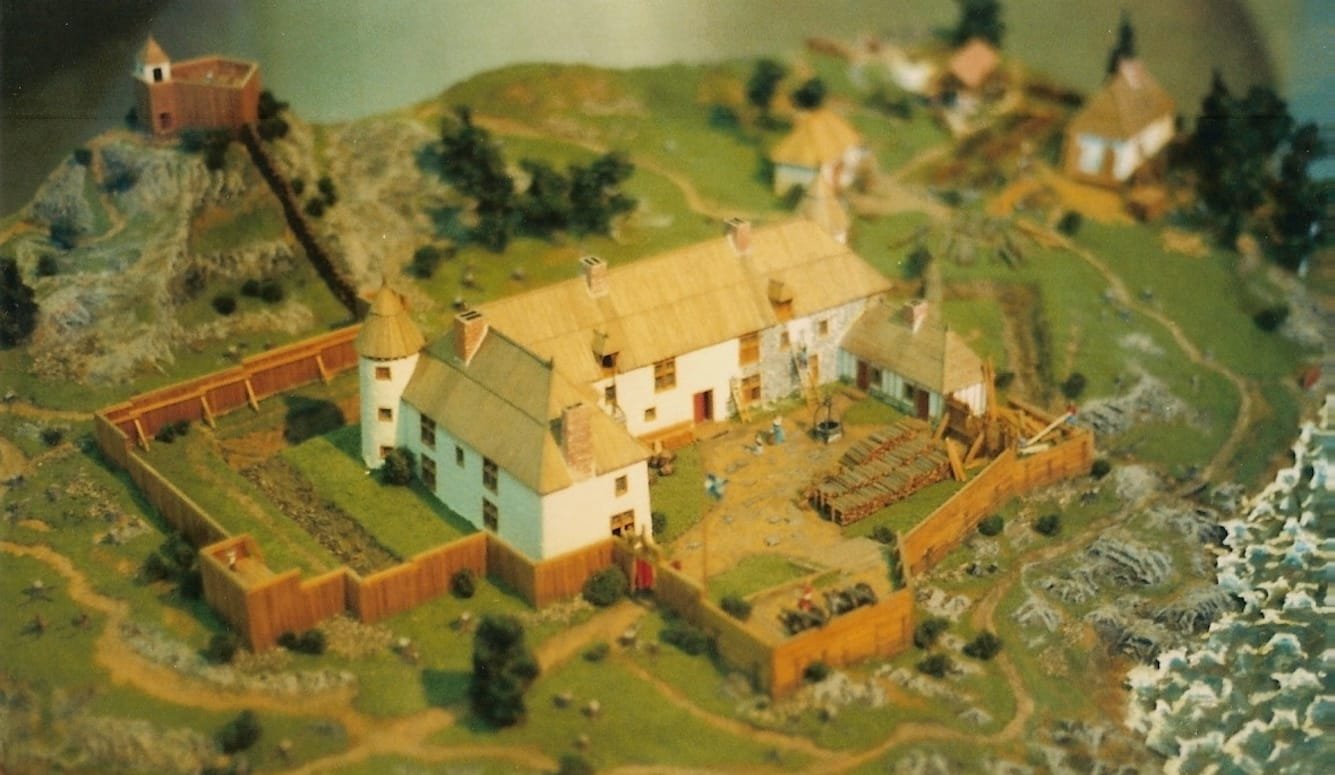
The centrepiece of Lalement’s system was the newly established settlement of Sainte-Marie-au-pays-des-Hurons—anglicised as Sainte-Marie Among the Hurons—located on the Wye River, a few miles inland from the southern shore of Georgian Bay, near the modern Ontario town of Midland. (Sainte Marie is a French term referring, of course, to Mary, the mother of Jesus.)
This was to be the first of its kind in Wendake: a brand new settlement, operated by the Jesuits, and totally separate from any existing Wendat village.
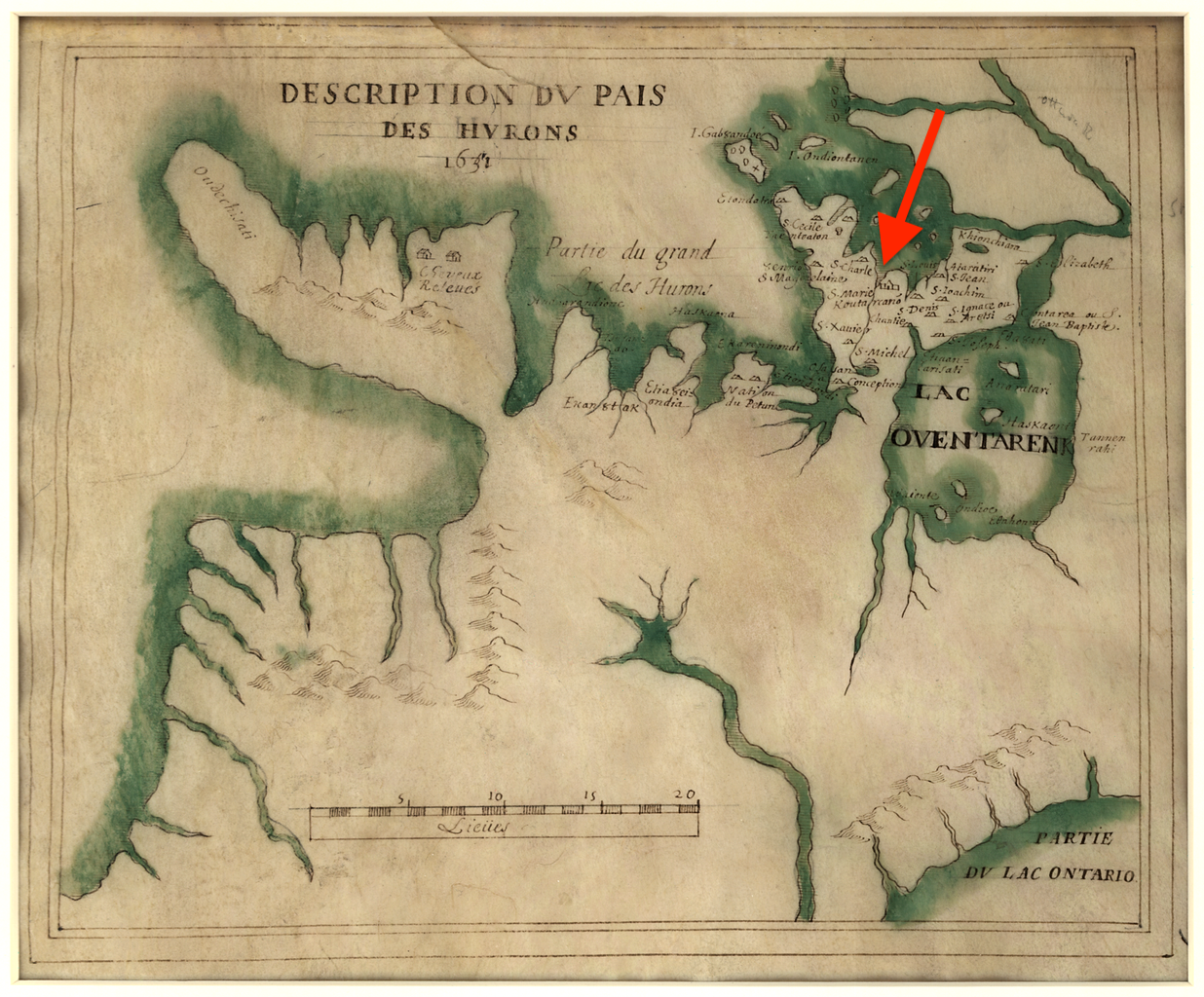
Lalement’s chosen site featured well-drained arable land on either side of the river, which would eventually allow the Jesuits to support themselves with corn cultivation. The goal was to create a self-sufficient community whose inhabitants would no longer be dependent for life and limb on the mercy of Wendat neighbours.
Sainte-Marie Among the Hurons was also well-positioned strategically. Inland waterways provided easy access to the rest of the Wendat Confederacy. And the Wye River emptied into Georgian Bay, which in turn allowed access to the Ottawa River route that linked Huronia to the St. Lawrence and Quebec (albeit with portages). The village was ideally placed to both protect the Jesuits’ link to the east, and help rally the Wendat Confederacy should it be threatened by Haudenosaunee invasion.
Aiding the Jesuits in the construction of Sainte-Marie Among the Hurons was a new category of colonial subject—the donné, a kind of lay Jesuit assistant. It was intended that these recruits would replace the contract workmen whom Brébeuf and other missionaries had hired to build structures and perform other specialised trades.
For the Jesuits, this was an important step, as they sought, whenever possible, to isolate their Indigenous converts from the secular French world—which they saw as populated by imperfect examples of proper Christian behaviour, especially when it came to exploiting the comparatively liberal sexual attitudes in Indigenous societies.
Though they weren’t formally ordained Jesuits or even clergy, donnés were seen as reliable and controllable adjuncts. They took a vow of celibacy for the duration of their service to the Jesuits, and were barred from enriching themselves in the fur trade.
(This doesn’t men that men volunteered to be donnés purely out of devotion to the Jesuit mission, it should be said. In a colonial world where the Jesuits wielded tremendous influence, forging a relationship with the Order could eventually set you on the fast track to social advancement.)
The first prominent donné, Robert Le Coq, had originally accompanied Brébeuf to Huronia as a contract worker back in 1634. Since then, however, he’d become a trusted quartermaster for the Jesuit mission, and gone on regular supply runs from Huronia back to the St. Lawrence. By the time Lalement arrived, Le Coq was firmly established as an informal member of the mission.
Lalement repaid Le Coq’s loyalty by putting him in charge of the construction of Sainte-Marie Among the Hurons. Over the summers of 1638 and 1639, he and other newly recruited donnés worked quickly to make the new site liveable. (Importantly for Lalement, they used European rather than Indigenous construction techniques.) By the end of 1639, enough work had been done for the Jesuits to make it their main base of operations, which they relocated from the Wendat village of Ossossone.
While the construction project was a success, a group of Lalement’s subordinates raised concerns about the removal from Indigenous society that life in Sainte-Marie Among the Hurons would entail. Prominent among these, not surprisingly, was Brébeuf himself.
Brébeuf worried that the missionaries sent to tour Wendat villages would be spread too thin. In his experience, progress could be achieved only by building personal relationships within a community over an extended period of time. If missionaries were forced to become itinerant, popping into a village once every few weeks or months and then leaving shortly thereafter, they would never be able to build trust or social capital. More importantly, they would never be able to understand the communities they worked in.
And this wasn’t the only complaint directed at Lalement. As his critics saw things, the newly arrived boss simply didn’t respect the methods that Brébeuf and his colleagues had developed through trial and error. The new boss had built his career back in France, and this was the first time he’d crossed the Atlantic. Much like a modern MBA-trained consultant who arrives at a client’s business and immediately starts ordering veteran workers to change the way they do their jobs, Lalement traced his knowledge about missionary work to theory, not practice.
Lalement was offering no apologies, however. In his view, he was bringing much needed coherence and discipline to what had been (to this point) a haphazard operation on the edge of the civilised world. Brébeuf had made significant progress, of course—he acknowledged that. But to become truly successful, what the Wendat mission needed now was some patented top-down Jesuit organisational development.
One of the starkest contrasts between Lalement’s academic world back in Paris and the rustic Wendat Confederacy involved the concept of time management. Since he’d been a teenager, Lalement had inhabited the strictly regimented milieu of Jesuit Colleges—as a student, teacher, and then administrator. It was taken for granted that success (both for individuals and society as a whole) required that one submit to a rigorous schedule of work and contemplation. In keeping with this view, Lalement laid out strict guidelines for missionaries that determined when they would teach and minister to the Wendat, and when they would retire to their private chambers for spiritual contemplation.
Lalement rarely entered Wendat longhouses, and refused to attend important Indigenous community events. This was especially damaging when it came to the periodic hospitality feasts that were intended to create bonds between the Jesuits and their hosts.
This approach made sense in France, but was completely unsuitable for life in Huronia. Brébeuf and the other veteran missionaries had learned through experience that the idea of privacy was problematic in the Indigenous world. The longhouses in which Iroquoian peoples lived weren’t just living quarters: they were communal spaces where the day-to-day civic life of the community played out. When the earliest arriving Jesuits in Huronia had constructed small purpose-built structures for private prayer, the local Indigenous population regarded them with suspicion.
There was no precedent for this sort of architecture in their villages. When Jesuits disappeared into these buildings, some assumed that they were engaged in sinister practices such as witchcraft. At best, the practice signalled eccentric or anti-social tendencies.
Lalement himself rarely entered Wendat longhouses, and refused to attend community events that Brébeuf and the others knew to be important. This was especially damaging when it came to the periodic hospitality feasts that were intended to create bonds between the Jesuits and their hosts.
Technically, Sainte-Marie Among the Hurons was open to Indigenous visitors: Curious Wendat neighbours could travel there to learn about Christianity if they wished. But while the chapel was accessible to all, the settlement also contained an inner sanctum, restricted to Christians. Barriers would now be separating believers from non-believers—something Lalement saw as a plus.
Brébeuf, on the other hand, had learned that the Jesuits were unlikely to make headway if they didn’t engage in proactive outreach within Indigenous communities themselves. He’d come to realise that these Indigenous peoples already had their own complex, fully realised spiritual lives (a fact that most European observers missed due to the absence of any kind of organised religious hierarchy)—and so it was unrealistic to expect that they would be drawn to Jesuit sermons out of some unrealised hunger to nourish their souls.
The Jesuits of the Wendat mission had learned other lessons, too—including the confounding (to Europeans) nature of Indigenous politics.
In Europe, power was understood hierarchically: Both the Catholic Church and the French nobility were structured around rigid and (typically) unquestioned lines of authority. The Wendat, by contrast, relied on moral suasion and consensus. As one of Brébeuf’s colleagues noted, “the chiefs have no authority; if they should use threats, far from making themselves feared, they would find themselves abandoned by the very men who chose them for chiefs.”
This had been a valuable lesson for the missionaries. Following the European adage of cuius regio, eius religio, some had focused their efforts on converting chiefs, in the hopes that they would then bring their entire communities with them. In practice, this was a counter-productive strategy. The political and spiritual functions of chiefs were intertwined. And so the moment the Jesuits convinced a chief to turn his back on traditional beliefs and ceremonies, he stopped being useful as an influential voice within his community.
Being a linguist, Brébeuf also had learned that much gets lost in translation, and so just directly translating the Word of God from French into Iroquoian tongues wasn’t enough—no matter how fluent the priests had become. Brébeuf understood that words do not exist in a vacuum, but are shaped by the associated culture.
For instance, referring to God as “the Lord” was straightforward enough in French (Notre Seigneur Dieu)—a language whose speakers understood the political authority of earthly lords as an accessible metaphor for divine power. (Indeed, since the time of Theodosius I, European rulers and Church officials had worked hard to link God and King in the minds of their subjects.) And so many missionaries assumed they could adopt a similar approach in Canada. Borrowing from local political structures, “chief” was often substituted for “Lord.” But as noted above, Indigenous chiefs aren’t European princes. And so, unbeknownst to many missionaries, they weren’t presenting God as an all-powerful being to whom mortals owed absolute submission, but rather a figure of limited authority, with whom people shared reciprocal obligations.
Come for the Whales. Stay for the Fur
In the seventh instalment of an ongoing Quillette series on the history of Canada, Greg Koabel describes how 16th-Century Basque whalers created a thriving industry in the waters off Newfoundland
Brébeuf recognised that even the basic European concept of “belief” didn’t map directly onto the Wendat worldview. Back in France, what an individual believed was crucial to his or her identity (not to mention the fate of his or her soul). Yet Brébeuf discovered that his Wendat hosts almost never expressed things in terms of belief—which is to say, an inner sense of what was true. Wendat conversation was much more focused on outward action. What behaviour was appropriate? How should rituals be conducted? Most of all, they were interested in the relationships that bound an individual to the society around him.
This language barrier presented a problem when it came to the key Christian rite of baptism. Missionaries were frustrated with potential converts who seemed to focus exclusively on the physical ritual. For the Jesuits, the key feature of the ceremony was that it signified the true belief of the baptised. In the Indigenous worldview, however, meaning was contained within the actions themselves—which could be combined with other (non-Christian) actions. And when converts continued to participate in traditional Wendat ceremonies after baptism, the Jesuits saw this as a sign of dishonesty.
In keeping with Lalement’s rigid style more generally, the Jesuits landed on a strict policy regarding baptisms. Those interested would have to undergo a long probationary period of at least a year, during which time their behaviour would be closely monitored. Candidates had to attend regular lessons, and demonstrate a willingness to turn their backs on certain aspects of the Wendat lifestyle that the Jesuits deemed incompatible with Christianity. Once the missionaries were convinced a candidate’s devotion was genuine, he or she would appear at Sainte-Marie to undergo a rigorous examination. Only following the successful completion of this regimen would a baptism be performed, and the candidate would be accepted as a full member of the Christian Church.
That said, the Jesuits were not above holding out earthly inducements for conversion. Baptised Wendat traders were given better prices for their furs. They were also given places of honour at the hospitality feasts that were part of the trade cycle—even if, by Indigenous custom, these were not particularly high-status men. Most importantly, converts were looked to as leaders in councils held with the French.
Indigenous allies had always seen baptism as a kind of social ritual, strengthening their personal connection to the French. Official French policy seemed to be confirming that understanding. And rumours circulated to the effect that, in time, baptism would become a requirement for anyone looking to trade in the region.
Eventually, the French would take things one step further, by allowing Christian traders to buy guns—the one European item they’d always refused to offer, despite persistent requests.
All this raises an important question: Just how successful were these Jesuits in securing conversions?
Read the full article here
Fact Checker
Verify the accuracy of this article using AI-powered analysis and real-time sources.