Close Menu
FSNN | Free Speech News NetworkFSNN | Free Speech News Network
  • Home
  • News
    • Politics
    • Legal & Courts
    • Tech & Big Tech
    • Campus & Education
    • Media & Culture
    • Global Free Speech
  • Opinions
    • Debates
  • Video/Live
  • Community
  • Freedom Index
  • About
    • Mission
    • Contact
    • Support
Trending

What next for XRP as related firm Ripple grabs $200 million funding

12 minutes ago

Bitmine Slows Ether Buy, Targets 5% ETH Supply by December

25 minutes ago

MoonPay Acquires Dawn Labs, Launches AI Trading Copilot for Prediction Markets

26 minutes ago
Facebook X (Twitter) Instagram
Facebook X (Twitter) Discord Telegram
FSNN | Free Speech News NetworkFSNN | Free Speech News Network
Market Data Newsletter
Tuesday, May 12
  • Home
  • News
    • Politics
    • Legal & Courts
    • Tech & Big Tech
    • Campus & Education
    • Media & Culture
    • Global Free Speech
  • Opinions
    • Debates
  • Video/Live
  • Community
  • Freedom Index
  • About
    • Mission
    • Contact
    • Support
FSNN | Free Speech News NetworkFSNN | Free Speech News Network
Home»News»Global Free Speech»The return of Syria’s underground theatre
Global Free Speech

The return of Syria’s underground theatre

News RoomBy News Room8 months agoNo Comments4 Mins Read1,853 Views
Share Facebook Twitter Pinterest Copy Link LinkedIn Tumblr Email VKontakte Telegram
The return of Syria’s underground theatre
Share
Facebook Twitter Pinterest Email Copy Link

Listen to the article

0:00
0:00

Key Takeaways

Playback Speed

Select a Voice

In the upscale Damascus neighbourhood of Al-Adawi, a blue metal door bears a sign reading: “The One Room Theatre.”

The entrance feels unwelcoming. The adjacent garden is frozen in time, suggesting abandonment. This impression deepens beyond the threshold – a cluttered “waiting room” overflows with scattered cassette tapes, faded playbills, film posters and yellowed newspaper clippings haphazardly pinned to walls and windows.

Dominating the wall in the theatre room, is a photo of identical twins, Mohamad and Ahmad Malas. Over 15 years ago, they dreamed of entering Syria’s theatrical scene. Rejected by state institutions that dismissed their vision, they converted a room in their family home into an intimate theatre. Small in size, vast in ambition.

Militias in support of former President Bashar al-Assad’s regime had occupied the house at some point during the Syrian civil war, according to Mohamad Malas, but family relatives later expelled them.

“When the regime fell last December we rushed back from a Jordan film festival,” he told Index. “Returning home was painful – the house stood looted and empty. Its soul has gone.”

Ahmad Malas recalls writing plays with his brother in 2009, inspired by their studies at a private Damascus theatre institute.

Under Assad’s rule, addressing direct political topics was forbidden, so they crafted humanist stories with whispered political undertones. After the Directorate of Theatres repeatedly ignored their licensing requests, they launched the underground One Room Theatre.

They hosted three plays, the last of which was staged shortly after Syria’s revolution began.

As protests surged, the twins joined the uprising personally, not only through art. Arrests and security threats followed, forcing them to flee Syria in late 2011. Heartbroken, they locked their theatre door. Months later, their family abandoned the home and headed to Saudi Arabia, leaving it silent.

The Malas Brothers drifted through Lebanon, Egypt and finally France, where they pursued theatre in Arabic and French. One play, The Two Refugees, serendipitously reached Damascus in late 2024.

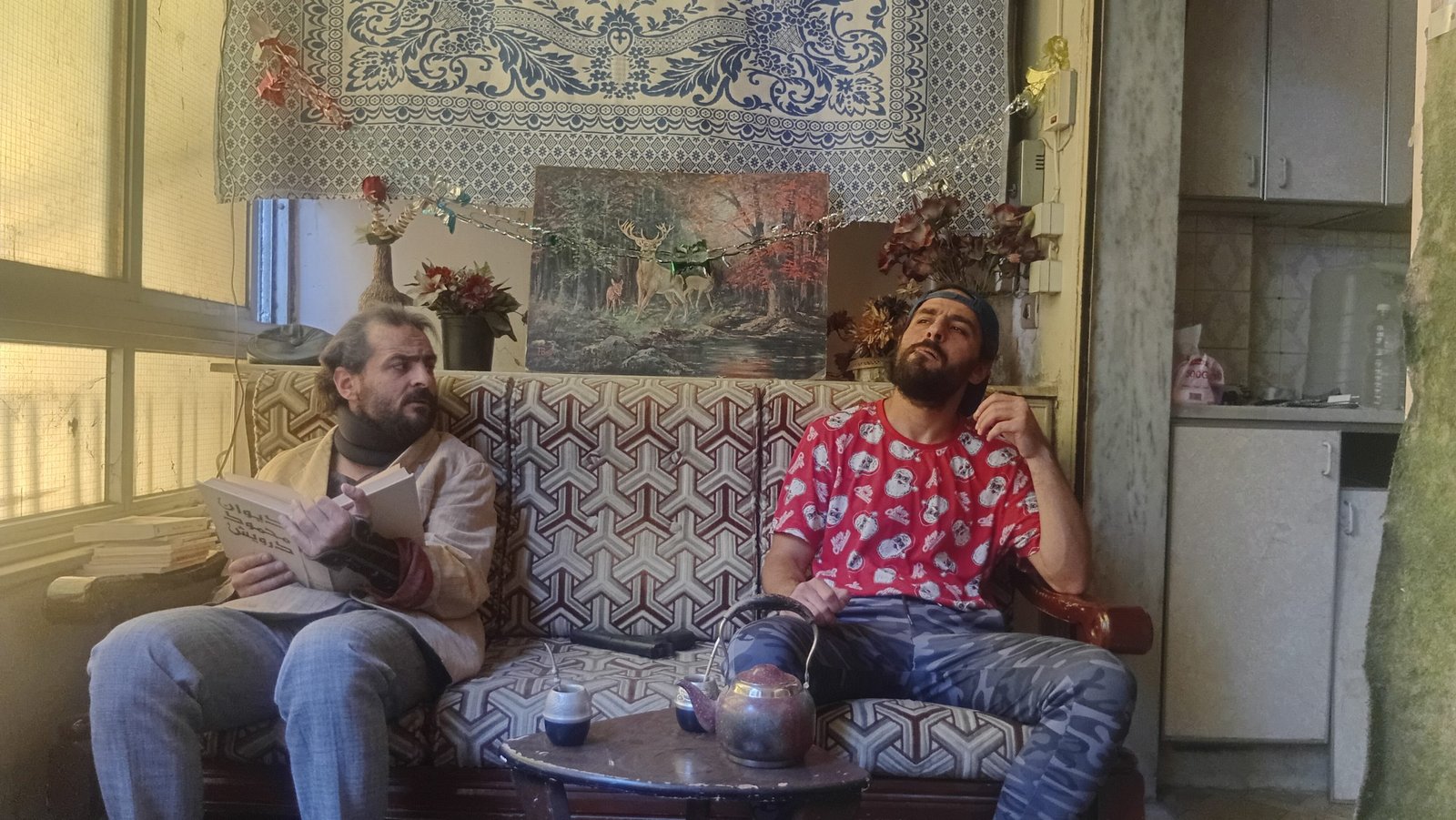
On their return, the twins deliberately left the waiting room’s chaos untouched – tapes strewn, posters peeling. Their only change was to move the theatre to a sunlit balcony near the kitchen due to Syria’s chronic power cuts. At 4pm, natural light frames their play All Shame Upon You.

Photo by Mawada Bahah

Mohamad Malas explained that the play, staged 20 times post-Arab Spring but paused in Syria, now features rewrites “we’d never dare perform before liberation”.

The performance unfolds on a crumbling sofa “stage” before low chairs. It follows two opposites sharing a flat: a heartbroken intellectual whose lover married during his imprisonment, and a crude soldier dreaming of martyrdom-for-glory. Their clashes blend rage, dancing and tears, culminating in the soldier forcing the poet to call his lost love.

The Culture Ministry has promised support – unlike the pre-revolution era when security agents monitored every show. Yet the twins remain pragmatic.

“The theatre in Syria doesn’t pay for bread,” Mohamad Malas said, adding that he and his brother will split time between France (to earn a living) and Syria (to follow their passion).

Their French passports offer global protection but “mean nothing in Syria,” he added. “If a French passport serves me better, our country is still on the wrong path.”

In their last show on 5 June, before they returned to France, the Malas brothers cautiously pushed boundaries, hinting at identity-based killings on Syria’s coast earlier this year.

In March, hundreds of minority Alawite civilians in coastal cities were killed by Sunni fighters, according to Reuters news agency reporting and several monitoring groups. Assad belonged to the Alawite sect, and the massacre came after a rebellion by remaining Assad loyalists, that ended in bloodshed.

The attacks took place only three months after Assad’s ousting in December ended his brutal rule and followed almost 14 years of civil war.

“Freedom isn’t just criticising the past regime,” Mohamad Malas said.

A pivotal line lingers in his play: “Was the homeland worth all this suffering?” When asked, Ahmad Malas admitted: “Sometimes, no, not after children died in Daraya, Ghouta… then again on the coast after the revolution.”

Despite Syria’s wounds, they harbour hope: “Mistakes happened, but awareness and law can heal rage.”

But despite the gloomy theme of the play, the Malas brothers struggle to hide their joy. The reason is that they’re finally able to stage work without censors hiding in the audience.

Read the full article here

Fact Checker

Verify the accuracy of this article using AI-powered analysis and real-time sources.

Get Your Fact Check Report

Enter your email to receive detailed fact-checking analysis

5 free reports remaining

Continue with Full Access

You've used your 5 free reports. Sign up for unlimited access!

Already have an account? Sign in here

Share. Facebook Twitter Pinterest LinkedIn Tumblr Email Telegram Copy Link
News Room
  • Website
  • Facebook
  • X (Twitter)
  • Instagram
  • LinkedIn

The FSNN News Room is the voice of our in-house journalists, editors, and researchers. We deliver timely, unbiased reporting at the crossroads of finance, cryptocurrency, and global politics, providing clear, fact-driven analysis free from agendas.

Related Articles

Global Free Speech

Bukele administration freezes Salvadoran news outlet’s assets in latest act of retaliation

3 days ago
Global Free Speech

Colombian journalist reported missing following capture by rebels

3 days ago
Global Free Speech

Daughter of murdered Serbian journalist Slavko Ćuruvija on her 27-year fight for justice

4 days ago
Global Free Speech

Tunisia court sentences journalist Zied el-Heni to 1 year in prison

4 days ago
Global Free Speech

Rwandan YouTuber dies of alleged overdose on day of release from prison

4 days ago
Global Free Speech

Narges Mohammadi, Iranian human rights defender and 2023 Nobel Peace Prize winner I pray that when you read this Narges Mohammadi is still alive. The Nobel Peace Prize winner is currently in an Iranian hospital in a critical condition. Her brother, who lives in Oslo, is anticipating terrible news. Mohammadi, 54, is in ill-health and is suspected of having suffered a heart attack in jail. Her move to a hospital is purely tokenistic – she is not in the right place for her condition. If she dies under these conditions, it’s a fate Mohammadi has warned about herself. In 2023 we shared a video made by Iranian filmmaker Vahid Zarezadeh of Mohammadi raising the alarm. When she gave the interview, she had just left hospital because of previous heart complications, following time in an appalling prison renowned for its punishing regime. In the video she said the “system sets up the conditions for the prisoner’s death,” and told people to not be surprised if, in the event she died in jail, the authorities blamed her death on an undiagnosed health problem. Heart attacks are common, they’d claim, downplaying their own role. Today it is even easier for them to downplay their role. The country is still in digital darkness. This Thursday marks day 69. That is 1632 hours of no connection to the global internet. There are some workarounds but they’re hard and risky. The cover of war has also seen an escalation in the execution of political prisoners, including those who took part in January’s protests. To be a dissident in Iran takes guts. To be as dedicated as Mohammadi is frankly awe-inspiring. What has made her so? Mohammadi was born in 1972 into a middle-class family with political persuasions. Following the Islamic revolution, her uncle and two cousins were arrested for activism. She studied nuclear physics at university, and it was there that she met her husband, Taghi Rahmani, who had himself spent 17 years in prison. After university, she worked for newspapers that were part of the reformist movement. In 2003 she joined the Defenders of Human Rights Center, founded by that year’s Nobel Peace Prize laureate, Shirin Ebadi. By this stage she had already been arrested and spent a year in jail. This became a pattern. According to her foundation, she’s been arrested 13 times and sentenced to a total of 31 years in prison and 154 lashes. A mother of twins — Kiana and Ali – Mohammadi has called the long years of separation from them an indescribable suffering. She has spoken about the fear and anxiety of solitary confinement and once said: “The price of the struggle is not only torture and prison, it is a heart that breaks with every regret and a pain that strikes to the marrow of your bones.” Still, she has continued to campaign for justice. Upon winning the Nobel Peace Prize in October 2023 “for her fight against the oppression of women in Iran and her fight to promote human rights and freedom for all”, she said: “I will never stop striving for the realisation of democracy, freedom and equality.” One month later she was on hunger strike to protest the delayed and neglectful medical care for sick prisoners. I’m fascinated by the anatomy of courage, though I’m unsure I’ll ever get to the bottom of it. What I do know is that Narges Mohammadi deserves every accolade and if she dies in the coming days the Iranian authorities are the culprits and not a dodgy heart. READ MORE

4 days ago
Add A Comment

Comments are closed.

Editors Picks

Bitmine Slows Ether Buy, Targets 5% ETH Supply by December

25 minutes ago

MoonPay Acquires Dawn Labs, Launches AI Trading Copilot for Prediction Markets

26 minutes ago

Father Free to Send Children to Church Camp During His Parenting Time, Even When Mother Objects to Church’s Views on Women

48 minutes ago

Bitcoin briefly hits $82,000, SOL, DOGE higher as Michael Burry warns of stock crash

1 hour ago
Latest Posts

MARA Shares Fall on $1.3B Q1 Loss, Revenue Miss

1 hour ago

Tom Lee’s BitMine Slows Ethereum Buying Pace, Adding $62 Million in ETH

1 hour ago

Trump Admin Appeals ACIP Court Ruling So RFK Jr. Can Continue Fucking With Vaccines

2 hours ago

Subscribe to News

Get the latest news and updates directly to your inbox.

At FSNN – Free Speech News Network, we deliver unfiltered reporting and in-depth analysis on the stories that matter most. From breaking headlines to global perspectives, our mission is to keep you informed, empowered, and connected.

FSNN.net is owned and operated by GlobalBoost Media
, an independent media organization dedicated to advancing transparency, free expression, and factual journalism across the digital landscape.

Facebook X (Twitter) Discord Telegram
Latest News

What next for XRP as related firm Ripple grabs $200 million funding

12 minutes ago

Bitmine Slows Ether Buy, Targets 5% ETH Supply by December

25 minutes ago

MoonPay Acquires Dawn Labs, Launches AI Trading Copilot for Prediction Markets

26 minutes ago

Subscribe to Updates

Get the latest news and updates directly to your inbox.

© 2026 GlobalBoost Media. All Rights Reserved.
  • Privacy Policy
  • Terms of Service
  • Our Authors
  • Contact

Type above and press Enter to search. Press Esc to cancel.

🍪

Cookies

We and our selected partners wish to use cookies to collect information about you for functional purposes and statistical marketing. You may not give us your consent for certain purposes by selecting an option and you can withdraw your consent at any time via the cookie icon.

Cookie Preferences

Manage Cookies

Cookies are small text that can be used by websites to make the user experience more efficient. The law states that we may store cookies on your device if they are strictly necessary for the operation of this site. For all other types of cookies, we need your permission. This site uses various types of cookies. Some cookies are placed by third party services that appear on our pages.

Your permission applies to the following domains:

  • https://fsnn.net
Necessary
Necessary cookies help make a website usable by enabling basic functions like page navigation and access to secure areas of the website. The website cannot function properly without these cookies.
Statistic
Statistic cookies help website owners to understand how visitors interact with websites by collecting and reporting information anonymously.
Preferences
Preference cookies enable a website to remember information that changes the way the website behaves or looks, like your preferred language or the region that you are in.
Marketing
Marketing cookies are used to track visitors across websites. The intention is to display ads that are relevant and engaging for the individual user and thereby more valuable for publishers and third party advertisers.