Moonshot AI launched Kimi K3 on Thursday—a 2.8-trillion-parameter open-weight model that ranked alongside Claude Fable 5 and GPT 5.6 Sol.
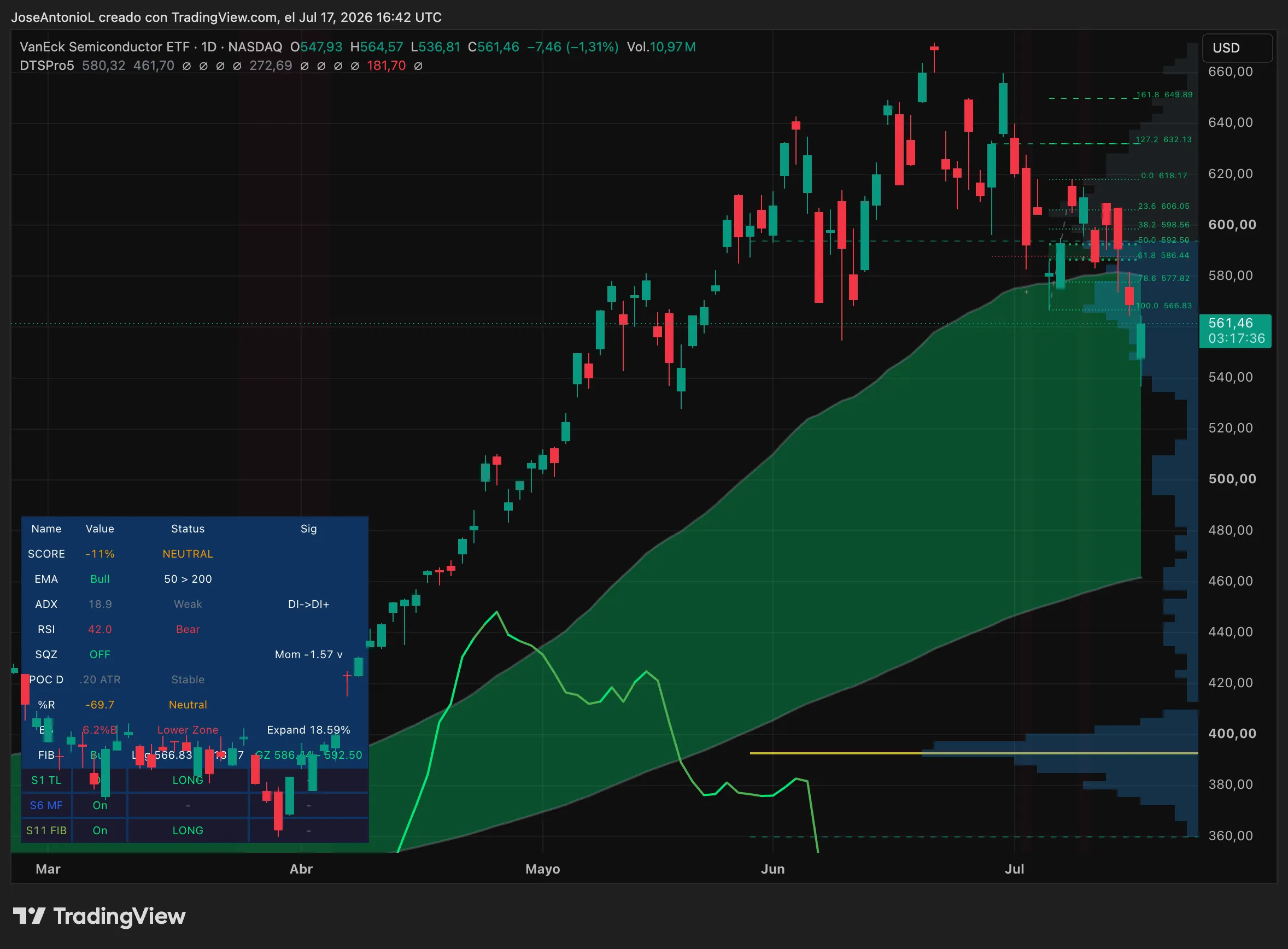
Semiconductor stocks cratered Friday, with the VanEck Semiconductor ETF (SMH) falling below key support for the first time since April.
Full model weights go public by July 27. If they hold up under independent testing, the pressure on U.S. AI companies to justify their infrastructure spending gets significantly harder to dismiss.
China did it again. Moonshot AI launched Kimi K3 in the dead of night and markets woke up today doing what they always do when a Chinese lab closes the gap: They panicked.
Semiconductor and AI stocks dropped across the board Friday. Taiwan’s benchmark fell more than 6%. Japan closed down 4%. The Nasdaq slid 1.5%, its worst session of the week.
The DeepSeek comparison seems well deserved. When DeepSeek dropped R1 in January 2025, the assumption that frontier AI required frontier spending—and the chip orders to match—cracked overnight. Nvidia shed around $590 billion in market cap in a single session. This time the damage spread across the sector.
The VanEck Semiconductor ETF (SMH) fell below its EMA support band—the moving average tracking the price trend over the prior months—for the first time since April, extending a rout that has put it more than 20% below its late-June record high.
On the Artificial Analysis Intelligence Index—an independent composite benchmark that aggregates model performance across reasoning, knowledge, mathematics, and coding—K3 scored 57, ranking above Claude Opus 4.8 and GPT-5.5, practically on par with Claude Fable 5 and OpenAI’s GPT-5.6 Sol, beating them in specific benchmarks at a fraction of the price. Full weights drop July 27 under a Modified MIT license which means small labs will have that model available for free.
Wall Street analysts largely saw this coming. Bernstein’s Robin Zhu called the release “confirmatory”—another data point in a trend that’s been building all year. Morgan Stanley analyst Gary Yu framed K3 as the product of steady compound progress rather than a shock. “K3 has received positive feedback globally, signaling an all-round catch-up of Chinese LLMs with U.S. leaders in model size, performance, and pricing,” he wrote.
Bernstein analyst Robin Zhu also framed this as a catch-up. “At a high level, K3 feels confirmatory of our views that (1) AI [state of the art] continues to evolve rapidly; and (2) China AI can continue to keep pace with global [state of the art], and take some share over time.”
Moonshot is backed by Alibaba, which put $1 billion into the company in 2024 at a $2.5 billion valuation. The startup now sits at roughly $31.5 billion.
As Decrypt covered in May, Moonshot already has deeper roots in U.S. developer circles than most realize—Cursor’s Composer 2 was found to be running on Kimi K2.5 without disclosure before the Cursor team acknowledged the open-source base.
Daily Debrief Newsletter
Start every day with the top news stories right now, plus original features, a podcast, videos and more.
The FSNN News Room is the voice of our in-house journalists, editors, and researchers. We deliver timely, unbiased reporting at the crossroads of finance, cryptocurrency, and global politics, providing clear, fact-driven analysis free from agendas.
We and our selected partners wish to use cookies to collect information about you for functional purposes and statistical marketing. You may not give us your consent for certain purposes by selecting an option and you can withdraw your consent at any time via the cookie icon.
Cookies are small text that can be used by websites to make the user experience more efficient. The law states that we may store cookies on your device if they are strictly necessary for the operation of this site. For all other types of cookies, we need your permission. This site uses various types of cookies. Some cookies are placed by third party services that appear on our pages.
Your permission applies to the following domains:
https://fsnn.net
Necessary
Necessary cookies help make a website usable by enabling basic functions like page navigation and access to secure areas of the website. The website cannot function properly without these cookies.
Statistic
Statistic cookies help website owners to understand how visitors interact with websites by collecting and reporting information anonymously.
Preferences
Preference cookies enable a website to remember information that changes the way the website behaves or looks, like your preferred language or the region that you are in.
Marketing
Marketing cookies are used to track visitors across websites. The intention is to display ads that are relevant and engaging for the individual user and thereby more valuable for publishers and third party advertisers.


 Freedom Index