

 Freedom Index

Listen to the article
A solo Bitcoin miner hit the jackpot and validated a solo block with a single Bitaxe mining rig, marking a rare win that beat massive statistical odds.
The retail Bitcoin miner secured a 3.125 Bitcoin (BTC) block reward, currently worth about $200,000, on Friday at block number 957382, according to blockchain data from mempool.space.
The miner was using a single Bitaxe mining rig, according to the BTC mining pool Public Pool. That Bitaxe is a budget, lower-power Bitcoin miner that costs less than $200 and has a hashrate of about 1 terahash per second (TH/s), which is a tiny fraction of the global Bitcoin network.
The solo block reward shows that even a sub-$200 investment in a mining rig can lead to a statistically rare payday for retail miners.
Another solo Bitcoin miner validated a solo block in April, through CKPool’s solo mining service. Earlier in February, another retail miner validated a solo block using rented hashrate from a mining provider, meaning that he didn’t own the physical mining rig that solved the block.
Source: Public Pool
Solo BTC miners bag $4.7 million during the past year
While mining a solo block is statistically rare, this marks the 12th Bitcoin block validated by a hobby-level miner so far in 2026, pushing the past 12 months’ total payouts to more than $4.7 million for retail miners.
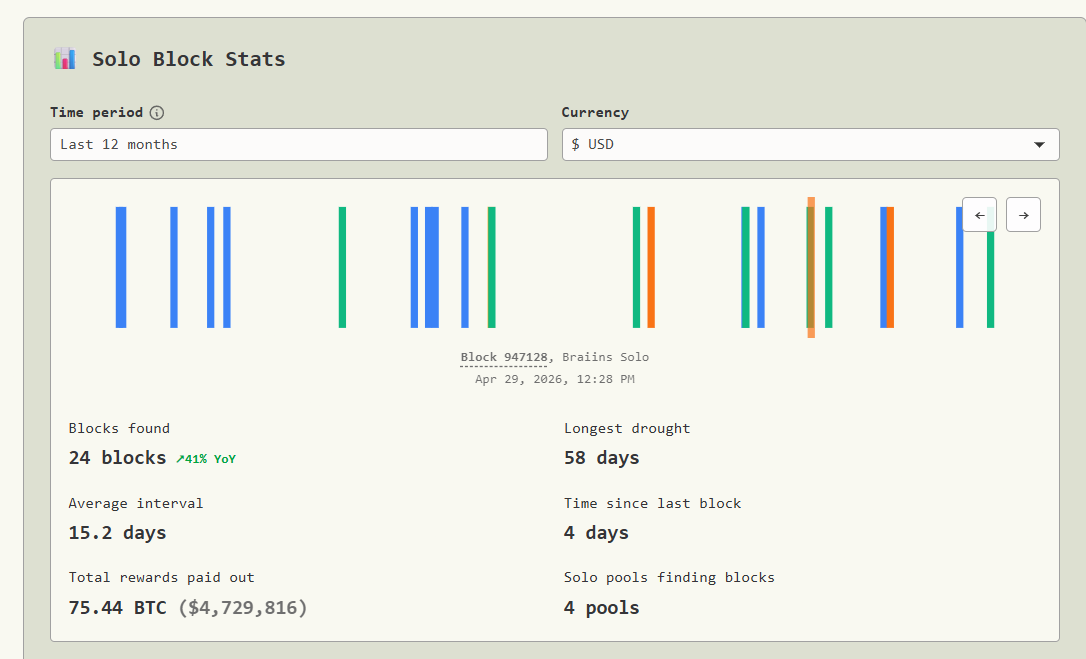
Solo block stats, 1-year. Source: Bennet.org
Solo blocks mined increases by 41% year-over-year, as solo miners validated a total of 24 blocks during the past year, according to solo miner data aggregator Bennet. This brings total rewards paid to solo miners to 75.4 Bitcoin, or $4.7 million, for the past year.
Related: Bitcoin whale moves $188M for first time in 7 years
The average interval for solo Bitcoin blocks stands at 15.2 days, while the longest drought without a successful solo block stands at 58 days.
Magazine: Bitcoin nearing late stages of bear market: Jamie Coutts, Real Vision
Read the full article here
Fact Checker
Verify the accuracy of this article using AI-powered analysis and real-time sources.