Close Menu
FSNN | Free Speech News NetworkFSNN | Free Speech News Network
  • Home
  • News
    • Politics
    • Legal & Courts
    • Tech & Big Tech
    • Campus & Education
    • Media & Culture
    • Global Free Speech
  • Opinions
    • Debates
  • Video/Live
  • Community
  • Freedom Index
  • About
    • Mission
    • Contact
    • Support
Trending

Today in Supreme Court History: July 13, 1787

9 minutes ago

U.S.-Iran hostilities send BTC price lower even as ETF flows show demand: Crypto Daily

32 minutes ago

Bitcoin Whale Moves $188M for First Time in 7 Years

33 minutes ago
Facebook X (Twitter) Instagram
Facebook X (Twitter) Discord Telegram
FSNN | Free Speech News NetworkFSNN | Free Speech News Network
Market Data Newsletter
Monday, July 13
  • Home
  • News
    • Politics
    • Legal & Courts
    • Tech & Big Tech
    • Campus & Education
    • Media & Culture
    • Global Free Speech
  • Opinions
    • Debates
  • Video/Live
  • Community
  • Freedom Index
  • About
    • Mission
    • Contact
    • Support
FSNN | Free Speech News NetworkFSNN | Free Speech News Network
Home»News»Global Free Speech»Contents War is brutal. During conflicts there is little time for art. Museums and theatres are flattened by bombs, a trend we have been covering in Index for some years now. On the ground, people often have more pressing concerns like finding food or repelling the enemy. But war can also inspire the most incredible artistic endeavour, as painters and poets are forced to look again at a fragile world and bear witness to the atrocities that warring parties would rather keep hidden. In this issue, Martin Bright talks to Magnum photographer and artist Nanna Heitmann about her work The Machinery of War, which presents uncomfortable truths about propaganda and the Ukraine war. As Salil Tripathi writes from the USA, writers and artists are able to discuss the Israel-Hamas war much more freely than they could during the Iraq war a quarter-century ago, and are less likely to face blanket censorship. After 9/11, Tripathi observes, George Bush essentially threw down the gauntlet. War is often talked about in stark black and white terms, but artists are able to give nuance. Maria Sorenson makes this point while highlighting work about war that has been censored in Russia, Belarus and Ukraine because it does not toe the official patriotic line. “Narrowing life into ideology, flattening human complexity into slogans, symbols and sanctioned truths is what propaganda does best. Art has always been – and still remains – one of the ways to resist that,” she writes. Enjoy the magazine. It has reports and discussions from around the world about how censorship works today, and about how brave artists continue to struggle to explain the complexity of the world Up Front The art of war: Sally GimsonArtists across the globe fight back against censors in times of war The Index: Mark StimpsonAll the latest free expression news, elections and people to watch Features Complacency, culture wars, and money troubles are killing theatre: Sally GimsonAn investigation into suppression of political theatre in the UK More haste, less free speech: Amy FallonThe phrases “globalise the intifada” is banned in Queensland Prove who you are: Sajad Hameed, Rehan Qayoom MirThe Kashmiri shawl sellers driven out of business for being Muslim AI brings the disappeared back to life: Amy BoothAI imagines the victims of Argentina’s military junta “Factually incorrect and dangerously one-sided”: how lawyers face down art: Freddie LoweHow the law is used against artists Putin’s Russia is policing women’s right to choose: Olga BorisovaRussia wants women to have children, if they want to or not The long reach of Rwanda: Martin PlautNowhere is out of reach of attacks by Kagame’s government Outwitting the censors: Mkhululi ChimoioThe artists censored in Africa for a quarter of a century The UK is a hunting ground for authoritarian regimes: Clive Stafford Smith, Roshaan KhattakTransnational repression, from Pakistan to Cambridge with love The monster unleashed Şener Özmen’s uncompleted story: Kaya Genç A profile of the Kurdish artist persecuted for his love of Tracey Emin The war in Sudan – artists and censorship: Danson KahyanaSudanese artists speak about their life in exile Ways of seeing – Iranian cinema’s struggle to reflect its country: Tara AghdashlooThe Iranian filmmakers fighting censorship, no matter the cost Art and anarchy in troubled times: Maria SorensenThe Ukrainian artists sticking it to the man Putting beauty – and brutality – in the eye of the beholder: Martin BrightThe War Is Peace? exhibition at Oslo’s Nobel Peace Centre Who gets to speak? American art and writing in times of war: Salil Tripathi Suppression of critical voices in the USA in the wake of 9/11 Comment Murdering the messenger: Oren PersicoThe reasons Israel killed more journalists than any other country last year Why can’t art be beautiful: Marc Nash A review of John Byrne’s Useful Art: How Activists Artists Can Change the World The secret world of royal finances: Norman Baker The Royal Family should be more open about money Taking a stance against the banning of books: Katie Dancey-DownsIndex investigates a Manchester school that banned twilight The wild west: Jemimah SteinfeldBanning Kanye West could be a slippery slope The power of a book: Sarah Wynn-WilliamsWynn-Williams’ acceptance speech, about fellow award-winner Virginia Giuffre Shadows called woman: Kaya Genç, Maryam RanjbariA painter detained multiple times for her paintings in Iran Culture Being queer in Ukraine – tales of citizenship and resistance: Connor O’Brien, J Lester FederWar, civic duty, and the desire of authoritarian regimes to suppress LGBTQ+ voices. Don’t forget the women of Afghanistan: Ruth Green, Marzia BabakarkhailThe author meets an exiled champion of women’s rights Unrequited love: Steve Komarnyckyj, Khrystia AlchevskaA romantic short story by poet Khrystia Alchevska More Tea?: Sophie TeaThe TikTok sensation talks about inclusivity in her art READ MORE
Global Free Speech

Contents War is brutal. During conflicts there is little time for art. Museums and theatres are flattened by bombs, a trend we have been covering in Index for some years now. On the ground, people often have more pressing concerns like finding food or repelling the enemy. But war can also inspire the most incredible artistic endeavour, as painters and poets are forced to look again at a fragile world and bear witness to the atrocities that warring parties would rather keep hidden. In this issue, Martin Bright talks to Magnum photographer and artist Nanna Heitmann about her work The Machinery of War, which presents uncomfortable truths about propaganda and the Ukraine war. As Salil Tripathi writes from the USA, writers and artists are able to discuss the Israel-Hamas war much more freely than they could during the Iraq war a quarter-century ago, and are less likely to face blanket censorship. After 9/11, Tripathi observes, George Bush essentially threw down the gauntlet. War is often talked about in stark black and white terms, but artists are able to give nuance. Maria Sorenson makes this point while highlighting work about war that has been censored in Russia, Belarus and Ukraine because it does not toe the official patriotic line. “Narrowing life into ideology, flattening human complexity into slogans, symbols and sanctioned truths is what propaganda does best. Art has always been – and still remains – one of the ways to resist that,” she writes. Enjoy the magazine. It has reports and discussions from around the world about how censorship works today, and about how brave artists continue to struggle to explain the complexity of the world Up Front The art of war: Sally GimsonArtists across the globe fight back against censors in times of war The Index: Mark StimpsonAll the latest free expression news, elections and people to watch Features Complacency, culture wars, and money troubles are killing theatre: Sally GimsonAn investigation into suppression of political theatre in the UK More haste, less free speech: Amy FallonThe phrases “globalise the intifada” is banned in Queensland Prove who you are: Sajad Hameed, Rehan Qayoom MirThe Kashmiri shawl sellers driven out of business for being Muslim AI brings the disappeared back to life: Amy BoothAI imagines the victims of Argentina’s military junta “Factually incorrect and dangerously one-sided”: how lawyers face down art: Freddie LoweHow the law is used against artists Putin’s Russia is policing women’s right to choose: Olga BorisovaRussia wants women to have children, if they want to or not The long reach of Rwanda: Martin PlautNowhere is out of reach of attacks by Kagame’s government Outwitting the censors: Mkhululi ChimoioThe artists censored in Africa for a quarter of a century The UK is a hunting ground for authoritarian regimes: Clive Stafford Smith, Roshaan KhattakTransnational repression, from Pakistan to Cambridge with love The monster unleashed Şener Özmen’s uncompleted story: Kaya Genç A profile of the Kurdish artist persecuted for his love of Tracey Emin The war in Sudan – artists and censorship: Danson KahyanaSudanese artists speak about their life in exile Ways of seeing – Iranian cinema’s struggle to reflect its country: Tara AghdashlooThe Iranian filmmakers fighting censorship, no matter the cost Art and anarchy in troubled times: Maria SorensenThe Ukrainian artists sticking it to the man Putting beauty – and brutality – in the eye of the beholder: Martin BrightThe War Is Peace? exhibition at Oslo’s Nobel Peace Centre Who gets to speak? American art and writing in times of war: Salil Tripathi Suppression of critical voices in the USA in the wake of 9/11 Comment Murdering the messenger: Oren PersicoThe reasons Israel killed more journalists than any other country last year Why can’t art be beautiful: Marc Nash A review of John Byrne’s Useful Art: How Activists Artists Can Change the World The secret world of royal finances: Norman Baker The Royal Family should be more open about money Taking a stance against the banning of books: Katie Dancey-DownsIndex investigates a Manchester school that banned twilight The wild west: Jemimah SteinfeldBanning Kanye West could be a slippery slope The power of a book: Sarah Wynn-WilliamsWynn-Williams’ acceptance speech, about fellow award-winner Virginia Giuffre Shadows called woman: Kaya Genç, Maryam RanjbariA painter detained multiple times for her paintings in Iran Culture Being queer in Ukraine – tales of citizenship and resistance: Connor O’Brien, J Lester FederWar, civic duty, and the desire of authoritarian regimes to suppress LGBTQ+ voices. Don’t forget the women of Afghanistan: Ruth Green, Marzia BabakarkhailThe author meets an exiled champion of women’s rights Unrequited love: Steve Komarnyckyj, Khrystia AlchevskaA romantic short story by poet Khrystia Alchevska More Tea?: Sophie TeaThe TikTok sensation talks about inclusivity in her art READ MORE

News RoomBy News Room2 hours agoNo Comments4 Mins Read379 Views
Share Facebook Twitter Pinterest Copy Link LinkedIn Tumblr Email VKontakte Telegram
Contents
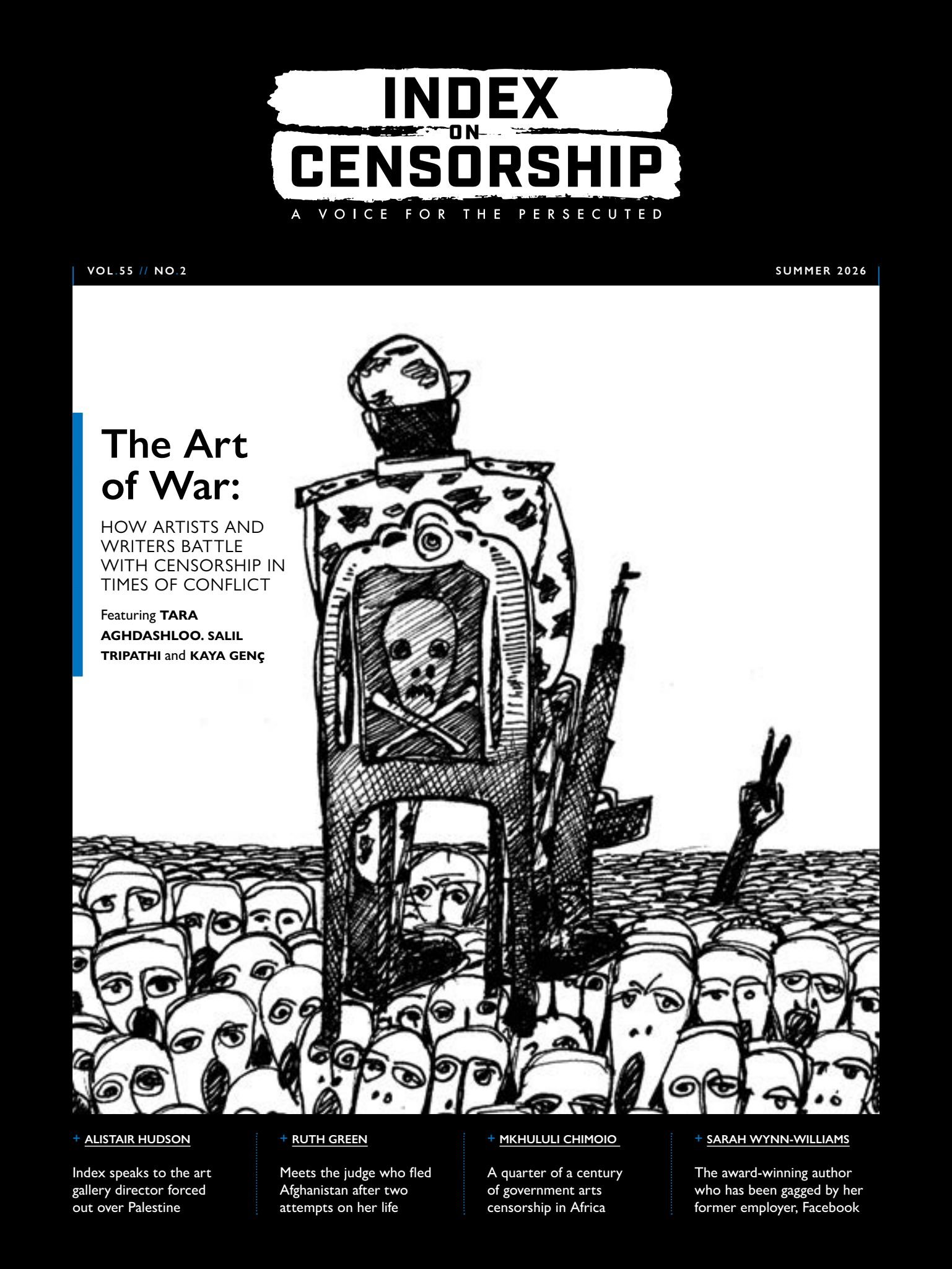
War is brutal. During conflicts there is little time for art. Museums and theatres are flattened by bombs, a trend we have been covering in Index for some years now. On the ground, people often have more pressing concerns like finding food or repelling the enemy. But war can also inspire the most incredible artistic endeavour, as painters and poets are forced to look again at a fragile world and bear witness to the atrocities that warring parties would rather keep hidden.
In this issue, Martin Bright talks to Magnum photographer and artist Nanna Heitmann about her work The Machinery of War, which presents uncomfortable truths about propaganda and the Ukraine war.
As Salil Tripathi writes from the USA, writers and artists are able to discuss the Israel-Hamas war much more freely than they could during the Iraq war a quarter-century ago, and are less likely to face blanket censorship. After 9/11, Tripathi observes, George Bush essentially threw down the gauntlet. War is often talked about in stark black and white terms, but artists are able to give nuance.
Maria Sorenson makes this point while highlighting work about war that has been censored in Russia, Belarus and Ukraine because it does not toe the official patriotic line. “Narrowing life into ideology, flattening human complexity into slogans, symbols and sanctioned truths is what propaganda does best. Art has always been – and still remains – one of the ways to resist that,” she writes.
Enjoy the magazine. It has reports and discussions from around the world about how censorship works today, and about how brave artists continue to struggle to explain the complexity of the world
Up Front
The art of war: Sally GimsonArtists across the globe fight back against censors in times of war
The Index: Mark StimpsonAll the latest free expression news, elections and people to watch
Features
Complacency, culture wars, and money troubles are killing theatre: Sally GimsonAn investigation into suppression of political theatre in the UK
More haste, less free speech: Amy FallonThe phrases “globalise the intifada” is banned in Queensland
Prove who you are: Sajad Hameed, Rehan Qayoom MirThe Kashmiri shawl sellers driven out of business for being Muslim
AI brings the disappeared back to life: Amy BoothAI imagines the victims of Argentina’s military junta
“Factually incorrect and dangerously one-sided”: how lawyers face down art: Freddie LoweHow the law is used against artists
Putin’s Russia is policing women’s right to choose: Olga BorisovaRussia wants women to have children, if they want to or not
The long reach of Rwanda: Martin PlautNowhere is out of reach of attacks by Kagame’s government
Outwitting the censors: Mkhululi ChimoioThe artists censored in Africa for a quarter of a century
The UK is a hunting ground for authoritarian regimes: Clive Stafford Smith, Roshaan KhattakTransnational repression, from Pakistan to Cambridge with love
The monster unleashed
Şener Özmen’s uncompleted story: Kaya Genç A profile of the Kurdish artist persecuted for his love of Tracey Emin
The war in Sudan – artists and censorship: Danson KahyanaSudanese artists speak about their life in exile
Ways of seeing – Iranian cinema’s struggle to reflect its country: Tara AghdashlooThe Iranian filmmakers fighting censorship, no matter the cost
Art and anarchy in troubled times: Maria SorensenThe Ukrainian artists sticking it to the man
Putting beauty – and brutality – in the eye of the beholder: Martin BrightThe War Is Peace? exhibition at Oslo’s Nobel Peace Centre
Who gets to speak? American art and writing in times of war: Salil Tripathi Suppression of critical voices in the USA in the wake of 9/11
Comment
Murdering the messenger: Oren PersicoThe reasons Israel killed more journalists than any other country last year
Why can’t art be beautiful: Marc Nash A review of John Byrne’s Useful Art: How Activists Artists Can Change the World
The secret world of royal finances: Norman Baker The Royal Family should be more open about money
Taking a stance against the banning of books: Katie Dancey-DownsIndex investigates a Manchester school that banned twilight
The wild west: Jemimah SteinfeldBanning Kanye West could be a slippery slope
The power of a book: Sarah Wynn-WilliamsWynn-Williams’ acceptance speech, about fellow award-winner Virginia Giuffre
Shadows called woman: Kaya Genç, Maryam RanjbariA painter detained multiple times for her paintings in Iran
Culture
Being queer in Ukraine – tales of citizenship and resistance: Connor O’Brien, J Lester FederWar, civic duty, and the desire of authoritarian regimes to suppress LGBTQ+ voices.
Don’t forget the women of Afghanistan: Ruth Green, Marzia BabakarkhailThe author meets an exiled champion of women’s rights
Unrequited love: Steve Komarnyckyj, Khrystia AlchevskaA romantic short story by poet Khrystia Alchevska
More Tea?: Sophie TeaThe TikTok sensation talks about inclusivity in her art


				READ MORE
Share
Facebook Twitter Pinterest Email Copy Link

Listen to the article

0:00
0:00

Key Takeaways

Playback Speed

Select a Voice

Contents

War is brutal. During conflicts there is little time for art. Museums and theatres are flattened by bombs, a trend we have been covering in Index for some years now. On the ground, people often have more pressing concerns like finding food or repelling the enemy. But war can also inspire the most incredible artistic endeavour, as painters and poets are forced to look again at a fragile world and bear witness to the atrocities that warring parties would rather keep hidden.

In this issue, Martin Bright talks to Magnum photographer and artist Nanna Heitmann about her work The Machinery of War, which presents uncomfortable truths about propaganda and the Ukraine war.

As Salil Tripathi writes from the USA, writers and artists are able to discuss the Israel-Hamas war much more freely than they could during the Iraq war a quarter-century ago, and are less likely to face blanket censorship. After 9/11, Tripathi observes, George Bush essentially threw down the gauntlet. War is often talked about in stark black and white terms, but artists are able to give nuance.

Maria Sorenson makes this point while highlighting work about war that has been censored in Russia, Belarus and Ukraine because it does not toe the official patriotic line. “Narrowing life into ideology, flattening human complexity into slogans, symbols and sanctioned truths is what propaganda does best. Art has always been – and still remains – one of the ways to resist that,” she writes.

Enjoy the magazine. It has reports and discussions from around the world about how censorship works today, and about how brave artists continue to struggle to explain the complexity of the world

Up Front

The art of war: Sally Gimson
Artists across the globe fight back against censors in times of war

The Index: Mark Stimpson
All the latest free expression news, elections and people to watch

Features

Complacency, culture wars, and money troubles are killing theatre: Sally Gimson
An investigation into suppression of political theatre in the UK

More haste, less free speech: Amy Fallon
The phrases “globalise the intifada” is banned in Queensland

Prove who you are: Sajad Hameed, Rehan Qayoom Mir
The Kashmiri shawl sellers driven out of business for being Muslim

AI brings the disappeared back to life: Amy Booth
AI imagines the victims of Argentina’s military junta

“Factually incorrect and dangerously one-sided”: how lawyers face down art: Freddie Lowe
How the law is used against artists

Putin’s Russia is policing women’s right to choose: Olga Borisova
Russia wants women to have children, if they want to or not

The long reach of Rwanda: Martin Plaut
Nowhere is out of reach of attacks by Kagame’s government

Outwitting the censors: Mkhululi Chimoio
The artists censored in Africa for a quarter of a century

The UK is a hunting ground for authoritarian regimes: Clive Stafford Smith, Roshaan Khattak
Transnational repression, from Pakistan to Cambridge with love

The monster unleashed

Şener Özmen’s uncompleted story: Kaya Genç
A profile of the Kurdish artist persecuted for his love of Tracey Emin

The war in Sudan – artists and censorship: Danson Kahyana
Sudanese artists speak about their life in exile

Ways of seeing – Iranian cinema’s struggle to reflect its country: Tara Aghdashloo
The Iranian filmmakers fighting censorship, no matter the cost

Art and anarchy in troubled times: Maria Sorensen
The Ukrainian artists sticking it to the man

Putting beauty – and brutality – in the eye of the beholder: Martin Bright
The War Is Peace? exhibition at Oslo’s Nobel Peace Centre

Who gets to speak? American art and writing in times of war: Salil Tripathi
Suppression of critical voices in the USA in the wake of 9/11

Comment

Murdering the messenger: Oren Persico
The reasons Israel killed more journalists than any other country last year

Why can’t art be beautiful: Marc Nash
A review of John Byrne’s Useful Art: How Activists Artists Can Change the World

The secret world of royal finances: Norman Baker
The Royal Family should be more open about money

Taking a stance against the banning of books: Katie Dancey-Downs
Index investigates a Manchester school that banned twilight

The wild west: Jemimah Steinfeld
Banning Kanye West could be a slippery slope

The power of a book: Sarah Wynn-Williams
Wynn-Williams’ acceptance speech, about fellow award-winner Virginia Giuffre

Shadows called woman: Kaya Genç, Maryam Ranjbari
A painter detained multiple times for her paintings in Iran

Culture

Being queer in Ukraine – tales of citizenship and resistance: Connor O’Brien, J Lester Feder
War, civic duty, and the desire of authoritarian regimes to suppress LGBTQ+ voices.

Don’t forget the women of Afghanistan: Ruth Green, Marzia Babakarkhail
The author meets an exiled champion of women’s rights

Unrequited love: Steve Komarnyckyj, Khrystia Alchevska
A romantic short story by poet Khrystia Alchevska

More Tea?: Sophie Tea
The TikTok sensation talks about inclusivity in her art

Read the full article here

Fact Checker

Verify the accuracy of this article using AI-powered analysis and real-time sources.

Get Your Fact Check Report

Enter your email to receive detailed fact-checking analysis

5 free reports remaining

Continue with Full Access

You've used your 5 free reports. Sign up for unlimited access!

Already have an account? Sign in here

Share. Facebook Twitter Pinterest LinkedIn Tumblr Email Telegram Copy Link
News Room
  • Website
  • Facebook
  • X (Twitter)
  • Instagram
  • LinkedIn

The FSNN News Room is the voice of our in-house journalists, editors, and researchers. We deliver timely, unbiased reporting at the crossroads of finance, cryptocurrency, and global politics, providing clear, fact-driven analysis free from agendas.

Related Articles

Global Free Speech

CPJ condemns Trump DOJ’s subpoena of NYT journalists

2 days ago
Global Free Speech

Mexican environmental journalist Alex Serna found dead in Zihuatanejo

3 days ago
Global Free Speech

3 Nigerian journalists harassed with detention, summons, punitive bail conditions

3 days ago
Global Free Speech

Israeli Prime Minister Benjamin Netanyahu. Photo: WORLD ECONOMIC FORUM/swiss-image.ch/Jolanda Flubacher Benjamin Netanyahu’s coalition wants to impose what it calls “institutional neutrality” on the country’s universities. The proposals – which could become reality within a month – would prevent higher education institutions from taking political positions, organising strikes or suspending teaching in response to political developments. University presidents would themselves be barred from expressing views that might be perceived as political or could encourage others to be. All of which sounds more like “neuter” than “neutrality”. There’s a concession: lecturers and students can express themselves politically and “participate in public discourse” provided that the activity is done privately “and is not specific to the institution or done by virtue of their academic or administrative role and does not harm the institution’s regular activity”. These are very broad caveats, which will still leave people very exposed. There’s nothing subtle about these plans. They’re clearly designed to stop campuses mobilising against controversial government measures, of which in Netanyahu’s Israel there are now many. They will also chill academic freedom more broadly. After all, universities are not meant to be impartial spaces. They are meant to be intellectually independent and curious. They are meant to question orthodoxies, challenge power and create conditions in which difficult ideas can be tested. In the words of poet Stephen Spender in his op-ed that launched Index, “universities represent the developing international consciousness which depends so much on the free interchange of people, and of ideas.” Israeli academics understand the danger. One organisation opposing the proposals described them as “the essence of dictatorship, tyranny of silencing and instilling fear in those whose nature is independent thought”. They warned: “History will remember who was in positions of power and did not turn over every stone to prevent the elimination of Israeli academia and democracy.” This is not the first attack those within Israeli universities faced. As reported by our writer Akin Ajayi, Palestinian academics and students within Israel have already experienced harassment in various forms. This led to one person telling us “silence is the best option”. Then there’s the destruction of Gaza’s higher education system, which has been described by some as “scholasticide”. The assault is not confined to academia either. I read about the plans in Israel’s leading, left-leaning newspaper Haaretz. The following morning came news that the newspaper’s offices had been vandalised after a masked man threw a brick through its entrance. Haaretz has repeatedly been targeted, while only last week a similar attack struck Channel 12 News in Tel Aviv. In May this year, Israeli journalist Oren Persico wrote for us about how Israel’s targeting of Palestinian journalists had helped create an atmosphere in which Israeli journalists increasingly found themselves under attack too. His argument echoed Martin Niemöller’s famous warning: once repression becomes normalised against one group, it rarely stops there. Hence what we’re seeing in universities – both the continuation and the escalation of Netanyahu’s assault on freedom of expression. READ MORE

3 days ago
Global Free Speech

Ukrainian court blocks publication of investigative report 

4 days ago
Global Free Speech

Algerian authorities arrest journalist Mourad At-Mimou over social media posts

4 days ago
Add A Comment
Leave A Reply Cancel Reply

Editors Picks

U.S.-Iran hostilities send BTC price lower even as ETF flows show demand: Crypto Daily

32 minutes ago

Bitcoin Whale Moves $188M for First Time in 7 Years

33 minutes ago

Chinese Prosecutors Float Treating Crypto Mixer, Privacy Coin Use as Sign of Money Laundering

34 minutes ago

Photo: A New Map of the Universe

1 hour ago
Latest Posts

U.S.-Iran hostilities over Strait of Hormuz drag crypto lower after positive week: Crypto Markets Today

2 hours ago

SBI to Debut Stablecoin Lending Service with 3% Yield in Japan

2 hours ago

Contents War is brutal. During conflicts there is little time for art. Museums and theatres are flattened by bombs, a trend we have been covering in Index for some years now. On the ground, people often have more pressing concerns like finding food or repelling the enemy. But war can also inspire the most incredible artistic endeavour, as painters and poets are forced to look again at a fragile world and bear witness to the atrocities that warring parties would rather keep hidden. In this issue, Martin Bright talks to Magnum photographer and artist Nanna Heitmann about her work The Machinery of War, which presents uncomfortable truths about propaganda and the Ukraine war. As Salil Tripathi writes from the USA, writers and artists are able to discuss the Israel-Hamas war much more freely than they could during the Iraq war a quarter-century ago, and are less likely to face blanket censorship. After 9/11, Tripathi observes, George Bush essentially threw down the gauntlet. War is often talked about in stark black and white terms, but artists are able to give nuance. Maria Sorenson makes this point while highlighting work about war that has been censored in Russia, Belarus and Ukraine because it does not toe the official patriotic line. “Narrowing life into ideology, flattening human complexity into slogans, symbols and sanctioned truths is what propaganda does best. Art has always been – and still remains – one of the ways to resist that,” she writes. Enjoy the magazine. It has reports and discussions from around the world about how censorship works today, and about how brave artists continue to struggle to explain the complexity of the world Up Front The art of war: Sally GimsonArtists across the globe fight back against censors in times of war The Index: Mark StimpsonAll the latest free expression news, elections and people to watch Features Complacency, culture wars, and money troubles are killing theatre: Sally GimsonAn investigation into suppression of political theatre in the UK More haste, less free speech: Amy FallonThe phrases “globalise the intifada” is banned in Queensland Prove who you are: Sajad Hameed, Rehan Qayoom MirThe Kashmiri shawl sellers driven out of business for being Muslim AI brings the disappeared back to life: Amy BoothAI imagines the victims of Argentina’s military junta “Factually incorrect and dangerously one-sided”: how lawyers face down art: Freddie LoweHow the law is used against artists Putin’s Russia is policing women’s right to choose: Olga BorisovaRussia wants women to have children, if they want to or not The long reach of Rwanda: Martin PlautNowhere is out of reach of attacks by Kagame’s government Outwitting the censors: Mkhululi ChimoioThe artists censored in Africa for a quarter of a century The UK is a hunting ground for authoritarian regimes: Clive Stafford Smith, Roshaan KhattakTransnational repression, from Pakistan to Cambridge with love The monster unleashed Şener Özmen’s uncompleted story: Kaya Genç A profile of the Kurdish artist persecuted for his love of Tracey Emin The war in Sudan – artists and censorship: Danson KahyanaSudanese artists speak about their life in exile Ways of seeing – Iranian cinema’s struggle to reflect its country: Tara AghdashlooThe Iranian filmmakers fighting censorship, no matter the cost Art and anarchy in troubled times: Maria SorensenThe Ukrainian artists sticking it to the man Putting beauty – and brutality – in the eye of the beholder: Martin BrightThe War Is Peace? exhibition at Oslo’s Nobel Peace Centre Who gets to speak? American art and writing in times of war: Salil Tripathi Suppression of critical voices in the USA in the wake of 9/11 Comment Murdering the messenger: Oren PersicoThe reasons Israel killed more journalists than any other country last year Why can’t art be beautiful: Marc Nash A review of John Byrne’s Useful Art: How Activists Artists Can Change the World The secret world of royal finances: Norman Baker The Royal Family should be more open about money Taking a stance against the banning of books: Katie Dancey-DownsIndex investigates a Manchester school that banned twilight The wild west: Jemimah SteinfeldBanning Kanye West could be a slippery slope The power of a book: Sarah Wynn-WilliamsWynn-Williams’ acceptance speech, about fellow award-winner Virginia Giuffre Shadows called woman: Kaya Genç, Maryam RanjbariA painter detained multiple times for her paintings in Iran Culture Being queer in Ukraine – tales of citizenship and resistance: Connor O’Brien, J Lester FederWar, civic duty, and the desire of authoritarian regimes to suppress LGBTQ+ voices. Don’t forget the women of Afghanistan: Ruth Green, Marzia BabakarkhailThe author meets an exiled champion of women’s rights Unrequited love: Steve Komarnyckyj, Khrystia AlchevskaA romantic short story by poet Khrystia Alchevska More Tea?: Sophie TeaThe TikTok sensation talks about inclusivity in her art READ MORE

2 hours ago

Subscribe to News

Get the latest news and updates directly to your inbox.

At FSNN – Free Speech News Network, we deliver unfiltered reporting and in-depth analysis on the stories that matter most. From breaking headlines to global perspectives, our mission is to keep you informed, empowered, and connected.

FSNN.net is owned and operated by GlobalBoost Media
, an independent media organization dedicated to advancing transparency, free expression, and factual journalism across the digital landscape.

Facebook X (Twitter) Discord Telegram
Latest News

Today in Supreme Court History: July 13, 1787

9 minutes ago

U.S.-Iran hostilities send BTC price lower even as ETF flows show demand: Crypto Daily

32 minutes ago

Bitcoin Whale Moves $188M for First Time in 7 Years

33 minutes ago

Subscribe to Updates

Get the latest news and updates directly to your inbox.

© 2026 GlobalBoost Media. All Rights Reserved.
  • Privacy Policy
  • Terms of Service
  • Our Authors
  • Contact

Type above and press Enter to search. Press Esc to cancel.

🍪

Cookies

We and our selected partners wish to use cookies to collect information about you for functional purposes and statistical marketing. You may not give us your consent for certain purposes by selecting an option and you can withdraw your consent at any time via the cookie icon.

Cookie Preferences

Manage Cookies

Cookies are small text that can be used by websites to make the user experience more efficient. The law states that we may store cookies on your device if they are strictly necessary for the operation of this site. For all other types of cookies, we need your permission. This site uses various types of cookies. Some cookies are placed by third party services that appear on our pages.

Your permission applies to the following domains:

  • https://fsnn.net
Necessary
Necessary cookies help make a website usable by enabling basic functions like page navigation and access to secure areas of the website. The website cannot function properly without these cookies.
Statistic
Statistic cookies help website owners to understand how visitors interact with websites by collecting and reporting information anonymously.
Preferences
Preference cookies enable a website to remember information that changes the way the website behaves or looks, like your preferred language or the region that you are in.
Marketing
Marketing cookies are used to track visitors across websites. The intention is to display ads that are relevant and engaging for the individual user and thereby more valuable for publishers and third party advertisers.