

 Freedom Index
Listen to the article
Stay-at-home moms: Reader, let me take your hand and guide you to a realm of the internet that I inhabit, which you probably don’t even know exists. Welcome to Mom Twitter, where the discourse vacillates between dumb and enlightening. Today’s topic? What exactly the term “stay-at-home mom” means, and whether “work”—presumably meaning formal participation in the labor force—disqualifies you.
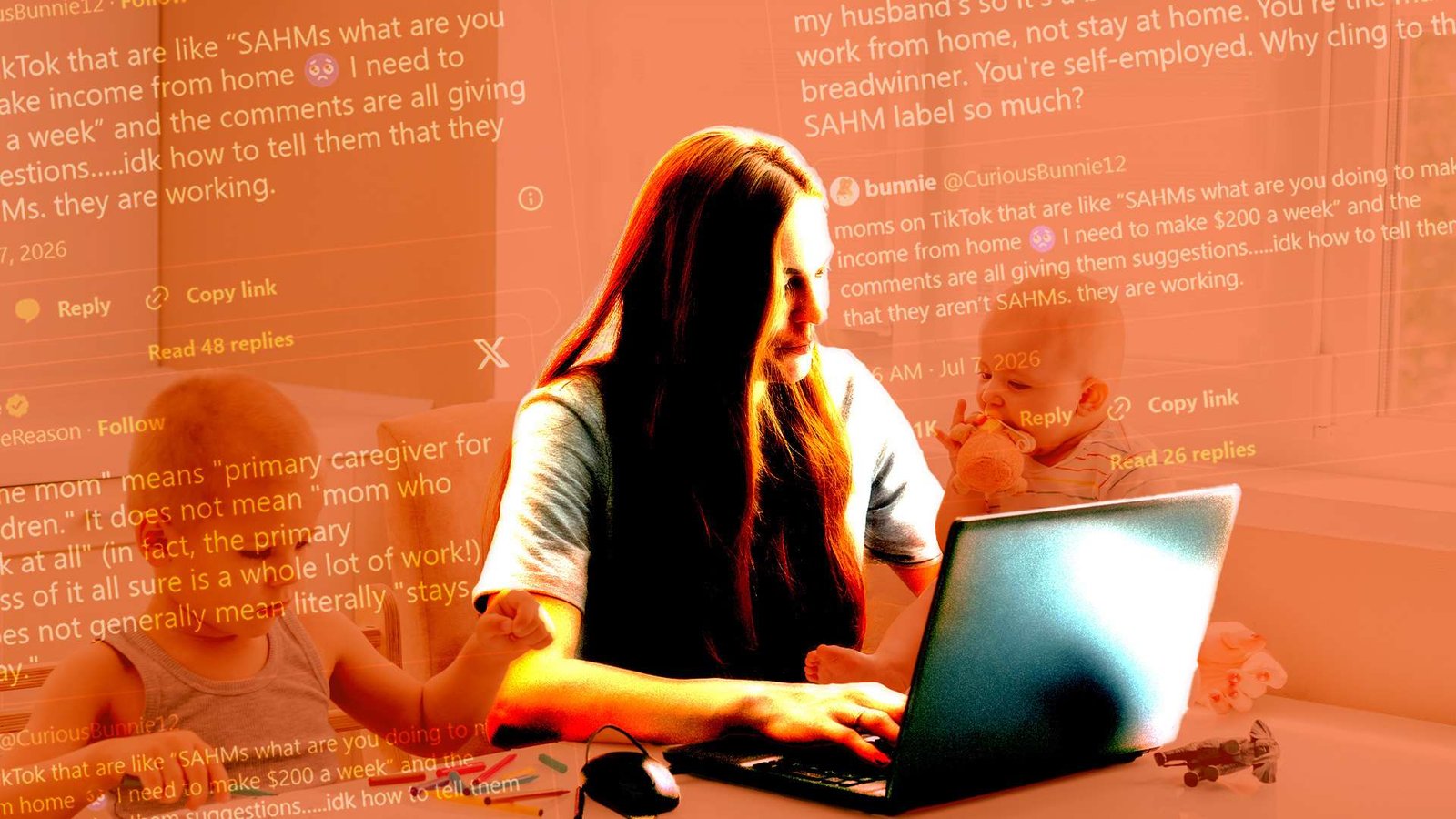
moms on TikTok that are like “SAHMs what are you doing to make income from home 🥺 I need to make $200 a week” and the comments are all giving them suggestions…..idk how to tell them that they aren’t SAHMs. they are working.
— bunnie (@CuriousBunnie12) July 7, 2026
An online creator I follow was like “yeah I’m a SAHM but I make an income from here and it’s more than my husband’s so it’s a bit different”. That’s called work from home, not stay at home. You’re the main breadwinner. You’re self-employed. Why cling to the SAHM label so much? https://t.co/LhcmNguuJH
— pasiem kone na betóne (@Sabrina45X) July 7, 2026
“Stay-at-home mom” means “primary caregiver for her own children.” It does not mean “mom who doesn’t work at all” (in fact, the primary caregiverness of it all sure is a whole lot of work!) just as it does not generally mean literally “stays at home all day.” https://t.co/3LhuOawD9x
— Liz Wolfe (@LizWolfeReason) July 9, 2026
Perhaps you’re thinking, Why should I, a reader of Roundup, care about any of this at all? There are a few reasons. One, at some point in the past, you probably benefited from the work of a stay-at-home mom or homemaker. A wife who fielded the domestic work and raised the kids, or maybe a mom who made sure your clothes were neatly pressed and that dinner was on the table by 5 p.m. each night, or maybe even a very 1970s mom who made you a latchkey kid, throwing some benign neglect your way that ended up helping you develop independence (and keeping the bills paid). Maybe the homemaker was you.
The Reason Roundup Newsletter by Liz Wolfe Liz and Reason help you make sense of the day’s news every morning.
Two, as an economic phenomenon, the fact that there are plenty of syncretic options available to women—serving as primary caregiver for the kids and doing some laptop-job work part-time on the side, or selling stuff on Etsy, or watching a neighbor’s kids in addition to her own—is an underdiscussed component of our labor market that we still don’t really know how to characterize (and that the Social Security Administration sure as hell doesn’t know what to do about). It’s also the type of person that socialists like New York Mayor Zohran Mamdani pretend doesn’t exist: Universal childcare solves problems (at a very high cost) for one segment of the working-parent population, but what about the many industrious mothers who actually want to have their children at home with them? Or those who also want to pursue other types of work simultaneously? (Mamdani could serve this population by loosening restrictions on home daycares, homeschooling co-ops, and the like, but he doesn’t seem to want to serve this constituency.)
Part of the reason policymakers don’t seem to know what to do is because this type of person has long existed but is often denigrated. “No woman gets an orgasm from shining the kitchen floor,” wrote Betty Friedan in The Feminine Mystique (1963), proving she’s never met a true homemaker. Friedan continued:
“Millions of women lived their lives in the image of those pretty pictures of the American suburban housewife, kissing their husbands goodbye in front of the picture window, depositing their stationwagonsful of children at school, and smiling as they ran the new electric waxer over the spotless kitchen floor. They baked their own bread, sewed their own and their children’s clothes, kept their new washing machines and dryers running all day. They changed the sheets on the beds twice a week instead of once, took the rug-hooking class in adult education, and pitied their poor frustrated mothers, who had dreamed of having a career. Their only dream was to be perfect wives and mothers; their highest ambition to have five children and a beautiful house, their only fight to get and keep their husbands. They had no thought for the unfeminine problems of the world outside the home; they wanted the men to make the major decisions.”
It’s possible the women Friedan was writing about truly had “no thought for the unfeminine problems of the world outside the home,” but I doubt it. She’s portraying women as vapid and unconcerned, not legitimate contributors to the household that powers, and could even be considered part of, the economy. Friedan goes on to describe, at length, “the problem that has no name”—comparing the home to a “comfortable concentration camp.” What she describes sounds an awful lot like depression, which she attributes to the domestic realm these women have been seemingly forced to inhabit. “We can no longer ignore that voice within women that says: ‘I want something more than my husband and my children and my home,'” Friedan writes. And indeed, we didn’t. Women’s liberation followed, along with the flourishing of choice that allowed many women who would have otherwise succumbed to a lifetime of ennui the option to lead meaningful, important careers. But somewhere along the way, Friedanism got mighty powerful, such that smart, educated women began to believe that domestic life shouldn’t even be on the menu of options before them.
“The cultural messaging seemed to me that I would waste my potential by not doing something professionally,” says my friend Meredith Thornburgh, mother of two and a historian of the domestic economy who studies “technological change in the modern home,” as well as our “thinking about the economy and what counts as work.”
Many such cases.
Now, our thinking about domestic work frequently falls into meme form: Should girls grow up to become girlbosses or tradwives? (Ill-defined terms that don’t encompass the majority.) The truth is less memed, less likely to go viral, and more serious: many women desire careers they can ratchet up and down to accommodate the years of childrearing; work that allows for time spent with children and time spent away (mentally away, if not physically away); to be meaningful contributors to their household budgets either by removing childcare as a line-item or by adding income, or possibly both. The more we embrace these realities, the better we’ll be able to meet the economic moment and take seriously the cultural moment. (After all, The Two-Income Trap was kind of right, even if Sen. Elizabeth Warren (D–Mass.) is smoking crack when it comes to all the solutions.)
Scenes from New York: “The New York attorney general on Thursday sued several chemical and manufacturing giants, including 3M and DuPont, accusing them of continuing to expose consumers to products containing chemicals linked to health problems and environmental damage, long after the companies knew of their danger,” reports The New York Times.
QUICK HITS
- Inside the fight between evolutionary psychologist Peter Gray and Jonathan Haidt over whether phones and social media are to blame for the adolescent mental health crisis. One thing I’m wondering about: Teen-suicide rates fell by 40 percent from 1990 to 2010—a time when teens were undoubtedly using the internet. Gray seems to believe this is helpful for his hypothesis. But isn’t this exactly like other forms of screen time discourse, where the specific mode and medium matter an awful lot? Internet users growing up during that time were using desktop computers and laptops to browse message boards and Wikipedia, use AOL instant messenger and Tumblr, and listen to Napster and Spotify and YouTube. But that was undoubtedly before smartphones had become pervasive; before influencers had optimized every inch of YouTube to serve their ends; before short-term video was king; before infinite-scroll social media ruled the day. Is it possible we’re just talking about two very different internets? I think about this a lot in the realm of 3-year-olds: watching Fiddler on the Roof with my son in the family room on a rainy day is undoubtedly a very different experience than giving him Cocomelon heroin on a personal iPad when we’re out at dinner—not just in terms of the inherent qualities of the media (rate at which screen changes; complexity of plot and characters) but also in terms of what the child ends up missing out on. The same could be true about the internet and could explain some of the Gray-Haidt disagreement.
- Very true:
People in NYC used to say that Trump was “a poor person’s idea of a rich person”–which was supposed to be a dunk and actually described his political appeal. Dems trying to tap that same populist energy instead selected a rich person’s idea of a poor person. https://t.co/ihlW9oAiyh
— Megan McArdle (@asymmetricinfo) July 8, 2026
Read the full article here
Fact Checker
Verify the accuracy of this article using AI-powered analysis and real-time sources.