

 Freedom Index
Listen to the article
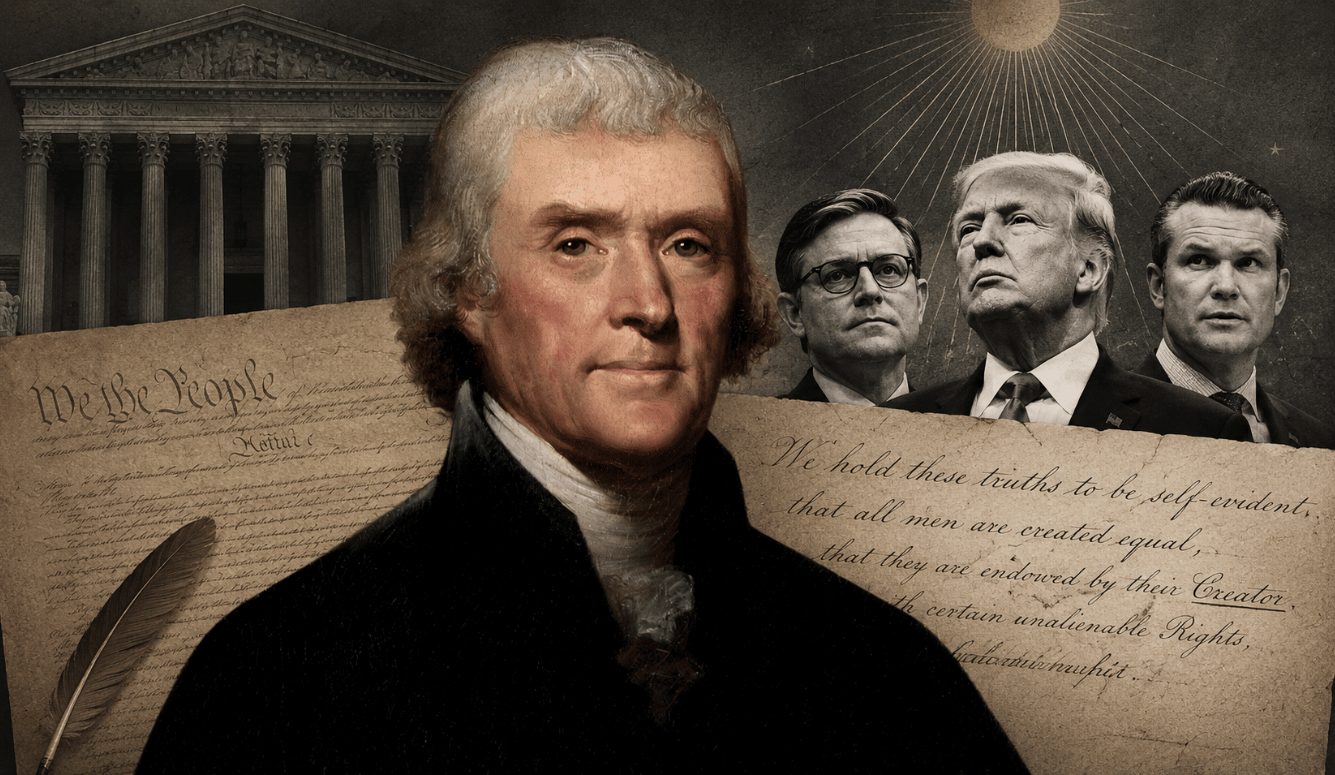
Anticipating the 250th anniversary of America’s Declaration of Independence, speaker of the House of Representatives Mike Johnson recalled: “We boldly proclaimed the self-evident truth that our rights do not come from government, they come from God Himself.” In 2018, President Trump likewise declared: “Our rights are not given to us by man; our rights come from our Creator.” And defence secretary Pete Hegseth recently stated: “Today we gather to recognize that our rights here in this great country come from a loving and benevolent God, not government.”
But the US Constitution—the repository of those rights—makes no mention of God. Its authority derives from “We the people.” God’s absence was a considered and deliberate omission, not an oversight. Luther Martin, a delegate to the original Constitutional Convention, reported that those who regarded the United States as a “Christian country” were an “unfashionable” minority who did not prevail against the “great majority”:
The part of the system which provides, that no religious test shall ever be required as a qualification to any office or public trust under the United States, was adopted by a great majority of the convention, and without much debate; however, there were some members so unfashionable as to think, that a belief of the existence of a Deity, and of a state of future rewards and punishments would be some security for the good conduct of our rulers, and that, in a Christian country, it would be at least decent to hold out some distinction between the professors of Christianity and downright infidelity or paganism.
Since God does not appear in the Constitution, people like Johnson and Hegseth tend to point to the Declaration of Independence, which famously stipulates: “We hold these truths to be self-evident, that all men are created equal, that they are endowed by their Creator with certain unalienable Rights, that among these are Life, Liberty and the pursuit of Happiness.” This text, they claim, established the United States as a nation “under God.” (Lincoln, by the way, may well not have used those words at Gettysburg. They do not appear in either the Nicolay copy of the speech, from which he read, or the Hay copy, which he wrote shortly afterwards as a record. Given that they disrupt the rhythm of “that this nation shall have a new birth of freedom,” it could be that these two words were a third-party interpolation, most likely by the AP reporter whose version was widely disseminated.)
The Declaration of Independence was largely written by Thomas Jefferson, who then took it to a five-person committee charged by the Continental Congress with writing it. Several amendments were made, some of which were attributed to John Adams and Benjamin Franklin, and some of which Jefferson protested. To understand the intent of the Declaration, at least in the mind of its primary author, recall that Jefferson was a deist rather than a Christian. As such, he regarded “God” as a remote and largely unknowable entity that did not intervene in human affairs. Indeed, he advised his young nephew Peter Carr to “Question with boldness even the existence of God; because, if there be one, he must more approve of the homage of reason, than that of blindfolded fear.”
Read the full article here
Fact Checker
Verify the accuracy of this article using AI-powered analysis and real-time sources.