Close Menu
FSNN | Free Speech News NetworkFSNN | Free Speech News Network
  • Home
  • News
    • Politics
    • Legal & Courts
    • Tech & Big Tech
    • Campus & Education
    • Media & Culture
    • Global Free Speech
  • Opinions
    • Debates
  • Video/Live
  • Community
  • Freedom Index
  • About
    • Mission
    • Contact
    • Support
Trending

Analysts split on whether Bitcoin's surge past key levels signals a new bull run

8 minutes ago

Review: A Novel Capturing the Cruelty of Mass Incarceration

49 minutes ago

Bitcoin tops $77,000 as best week since 2023 pulls altcoins along for the ride

1 hour ago
Facebook X (Twitter) Instagram
Facebook X (Twitter) Discord Telegram
FSNN | Free Speech News NetworkFSNN | Free Speech News Network
Market Data Newsletter
Friday, August 21
  • Home
  • News
    • Politics
    • Legal & Courts
    • Tech & Big Tech
    • Campus & Education
    • Media & Culture
    • Global Free Speech
  • Opinions
    • Debates
  • Video/Live
  • Community
  • Freedom Index
  • About
    • Mission
    • Contact
    • Support
FSNN | Free Speech News NetworkFSNN | Free Speech News Network
Home»News»Media & Culture»Thomas Paine: The Founding Father Worth Celebrating
Media & Culture

Thomas Paine: The Founding Father Worth Celebrating

News RoomBy News Room2 months agoNo Comments6 Mins Read4 Views
Share Facebook Twitter Pinterest Copy Link LinkedIn Tumblr Email VKontakte Telegram
Thomas Paine: The Founding Father Worth Celebrating
Share
Facebook Twitter Pinterest Email Copy Link

Listen to the article

0:00
0:00

Key Takeaways

Playback Speed

Select a Voice

On June 8, 1809, 72-year-old Thomas Paine took his last breath inside a small house in Greenwich Village. The next day the best-selling author and revolutionary’s body was loaded onto a cart and taken to his farm in New Rochelle, about 22 miles north of New York City, for burial. There was no procession, no national moment of silence, no celebration of a life fully lived. 

A small group attended his funeral, including his caretaker, Marguerite Bonneville, a friend from his many years in Revolutionary France, and her son, Benjamin. As the dirt hit the mahogany coffin, Bonneville exclaimed, “Oh! Mr. Paine! My son stands here as testimony of the gratitude of America, and I, for France!”

By the time of his death, there was little gratitude for Paine’s contributions to the United States outside of workingmen’s associations because of his blistering attacks on revealed religion, particularly Christianity. But as America barrels toward its semiquincentennial, Thomas Paine emerges as the Founding Father Americans can celebrate without regret. Unlike his contemporaries, Paine’s radical liberalism feels strikingly modern—pro-democracy, pro-market, anti-poverty, and antislavery—and worth defending as the forces of reaction mount here at home and abroad. Without the pen of Paine, in fact, there might not be a United States to celebrate today. 

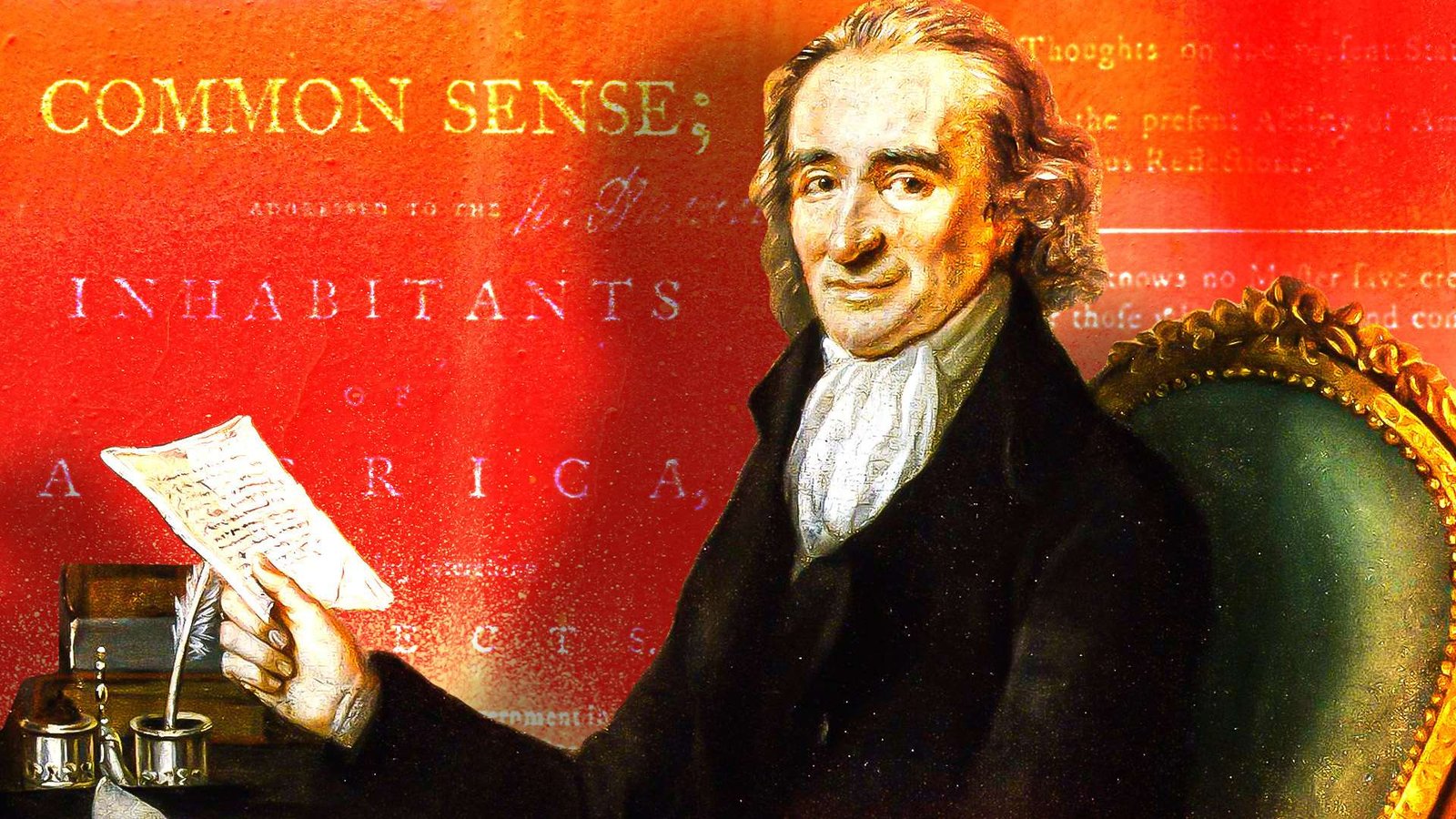
In January 1776, Paine’s Common Sense hit the streets of Philadelphia like a cannonball. The 47-page pamphlet was an immediate sensation. Not only did Paine reject reconciliation with Great Britain and call for independence, he attacked hereditary monarchy and aristocracy as millstones around humanity’s neck. What made the text dangerous was that Paine didn’t write it for polite society. With wit and verve, he wrote it for the masses in language any farmer or artisan could understand. But Paine went further. He had the temerity to tell common people that they weren’t mules to be driven into the mud by their so-called betters. Instead, they had the right and ability to rule themselves with dignity, the divine right of kings be damned.

Paine’s democratic beliefs terrified the more elitist and conservative Founding Fathers, most notably his decades-long nemesis, John Adams. While Adams conceded that without Paine “the sword of Washington would have been wielded in vain,” he feared Paine’s egalitarian ethos would unleash anarchy into the nascent republic. Paine’s forceful argument for universal male suffrage without a property qualification petrified Adams. (Though he had a friendship with the founding feminist Mary Wollstonecraft during his time in England and revolutionary France, Paine doesn’t seem to have commented on women’s voting rights.) 

A few short months after the Declaration of Independence in September 1776, Pennsylvania made good on Paine’s democratic promise. The state’s constitutional convention—presided over by Benjamin Franklin, Paine’s friend and benefactor—codified popular democracy into the state constitution while protecting civil liberties such as free speech and the right to bear arms for self-defense. In response, the embattled nation’s working people celebrated him while the colonial elite cursed him for unleashing the unforgivable conceit: equality by birth.

Paine, however, couldn’t be typecast as a typical progressive today. As the Democratic Party flirts with socialism and Donald Trump’s MAGA movement champions tariffs, Paine’s bourgeois radicalism stands firm: Markets and private property are the best ways to combat poverty. He anticipated that great wealth could be “capable of good” and rebelled against the simplistic notion that entrepreneurs and business owners were evil. “I care not how affluent some may be,” he wrote in Agrarian Justice, “provided that none be miserable in consequence of it.” In The American Crisis, Paine insisted that trade “flourishes best when it is free, and it is weak policy to attempt to fetter it,” understanding that prosperity flowed from the free trade in goods and services between individuals and nations. 

Paine, however, wasn’t an apologist for the rich or inequality. Instead, he earned the admiration of working people. Not only because he was one of them, but because he fought for them wholeheartedly. Enraged by the privilege and feudalism of the Old World and any scheme to plant such poison in American soil, Paine laid out an early proposal for social insurance to provide public education for poor children, maternity benefits for new mothers, and pensions for the infirm and elderly. But Paine didn’t see his proposal as welfare. He saw it as every individual’s natural inheritance from common land being cultivated and taken out of common use. “It is not a charity but a right,” he wrote, “that I am pleading for.” Paine thought his plan would undercut the rampant inequality and dependency that corrupted the Old World.

Unlike many in the Founding generation, Paine detested slavery. When he arrived in Philadelphia in 1774, his quarters sat next to a slave market. What he called “the infernal trafic (sic)” horrified him. Later in life he would write a sentence that connected his hatred of subjugation to his celebration of democracy and individual rights: “Man has no property in man, neither has one generation a property in the generations that are to follow.” 

About seven months before his death, Paine even hurled his abolitionist views in the face of former president Thomas Jefferson, according to textual analysis by the historians behind Thomas Paine: Collected Writings, published this week by Princeton University Press. In what was considered a letter of unknown authorship to Jefferson from November 1808, Paine chastised the former president and slaveholder, reminding Jefferson of the Declaration’s language he penned. “We hold these truths self-evident; that all men, (not all white men) are created equal,” he wrote. Then he came in for the kill, telling Jefferson that if slavery was so entrenched in America then that meant it was “high time for America to give up all pretentions [sic] to liberty & freedom.” Paine’s antislavery credentials shouldn’t need defending today, but they take on new salience when the U.S. government rewrites American history to sand down slavery’s wickedness.

This year, more than ever, there is an impulse to engage in hagiography when discussing the Founding generation. Paine was far from perfect, but when it comes to the questions that matter most today, he’s the Founding Father to cast our lot with. He reminds us of America’s true covenant: the right of every person to live without a master.

Read the full article here

Fact Checker

Verify the accuracy of this article using AI-powered analysis and real-time sources.

Get Your Fact Check Report

Enter your email to receive detailed fact-checking analysis

5 free reports remaining

Continue with Full Access

You've used your 5 free reports. Sign up for unlimited access!

Already have an account? Sign in here

#CivicEngagement #Democracy #MediaAccountability #MediaBias #PublicOpinion
Share. Facebook Twitter Pinterest LinkedIn Tumblr Email Telegram Copy Link
News Room
  • Website
  • Facebook
  • X (Twitter)
  • Instagram
  • LinkedIn

The FSNN News Room is the voice of our in-house journalists, editors, and researchers. We deliver timely, unbiased reporting at the crossroads of finance, cryptocurrency, and global politics, providing clear, fact-driven analysis free from agendas.

Related Articles

Media & Culture

Review: A Novel Capturing the Cruelty of Mass Incarceration

49 minutes ago
Cryptocurrency & Free Speech Finance

Binance Opens the Door to AI Agents That Can Trade Crypto for You

1 hour ago
Media & Culture

Brickbat: Paying More for Less

3 hours ago
Media & Culture

A Wealth Tax Built on Billionaires Who Aren’t Really Billionaires

5 hours ago
Media & Culture

Tenn. S. Ct. Lets Stand Decision That Copyright Law Doesn’t Bar Release of Covenant Shooter Manifesto

6 hours ago
Media & Culture

Justice Department Finds ‘Unbroken Pattern’ of Sexual Abuse in Two California Women’s Prisons

7 hours ago
Add A Comment

Comments are closed.

Editors Picks

Review: A Novel Capturing the Cruelty of Mass Incarceration

49 minutes ago

Bitcoin tops $77,000 as best week since 2023 pulls altcoins along for the ride

1 hour ago

Coldcard Security Upgrade Strengthens Seed Phrase Generation

1 hour ago

Binance Opens the Door to AI Agents That Can Trade Crypto for You

1 hour ago
Latest Posts

CPJ joins call to extend UN fact-finding mission on Sudan

2 hours ago

Reporting in Somalia is becoming a much more dangerous proposition. Photo: UNSomalia/Ilyas Ahmed “Do you know that we can kill you? To us, your life is worth less than a cigarette.” These are the words with which operatives from Somalia’s National Intelligence and Security Agency (NISA) threatened freelance journalist Mohamed Bulbul, days after he co-authored a news report for UK news outlet The Guardian about the prosecution of activist Sadia Moalim Ali. Two days after the article ran in June 2026, Bulbul was having dinner with two fellow journalists at a restaurant in Mogadishu’s Zoobe area when armed men wearing black masks entered the establishment. “They walked straight towards our table [shouting] ‘Stand up! Stand up!’” Bulbul told Index. The masked men beat all three journalists before they dragged him outside, placed a bag over his head and forced him into a vehicle.  After being moved between two police stations and the offices of the regional police commissioner, Bulbul was interrogated by NISA officers about the article. “They asked me why I had published it.” He was then, he said, given three choices: “Work with us and take money, leave the country, or if you refuse both, we will kill you.” Bulbul fled Somalia and is now in an undisclosed safe location. “Saving my own life become my priority,” he said. “I can no longer spend time with my parents or my children.” Bulbul’s experience is not unique. Across Somalia, journalists and press freedom advocates say that intelligence and security agencies are intimidating, detaining and otherwise silencing reporters. Recent cases in Mogadishu and Puntland state indicate the state’s growing reliance on intelligence agencies and extra-legal actions, rather than the police and the courts, to deal with critical journalism. On 2 July, journalist Suways Jama Mohamed was arrested outside her home in Garowe, Puntland. Suways, founder of Suways Media, a Facebook-based news platform covering social issues, was detained after the platform published a 15-second video showing armed militia operating in her neighbourhood. She was held in Puntland’s Garowe Central Prison for 13 days before being released on bail on 15 July. Mohamed has been charged with spreading false information, defamation, insulting public officials and disturbing public order. If convicted, she could face up to three years in prison. Qareen Abdiweli, Suways’ lawyer, has challenged both the legal basis of the charges and the court’s jurisdiction. “A journalist cannot be prosecuted under the Penal Code for acts related to the exercise of their profession,” Abdiweli told RSF. Suways’ defence team have filed a motion asking for the case be referred to the Puntland Media Council, the media regulatory body. The case is pending. Less than two weeks after Suways’ arrest, Mohamed Jama Mohamad, an independent journalist who had previously worked for private television channel SBC TV, was also detained in Puntland state. Mohamed had been reporting on business closures in the city of Bosaso, following an increase in port taxes. Mohamed was taking photographs of the closed market when he noticed several men following him. “They looked suspicious and kept talking on their phones while following me everywhere I went.” Moments later, a vehicle pulled to a halt beside him. “[The people in the vehicle] weren’t police officers,” Mohamed told Source. “Their uniform [sic] looked more like military uniforms.”  Mohamed was forced into the vehicle without explanation, blindfolded and then taken to a detention facility run by the Puntland Intelligence Service (PISA). Mohamed said that he was held for four days without seeing a lawyer or being arraigned before a court.  “I had simply been taken from the marketplace. No warrant. No judge. No lawyer.” According to the Somali Journalists Syndicate (SJS), these arrests are indicative of the government’s wish to suppress free expression. In June, SJS reported the abduction by NISA agents of journalist Mascuud Warsame, founder of Xogbile TV, in Mogadishu. Warsame was released, without charge, after 39 days in detention. For media organisations, these incidents are becoming increasingly familiar. “Compared with previous years, the overall pattern of violations remains consistent,” Abdalle Ahmed Mumin, Secretary General of the Somali Journalists Syndicate, told Index. “But this year has seen a sharp increase in arbitrary arrests [and] politically motivated detentions, particularly during the ongoing political and constitutional crisis in Somalia.” Somalia’s federal government is currently advancing amendments to the country’s constitution despite objections from two federal states. This may have implications for the balance of power between the federal states, and critics fear that it will allow incumbent president Hassan Sheikh Mohamud to extend his current term of office. Mumin said that while journalists in Somalia have long been obliged to deal with intimidation and violence, the first seven months of 2026 have seen a spike in the use of prolonged detention without charge, alongside more overt interventions by Somalia’s intelligence agencies. Security analyst Samira Gaid told Index that Somalia’s security institutions are increasingly being used as a tool to suppress journalism, activists and anyone courageous enough to challenge the government.  “The role of the media is to hold those in public office accountable,” she said.  “Yet journalists are being targeted simply because they reported information that the government did not want the public to know.” International partners, according to Gaid, invested heavily in building Somalia’s security institutions – a key priority following the end of the country’s destructive civil war. “Those institutions are now being used in ways that go beyond the law.”  Gaid said, noting that NISA was created to protect national security rather than investigate journalists or detain civilians engaged in legitimate reporting. The journalists interviewed for this article all described strikingly similar experiences – arrests without warrants, detention by intelligence agencies, questioning over their reporting. For Somalia’s independent media, the message is becoming increasingly clear; reporting on anything deemed sensitive by the authorities may carry consequences extending far beyond the newsroom. READ MORE

2 hours ago

Treasury's latest measure isn't QE or YCC. Still, bitcoin is skyrocketing. Here's why.

2 hours ago

Subscribe to News

Get the latest news and updates directly to your inbox.

At FSNN – Free Speech News Network, we deliver unfiltered reporting and in-depth analysis on the stories that matter most. From breaking headlines to global perspectives, our mission is to keep you informed, empowered, and connected.

FSNN.net is owned and operated by GlobalBoost Media
, an independent media organization dedicated to advancing transparency, free expression, and factual journalism across the digital landscape.

Facebook X (Twitter) Discord Telegram
Latest News

Analysts split on whether Bitcoin's surge past key levels signals a new bull run

8 minutes ago

Review: A Novel Capturing the Cruelty of Mass Incarceration

49 minutes ago

Bitcoin tops $77,000 as best week since 2023 pulls altcoins along for the ride

1 hour ago

Subscribe to Updates

Get the latest news and updates directly to your inbox.

© 2026 GlobalBoost Media. All Rights Reserved.
  • Privacy Policy
  • Terms of Service
  • Our Authors
  • Contact

Type above and press Enter to search. Press Esc to cancel.

🍪

Cookies

We and our selected partners wish to use cookies to collect information about you for functional purposes and statistical marketing. You may not give us your consent for certain purposes by selecting an option and you can withdraw your consent at any time via the cookie icon.

Cookie Preferences

Manage Cookies

Cookies are small text that can be used by websites to make the user experience more efficient. The law states that we may store cookies on your device if they are strictly necessary for the operation of this site. For all other types of cookies, we need your permission. This site uses various types of cookies. Some cookies are placed by third party services that appear on our pages.

Your permission applies to the following domains:

  • https://fsnn.net
Necessary
Necessary cookies help make a website usable by enabling basic functions like page navigation and access to secure areas of the website. The website cannot function properly without these cookies.
Statistic
Statistic cookies help website owners to understand how visitors interact with websites by collecting and reporting information anonymously.
Preferences
Preference cookies enable a website to remember information that changes the way the website behaves or looks, like your preferred language or the region that you are in.
Marketing
Marketing cookies are used to track visitors across websites. The intention is to display ads that are relevant and engaging for the individual user and thereby more valuable for publishers and third party advertisers.