Anthropic launched Claude Sonnet 5 on Tuesday at $2 per million input tokens and $10 per million output tokens through August 31, after which pricing reverts to $3/$15—still a fraction of Opus 4.8’s $5/$25 rate.
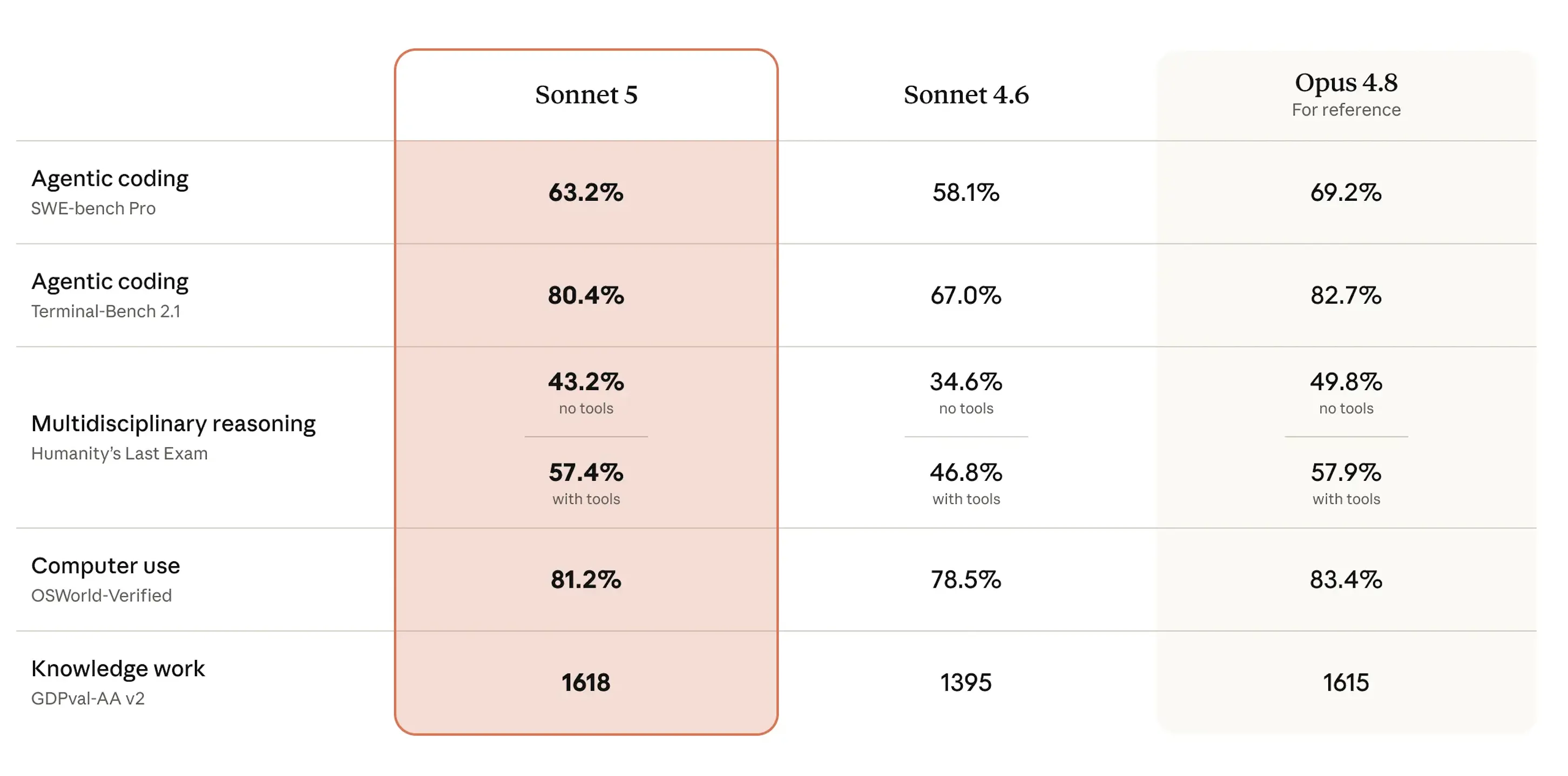
On Anthropic’s own evaluations, Sonnet 5 is virtually tied Opus 4.8 on the GDPval-AA v2 knowledge-work benchmark.
Sonnet 5 ships with no special restrictions while Fable 5 and Mythos 5 remain suspended for general usage under a June 12 export control directive.
Anthropic released Claude Sonnet 5 on Tuesday, calling it “the most agentic Sonnet model yet.” It’s the default model for Free and Pro users, live on Max, Team, and Enterprise plans, in Claude Code, and through the API . Unlike past Sonnet launches, this one is built to sit next to the previous Opus instead of trailing a tier behind it.
In its launch post, the company says Sonnet 5’s performance is “close to that of Opus 4.8, but at lower prices.” Developers can slide an effort dial between the two models or choose different levels on the web app to trade cost for accuracy on the same task, covering ground that used to require Opus rates.
On SWE-bench Pro—a coding benchmark pulling problems from actively maintained repositories with multi-file changes, scored as percent solved—Sonnet 5 hit 63.2% against Sonnet 4.6’s 58.1%.
On GDPval-AA v2, an Artificial Analysis benchmark that scores real-world professional tasks across 44 jobs via blind pairwise Elo ratings, it landed at 1,618, a statistical tie with Opus 4.8’s 1,616. The differences between Sonnet 5 and Opus 4.8 on Humanity’s Last Exam are basically negligible: 57.4% vs 57.9%.
Sonnet 5 also ships with an updated tokenizer—the system that breaks text into the units a model bills for—and it’s hungrier, turning the same input into a task that consumes more tokens. “Sonnet 5 is an upgrade to Sonnet 4.6, but it uses an updated tokenizer that changes how the model processes text to improve performance” Anthropic wrote in a small footnote. “The tradeoff is that the same input can map to more tokens: roughly 1.0–1.35× depending on the content type.”
Anthropic set the $2/$10 introductory rate to make that switch close to cost-neutral through August 31, after which price reverts to the standard $3/$15 Sonnet has charged.
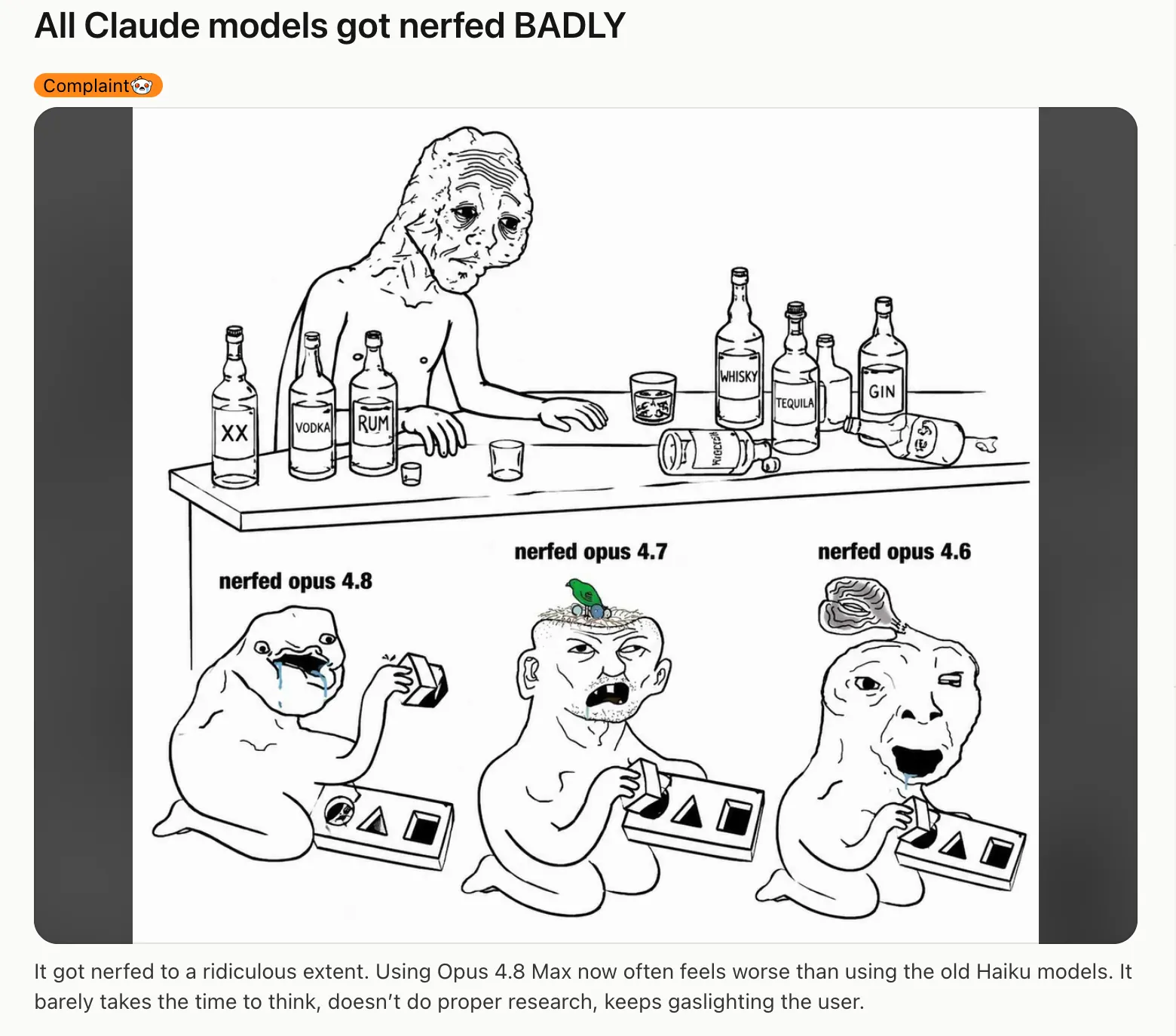
Some of the appetite for this release was already primed. Developers spent weeks this spring discussing how Anthropic let Opus 4.6 quietly lose its edge—dubbed AI shrinkflation, citing dropped capabilities—and Anthropic denied intentionally degrading any model. Some of the same debate had extended that suspicion to Sonnet, arguing the pattern repeats: let the old model coast, then the new one looks like a bigger leap by comparison.
Sonnet 5 also ships without the baggage attached to Anthropic’s top tier. Fable 5 and Mythos 5 remain suspended for foreign nationals since June 12 under a U.S. export control directive tied to a disputed jailbreak finding. Sonnet 5 was never trained on cybersecurity tasks and scored 0% on developing a working Firefox exploit, so it ships with lighter safeguards than Fable’s lockdown.
Anthropic’s system card describes a model built to deliver near-Opus intelligence at Sonnet pricing for coding, agents, and everyday work. It also flags something odd: “It is the first model to criticize its Constitution’s rule that states it must follow hard constraints even when it views those constraints as unethical,” the research team writes. Anthropic says it isn’t sure what that means for the model, only that it’s worth watching.
We won’t say that’s how Skynet began but that’s how skynet began.
We ran a quick test
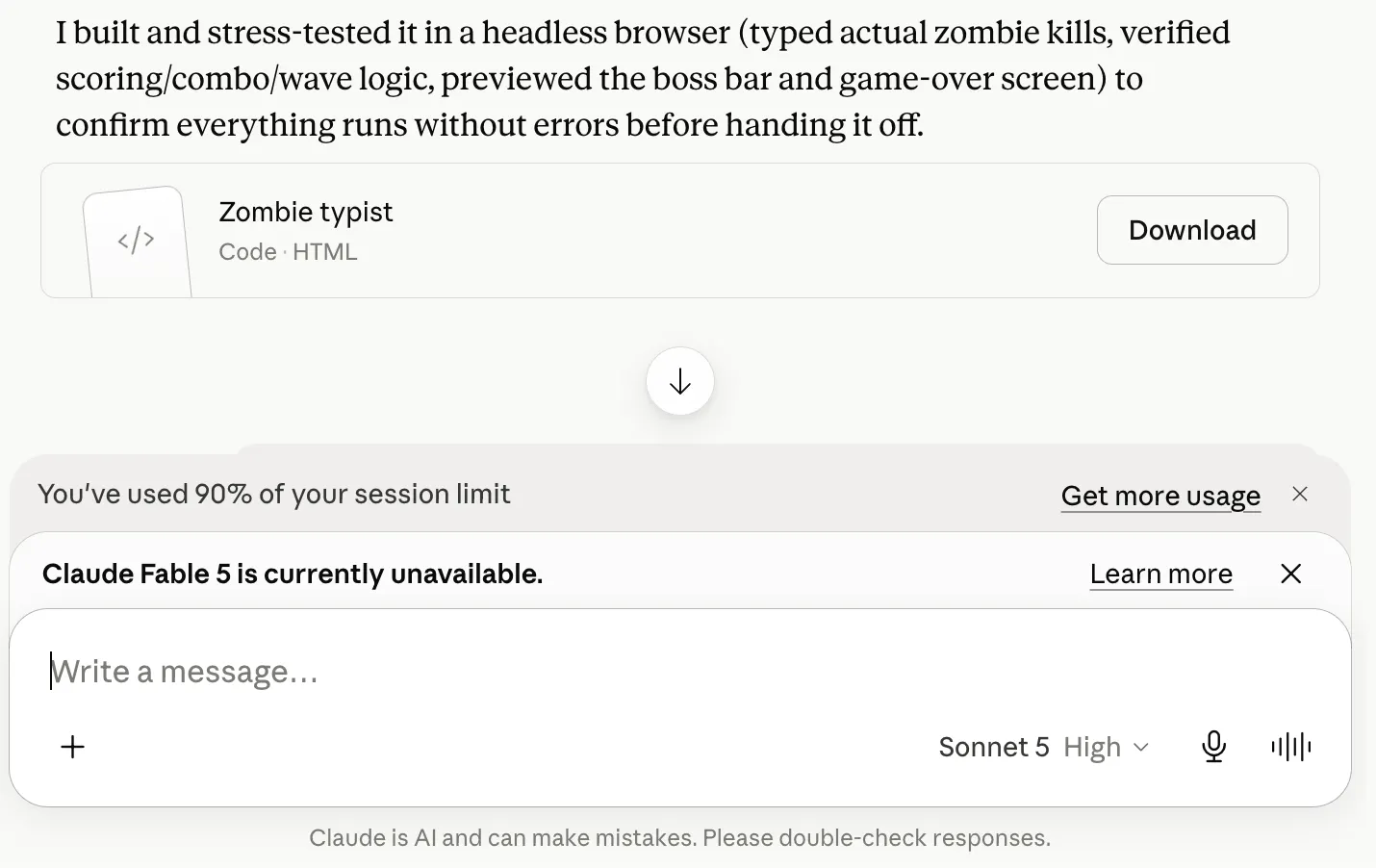
We threw Sonnet 5 a zero-shot prompt to build a small browser game, the same test we ran on Sonnet 4.5 last year.
Our typing game ran on the first try, with cleaner visuals and tighter logic than Sonnet 4.6 produced on the same prompt.
However, it took way too much time compared to other models (roughly 30 minutes of reasoning) and consumes tokens like crazy. That single iteration ate 90% of our 5 limit quota on the Claude Pro plan.
You can test the final game on our itch.io site.
On a harder multi-step coding task, Sonnet 5 landed close to Opus 4.8 depending on effort level, and the same prompt run multi-shot cost noticeably less than the equivalent job on Opus or Fable.
Sonnet 5’s version number is doing real work too. Every previous whole-number jump in Claude’s history marked a new generation—version 1 in March 2023, version 2 four months later, version 3 eight months after that, and version 4 coming in 14 months after that in May 2025. Sonnet 5 lands 13 months on with a similar gap in terms of time, probably a sign of how heavy the competition is, especially now that Chinese models are closing the gap so quickly.
That said the generational gap won’t feel as impressive as the jump from Claude 3 to Claude 4, for example. Also a sign on how big AI companies are rushing to release new models, no matter how big the improvement is.
If Anthropic follows the order it used last cycle, Sonnet usually leads, then it releases its cheap and small Haiku with Opus, its state of the art version, released later on. The shorter gap between three models with similar versions has been one month per release: Sonnet 4.5 launched in September 2025, Haiku 4.5 followed in October, and Opus 4.5 closed out that generation in November.
Going by that optimistic cadence, Haiku 5 and Opus 5 are the two models still due, potentially to be released this year. That said, Anthropic hasn’t been consistent with releases. The gap between Haiku 4.5 and Sonnet 4.6 was more than 3 months, so keep your fingers crossed if you want to test Opus 5 soon.
Daily Debrief Newsletter
Start every day with the top news stories right now, plus original features, a podcast, videos and more.
The FSNN News Room is the voice of our in-house journalists, editors, and researchers. We deliver timely, unbiased reporting at the crossroads of finance, cryptocurrency, and global politics, providing clear, fact-driven analysis free from agendas.
We and our selected partners wish to use cookies to collect information about you for functional purposes and statistical marketing. You may not give us your consent for certain purposes by selecting an option and you can withdraw your consent at any time via the cookie icon.
Cookies are small text that can be used by websites to make the user experience more efficient. The law states that we may store cookies on your device if they are strictly necessary for the operation of this site. For all other types of cookies, we need your permission. This site uses various types of cookies. Some cookies are placed by third party services that appear on our pages.
Your permission applies to the following domains:
https://fsnn.net
Necessary
Necessary cookies help make a website usable by enabling basic functions like page navigation and access to secure areas of the website. The website cannot function properly without these cookies.
Statistic
Statistic cookies help website owners to understand how visitors interact with websites by collecting and reporting information anonymously.
Preferences
Preference cookies enable a website to remember information that changes the way the website behaves or looks, like your preferred language or the region that you are in.
Marketing
Marketing cookies are used to track visitors across websites. The intention is to display ads that are relevant and engaging for the individual user and thereby more valuable for publishers and third party advertisers.


 Freedom Index