

 Freedom Index
Listen to the article
The Framers established a federal government consisting of three branches that were supposed to exercise distinct functions: legislative, executive, and judicial. But beginning in the late 19th century, Congress created dozens of “independent” agencies that exercise all three functions.
On Monday in Trump v. Slaughter, the Supreme Court addressed one puzzle posed by that situation: the purported independence of those agencies. But as Reason‘s Damon Root notes, that decision did not address the line-crossing authority of ostensibly executive agencies that also effectively make law and adjudicate cases. Instead, the Court concentrated those powers in the hands of the president—a development that should worry anyone concerned about executive overreach.
Fortunately, that is not the end of the matter. Even without congressional intervention, the Supreme Court can restrict the actions of presidentially controlled administrative agencies by enforcing the separation of powers. Potential tools include the nondelegation doctrine, the major questions doctrine, and statutory interpretation unconstrained by the deference that the Court repudiated in 2024. Agency actions also can be challenged under constitutional provisions guaranteeing due process and the right to trial by jury.
In Trump v. Slaughter, the Court answered a question that presidents of both major parties had been asking for more than a century: If agencies such as the Federal Trade Commission (FTC) are part of the executive branch, how can Congress, consistent with the separation of powers, restrict the president’s authority to remove the officials who run them? It can’t, the Supreme Court ruled, allowing President Donald Trump to fire FTC Commissioner Rebecca Slaughter without meeting the statutory requirement of citing “inefficiency, neglect of duty, or malfeasance in office.”
That decision applies broadly to agency leaders who were formerly protected by similar provisions. It overturns the Court’s 1935 ruling in Humphrey’s Executor v. United States, which rejected President Franklin Roosevelt’s attempt to fire an FTC commissioner on policy grounds. FTC commissioners are not “purely executive officers,” Justice George Sutherland said in that case. Rather, the FTC was a “nonpartisan” panel of “experts” with “predominantly quasi-judicial and quasi-legislative” functions that was meant to be “independent of executive authority.”
That take “was tethered to a highly circumscribed and almost fictional view of the FTC’s role,” Chief Justice John Roberts wrote for the majority in Trump v. Slaughter, noting the commission’s extensive law enforcement responsibilities. At the same time, Roberts highlighted the FTC’s mix of functions.
“Since its creation in 1914, the FTC has accumulated vast rulemaking, enforcement, and adjudicatory powers under more than 80 statutes,” Roberts noted. “Not only does it promulgate rules that carry the force of law, but it also enforces those rules against private parties, collecting civil penalties in the billions of dollars.”
The problem, as Roberts saw it: The FTC’s powers “do not belong to the President or his appointees alone; they instead belong to five Commissioners, each of whom serves for seven years and may be removed by the President only ‘for inefficiency, neglect of duty, or malfeasance in office.'” He concluded that “such protection from removal is contrary to the separation of powers enshrined in the Constitution.”
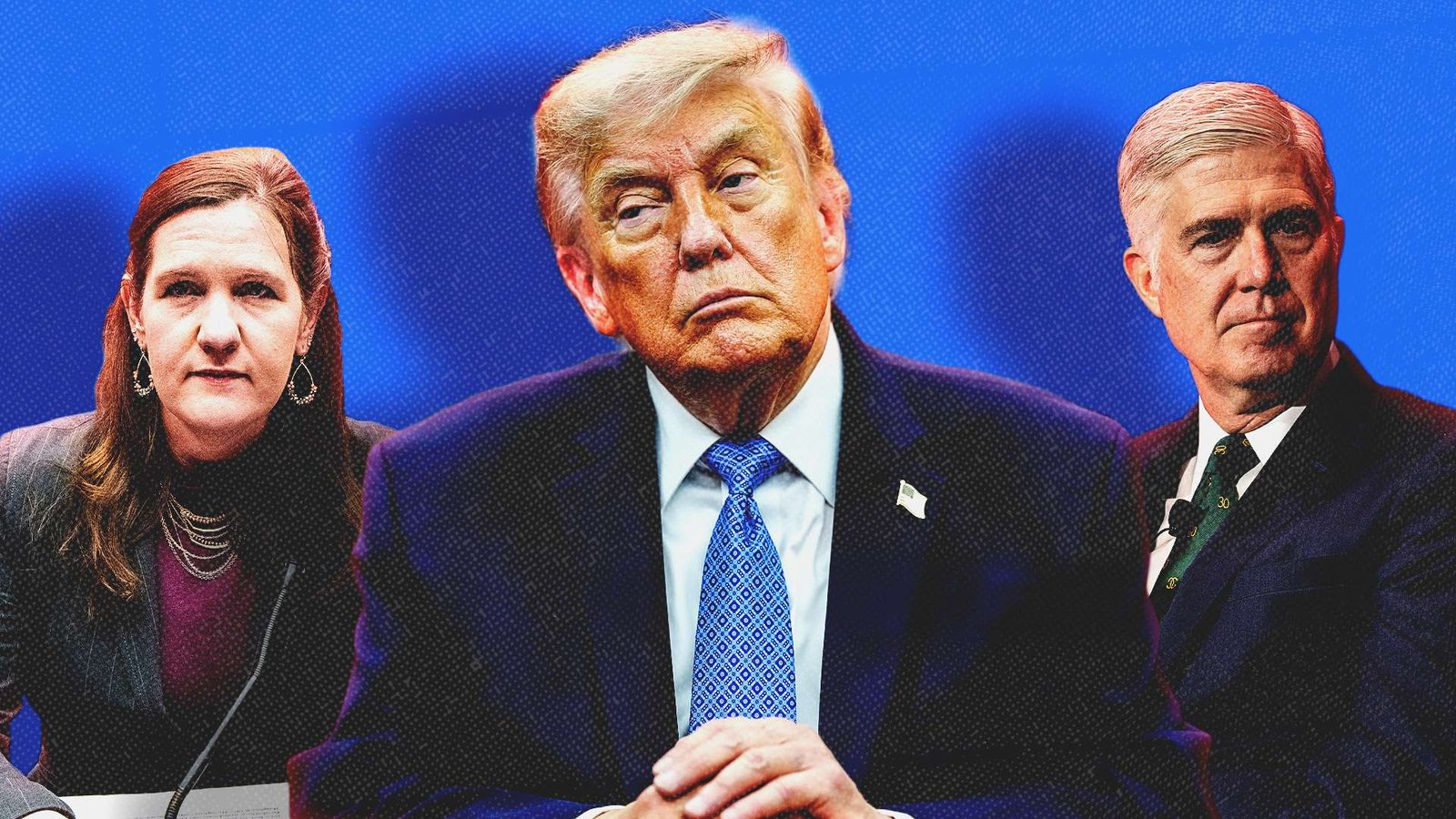
That is by no means the only way in which agencies like the FTC, given their “vast” rulemaking and adjudicatory authority, seem to violate the separation of powers. “Today, independent agencies do not just exercise executive law-enforcement powers,” Justice Neil Gorsuch noted in a concurring opinion. “Congress has also delegated to them vast legislative and judicial powers, effectively allowing these agencies to make laws and decide disputes under them. And, after today’s decision, the President can effectively exercise all those powers too.”
Although Gorsuch joined the majority opinion, he noted that “allowing so much legislative and judicial power to accumulate in the President’s hands invites real risks” and raises “important questions.” For instance: “Would Congress have delegated so much power, including legislative and judicial power, to independent agencies had it known that the President would come to control them? How will Congress respond now—if realistically it can? And what, if anything, will this Court do about it?”
The Supreme Court “already has many doctrines designed to protect the Constitution’s separation of powers,” Gorsuch noted. Under the nondelegation doctrine, for example, Congress may not surrender its lawmaking powers to another branch of government. Although it has been nearly a century since the Court last invoked that doctrine in striking down a federal statute, several recent decisions have relied on a related principle: the major questions doctrine, which says an agency must identify “clear” statutory authority for regulations of “vast ‘economic and political significance.'”
Even when an agency is not claiming powers that would trigger either of those doctrines, its actions must be lawful. Until recently, the Supreme Court’s ability to enforce statutory limits on federal agencies was hampered by the Chevron doctrine, which required deference to an agency’s “reasonable” interpretation of an “ambiguous” law. But the justices ditched that doctrine in the 2024 case Loper Bright Enterprises v. Raimondo, saying courts should instead be guided by “the best reading of the statute.”
Gorsuch noted that vagueness doctrine, which requires that laws define offenses with “sufficient definiteness that ordinary people can understand what conduct is prohibited and in a manner that does not encourage arbitrary and discriminatory enforcement,” also plays a role in constraining agency conduct. It is the job of Congress, “rather than the executive or judicial branch,” to make sure that standard is met, he noted, since it has the power to “define what conduct is sanctionable and what is not.”
Gorsuch added that “our doctrines addressing Article III, the Due Process Clause, and the Seventh Amendment can help ensure that adjudications of private rights take place where they belong, before independent judges and juries.” Article III defines the functions of the judicial branch, the Due Process Clause requires fair civil and criminal procedures, and the Seventh Amendment guarantees the right to trial by jury in civil cases.
The Supreme Court has “no shortage of tools,” Gorsuch wrote. “The only real question is whether we will use them.”
Left-leaning critics of the Supreme Court historically have frowned on some of these tools, viewing them as excuses for unjustified interference with the judgments of dispassionate experts. They may change their tune now that Trump has untrammeled authority over the agencies that Congress sought to shield from presidential control.
Since “removal protections are a thing of the past,” Gorsuch noted, “the President enjoys direct control over independent and executive agencies alike. So even if entrusting legislative and judicial powers to insulated, independent agencies once seemed a good idea to some, it’s simply not an option anymore. Now, we face only two ways forward: Let Presidents exercise all those powers or begin subjecting them to the Constitution’s constraints.”
Read the full article here
Fact Checker
Verify the accuracy of this article using AI-powered analysis and real-time sources.