

 Freedom Index
Listen to the article
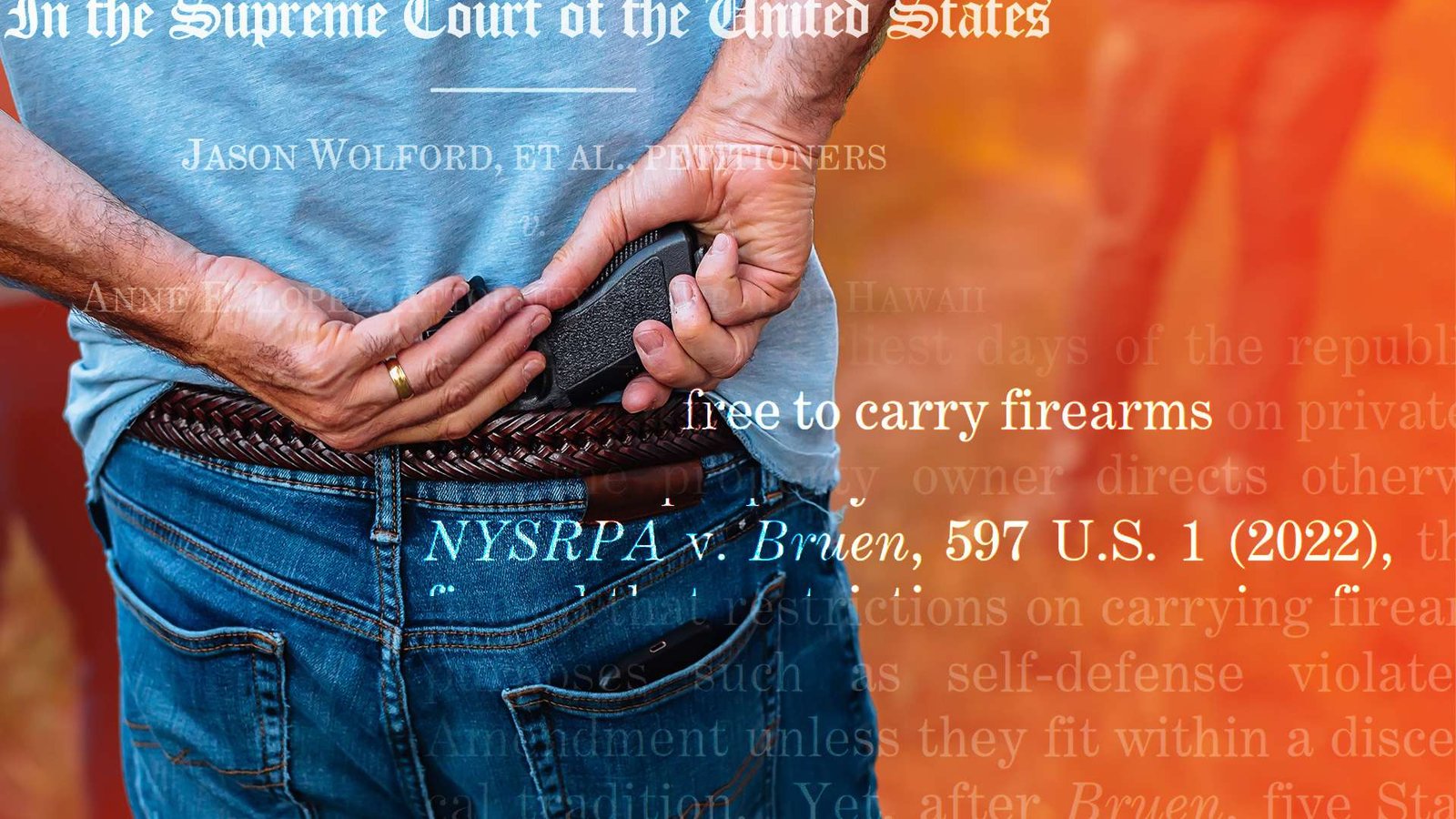
After the Supreme Court upheld the right to bear arms in the 2022 case New York State Rifle & Pistol Association v. Bruen, several states made it easier to obtain carry permits but much harder to use them. Even as they eliminated requirements that applicants demonstrate a “special need” to carry guns in public for self-defense, they banned firearms from long lists of “sensitive” locations. On Thursday, the Supreme Court rejected a variation on that theme: Hawaii’s default rule against guns on private property open to the public.
After a federal judge in Hawaii enjoined enforcement of that rule in 2023, the U.S. Court of Appeals for the 9th Circuit overturned her order, deeming the law consistent with the Second Amendment. Not so, the Supreme Court says in Wolford v. Lopez.
“This regime hobbles what the Second Amendment protects: the right of Americans to carry arms for self-defense as they go about their daily lives,” Justice Samuel Alito writes in the majority opinion, which was joined by Chief Justice John Roberts and Justices Clarence Thomas, Brett Kavanaugh, Neil Gorsuch, and Amy Coney Barrett. “We hold that the law is unconstitutional.”
For many years, Alito notes, Hawaii “made it almost impossible to obtain a license to carry a firearm.” After Bruen, the state “responded by replacing its old law on carry permits with new laws that achieved a similar result. On a large portion of the land
within the State’s boundaries, possession of a firearm is now flatly prohibited. And the law now before us severely burdens the ability to carry a firearm in much of the rest of
the State by prohibiting firearms on private property without the express and affirmative consent of the property owner.”
That law, Alito says, “departs sharply from the standard common-law rule on access to private property held open to the public. Under that rule, everyone, including those lawfully carrying firearms, may enter unless expressly prohibited from doing so. By contrast, under the new Hawaii law, no one carrying a firearm may enter without the property owner’s express authorization. The effect of this new rule is to impose severe restrictions on the daily activities of residents who have satisfied the State’s rigorous requirements for the issuance of a carry permit.”
Those restrictions make daily life difficult for people attempting to exercise the right recognized in Bruen. “When these permit holders leave home in the morning,” Alito notes, they not only must “take care to avoid all the territory where the possession of a gun is prohibited outright.” They also will find that they are “barred from entering many places that people routinely visit in the course of their daily routines, such as gas stations, convenience stores, restaurants, coffee shops, drug stores, grocery stores, ‘big box’ stores, home improvement stores, barber shops or hair salons, dry cleaners, and laundromats.”
Under Hawaii’s law, armed carry permit holders are allowed to enter such businesses only if the owner has posted “clear and conspicuous signage” allowing guns or granted “unambiguous written or verbal authorization.” But business owners may be reluctant to announce gun-friendly policies “for fear of alienating other customers,” Alito notes. Even if they are happy to welcome customers who are legally carrying concealed handguns, they “may only be willing to consent discreetly to the entry of permit holders who make the effort to inquire.” The requirement that gun carriers obtain such explicit permission before entering businesses vastly complicates their ability to engage in quotidian activities.
Under Bruen, Hawaii was required to justify that burden by showing that it is “consistent with this Nation’s historical tradition of firearm regulation.” Toward that end, the state cited 18th-century laws that barred people from carrying guns into “the improved or inclosed lands of any plantation” without the owner’s permission. But as Alito notes, those laws “principally targeted unauthorized hunting,” and “their coverage differed sharply from that of the Hawaii law now before us.”
The laws that Hawaii cited “applied to land where game could be found, not retail establishments that residents of cities and suburbs frequent as part of their daily routines,” Alito writes. “They had little if any impact on the Second Amendment’s central objective: protecting the fundamental right to self-defense. And their obvious aim was to prevent the distinctive harms and risks associated with unauthorized hunting.”
These purported analogs are not “relevantly similar” to Hawaii’s law, Alito says. Even if “it was accepted that prohibiting unauthorized hunting on private land was consistent with the Second Amendment right,” he says, it does not follow that “it is also consistent with that right to ban a person who is lawfully carrying a concealed handgun for self-defense from entering a gas station, coffee shop, grocery store, or other private property open to the public without express and unambiguous consent.”
Hawaii also cited an 1865 Louisiana statute that made it illegal to “carry fire-arms on the premises or plantations of any citizen, without the consent of the owner or proprietor, other than in lawful discharge of a civil or military order.” That law, Alito notes, was one example of the “Black Codes” that Southern states enacted between the Civil War and the beginning of Reconstruction, which aimed to “perpetuate the subjugation” of newly emancipated slaves. “The statute Hawaii cites was part of Louisiana’s Black Code,” Alito writes, and “it provided a tool for disarming blacks and thus leaving them defenseless against attacks.”
During oral argument in Wolford last January, Alito said it was “the height of irony to cite a law that was enacted for exactly the purpose of preventing someone from exercising the Second Amendment right” to illuminate “what the Second Amendment protects.” Gorsuch noted that Hawaii was relying “heavily” on the Louisiana law, which it claimed was enough evidence on its own to meet the Bruen test. He described that as “quite an astonishing claim,” expressing dismay that “a lot of people” who support gun control “like to cite the Black Codes,” which ordinarily would be like “garlic in front of a vampire” to them.
Leaving aside “this provision’s pedigree,” Alito writes, “it has no probative value for present purposes. As we have said, in considering the probative value of a historical analogue, we must consider whether it was widespread, well-known, and widely accepted. Because this statute was neither widespread nor widely accepted, it carries no weight.”
Even more implausibly, Hawaii claimed its own history of strict gun regulation should count as justification for the law at issue in Wolford. Contrary to that argument, “the Second Amendment has the same meaning in all parts of the United States,” Alito writes. “It cannot give way to ‘the spirit of Aloha’ in Hawaii, any more than it can yield to the spirit of the Big Apple…or the Windy City.” Those are references to New York’s severe restrictions on carrying handguns, which the Court overturned in Bruen, and the local handgun ban that it rejected in the 2010 case McDonald v. Chicago.
No matter what the Hawaii Supreme Court might think, the Second Amendment “applies in the same way to our 50th State (where about 8% of adults possess guns) and our 49th State (where the figure is roughly 59%),” Alito says. “Merely local attitudes can neither shrink nor inflate the meaning of fundamental Bill of Rights guarantees that apply to the States through the Fourteenth Amendment.”
Hawaii’s law “violates the constitutional right to keep and bear arms,” Alito concludes. “Therefore, the judgment of the Court of Appeals for the Ninth Circuit is reversed, and the case is remanded for further proceedings consistent with this opinion.”
In a concurring opinion, Barrett focuses on Hawaii’s claim that the case was about property rights rather than the Second Amendment. Here is how she summarizes that argument: “No one has the right to enter private property—let alone to bring firearms onto it—without the owner’s consent. Whether consent can be implied or must be express depends on local custom and property rules, which States have always had authority to modify. By requiring express consent, Hawaii has simply modified a default rule of property law. And because the [Second Amendment] did not require any particular default rule, Hawaii’s law does not even implicate the Second Amendment.”
Two of the dissenters, Justices Kentanji Brown Jackson and Sonia Sotomayor, found that argument persuasive. But as Barrett notes, it glosses over the significance of Hawaii’s law. “No one doubts that all property owners in Hawaii could bar the carry of arms on their respective premises, if they wanted to,” she writes. “But the Second Amendment does not apply to private parties. It does apply to the States. And when a State enacts a property law that regulates arms-bearing conduct, that law implicates the Second Amendment.”
Barrett notes the troubling implications of Hawaii’s logic: “What if a State made it a crime to wear religious head garb (say, a hijab) onto private property open to the public without obtaining express authorization? Could that statute evade constitutional scrutiny? On Hawaii and the principal dissent’s logic, the answer is apparently yes: No one has the right to enter another’s property without permission, and the State has merely adjusted the default to require permission to be clear. But that is plainly wrong. Because the law regulates religious and expressive conduct, its enactment is state action that triggers First Amendment scrutiny.”
The same goes for Hawaii’s law, Barrett says: “Property laws, no less than other laws, are subject to constitutional limits. So when a property law ‘restrict[s]’ the bearing of arms, the State must prove that the law abides by the limits of the Second Amendment.”
This decision means that similar rules adopted by California, Maryland, New Jersey, and New York are likewise unconstitutional. It also suggests that location-specific gun bans enacted by those states may be inconsistent with the Second Amendment when they cover a lot of territory.
“New York adopted [its] law first, and the governor of New York said the express reason they were doing that was to undermine the Bruen opinion,” Alan Beck, the lawyer representing the plaintiffs in Wolford, told the Supreme Court during oral argument. California’s governor likewise presented that state’s new gun restrictions as a response to the Supreme Court’s “very bad ruling.” Given such statements, Beck said, “there’s a clear body of evidence here that this was done to undermine Bruen and to undermine the Second Amendment right.”
Read the full article here
Fact Checker
Verify the accuracy of this article using AI-powered analysis and real-time sources.