

 Freedom Index
Listen to the article
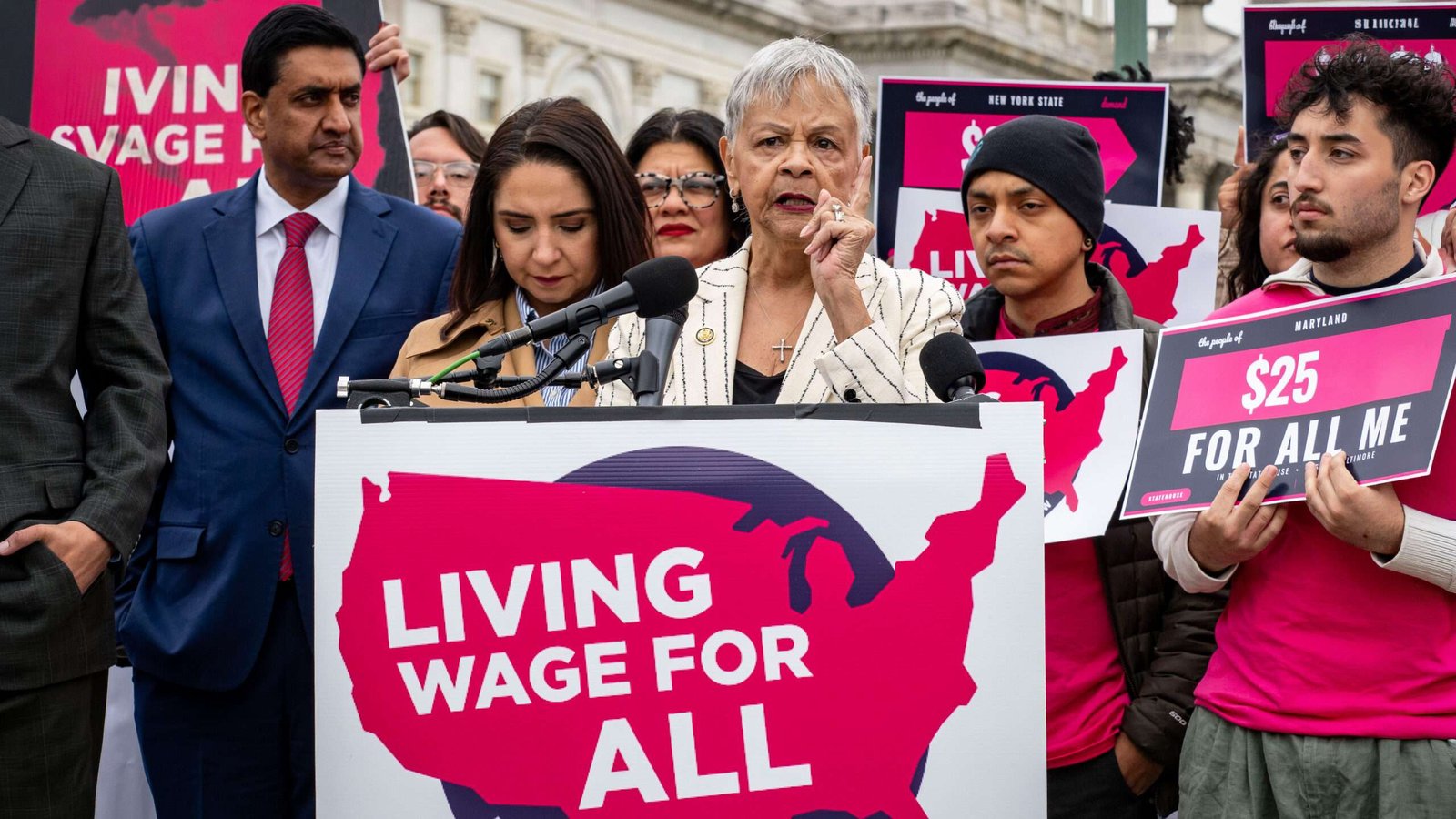
“Extractive capitalism” is a slippery concept that tends to mean whatever the speaker wants. Rep. Ro Khanna (D–Calif.) invokes the term as a bogeyman to be slain by the economic snake oil he peddles in the form of a $25 “living wage” bill he and other Democrats introduced. Fortunately, the legislation is not only unlikely to pass the current Congress; it’s almost as slippery as Khanna’s bogeymen. It’s still a bad idea.
You are reading The Rattler from J.D. Tuccille and Reason. Get more of J.D.’s commentary on government overreach and threats to everyday liberty.
“I co-introduced historic legislation to increase the minimum wage to $25,” Khanna posted on X in April. “As someone who taught economics at Stanford, here is why it makes sense. The real minimum wage was $14 in 1968. Today it is half, but productivity has increased 2.5x. Instead of extractive capitalism, we need a free enterprise system that pays workers what they are worth.”
Khanna’s boast that he “taught economics at Stanford” does a lot of work here. He has a bachelor’s degree in economics and had a visiting lecturer gig of the sort often awarded to political figures—in his case, after he served in the Obama administration and was preparing a congressional run.
Still, Khanna has some training in economics, which may explain why he talks about a $25 minimum wage, but the Living Wage for All Act doesn’t deliver quite that until sometime in the 2030s. In truth, the bill proposes “to place the Federal minimum wage on a durable path toward a living wage by ensuring that it reaches a level equal to two-thirds of the national median hourly wage.”
According to the Bureau of Labor Statistics (BLS), the national median hourly wage was $24.51 and growing in May 2025. Two-thirds of that is somewhat more than $16 per hour. That’s more than double the federal $7.25 minimum wage, though rather less than the rate in the roughly half of states that have higher minimums. Not that many people anywhere earn just minimum wage.
“In 2024, 80.3 million workers age 16 and older in the United States were paid hourly rates, representing 55.6 percent of all wage and salary workers,” the BLS noted last year. “The percentage of hourly paid workers earning the prevailing federal minimum wage or less, at 1.0 percent in 2024, was little changed from the prior year.”
Wages are set by the market as the price for labor. For the vast majority of people, labor commands a higher price than the mandated minimum wage. The BLS goes on to add that “minimum wage workers tend to be young,” they disproportionately lack high school diplomas, and that part-time workers earn the federal minimum wage or less at a rate “four times higher than the rate for full-time workers.” That is, as has always been the case, most people earning the lowest wages are low-skilled, and entry-level workers putting in part-time hours.
Khanna added that “the real minimum wage was $14 in 1968,” double the current federal minimum wage. But the Cato Institute’s Ryan Bourne and Nathan Miller observe that Khanna picked 1968 as a reference point for a reason. That year’s minimum wage “was the highest real wage floor in US history. Had he averaged over the full 90-year history of the federal minimum wage, the figure is only $9.92.”
Even that overstates the difference since “the population-weighted effective minimum wage—the greatest of each locality’s federal, state, or local floor averaged across all working-age Americans—was $12.13 in January 2026.”
The federal minimum wage is low, but it’s essentially irrelevant. It has been superseded by a combination of the market and by state and local rules. To the extent it still applies, it mostly affects teenagers working first jobs and gaining work experience that will make their labor more valuable in the future.
That raises another point. Khanna claims that workers deserve a higher minimum wage because “productivity has increased 2.5x.” But Bourne and Miller emphasize that higher productivity is averaged across the working population. That’s not necessarily true of entry-level employees. “Minimum wages don’t bind average workers,” comment the Cato scholars. “They affect the lowest-paid workers, who tend to cluster in sectors with productivity levels, and sometimes productivity growth, well below the economy-wide average.” For some sectors, productivity has decreased. “Demanding higher minimum wages in these industries, even while productivity has fallen, is a recipe for layoffs or lower hiring.”
The BLS notes, for example, that “nearly 3 out of 4 workers earning the minimum wage or less in 2024 were employed in service occupations, mostly in food preparation and serving-related jobs.” These are jobs that lend themselves to automation via kiosks for orders and tabletop payment consoles.
In a 2017 paper for Labour Economics, Grace Lordan of the London School of Economics and David Neumark of the University of California-Irvine warned, “increasing the minimum wage decreases significantly the share of automatable employment held by low-skilled workers, and increases the likelihood that low-skilled workers in automatable jobs become nonemployed or employed in worse jobs.”
Last year, economists reported California’s minimum wage hike for fast-food workers from $16 to $20 per hour cost 18,000 jobs. They believed the hike also hit employment in full-service restaurants that “may have reduced employment in anticipation of future minimum wage increases in their sector as well.”
In a 2023 evaluation of a proposed national minimum wage hike to $17 per hour, the Congressional Budget Office forecast that “employment would be reduced because employers would respond by reducing their workforces. As a result, 0.7 million additional workers (or 0.4 percent of the overall workforce) would be jobless.” It also predicted “higher prices for goods and services.”
On that note, this year, a University of California, Santa Cruz, study found that after California hiked the minimum wage, “franchised fast food restaurants seemed to have increased their menu prices by approximately 8-12%.” Work hours were also reduced, locations closed, and researchers “saw many fast food franchises increasingly investing in labor automation as a cost-cutting measure.”
Happily, despite their claims, Rep. Khanna and his colleagues don’t plan to immediately hike the national minimum wage to $25 per hour. But even an incremental, slow-motion hike would price low-skilled and entry-level workers out of the market as it exceeded the value of their labor. That would turn his remedy for “extractive” capitalism into an extraction from work and prosperity for many Americans.
Read the full article here
Fact Checker
Verify the accuracy of this article using AI-powered analysis and real-time sources.