

 Freedom Index
Listen to the article
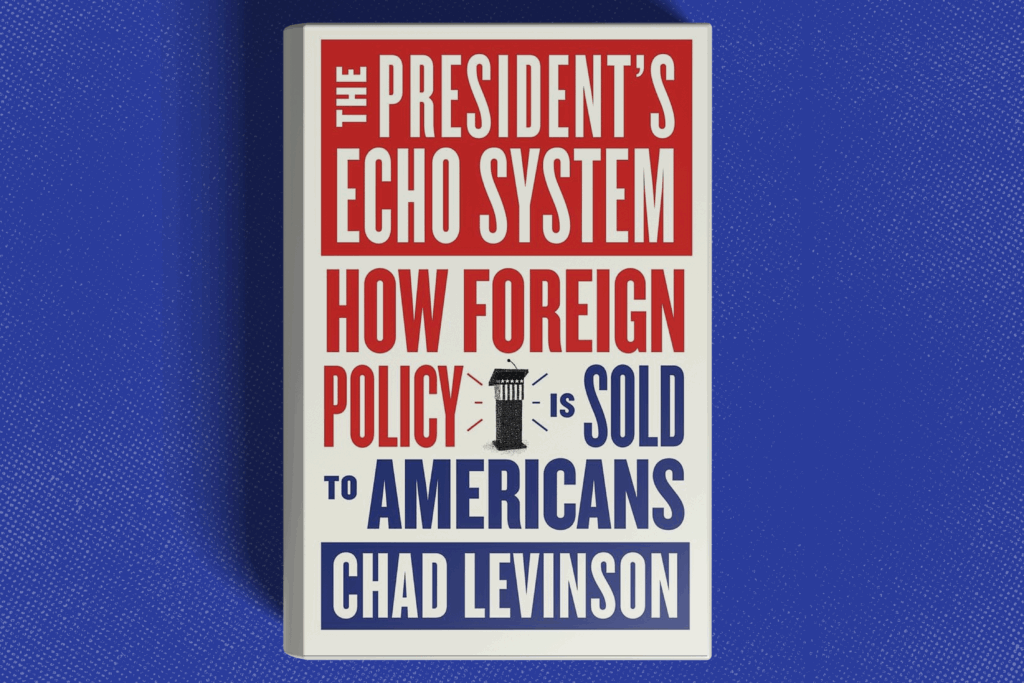
The President’s Echo System: How Foreign Policy Is Sold to Americans, by Chad Levinson, Harvard University Press, 288 pages, $39.95
The modern presidency frequently sells its foreign policy to the American people via nominally private institutions, thereby bypassing official sanctions against propagandizing the public. So argues Chad Levinson, a political scientist at Virginia Tech, in The President’s Echo System.
These political pressure groups have ranged from the Century Group, which operated during the run-up to America’s entry into World War II, to the Project for the New American Century, active at the height of American hegemony in the 1990s. Levinson calls them extragovernmental organizations (EGOs): a web of private but government-aligned think tanks, pressure groups, and other players that lobby Congress and the public for foreign policies aligned with the president’s agenda. Pushing back against earlier scholars of elite machinations, such as C. Wright Mills, Levinson argues that the relationship between EGOs and the presidency is “symbiotic rather than coercive”: The White House serves as the senior partner, with their private counterparts playing a role akin to a “contemporary flash mob,” springing into action to amplify the president’s agenda.
Levinson opens by describing how EGOs operate in a public space defined by popular apathy toward foreign affairs. (“Left unprovoked,” he notes, “the US public pays little attention to foreign affairs.”) After America’s disastrous experience with the Committee on Public Information during World War I, Congress placed significant roadblocks on the executive’s ability to use overt propaganda. Meanwhile, Levinson notes, “Nonofficial propaganda…is protected by the freedoms of association and speech,” even when acting in coordination with the White House. He argues that EGOs are heavily slanted toward intervention: Such groups respond to incentives set by the executive branch—and broadly speaking, “Presidential ambitions…favor interventionism.” There are exceptions, of course: Levinson illustrates how President Barack Obama’s adviser Ben Rhodes enlisted EGOs to sell the Joint Comprehensive Plan of Action (JCPOA) with Iran, and how President Jimmy Carter used the Committee of Americans for the Canal Treaty to return the Panama Canal to Panama. But those were relatively dovish exceptions to a generally hawkish rule.
The ensuing chapters offer a series of historical case studies. The strongest one illustrates how President Franklin Delano Roosevelt coordinated with the Century Group, later known as the Fight For Freedom Committee and the Committee to Defend America (CDA), on messaging prior to America’s formal entry into World War II. Roosevelt allowed himself to be narratively paced by his EGO counterparts, delegating the responsibility of floating new policy ideas, creating the sense of public momentum, and creating a political space for the president to act. After America entered the war, EGO figures entered Roosevelt’s government, filling out public relations positions. Adlai Stevenson, for example, went from running the CDA’s Chicago chapter to working for the Department of the Navy.
A chapter on the early Cold War expands on these continuities, illustrating how the playbook used to sell Americans on entering World War II was repurposed to sell them on the Marshall Plan. The Democrats’ EGO model was so successful that the Republican wing of the Cold War consensus emulated it, with President Dwight Eisenhower launching his own EGOs, such as the Committee for the Marshall Plan, to promote his policies.
The ensuing chapters show how EGOs operated during the height of the Cold War. During the run-up to American involvement in the Vietnam War, Levinson notes, President Lyndon B. Johnson did not use EGOs to sell his policies: He didn’t need them, since the American people and Capitol Hill were at that point broadly supportive of Washington’s involvement in Southeast Asia. Such was not the case by the time President Richard Nixon took over the war, and the Nixon White House breathed new life into the long-established but politically inert American Enterprise Institute (AEI) to help sell his policy of Vietnamization.
Levinson’s chapter on the late Cold War, focused on President Ronald Reagan’s use of EGOs, shows yet more continuities. The EGO network born in the 1980s, built around such organizations as the Heritage Foundation and various Cuban exile groups, served as the backbone of right-wing foreign-policy politics that extended well into the 1990s and informed Republican thinking during the war on terror.
Unlike John Mearsheimer and Stephan Walt, authors of The Israel Lobby and U.S. Foreign Policy, Levinson places the onus of American interventionism upon the presidency. Pressure groups such as the Iraqi National Congress and the Project for the New American Century “did not coerce the [George W. Bush] administration into doing something it did not want to do,” he argues, but rather served as an external partner that “helped persuade the public and Congress to go along.” Noting that both President Bush and Vice President Dick Cheney had backgrounds in the oil industry and were primed to “identify a national security interest in promoting the stability of the supply for oil,” he suggests that they “needed no prodding from the outside.”
Levinson concludes by looking forward, speculating about the new forms propaganda-laundering will take in the digital era. Interwar organizations had to operate on a hub-and-spoke model, headquartered in New York or Washington with local chapters staffed through standing social and professional networks. Not so now, when the costs of organizing and the barriers to disseminating information have both come down. The same absence of friction that enables people to challenge the existing status quo can be used to propagandize them back into it.
Like all good books, The President’s Echo System raises further questions. Does Levinson’s thesis hold as firmly in the late Cold War and beyond as it did in World War II and the early U.S.–Soviet confrontation? Or did presidential agency diminish once an interventionist consensus hardened into not just a norm of the presidency but an entrenched feature of the state itself, with a Congress that at times has been more hawkish than the president? No book serves as a final word on any given subject, but Levinson’s work is a welcome addition to this evolving literature.
Despite such strengths, the book does contain a few historical inaccuracies. For instance, Levinson’s chapter on World War II says that Sen. Robert A. Taft (R–Ohio) was “among a small number of legislators who had opposed sending aid to the Allies before Pearl Harbor.” That misstates Taft’s position: Like a number of conservative Republicans on the eve of the war, Taft did not oppose aiding Great Britain per se, but he compromised on the issue by reluctantly endorsing the “cash and carry” provision in later iterations of the Neutrality Act. The provision held that the Allies could purchase munitions and other supplies so long as they paid for them up front and transported the items themselves. The difference may seem pedantic, but such policy minutiae fed into the EGOs’ work as they collapsed these distinctions and treated aid to the Allies as a binary policy choice when it was anything but.
Levinson has another lapse when he describes a photo of Sen. Burton K. Wheeler (D–Mont.) and the aviator turned America First activist Charles Lindbergh with “arms raised in the Nazi salute.” In fact, Wheeler and Lindbergh were not Sieg Heil-ing; they were doing the aesthetically similar Bellamy salute, which Americans used to perform during the Pledge of Allegiance. Levinson’s citations for the incident are a polemical essay in The New York Review of Books and the Rachel Maddow podcast Ultra, neither of which is a rigorous secondary source.
But these are small problems. The President’s Echo System is a worthy examination of how foreign policy propaganda operates in the United States. If you’re among those arrayed against that system, it’s a valuable tool for understanding what you face.
Read the full article here
Fact Checker
Verify the accuracy of this article using AI-powered analysis and real-time sources.