

 Freedom Index
Listen to the article
It was Samuel Johnson who didn’t quite say “When a man is tired of making lists, he is tired of life.” Nobody seems to have conjured up a corresponding epithet for being tired of reading lists, because nobody is. Some people complain about seeing lists everywhere and bemoan the ease with which “listicles” of Top Tens (or Twenties or Fifties) have displaced “proper” journalism. Others think lists are fantastic and compile their own when they are not devouring those published online and in print. Johannes Gutenberg, they might say, was just making work for himself when he used Europe’s first moveable-type printing press to publish an edition of the Bible back in the 1450s. He should have just compiled a list of God’s Ten Greatest Interventions in the Affairs of Man (that book does include The Top Ten Commandments, though—the best-known listicle in history!).
No matter how we feel about them, lists are now firmly established among the apex predators of the modern internet, along with cats, porn, and—or maybe this is just me?—wacky reels from romance authors. (My favourite is Elisabeth Wheatley’s Book Goblin, by the way.)
- Ten Possible Causes of That Embarrassing Rash
- Five Foods Doctors Say to Avoid if You Don’t Want to Die Today
- The Top Twenty Hairiest Presidential Beards
- Twenty Shocking Diseases You Can Contract from Used Vinyl
Lists—and our ongoing love/hate relationship with the things—are not a new phenomenon. Coin- and stamp-collector catalogues have been around for years, but really, they’re just lists. The Guinness Book of Records—effectively a compendium of stupid pet tricks undertaken by humans—has been topping the bestsellers for seventy years now.
To the chagrin of serious book reviewers the world over, one of 1977’s top selling titles was the extraordinarily sensibly titled Book of Lists. Compiled by David Wallechinsky, Irving Wallace and Amy Wallace, it was compulsive browsing; so much so that it was swiftly succeeded by its own litany of offspring—both from the original’s authors, and from a host of folk who thought “that’s a good idea.” Sports lists, animal lists, book lists, movie lists. There might even be a book ranking the best lists. Admit it, you’d like to look at that.
Although they had a minimal role to play in the original Book of Lists, music lists have an equally storied history. The “best” music/musician polls that print magazines once rolled out at the end of every year were effectively lists, albeit compiled with the aid of however many readers filled in the form. And most of us did. Radio stations, too, delighted (and still delight) in meandering Top 100 Songs type shows, usually spread over a number of days to maximise listener involvement. Even the late John Peel—sainted doyen of British late night DJs—ran an annual Festive Fifty every year from the mid-1970s on, while legendary radio host Dr. Demento actually crossed over into the first Book of Lists, offering up his Ten Worst Song Titles of All Time (number one was the Bobby Peterson Quintet’s “Mama Get Your Hammer (There’s a Fly on Baby’s Head)”).
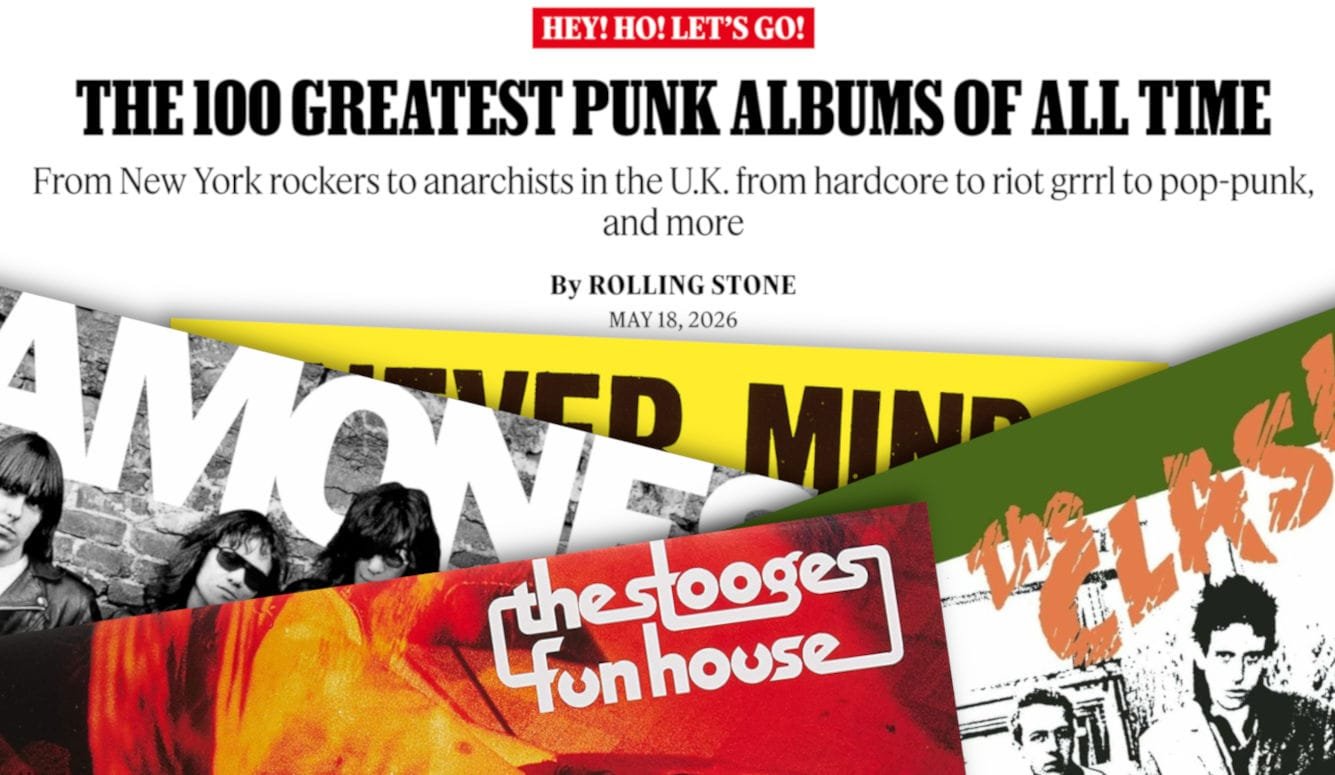
Today, lists devour space on even the most respected music websites, as Rolling Stone reminded us on 18 May. A feature vaingloriously titled “The 100 Best Punk Albums Of All Time.” Rolling Stone is no stranger to lists. Just in the last month, it has published “The Ten Wildest Album Releases” and “The 100 Greatest Guitar Solos of All Time.” Rummage through the magazine’s online archive and you’ll find that everything from “The Greatest Artists of All Time” to “The Worst Albums Ever Made” has been tabulated. And why?
The Top Four Reasons Publishers Insist on Publishing Lists:
- They Promote Reader Engagement (disagreement, mostly).
- They’re Easily Digestible by Readers with Short Attention Spans (most of them now).
- Anyone Who Can Count to Ten Can Compile One (and they do).
- We All Like Making Lists (no disagreement there).
All of which seems somewhat cynical, but it’s also true. Not everybody has either the time or the inclination to read a five-page interview with the surviving members of the Who. But give them a list of the band’s twenty greatest songs, and they will reply with twenty reasons why you have your head up your ass. Lists encourage fan interaction at its purest, and in a world where magazines cherish those all-important clicks, lists are one of the easiest ways of harvesting them. Pat Prince, editor of the US record-collecting magazine Goldmine, cheerfully acknowledges that lists, in general, generate a stronger response from readers than almost anything else published on the website. “Definitely, yes,” he says.
It’s number four on the above Top Four Reasons list, though, that is the most interesting. Because we do like making lists, whether it’s a gathering of favourite songs on the iPod (they’re called “playlists” for a reason); maintaining an ongoing record of a personal collection; an aide-mémoire for the next time you go to the store (a “shopping list”); a letter to Santa (The Top 50 Presents I Want This Year); potential baby names; a dinner menu; a Goodreads account. Even sports leagues are, ultimately, lists.
There have even been songs that are nothing more than lists, and people bought them—sometimes in droves. “Life Is A Rock (But the Radio Rolled Me),” a 1974 hit by the Reunion, unapologetically rhymed a couple of hundred song titles, artist and DJ names, snatches of lyrics and record labels. The Freshies’ “I’m in Love with the Girl on a Certain Manchester Megastore Checkout Desk” focused on the labels alone (all of whom, the lyric admits, “turned me down”). My Life Story’s poptastic “12 Reasons Why I Love Her” was devoted, indeed, to an unnamed paramour’s twelve most endearing idiosyncrasies; Billy Joel’s spitefully irritating “We Didn’t Start the Fire” attempted to document the history of postwar culture in 100+ names and events.
Lists, then, are ancient and they are universal. They are also, it is often claimed, a distinctly male pursuit—a chest-baring, muscle-flexing display of personal taste and preferences guaranteed to generate an all-night argument in the bar with your friends. There are exceptions to the men-only rule, of course. Author and journalist Gillian Gaar’s book 100 Things Beatles Fans Should Know & Do Before They Die is a breathless and unfailingly entertaining gallop through the band’s history, even if there’s plenty to disagree with. Likewise, teenVOGUE’s 2025 list “The 26 Best Girl Groups of All Time,” compiled by writers Abby Webster and Marilyn La Jeunesse, is all but peerless, but by omitting Girlschool, Fanny, the Runaways, the Slits, and the Shangri-Las, it still proved to be as divisive as any male contribution to the field.
Despite the rage that they can provoke, however, lists are essentially harmless—a benign cyst that is really among the least of “proper” journalism’s problems. We can hypothesise all day about whether or not the compiler is deliberately courting controversy. But a well-timed list, and the comments that follow it, is as accurate a barometer of an artist’s standing among both fans and casual bystanders as record sales. More so, in fact, because it doesn’t cost anything to make your personal viewpoint heard.
The majority of published music lists, of course, appeal to (or infuriate) a niche audience—individual bands, specific genres, and so on. Even the Rolling Stone punk 100 is pitched at a relatively small cross-section of readers. That doesn’t usually affect their impact, of course. Pat Prince says that a top twenty of progressive rock songs that last less than five minutes was among Goldmine’s most popular online lists, closely followed by prog songs longer than ten minutes. But in general, it’s the more ambitious compendiums (“The Top Ten Scratched Records That Are Actually Improved by the Damage”) that properly highlight our need to make lists and our need to read them.
At the same time, they tend to torpedo their own sagacity by either steadfastly refusing to step out of line with their predecessors, or deliberately stepping away from those templates. The logic of the more conservative approach made some sense. Critical response and acknowledged influence were the key criteria for inclusion. Peer pressure, too, played a major role. The compiler would look back at the album that topped the last chart, and of course it made sense not to change things. Unless, of course, the last few years had seen a new release that was universally regarded as better—something that we can unanimously agree wasn’t at all likely.
Read the full article here
Fact Checker
Verify the accuracy of this article using AI-powered analysis and real-time sources.