

 Freedom Index
Listen to the article
When I was in college, liberals, not conservatives, were more zealous in defending free speech, when it came to issues like whether pornography ought to be constitutionally protected. In 1990, when I was in law school, and my first-year constitutional law class discussed Texas v. Johnson, the famous flag burning case, only the more conservative students thought that what Gregory Johnson did should not be constitutionally protected expressive conduct. At that time, a decade before I took Professor Volokh’s free speech class when I was a graduate student in the political science department at UCLA, I hoped that someday, free speech would be a principle that would transcend partisanship. After all, it can be hard to predict what political party will control your school board, city council, state legislature, or Congress. If you give lawmakers the authority to censor an idea that you despise at one moment, whether you realize it, you also are giving them the authority to censor ideas that you find valuable in the future. No doubt, it can be very hard to stomach ideas that you find repulsive but inevitability, others will feel the same way about your ideas. In a society committed to free speech, the government must be neutral; it may not discriminate against viewpoints, including deeply offensive and even racist, sexist, and homophobic ones. No real human government will be able to censor “bad” viewpoints competently or fairly, even if we agreed which ones were bad most of the time. Equally importantly, the people who live in that society must be willing to allow others to speak their minds. The quality of their arguments ought to be beside the point.
These days in this country, it seems like a bad situation is becoming worse. On both the left and the right, of the American political spectrum, the natural tendency to censor disagreeable ideas seems increasingly more difficult to resist, including young adults. As someone who teaches at an undergraduate institution and has been doing so for more than twenty years, my impression is that college students are not nearly willing to countenance the expression of ideas, which they despise, as they used to be. Unlike concerns about censorship on college campuses, which have received a lot of media attention, when guest speakers are disinvited or shouted down, few people care much about the extent to which school authorities may suppress student speech in a public junior high or high school. The assumption is that due to their age and relative immaturity, most of what they contribute to the marketplace of ideas at their school will have little, if any, value. Furthermore, the primary mission of a school is to educate its students, and student speech can be disruptive or distracting.
As such, it may appear to be obvious that teenagers should not be able to exercise the same free speech rights that college students may exercise. However, position strikes me as harder to defend than most people acknowledge. After all, it is almost self-evident that if tweens and teenagers, who are impressionable, go to schools that are hostile to free speech, will absorb the wrong lessons, regardless of what they might read in their civics class. They can be punished for saying this, writing that, or wearing a tee short that expresses a view about abortion, guns, same-sex sex, or whatever, they could get detention, be suspended, or even expelled. Sooner rather than later, they will learn how to self-censor.
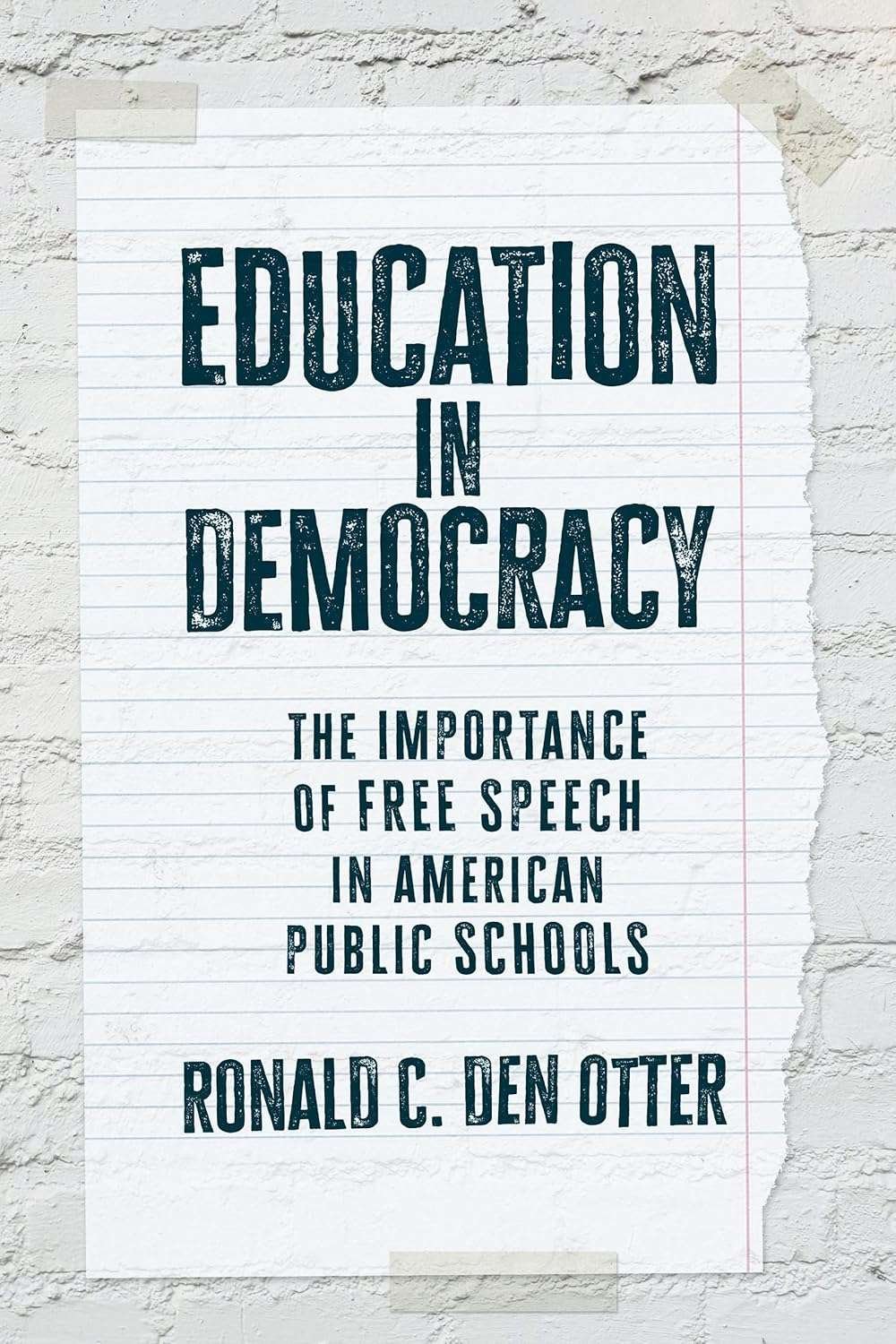
My new book, Democracy in Education: The Importance of Free Speech in American Public Schools, is about the importance of the free speech of junior high school and high school students in a country like our own; it calls into question the double standard as well, where public schools are treated so differently than colleges for free speech purposes. There are many ways to defend free speech, and my focus is on how educational the experience can be, when students not only are challenged to formulate their own views but are exposed to those of their classmates. Indeed, an important part of becoming a citizen in a democracy calls for learning how to deal with difference and disagreement in political life.
In 2021, the U.S. Supreme Court decided a case, Mahanoy, involving this exact topic, the first time in fourteen years. In the famous Tinker decision (1969), the U.S. Supreme Court gave constitutional protection to student speech at public junior high and high schools for the first time in American history. In Mahanoy, the Court sided with a freshman who had been punished for what she said about the cheerleading coach and team. On Snapchat, on a weekend, B. L. posted a picture where she raised her middle finger with a caption that used the f-word multiple times, expressing her frustration about not making the varsity cheerleading team. In the eyes of school officials, such a crude gesture, coupled with crude language, was inappropriate. While Mahanoy did not receive extensive media coverage, for anyone who cares about free speech, it is a more important decision than most people realize, because it raises fundamental questions about the value of student speech and the place of censorship in a high school. If she had been a college student, the case would have been very easy: her speech would have been unequivocally constitutionally protected. Recently, scholars have had a lot to say about free speech on college campuses. However, few of them have had much to say so far about the free speech rights of junior high and high school students, which arguably may be even more important.
For now, school board members, administrators, and teachers have considerable discretion in such matters when they can make a plausible claim that the student speech in question is disruptive, sexual, offensive, school-sponsored, or advocates illegal activity. The implication is not only that they can discriminate against progressive viewpoints but against conservative or libertarian viewpoints as well. That should concern all of us in a society that is supposed to prepare teenagers for adulthood and democratic citizenship.
What I have to say in this book is less descriptive or explanatory and more normative. I spell out where the U.S. Supreme Court went wrong and what the law ought to be, as opposed to predicting what lower courts might do or what they are doing. Ultimately, my aim is to convince the reader that free speech doctrine must be revised so that such speech receives the kind of extensive constitutional protection that it deserves.
Initially, it may not be obvious why anyone would care about this topic if they are not interested in the details of free speech doctrine. For someone like that, I would maintain it is far too easy to underestimate the likelihood that student speech, more often than not, will help teenagers, at an age when they still are impressionable, become better democratic citizens by exposing them to political issues, giving them opportunities to have their voices heard, enabling them to appreciate the place of dissent in a democracy, encouraging them to listen to others, inculcating tolerance, teaching them how to exchange reasons with one another, and encouraging them to respond appropriately to disagreement -i.e.– counter speech instead of censorship by a political authority. In this respect, the protection of this kind of student speech may be even more imperative than protecting the speech of adults, who already have formed their own views about the world.
I expound on why student speech ought to be afforded significantly more constitutional protection than it currently receives. Simply put, the value of student speech should not be underestimated, given the place of teenagers on the learning curve, and the state’s countervailing interests in restricting it are weak upon closer examination. I go much farther than the U.S. Supreme Court has ever gone in ensuring that students can exercise their free speech rights when they are at school (and off-campus as well, when they are using social media) by proposing that public junior high and high schools be treated like public universities for purposes of freedom of expression (approximating California’s Leonard Law, the only statute in the country that goes well beyond the constitution minimum. I formulate a much stricter version of the Tinker v. Des Moines Independent Community School District substantial disruption test. The only reason why I do not adopt this extreme, and simply abandon the Tinker test, is that in my view, school officials ought to be able to restrict student speech in rare situations where it is likely to substantially disrupt the learning environment in the classroom, which would be equally true in at a public university. Content-neutral restrictions would be permissible in some places on school grounds yet they cannot serve as cover for school officials who want to avoid controversy. Ultimately, no public educational institution should be able to engage in any sort of viewpoint discrimination. As it turns out, junior high and high school students do not really differ from college students, who also are young and often immature, in terms of their being able to engage in freedom of expression and benefit educationally from the experience.
Read the full article here
Fact Checker
Verify the accuracy of this article using AI-powered analysis and real-time sources.