Close Menu
FSNN | Free Speech News NetworkFSNN | Free Speech News Network
  • Home
  • News
    • Politics
    • Legal & Courts
    • Tech & Big Tech
    • Campus & Education
    • Media & Culture
    • Global Free Speech
  • Opinions
    • Debates
  • Video/Live
  • Community
  • Freedom Index
  • About
    • Mission
    • Contact
    • Support
Trending

CPJ condemns Tunisia’s judicial harassment of Sonia Dahmani after fresh conviction  

5 minutes ago

Indonesia blocks Polymarket, calling prediction market online gambling in disguise

9 minutes ago

XRP Price Holds ‘Best Accumulation Zone’ as Whales Pull $170M From Binance

13 minutes ago
Facebook X (Twitter) Instagram
Facebook X (Twitter) Discord Telegram
FSNN | Free Speech News NetworkFSNN | Free Speech News Network
Market Data Newsletter
Monday, May 25
  • Home
  • News
    • Politics
    • Legal & Courts
    • Tech & Big Tech
    • Campus & Education
    • Media & Culture
    • Global Free Speech
  • Opinions
    • Debates
  • Video/Live
  • Community
  • Freedom Index
  • About
    • Mission
    • Contact
    • Support
FSNN | Free Speech News NetworkFSNN | Free Speech News Network
Home»Cryptocurrency & Free Speech Finance»Pope Leo Releases First AI Encyclical, Calls Data a Common Good and Rejects Moral Neutrality of Tech
Cryptocurrency & Free Speech Finance

Pope Leo Releases First AI Encyclical, Calls Data a Common Good and Rejects Moral Neutrality of Tech

News RoomBy News Room1 hour agoNo Comments5 Mins Read1,156 Views
Share Facebook Twitter Pinterest Copy Link LinkedIn Tumblr Email VKontakte Telegram
Pope Leo Releases First AI Encyclical, Calls Data a Common Good and Rejects Moral Neutrality of Tech
Share
Facebook Twitter Pinterest Email Copy Link

Listen to the article

0:00
0:00

Key Takeaways

Playback Speed

Select a Voice

In brief

  • Pope Leo XIV released “Magnifica Humanitas” on May 25, the first papal encyclical dedicated entirely to AI.
  • The encyclical classifies algorithms, data, and digital platforms as common goods that cannot remain under private monopoly control.
  • Anthropic co-founder Christopher Olah spoke at the Vatican launch and warned that AI labor displacement at scale would become “a moral imperative of historic proportions” to address.

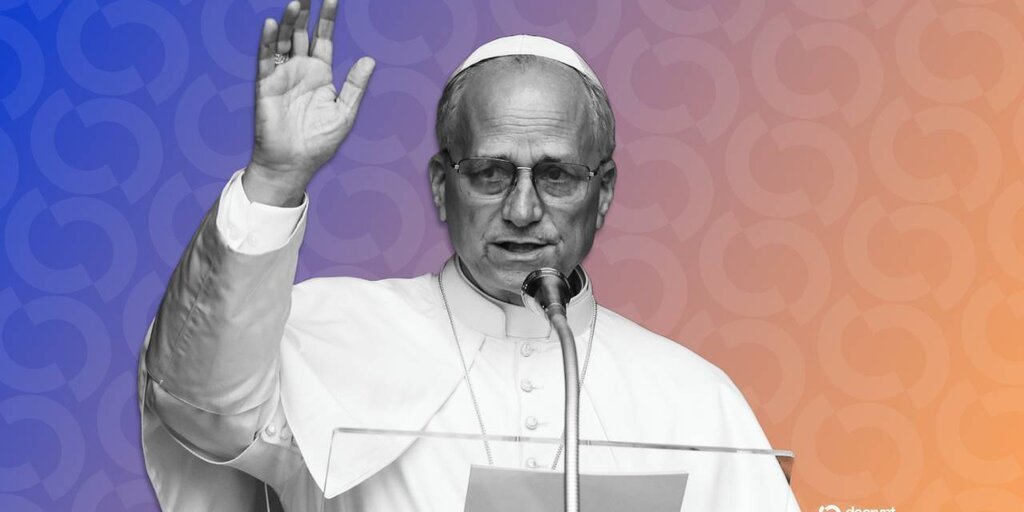
Pope Leo XIV published his first encyclical on Monday, a 245-paragraph document dedicated entirely to artificial intelligence that demands tighter oversight of Big Tech, classifies data as a shared human resource, and argues that “technology is never neutral” because it absorbs the values, blind spots, and economic incentives of whoever builds it.

The document, Magnifica Humanitas (“Magnificent Humanity”), was released at the Vatican’s Synod Hall on May 25. Pope Leo signed it 10 days earlier, on May 15, the 135th anniversary of Rerum Novarum—the 1891 encyclical by Pope Leo XIII on labor rights that became the foundation of modern Catholic social teaching.

Pope Leo has consistently framed AI as the defining moral challenge of his papacy, and compared the coming social upheaval to that of the Industrial Revolution.

The encyclical covers a lot of ground: AI in warfare, dehumanization, technocracy, data colonialism, child safety online, mass unemployment, disinformation, autonomous weapons, and even transhumanism. But the argument tying it together is simple. Every algorithm reflects the priorities of the people who designed, funded, and deployed it. Building systems that pretend otherwise doesn’t eliminate that bias—it just hides it.

Data belongs to everyone. Including yours.

Catholic social teaching has long held that the earth’s natural resources are intended for all of humanity, not private owners. Leo extends that principle directly to the digital economy. Algorithms, platforms, and data, the encyclical argues, must be governed as common goods, not locked behind commercial walls by a few companies.

“Data is the product of many contributors and should not be treated as something to be sold off or entrusted to a select few,” the pope writes.

The text also applies subsidiarity—the principle that decisions should be made at the most local level possible—to tech platforms specifically. The encyclical doesn’t just call for top-down regulation; advocating instead for transparent algorithms, independent community audits, and real legal power for people to challenge automated systems that affect their credit scores, job applications, or criminal risk assessments. Without that distributed oversight, Leo argues, governance of AI becomes a form of digital authoritarianism that silences the populations it claims to serve.

The encyclical also takes aim at transhumanism—the idea that human limitation and vulnerability are flaws to be engineered away. Leo’s counter is that finitude is not a bug. It’s what makes empathy, moral judgment, and genuine care for other people possible. Systems built to optimize it out don’t produce a better human. They produce something that evaluates and excludes the vulnerable more efficiently.

The pope is careful not to anthropomorphize the technology. AI systems, the encyclical states, “do not possess a body, do not feel joy or pain,” he writes. The encyclical notes that AI systems lack the lived experience that produces real understanding. They can simulate empathy and produce convincing language, but they don’t comprehend what they output.

That distinction matters practically. When an algorithm makes hiring decisions, sets credit terms, or assigns a risk score in a courtroom, its apparent objectivity obscures the choices baked in by its designers. The encyclical warns specifically against delegating sensitive decisions to automated systems that “do not know compassion, mercy, forgiveness” and against treating the result as neutral just because a machine produced it.

Anthropic was there

The person sharing the stage with Leo on Monday drew as much attention as the document itself. Christopher Olah—co-founder of Anthropic and head of its interpretability research team—spoke at the Synod Hall presentation alongside two Vatican cardinals and a pair of theologians.

As Decrypt reported when Leo was elected, the pope framed AI as the central moral question of his papacy from his very first address to the cardinals. Monday’s encyclical is the formal doctrinal version of that commitment.

Olah used the occasion to say openly what most AI executives avoid: that every major lab “operates inside a set of incentives and constraints that can sometimes conflict with doing the right thing,” and that outside scrutiny—from governments, religious institutions, and civil society—isn’t optional. He also flagged AI-driven labor displacement as a near-term risk that, if it materializes at scale, would create “a moral imperative of historic proportions.”

Leo had already written the harder version of that argument. “A more moral AI is not enough,” the encyclical states, if the morality behind it is set exclusively by whoever controls the data and the compute. Leo made the same case directly to Silicon Valley executives at the Vatican in November 2025. The Vatican also approved a new internal AI commission on May 16 drawing from seven departments to coordinate AI governance work across the Holy See going forward.

Daily Debrief Newsletter

Start every day with the top news stories right now, plus original features, a podcast, videos and more.


Read the full article here

Fact Checker

Verify the accuracy of this article using AI-powered analysis and real-time sources.

Get Your Fact Check Report

Enter your email to receive detailed fact-checking analysis

5 free reports remaining

Continue with Full Access

You've used your 5 free reports. Sign up for unlimited access!

Already have an account? Sign in here

Share. Facebook Twitter Pinterest LinkedIn Tumblr Email Telegram Copy Link
News Room
  • Website
  • Facebook
  • X (Twitter)
  • Instagram
  • LinkedIn

The FSNN News Room is the voice of our in-house journalists, editors, and researchers. We deliver timely, unbiased reporting at the crossroads of finance, cryptocurrency, and global politics, providing clear, fact-driven analysis free from agendas.

Related Articles

Cryptocurrency & Free Speech Finance

Indonesia blocks Polymarket, calling prediction market online gambling in disguise

9 minutes ago
Cryptocurrency & Free Speech Finance

XRP Price Holds ‘Best Accumulation Zone’ as Whales Pull $170M From Binance

13 minutes ago
Cryptocurrency & Free Speech Finance

Vitalik Buterin Signals Shift to ‘Smaller Ship’ at Ethereum Foundation Amid Departures

19 minutes ago
Cryptocurrency & Free Speech Finance

Vitalik Biterin breaks silence about Ethereum Foundation amid community frustration

1 hour ago
Cryptocurrency & Free Speech Finance

ARIQO makes its Bangkok debut at SEABW, drawing industry attention

1 hour ago
Cryptocurrency & Free Speech Finance

Paper losses and scrapped ETFs. What Trump Media’s 2,650 BTC transfer really means

2 hours ago
Add A Comment
Leave A Reply Cancel Reply

Editors Picks

Indonesia blocks Polymarket, calling prediction market online gambling in disguise

9 minutes ago

XRP Price Holds ‘Best Accumulation Zone’ as Whales Pull $170M From Binance

13 minutes ago

Vitalik Buterin Signals Shift to ‘Smaller Ship’ at Ethereum Foundation Amid Departures

19 minutes ago

Vitalik Biterin breaks silence about Ethereum Foundation amid community frustration

1 hour ago
Latest Posts

ARIQO makes its Bangkok debut at SEABW, drawing industry attention

1 hour ago

Pope Leo Releases First AI Encyclical, Calls Data a Common Good and Rejects Moral Neutrality of Tech

1 hour ago

Paper losses and scrapped ETFs. What Trump Media’s 2,650 BTC transfer really means

2 hours ago

Subscribe to News

Get the latest news and updates directly to your inbox.

At FSNN – Free Speech News Network, we deliver unfiltered reporting and in-depth analysis on the stories that matter most. From breaking headlines to global perspectives, our mission is to keep you informed, empowered, and connected.

FSNN.net is owned and operated by GlobalBoost Media
, an independent media organization dedicated to advancing transparency, free expression, and factual journalism across the digital landscape.

Facebook X (Twitter) Discord Telegram
Latest News

CPJ condemns Tunisia’s judicial harassment of Sonia Dahmani after fresh conviction  

5 minutes ago

Indonesia blocks Polymarket, calling prediction market online gambling in disguise

9 minutes ago

XRP Price Holds ‘Best Accumulation Zone’ as Whales Pull $170M From Binance

13 minutes ago

Subscribe to Updates

Get the latest news and updates directly to your inbox.

© 2026 GlobalBoost Media. All Rights Reserved.
  • Privacy Policy
  • Terms of Service
  • Our Authors
  • Contact

Type above and press Enter to search. Press Esc to cancel.

🍪

Cookies

We and our selected partners wish to use cookies to collect information about you for functional purposes and statistical marketing. You may not give us your consent for certain purposes by selecting an option and you can withdraw your consent at any time via the cookie icon.

Cookie Preferences

Manage Cookies

Cookies are small text that can be used by websites to make the user experience more efficient. The law states that we may store cookies on your device if they are strictly necessary for the operation of this site. For all other types of cookies, we need your permission. This site uses various types of cookies. Some cookies are placed by third party services that appear on our pages.

Your permission applies to the following domains:

  • https://fsnn.net
Necessary
Necessary cookies help make a website usable by enabling basic functions like page navigation and access to secure areas of the website. The website cannot function properly without these cookies.
Statistic
Statistic cookies help website owners to understand how visitors interact with websites by collecting and reporting information anonymously.
Preferences
Preference cookies enable a website to remember information that changes the way the website behaves or looks, like your preferred language or the region that you are in.
Marketing
Marketing cookies are used to track visitors across websites. The intention is to display ads that are relevant and engaging for the individual user and thereby more valuable for publishers and third party advertisers.