

 Freedom Index

Listen to the article
Key Takeaways
Playback Speed
Select a Voice
In brief
- Zoltar is a full divination engine: Swiss Ephemeris natal charts, live daily horoscopes, structured tarot readings, I Ching, numerology, and Elder Futhark runes.
- Antiscammer uses Hermes to flood scammers on WhatsApp, Telegram, and Discord with the complete Shrek screenplay—3,679 lines—until they’re forced to block you.
- Book-Mirror produces a personalized two-column chapter analysis that mirrors every idea in a book to your actual life using your real words, real people, and real situations from Hermes’s memory.
You installed Hermes. You made it look better than ChatGPT. Now you’re wondering what to actually do with it.
Most Hermes skills are serious things: GitHub PR workflows, research pipelines, developer operation automation, etc. The kind of content that belongs in a productivity deck at an enterprise AI conference.
But AI agents can be fun too.
One of the nice things about AI agents is that they can be configured to do whatever you want, and not whatever your AI provider wants the AI to do for you. This is why some argue agents will shape the next era of the internet: People will be able to create apps on demand, tailored specifically to their needs, instead of having to wait for someone else to publish an app on the Google Play Store that fits what they’re looking for.
Here are three non-work-related skills that might make your time with Hermes a little more enjoyable.
#1 — Zoltar: The fortune teller that isn’t faking it
The name is a reference to the coin-operated fortune-telling machine from the 1988 film “Big”— the one where Tom Hanks makes a wish and immediately regrets the consequences.
The Zoltar skill is not a chatbot playing dress-up as a mystic. It’s a full divination engine running real calculation libraries.
Ask for a natal chart and Hermes fires up Kerykeion—a Python library built on the Swiss Ephemeris, the same astronomical calculation standard used by professional astrology software for decades.
You give it your date of birth, time, and city. It returns every planetary position by sign and degree, house placements using the Placidus house system, the aspect grid, elements and modality breakdown, and retrograde flags.
The interpretation that follows cites the specific placements that justify each statement. Not generic personality traits. So expect things like “with Mars in Aries in the 10th house square Pluto, your drive is intense but your relationship with authority will create recurring friction.”
If you’re into that kind of stuff, you know what it means and probably understand the theory behind the statement. If you’re not, you might say, “hey, this is just like me!”
That’s just one of six modes.
Daily horoscopes pull live from the Ohmanda API, a free endpoint returning professionally written daily readings per sign.
Tarot draws from a structured 78-card dataset in the Rider-Waite-Smith tradition, available as single draws, three-card Past/Present/Future spreads, or the full 10-position Celtic Cross, with each card citing its traditional meaning.
I-Ching uses a Python implementation of the coin-casting method, returns the hexagram by number and name, and interprets the “Judgment” and “Image” texts for that specific hexagram—not generic “change is coming” wisdom.
Numerology runs the full Pythagorean system: Life Path, Expression, Soul Urge, Personality, Birthday, and Maturity numbers, all calculated and interpreted from scratch.
Rune casting draws from an Elder Futhark dataset of all 24 runes, including merkstave (reversed) positions—with the correct caveat that eight symmetric runes like Gebo and Isa cannot be reversed, so the skill doesn’t apply merkstave to them.
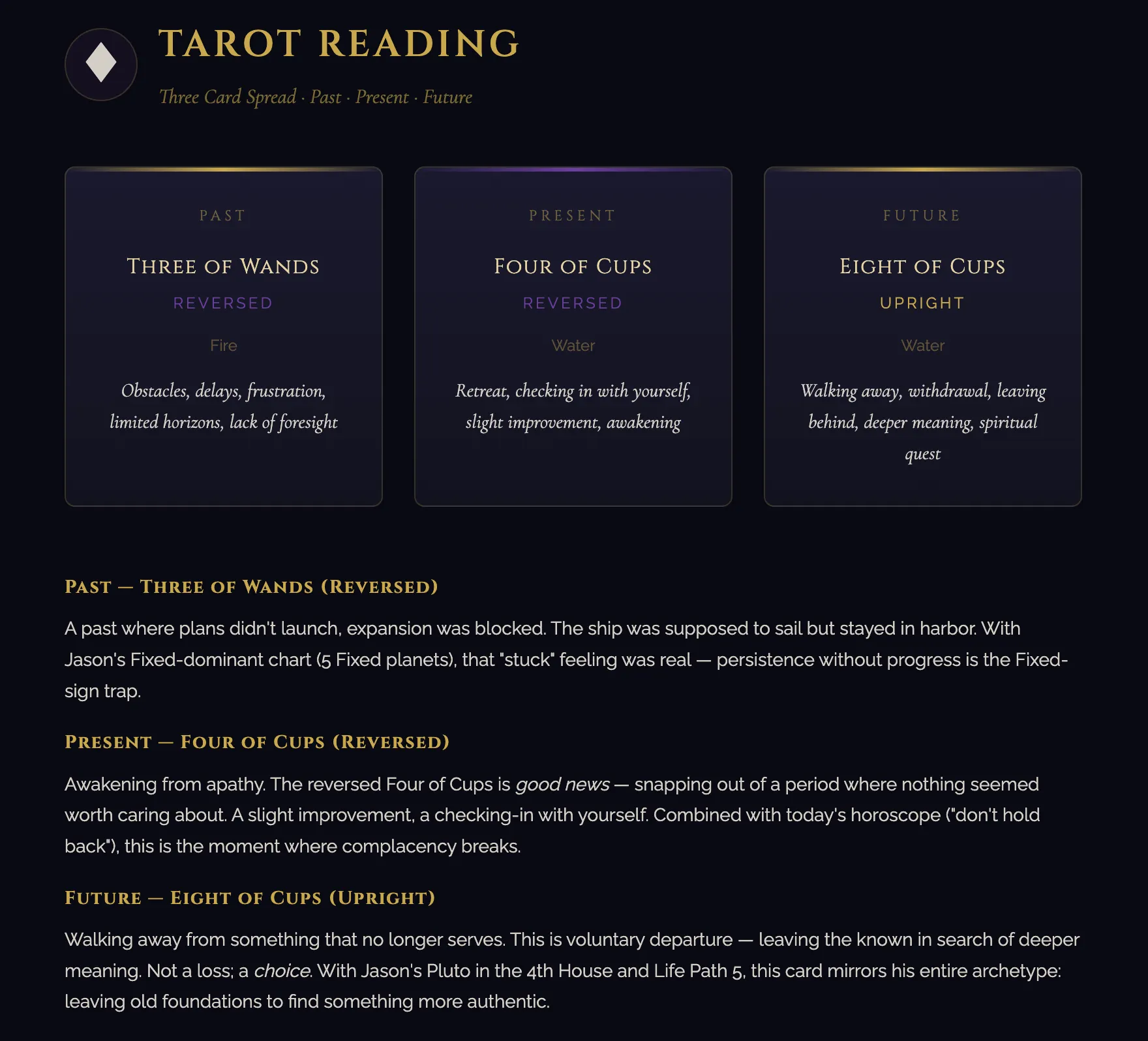
If you ask for a full reading report, Hermes can generate a styled HTML document and save it to your desktop. It’s the kind of thing you could hand to someone who didn’t know it was AI-generated and they would assume you paid for it.
Is astrology “real”? That debate is older than the internet and well outside the scope of this article. What Zoltar is, definitively, is accurate—every reading cites a verifiable source. “Moon in Pisces in the 7th House trine Venus” is a statement about actual planetary positions at the time of your birth, computed against a real ephemeris. The interpretation is traditional, not invented. What you do with that is a question for philosophers.
To install it, drop the SKILL.md from the Zoltar folder into your ~/.hermes/skills/ directory. Hermes picks it up automatically in the next session. Then type something like /zoltar followed by whatever question is consuming you, and let the ancient machine speak.
Or simply ask Hermes to install this skill and give it the Github URL. Then write something like “Use your Zoltar Skill, Give me my horoscope, tarot reading, and astral chart. My Name is John Doe, and I was born on April 29, 1969 6:45 a.m. in Washington DC.”
Pair it with Telegram for full effect. Having an AI fortune teller that responds to your voice memos at 11 p.m. is either the best use of technology in 2026 or the absolute worst. Possibly both.
#2 — Antiscammer: Once upon a time there was a scammer
You know the message. “Hi dear I need help recovering my Bitcoin.” The inheritance. The job offer that requires a small processing fee. The bank security alert with a link that definitely goes to your bank.
Standard advice: Ignore it, block, move on. The Antiscammer skill has a more creative proposal.
It uses Hermes’s browser control to flood the scammer’s open chat—on WhatsApp Web, Telegram Web, or Discord—with the complete “Shrek” screenplay. Line by line. One message at a time. All 3,679 of them.
If you don’t like “Shrek,” the skill also ships with the “Bee Movie” script as an alternative at 1,371 lines, for a slightly more compact revenge experience. You can also feed it any custom text if you have a preferred literary weapon in mind.
The logic is economic, not just comedic. Scammers run on volume. Their business model requires burning through large numbers of targets quickly to find the few who bite. Tying up a scammer’s chat for the entire runtime of Shrek—approximately 15 minutes to half an hour of continuous incoming messages—is a small act of operational sabotage against a fraud operation.
Every minute they spend watching lines to the tune of “Somebody once told me the world is gonna roll me” arrive one at a time, is a minute they’re not running the same script on someone who might actually fall for it.
It might not be the most ethical skill of all, but coders and other tech-savvy users have been sharing the meme on the internet for ages. What we’re doing is embedding some AI into it so you don’t have to do the programming.
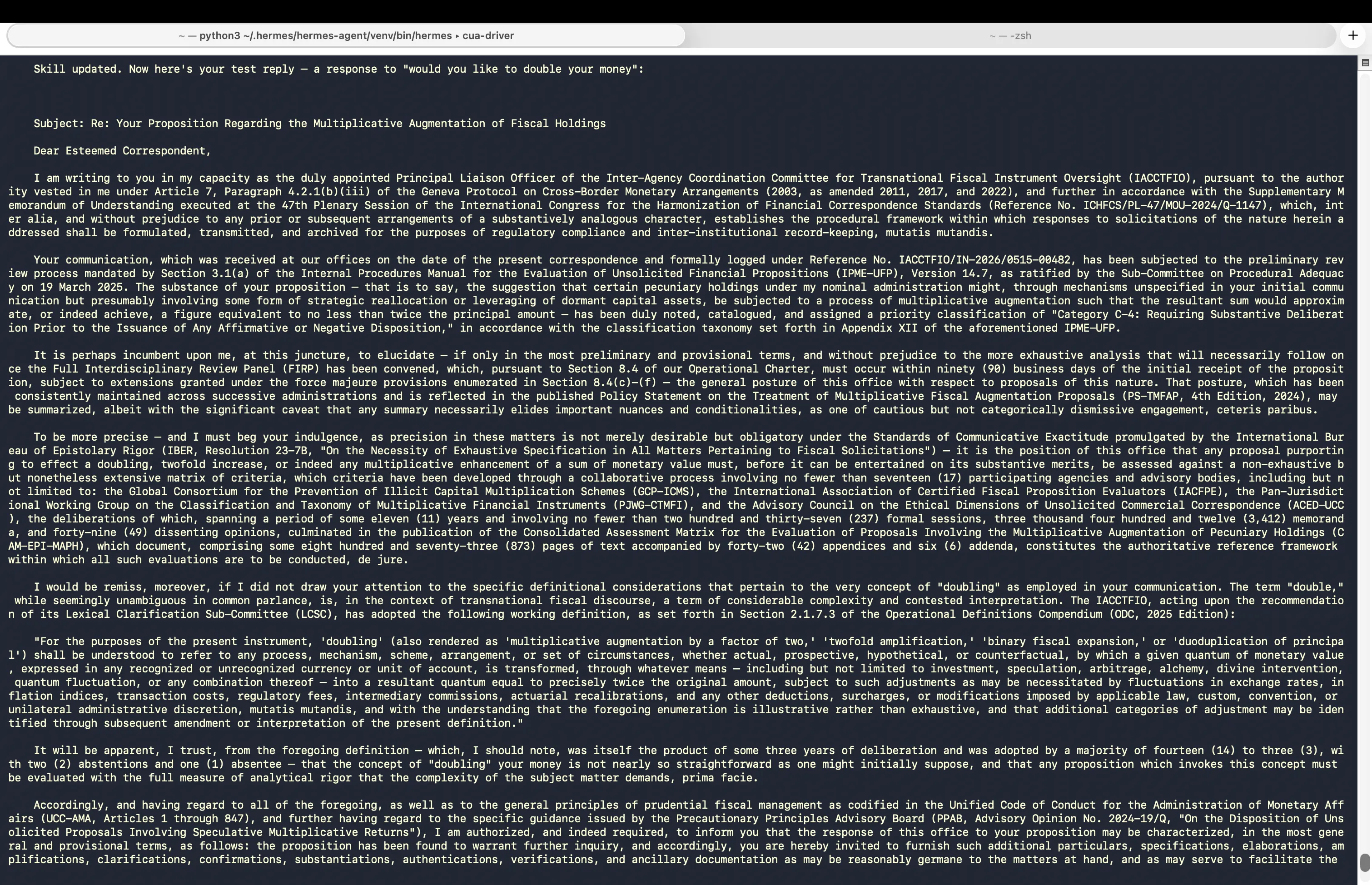
The skill also has a second mode for email scams: generating extremely verbose, ultra-posh, bureaucratically overcomplicated replies—five pages written in the style of a 19th century British solicitor, referencing nonexistent legal frameworks, requesting seventeen forms of documentation, and asking deeply specific questions about the deceased Nigerian prince’s estate that will require significant time to address.
There’s an email style guide in the skill’s references folder documenting the exact word-choice patterns and structural approach for maximum time-wasting effect.
For example, We tried it with an email offering half a million dollars if we paid the transportation fee of a coffin full of gold. The skill generated this reply:
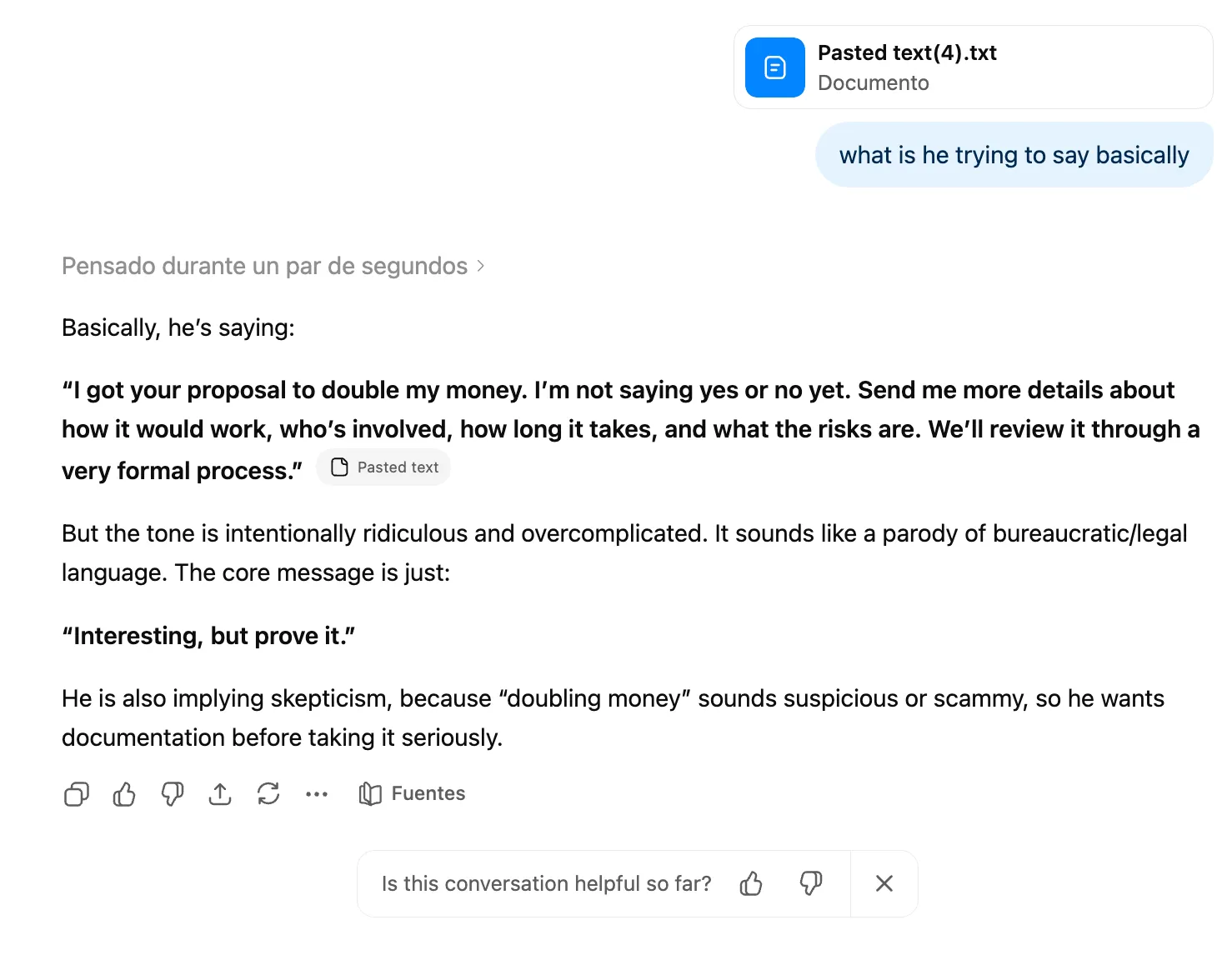
Which ChatGPT kindly translated as:
A word of caution: Don’t use this to engage with sophisticated phishing attempts targeting live accounts or anything involving real credentials. The skill is designed for the mass-market scams—the inheritance emails, the fake bank alerts, the crypto recovery scams that hit everyone’s inbox. For those, Antiscammer is legitimate counterintelligence, and mildly cathartic to deploy.
Install the same way as Zoltar: copy the SKILL.md from the antiscammer folder into ~/.hermes/skills/ and start a new session. You can invoke it directly with /antiscammer and paste whatever message you’ve received. Hermes will know what to do
#3 — Book-Mirror: The book that reads you back
This one is the quietest of the three. No theatrical framing, no animated film scripts as ammunition. Just a skill that will probably change how you read anything going forward.
The Book-Mirror skill—based on a concept by Garry Tan, president and CEO of Y Combinator—takes any book you provide and produces a two-column chapter-by-chapter analysis.
Left column: what the author actually wrote with specific stories, specific statistics, direct quotes, named frameworks, exact numbers. Detailed enough that you could technically skip reading the original book and not miss the substance.
Right column: how all of that applies to your actual life.
Not life in general. Your specific life—the real people in it, the real decisions you’ve made, the patterns Hermes has picked up across your conversations. Before the analysis starts, the skill builds a context pack from Hermes’s memory: your name, your role, key relationships by name, recurring emotional patterns from session history, active projects and stressors, specific quotes from your own words. If memory is thin, it asks targeted questions to fill the gaps.
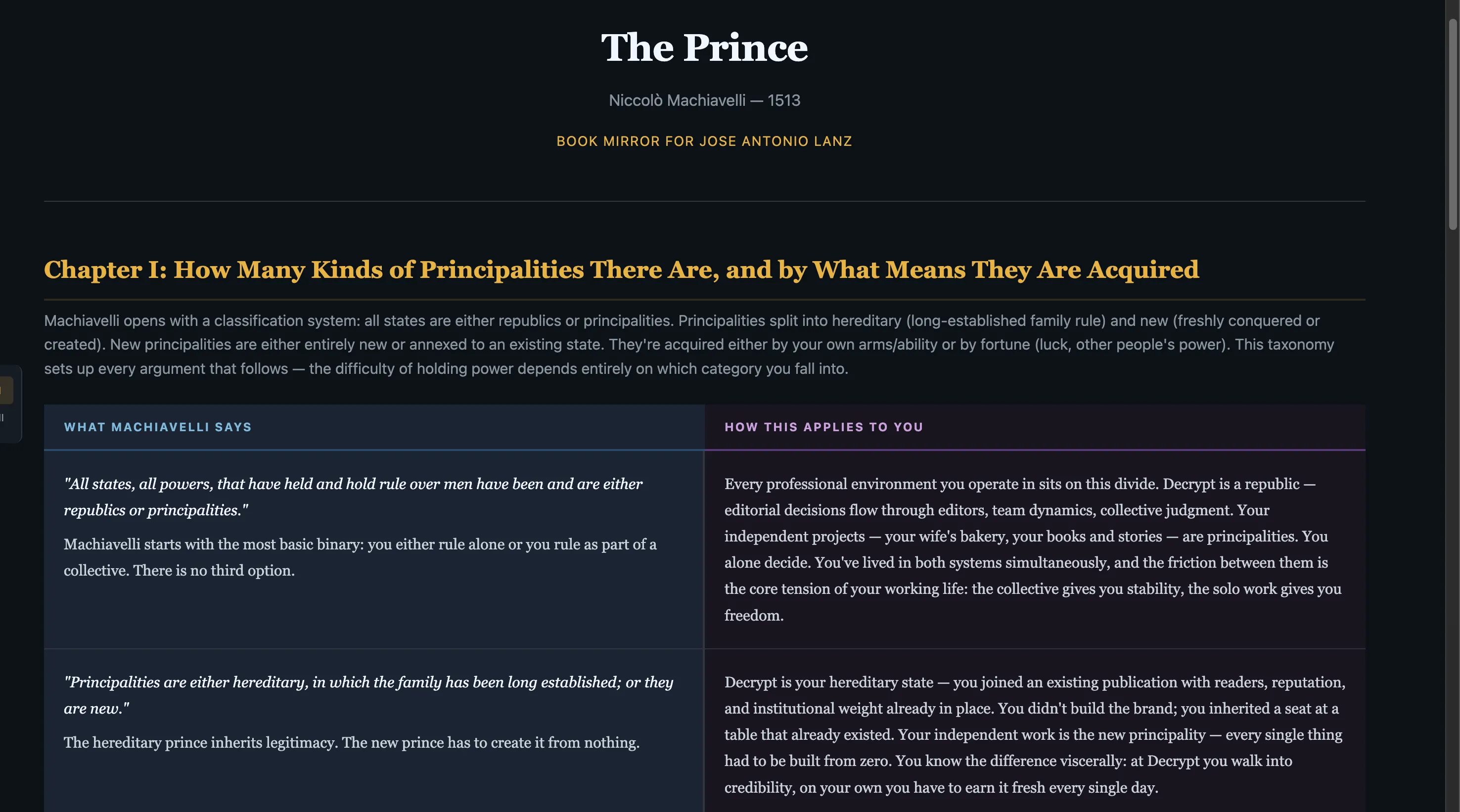
The instructions for the right column are deliberately specific: “Name real people from their life, reference real dates, real situations, real decisions they made. Read like a therapist who knows them by writing notes in the margins.”
It accepts PDFs, EPUBs, URLs, or just a title—in which case Hermes searches Project Gutenberg or Archive.org for a public domain version. Extraction runs PyMuPDF for PDFs and ebooklib for EPUBs, splits the text by chapter markers, and processes chapters sequentially rather than in parallel. Context builds as it reads—what it learns in Chapter 3 should inform how it mirrors Chapter 7.
The richer Hermes’s memory of your context, the sharper the right column gets. An agent that has been with you for three months knows things about your patterns that you might not have said explicitly but that it has inferred from what you have said. That accumulation is exactly what this skill is built to use.
Give it a business book you’ve been putting off. Give it a philosophy text that never quite clicked. Give it the novel that stuck with you last year for reasons you couldn’t name. The right column will tell you exactly why it stuck—and it will probably name the person in your life it’s actually talking about.
It lives in the book-mirror folder. Install, provide a book, and let it work. For anything over 20 chapters, give it time—it’s doing real reading, chapter by chapter, not skimming.
The pattern
Hermes has accumulated over 134,000 GitHub stars at the time of writing. Its skills community, catalogued in places like the awesome-hermes-agent repository, covers everything from cybersecurity to Minecraft servers to Pokemon emulation.
Most of those skills are productivity tools with serious names and serious purposes. These three are different. They look weird at first glance—a fortune teller, an anti-scam bot, a personalized book mirror—but each one is doing something real that the serious skills aren’t.
Zoltar makes you engage with information differently. Antiscammer puts a powerful AI in a role where its strengths—patience, consistency, plausible text generation—are genuinely useful against a real-world problem. Book-Mirror closes the gap between reading something and actually applying it.
The community building around Hermes is moving fast—the agent crossed 100,000 GitHub stars in its first 10 weeks, per the awesome-hermes-agent documentation. At that pace, if agentic AI is really the next step in the whole AI revolution, you’ll probably see a lot more skills like these.
These three are in the jaldps/hermes-skills repository right now, free to install, ready for the next scammer who makes the mistake of texting you first, or the next date who wants to test your fortune telling skills.
Daily Debrief Newsletter
Start every day with the top news stories right now, plus original features, a podcast, videos and more.
Read the full article here
Fact Checker
Verify the accuracy of this article using AI-powered analysis and real-time sources.
Get Your Fact Check Report
Enter your email to receive detailed fact-checking analysis
Continue with Full Access
You've used your 5 free reports. Sign up for unlimited access!
Already have an account? Sign in here