

 Freedom Index
Listen to the article
A month ago, I offered some predictions about how Canadian journalists would cover the five-year anniversary of the country’s infamous “unmarked graves” social panic, which began on May 27, 2021. On one hand, this kind of important landmark would be difficult for news outlets to ignore. (After all, this was considered the Canadian “Story of the Year” at the time.) On the other hand, any intellectually honest retrospective that these outlets produced would require at least some passing explanation as to why the entire Canadian media establishment had fallen hook, line, and sinker for a story that turned out to be fake—something that most journalists have so far proven unwilling to do.
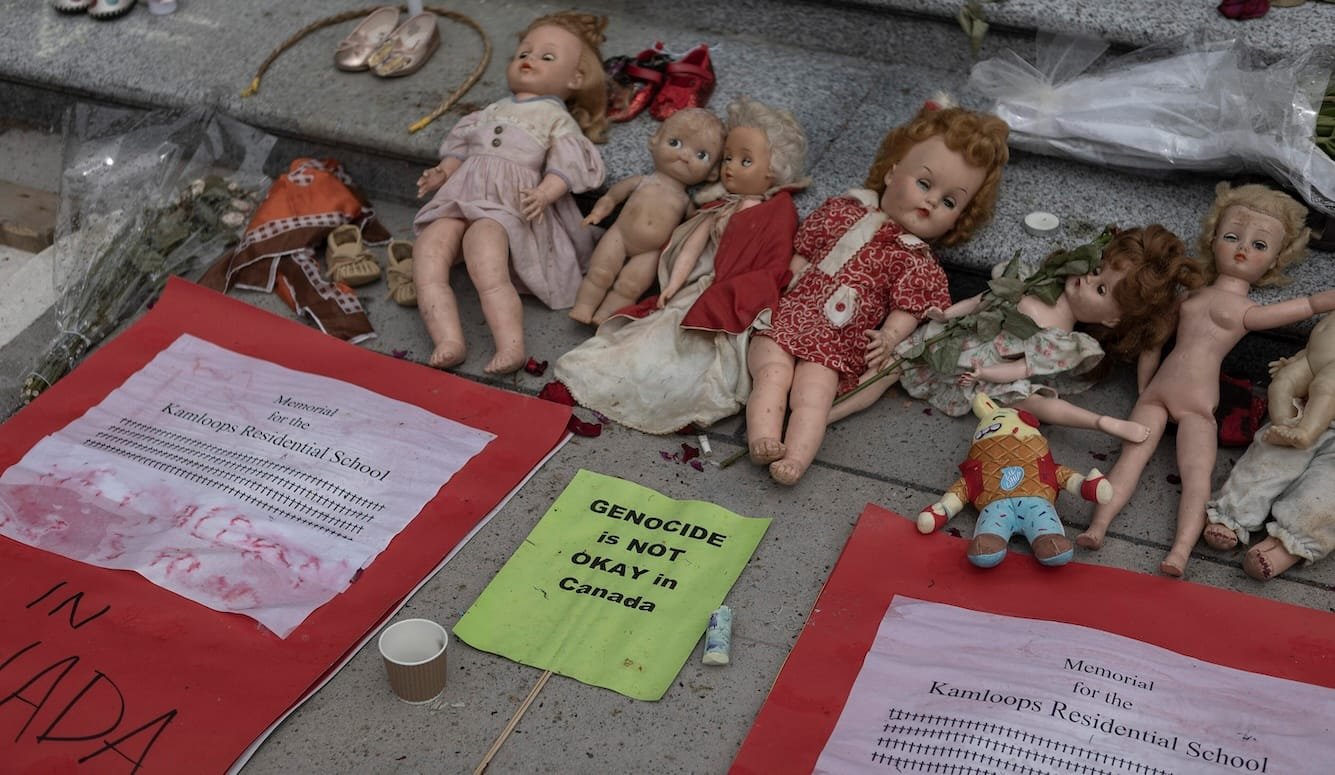
On Wednesday, it will have been exactly five years since the Kamloops First Nation in British Columbia claimed it has found 215 unmarked graves of Indigenous children on the grounds of the community’s former residential school. In the weeks that followed, gullible reporters transformed the narrative into a kind of horror-movie script, complete with mass murdering priests and midnight burials.
It all turned out to be complete nonsense. In five years, not a single actual grave has been found.
The only evidence that had been offered in support of the original claims consisted of a ground-penetrating radar (GPR) survey of the former residential school grounds. As reporters (belatedly) learned, GPR technology merely detects sub-surface soil dislocations—not actual graves. These dislocations can be associated with graves, but also with pipes, rocks, tree roots, and a dozen other common subsurface artifacts. To truly identify actual graves, one must dig—something that the Kamloops First Nation leaders who originally advanced these false claims have conspicuously failed to do; despite having received more than $12-million from Canada’s (equally gullible) government for search activities.
Canada’s 215 Imaginary Martyrs
How will Canadian journalists cover the five-year anniversary of the 2021 ‘unmarked-graves’ social panic without admitting their complicity in promoting a fake story?
In polite Canadian society, it is still considered ideologically outré to admit frankly that none of these supposed “unmarked graves” have been found, or even to suggest that evidence was ever necessary to prove their existence in the first place. From the start of the social panic, these (unidentified) children were cast as sacred martyrs, and their grim fate was attested to by (equally sacred) Indigenous elders who’d claimed to have experienced some kind of mystical “knowing.” The whole movement quickly became an ersatz religious movement for Canada’s upper middle-class lawn-sign set.
In that aforementioned April 21 column, I tried to imagine how Canadian media outlets would square this circle. And this is what I came up with:
We’ll get a lot of studiously vague interview pieces, illustrated with photographic portraits of [Kamloops First Nation chief Rosanne Casimir] or other Indigenous figures staring morosely into the middle distance. These pieces will feature an early passing reference to the original unmarked-graves announcement from Kamloops—that moment of moral ‘reckoning,’ according to the usual stock phrase—but then segue hurriedly to emotional laments about the ‘unfinished work’ of reconciliation. This will be followed by carefully worded references to the ‘doubts’ that some Canadians have about the existence of unmarked graves, and then a substantial section about the scourge of ‘denialism.’
Yesterday, the Globe & Mail—sometimes referred to as Canada’s “newspaper of record”—published its big fifth-anniversary spread, giving me an opportunity to put my predictions to the test. And it turned out that I got things mostly right. Indeed, the words “doubt” and “denialism” are right there in the Globe & Mail’s sub-headline (“Five years after a grim announcement in B.C., uncertainty gives rise to doubt and denialism.”) National “reckoning” gets a shoutout, too. And the Globe & Mail photo pool supplied readers with the obligatory image of a Kamloops First Nations “knowledge keeper” staring resolutely out into space.
But the article also served up a few surprises, which are worth exploring in some detail. The “unmarked graves” farce is arguably the greatest journalistic scandal in Canada’s history. Over the last half-decade, several outlets have (grudgingly, in most cases) admitted that they got the original story wrong—including the National Post, New York Times, and, more surprisingly, the CBC. But many others, including the Globe, had never (to my knowledge) explicitly done so—whether out of embarrassment, fear of being labelled an enemy of Indigenous “reconciliation,” or, more likely, some combination of both. The new Globe article offers clues as to whether the newspaper (and similarly herd-minded legacy media outlets) will ever fully pivot to a genuinely truth-based approach to the subject.
The Globe article has two bylines on it: Patrick White and Willow Fiddler. White is listed as a specialist “on reconciliation and justice issues.” Fiddler is an Indigenous journalist whose beat is “Indigenous Affairs.” In the past, both have written Globe stories that repeat the false claim that “bodies” and “remains” were found at the site of Kamloops’ “unmarked graves.” In neither case have their erroneous stories been corrected or retracted by the Globe.
Back in 2021, for instance, White not only repeated the false claim that “215 children’s remains” had been discovered in Kamloops, but also misinformed Globe readers about what he called “the discovery of 182 human remains in unmarked graves” at another B.C. location. This was fake news then, and it remains fake news now.
Three paragraphs into their new story, however, it begins to appear that the pair will serve up an at least somewhat more fact-based approach: After describing the national meltdown that took place in 2021, they write, “five years on, the country is still trying to understand what it is the First Nation found at the [Kamloops] site, in an old apple orchard.”
But then they confuse things by adding, “the truth remains buried by two acres of dirt and a [First Nations] leadership that has, so far, resisted demands to bring up the dead.”
Those last few words falsely suggest that we know for a fact there are “dead’ to “bring up.” Which isn’t true. And so this introduction comes off as muddled and self-contradictory. As at other points in the article, you get the sense that one editor or writer stepped in to soften, spin, or walk back ideas that another had inserted.
In paragraph five, those detestable “denialists” make their appearance—this being a slur often used to speciously demean anyone who (rightly) points out that no unmarked graves have been found in Kamloops. It’s an obscene word choice meant to suggest a moral equivalence with hatemongers who deny the documented existence of true genocides such as the Nazi Holocaust. And it’s regrettable that the Globe would parrot this kind of language (especially since White and Fiddler, by the very act of admitting the unproven nature of the unmarked-graves claims, have now officially enlisted themselves in the ranks of “deniers”).
This paragraph also repeats the cheap motte-and-bailey trick of conflating real evidence-based critiques of the unmarked-graves social panic (such as the one you are reading here) with claims that Canadians have been victimized by a “vast hoax.” The word “hoax” suggests a deliberate and systematic effort to deceive. But as I have repeatedly stressed in my own articles, the politicians, journalists, and academics who first promoted the unmarked-graves story genuinely believed it was true. Yes, it’s shameful that all of these people were so childishly gullible about the powers of GPR technology. But naiveté and ignorance are different from fraud and deceit.
In paragraph eight, we are informed that “regardless of what they find [in Kamloops], the fact remains that more than 3,500 children are named on the National Centre for Truth and Reconciliation‘s registry of students who died as a result of the residential school system, which operated in Canada for more than 160 years.” This is absolutely true. But it’s also completely irrelevant. No one disputes the information published by the National Centre for Truth and Reconciliation, which, unlike the Kamloops hysteria, was based on careful research. In that case, we have names, birthdays, and other identifying details for the victims. None of that exists in the case of the Kamloops story.
The Globe’s implicit argument here is that it doesn’t really matter all that much if those 215 children actually existed or not, since we have the names of 3,500 other children that can be trotted out for the same purpose—so, at worse, we’re still batting 94% on dead-child statistics.
As my deliberately crude wording here is intended to suggest, the rhetorical trick the Globe is playing here isn’t just misleading, it’s also grotesquely reductionist. The documented deaths at residential schools were largely the result of tuberculosis. While the elevated tuberculosis death rates at residential schools represent a stain on Canada’s national conscience, the issue of substandard public-health amenities is completely distinct from lurid fairy tales in which mass murdering Catholic clerics intentionally dispatch 215 children into shallow graves. Every morally aware adult knows this, notwithstanding the Globe’s effort to blur the two categories.
Much of the material that immediately follows in the Globe article is factual and apt—included an extended section on the limits of GPR technology. To its credit, the Globe reporters admit that the Kamloops First Nations leadership has changed its messaging several times in regard to the 2021 GPR survey, and that Chief Casimir herself has refused Globe interview requests. They also point out that “in Tulsa, Oklahoma, archaeologists [recently] used ground-penetrating radar and oral stories to pin-point what they believed was a mass grave from the city’s 1921 race massacre, [but] when they excavated the area in 2020, they found construction debris, artifacts and dirt, but no remains.” (They might have also pointed out that something similar happened in at least two Canadian locations that Indigenous activists and elders had claimed were full of bodies—Pine Creek First Nation in Manitoba and the site of a former hospital wing in Montreal.)
Following this comes a lengthy section that reads something like a legal brief, defending the Kamloops First Nation from claims that it misused the funds supplied by Ottawa to search for graves. As the Globe notes, the Indigenous band was not technically required to use the money to perform excavations, and was entitled to spend it on office activities such as hiring consultants, performing historical research, hiring communications staff, and so forth. But all of this comes off as a non sequitur: The real scandal at play here was never that a formerly obscure First Nations community in the B.C. interior had misused a few million dollars in government cash. The real scandal was that the entire country was convulsed by a fake story that journalists—including White and Fiddler, of course—should have treated with skepticism from day one.
Moreover, the idea that any community—Indigenous or otherwise—would spend five years blithely doing paperwork while the bodies of 215 murdered children were decomposing a few feet from the earth’s surface at precisely identified locations a stone’s throw away is fantastically absurd.
Remember, this is supposed to be the site of the greatest act of mass murder in Canadian history. Yet the Globe would have us believe that before anyone can lift a shovel, it is first necessary for the Kamloops First Nations to procure “micro-fiche scanners” and perform “1,720 hours of analysis and reporting”—and even then, without any promise that the site will ever be investigated.
Excavations could conceivably begin next year, the Globe reports—something the reporters describe as their “biggest reveal.” In fact, Casimir dangled the possibility of excavations months ago, only to hedge with the caveat that she must first get a “consensus” on the path forward from 119 other First Nations communities in the region. Which gives her 119 possible new excuses to not dig. Instead, Chief Casimir said in a statement, her community may just preserve the location “as a Sacred Site—a place of memory and healing.”
The most honest part of the Globe article comes toward the end, even if Globe editors take the coward’s route by expressing it as a theoretical question instead of a description of the world as it exists: “What if, like the Tulsa archeologists, they ultimately find nothing? The lowered [Canadian] flags, the vigils, the hundreds of millions in government funding, the national reckoning—what if all of it was dedicated to 215 burials that don’t exist?“
The answer, the authors then attempt to suggest—for the second time—is that it doesn’t really matter if the graves exist—not in moral terms, at least. At this juncture, they appeal to an Indigenous “cultural knowledge keeper” named Garry Gottfriedson, who responded to the Kamloops unmarked-graves story by writing poems that purport to catalogue fresh horror stories about the Kamloops residential school. By the Globe’s description, the poems are filled with pseudonyms, hearsay, and unverified accusations. In one of them, a narrator dubiously claims to have walked into a barn and seen a fellow student “hanging dead from the rafters.”
“Regardless of whether there are children in the orchard, there are dozens of school survivors memorialized throughout Gottfriedson’s book,” the Globe assures us. “Their names have been changed, but their experiences of sexual abuse, beatings and death are all true, [Gottfriedson] said.” The poems are presented by the Globe as a morally authoritative guide to understanding how we should all feel about the last five years, while expressing implicit disdain for those heartless “cynics” (such as me, I guess) who “dispute [Gottfriedson’s] poetic testimony” through acts of “denial.”
You’d think that the last five years might have taught the article’s co-authors a thing or two about the perils of signal-boosting exactly this type of lurid tale from the crypt. Then again, the normal rules of proof and logic never really pertained to the Kamloops unmarked-graves movement. Among this religion’s true journalistic believers, the spark of faith may have become dimmer over the last few years, but it has not been fully extinguished.
Quillette invites thoughtful responses to its essays.
Selected responses are published once per week as part of a curated Letters to the Editor feature. If selected, letters appear under the contributor’s real name and may be edited for clarity and length.
To submit a letter for consideration, please email [email protected].
Read the full article here
Fact Checker
Verify the accuracy of this article using AI-powered analysis and real-time sources.