

 Freedom Index
Listen to the article
A review of Constable’s Year: An Artist in Changing Seasons by Susan Owens; 223 pages; Thames & Hudson (January 2026)
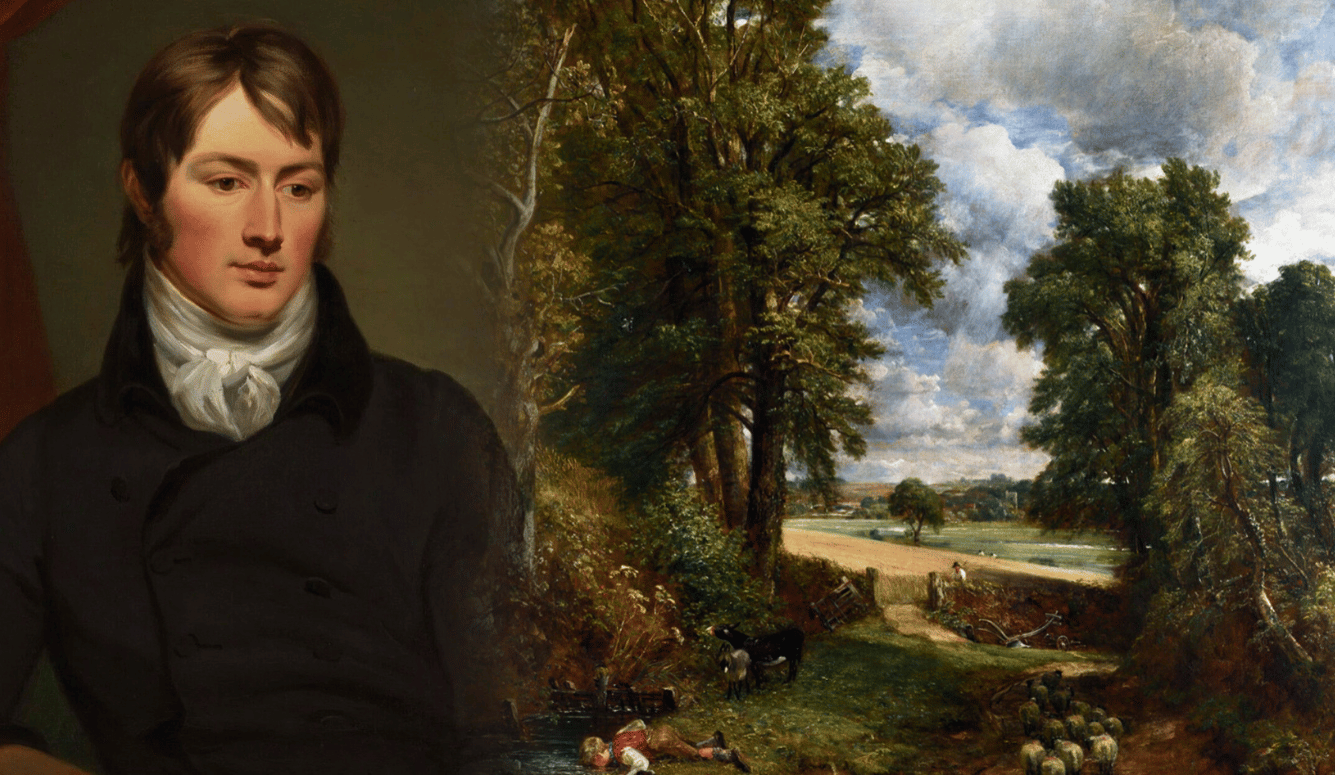
John Constable was born two and a half centuries ago on 11 June 1776, and to mark the occasion, Thames & Hudson has published a handsome new monograph on the artist, replete with prints of his paintings. Constable’s Year by Susan Owens is divided into four sections: Spring, Summer, Autumn, and Winter. This structure is a bit of a gimmick, and it means the story has to jump around a lot, hopping from scenes of Constable’s youth to his late-life and then back again in the space of just a few pages. Nevertheless, Constable’s work was deeply connected to the seasons, so the theme is hardly arbitrary. Nearly all his pictures are set during spring and summer, his favourite time of the year for painting alfresco. Unfortunately, this was also when the Royal Academy held its annual exhibition, which forced him to travel into London when he most wanted to be traipsing through the English countryside. “Mill dams … Willows, Old rotten Banks, slimy posts, & brickwork. I love such things,” he explained. “As long as I do paint I shall never cease to paint such Places. They have always been my delight.”
These days, Constable is generally considered a conservative painter. In part, that’s due to his politics, which were quite conservative. He was a staunch royalist who loathed reform, trade unions, and elected representatives of all stripes. “I hate the Whigs, but the Tories have done the greatest mischief, for it was they that passed the Catholic bill,” he complained in 1836. “Almost all the world is ignorant & vulgar.” Modern critics have sometimes tried to read such sentiments into his paintings, as John Barrell did in his 1980 book, The Dark Side of the Landscape, which accused Constable of being an apologist for the British class system:
The only figures he paints are those of the labouring poor, and there are not many of them. … It was necessary for him to reduce his figures until they merge insignificantly with the landscape, to distance them, and even when they are in the foreground to paint them as indistinctly as possible, to evade the question of their actuality.
Mostly, though, it’s Constable’s subject matter that gets him tagged as a traditionalist. His paintings are windows into a lost world, before the countryside was sullied by highways and high-tension wires. It’s his rival J.M.W. Turner who’s seen as the great innovator of the age. The men were opposites in almost every regard. Turner was a committed bachelor; Constable was a devoted family man. Turner traveled all over the Continent; Constable never left England. Turner’s paintings are like stills from disaster movies; Constable’s landscapes look comparatively staid.
Owens tries to correct that misperception:
In truth Constable was radical: radical in rejecting second-hand, slip-shod versions of nature; radical in subjecting natural phenomena to intense scrutiny; radical in doggedly forging a new kind of painting to fit the landscape he saw with his farmer’s eye and felt beneath the soles of his boots. He spent his career taking a stand against convention, against habit, against all the tricks and mannerisms that had made art stale.
She’s right, if a little light on specifics. In the early 19th century, it was thought that brushwork ought to be invisible. Bristle lines and impasto were taboo in European painting. Viewers were not supposed to notice artists’ technique. Constable challenged that convention. “Disrupting centuries of academic practice, [Constable] smashed through the assumption that a painting should act like a mirror,” Nicola Moorby observed in her excellent double-headed biography, Turner and Constable, published last year. “No longer was it needful for paint to form a flawless skin on canvas—a mimetic carapace indistinguishable from reality. Now, brushstrokes could be the most visible part of a painting, even to the point of obscuring the intended subject.”
Contemporaries often griped about the “spottiness” of Constable’s brushwork. There are “scattered and glittering lights that pervade every part [of the picture],” one reviewer said of his 1821 masterpiece The Hay Wain. To the modern eye, though, Constable’s brushwork doesn’t look spotty; it looks ahead of its time, calling to mind the paintings of the great French Impressionists from the latter half of the century. Notice how the light catches the iron rims of the wagon wheels in The Hay Wain and the thunderclouds gathering overhead. Looking at the picture, you can almost feel the humid summer air, hear the water trickling over the rocks, and smell the coming rain.
Constable’s Impressionistic tendencies are even more evident in his sketches, the quick oil studies he made for future reference or simply for the pleasure of painting them, rather than for exhibition at the Royal Academy. In his lovely 1816 sketch of Bowleaze Cove, the foamy water near the shore is rendered in thick, lumpy swirls of white. A man and a woman stand together on the beach, looking at the stormy sea. Though they are comprised of no more than a few daubs of paint, they are each remarkably distinct. The man, dressed in black, is leaning forward into the wind, while the woman, presumably his wife, is holding a parasol out in front of her, shielding herself from the spray. She has a pink shawl or scarf around her shoulders, and her white dress is luffing about her like an untrimmed sail. Observed Moorby:
So whilst on face value alone it looks like it must have been Turner who anticipated Impressionism, it was actually Constable who had the more direct impact. His insistence on capturing a given moment in time closely anticipated the movement’s ethos, and by only painting what he could see he provided an important precedent of unidealized landscape.
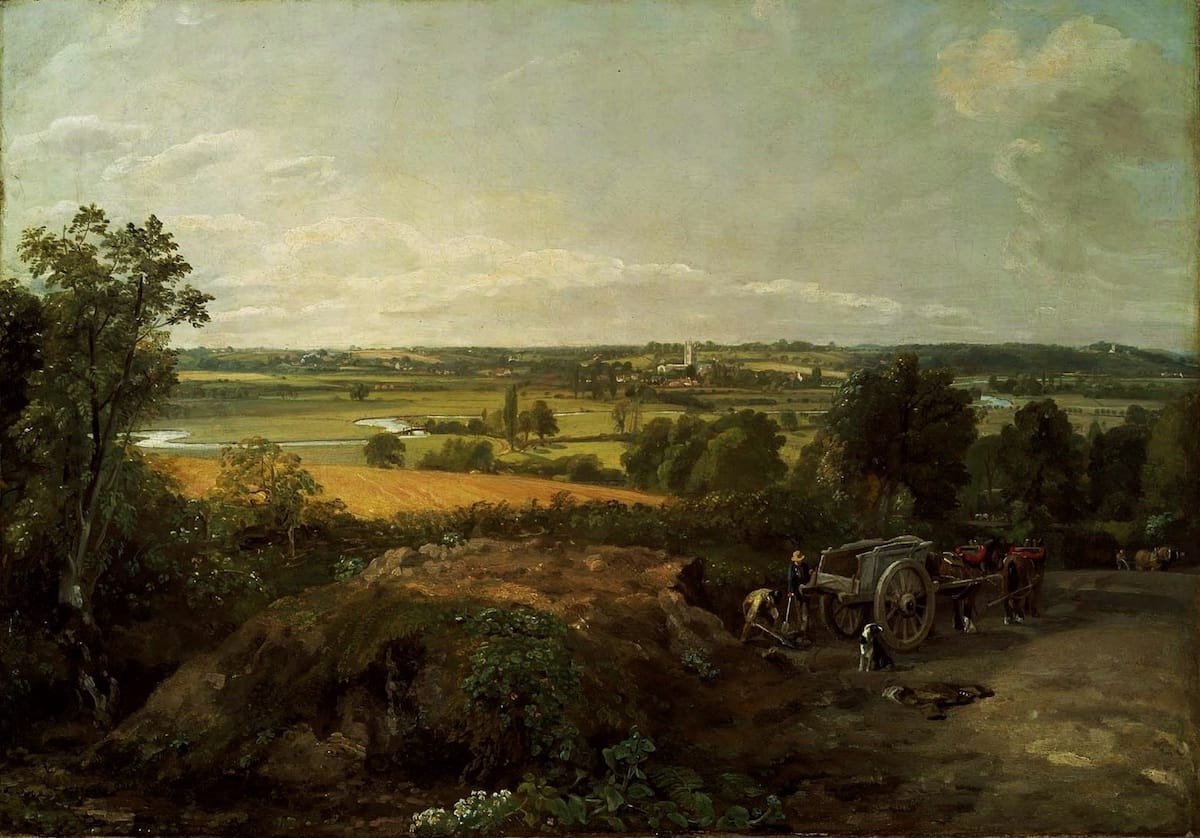
She may have been thinking of Constable’s 1815 painting Stour Valley and Dedham Church when she wrote that last sentence. In the foreground of the picture, we see two men loading the mulch from a dungle into the back of a horse cart. For those who don’t know, a dungle is a giant mound of manure, which farmers would accumulate for months, then use as fertiliser when planting season came. In other words, it’s a picture of men shoveling shit, and while it’s not as unattractive as it sounds, it puts the lie to John Barrell’s claim that Constable had no feeling for the working poor.
Look at the carpenters in Boat-Building near Flatford Mill (1815) or the boys towing the barge across the Stour in Flatford Mill: Scene on a Navigable River (1816-17). In each case, we see professionals performing hard, highly technical tasks—and performing them well. Yet, unlike Camille Corot (1796–1875), the great French landscapist to whom he is often compared, Constable didn’t feel the need to gussy up his pictures with Greek columns or naked maidens frolicking in brooks. He painted the world as it was, dungles and all.
Poetic Justice
How an octogenarian artist defied curatorial bureaucracy.
In 1816, at the age of forty, Constable wed Maria Bicknell, a fetching young woman twelve years his junior. He could have gotten married earlier if he’d had a mind to. As a young man, he’d been quite a dashing fellow, as you can see in Ramsay Richard Reinagle’s 1799 portrait of him, which makes Constable look a bit like Hugh Grant in Sense and Sensibility (1995), complete with rosy cheeks, floppy hair, and fluffy white cravat.
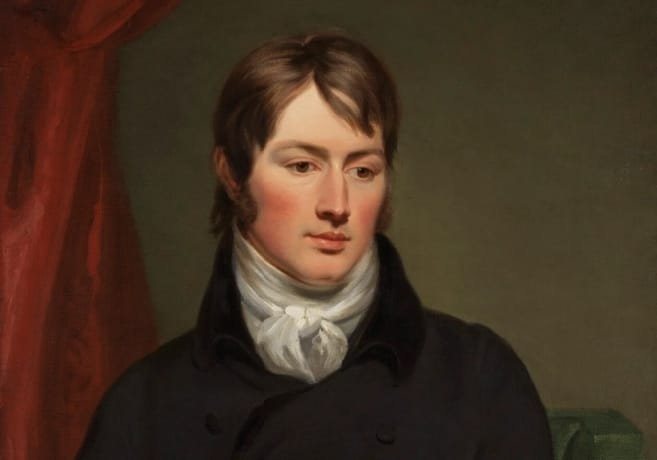
Around his hometown of East Bergholt, women called Constable “the handsome miller.” But he was devoted to Maria, and he waited out her intransigent family, who refused to permit the couple to marry for seven years. After the couple finally tied the knot, they quickly made up for lost time, producing seven children (four boys, three girls) in eleven years. By all accounts, Constable was a tender husband and father. Having often been lashed as a child, he refused to let his own children suffer the same fate. “Oh! My dear pet!” he exclaimed, when one of his sons put a broomstick through an unfinished painting. “Dear, dear! What shall we do to mend it? I can’t think—can you?” Maria’s death from consumption in 1828 clearly devastated him. “I shall never feel again as I have felt,” he wrote to his brother, “the face of the World is totally changed to me.”
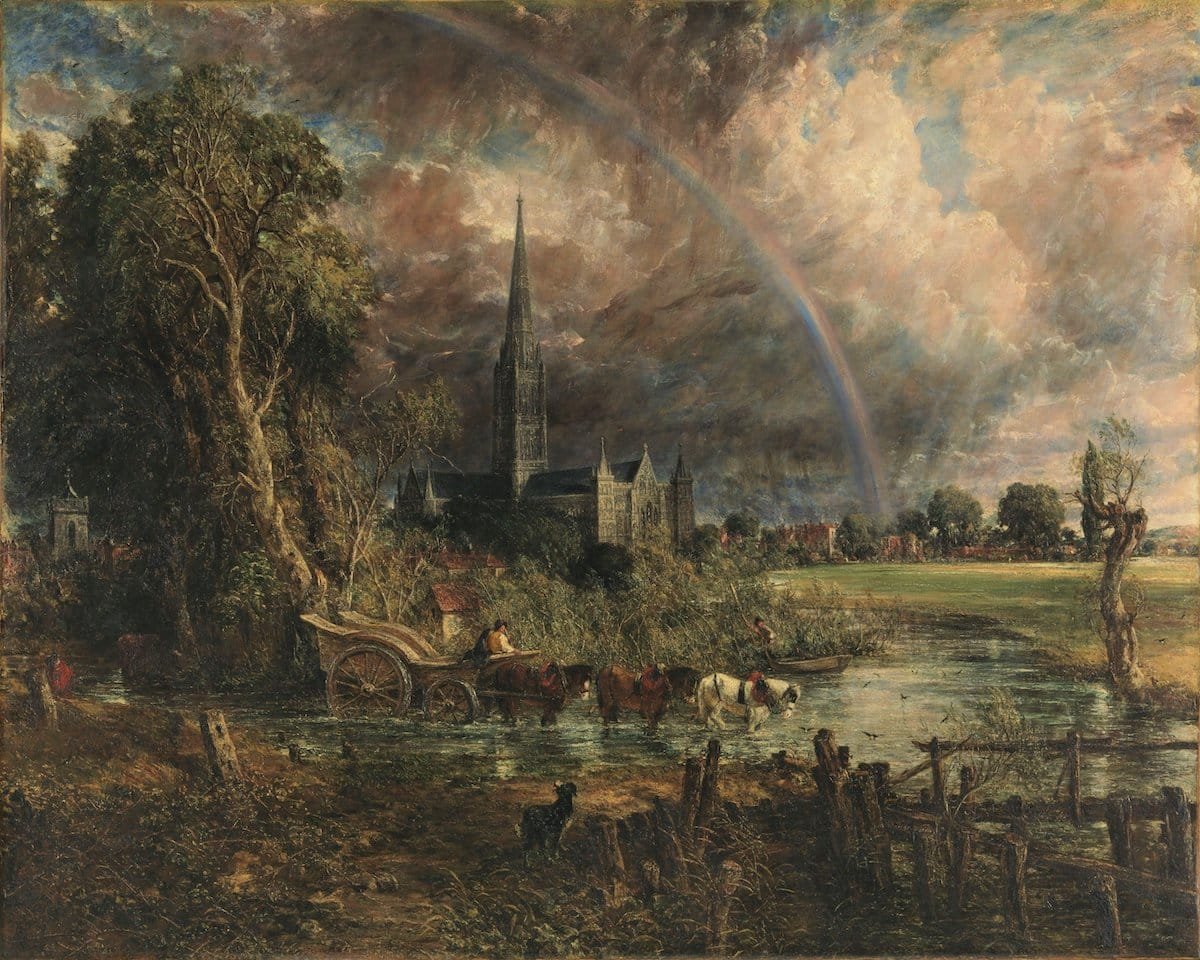
He was, it turned out, exaggerating only slightly. While his paintings didn’t completely change after Maria’s death, they did assume a darker complexion, as you can see in Salisbury Cathedral from the Meadows (1831). Contemporary reviewers hardly knew what to make of the painting. Many compared it unfavourably to the work of Turner, suggesting that Constable was trying to imitate his more bombastic rival. “If Mr. Turner and Mr. Constable were professors of geology,” the Literary Gazette opined, “the first would certainly be a Plutonist, the second a Neptunist … the one all heat, the other all humidity.” They had a point. One of the things that distinguished Constable as a painter was that, generally speaking, he didn’t go in for dramatic imagery. Turner’s success was due in no small part to the fact that he gave the public what it wanted, filling his canvases with storms and shipwrecks and battles. Salisbury Cathedral from the Meadows aside, Constable eschewed theatrics of this sort. His art, as he observed, was “to be found under every hedge, and in every lane, and therefore nobody thinks it worth picking up.”
Despite the slimness of Owens’s book, a third of which is illustrations, the author does a good job of emphasising this point, which modern viewers often miss when they look at Constable’s paintings. While his contemporaries roamed the Continent in search of spectacular vistas, he stayed at home and found beauty in the ordinary world around him—Brighton beach, Hampstead Heath, and the drydocks around his father’s watermill. Today, it’s easy to underestimate how daring this was because so many subsequent painters followed Constable’s lead. The famous Barbizon school—which included Théodore Rousseau, Jean-François Millet, and Camille Corot—began life in the summer of 1824, when The Hay Wain and View on the Stour near Dedham were first exhibited in Paris. As the critic P.G. Hamerton observed in 1890, “Almost all of Constable’s sketches have a French air; the reason being, not that Constable imitated foreign art, for he was British to the backbone, but because he is the father of genuine nature-study amongst French landscape painters, and they have been led into his ways of study, which have now become almost universal amongst them.”
Owens ends her book by decrying the effects of industrialisation on the climate, suggesting that Constable would have hated to see how despoiled the English landscape has become in the nearly two centuries since his death. She’s almost certainly right, although I doubt he would have had much sympathy with the Just Stop Oil protesters who glued themselves to the frame of The Hay Wain in 2022. As much as he loved the natural world, he hated radicals with an equal intensity. The irony, of course, was that Constable was himself much more radical than he was willing to admit, not in his politics but in his art, which he refused to mould to the standards of his time. When friends encouraged him to take his easel to the Netherlands or the Alps or the other places to which painters flocked, he dismissed the suggestion. “I have a kingdom of my own both fertile & populous,” he explained. “My landscape and my children. … Am I doomed never to see the living scenes—which inspired the landscape of Wilson & Claude Lorraine? No! but I was born to paint a happier land, my own dear England.”
Quillette invites thoughtful responses to its essays.
Selected responses are published once per week as part of a curated Letters to the Editor feature. If selected, letters appear under the contributor’s real name and may be edited for clarity and length.
To submit a letter for consideration, please email [email protected].
Read the full article here
Fact Checker
Verify the accuracy of this article using AI-powered analysis and real-time sources.