Close Menu
FSNN | Free Speech News NetworkFSNN | Free Speech News Network
  • Home
  • News
    • Politics
    • Legal & Courts
    • Tech & Big Tech
    • Campus & Education
    • Media & Culture
    • Global Free Speech
  • Opinions
    • Debates
  • Video/Live
  • Community
  • Freedom Index
  • About
    • Mission
    • Contact
    • Support
Trending

Illinois lawmakers pass bill aimed at protecting public media outlets at public universities

9 minutes ago

U.S. CFTC secures deal with National Hockey League on prediction market safeguards

10 minutes ago

Bitcoin Trader Sees Breakout Move ‘Soon’ With BTC Circling $77,000

11 minutes ago
Facebook X (Twitter) Instagram
Facebook X (Twitter) Discord Telegram
FSNN | Free Speech News NetworkFSNN | Free Speech News Network
Market Data Newsletter
Thursday, May 21
  • Home
  • News
    • Politics
    • Legal & Courts
    • Tech & Big Tech
    • Campus & Education
    • Media & Culture
    • Global Free Speech
  • Opinions
    • Debates
  • Video/Live
  • Community
  • Freedom Index
  • About
    • Mission
    • Contact
    • Support
FSNN | Free Speech News NetworkFSNN | Free Speech News Network
Home»News»Global Free Speech»CPJ, partners call on incoming Guatemalan attorney general to end persecution of journalists
Global Free Speech

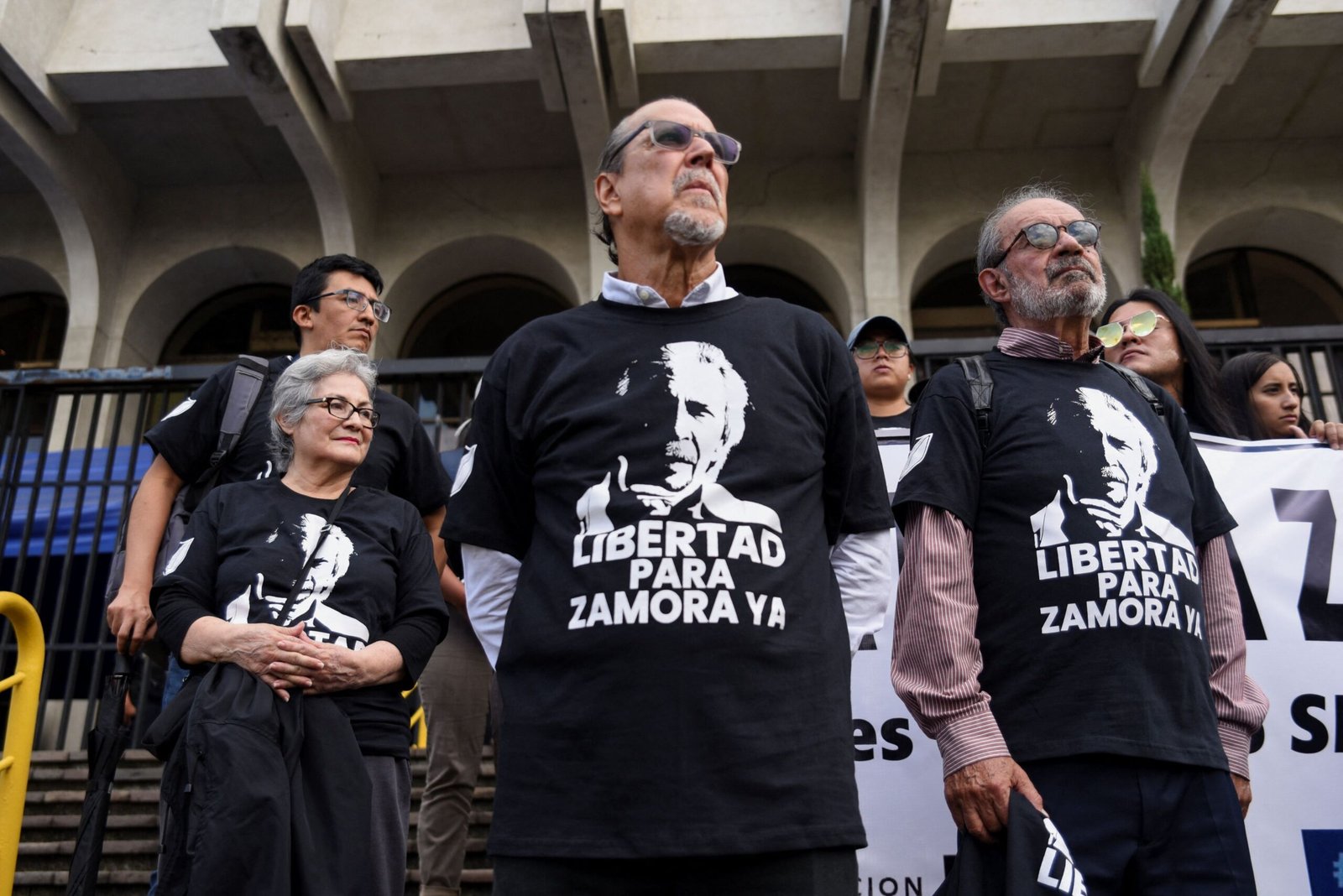
CPJ, partners call on incoming Guatemalan attorney general to end persecution of journalists

News RoomBy News Room2 hours agoNo Comments1 Min Read1,976 Views
Share Facebook Twitter Pinterest Copy Link LinkedIn Tumblr Email VKontakte Telegram
CPJ, partners call on incoming Guatemalan attorney general to end persecution of journalists
Share
Facebook Twitter Pinterest Email Copy Link

Listen to the article

0:00
0:00

Key Takeaways

Playback Speed

Select a Voice

In a joint letter led by the Committee to Protect Journalists, eight international press freedom and human rights organizations urged Guatemala’s incoming attorney general, Gabriel García Luna, to end the use of criminal prosecutions against journalists, drop politically motivated cases, and ensure safe conditions for exiled reporters to return.

Over the past eight years, the Public Prosecutor’s Office has been used to systematically target independent journalists through legal harassment, forced exile, and arbitrary detention. Journalist Jose Rubén Zamora, whose imprisonment has been widely condemned as retaliation for his corruption reporting, has become the most visible symbol of this crackdown. More than 20 journalists fled the country between 2022 and 2023, while killings of media workers continue with near-total impunity.

The organizations call on García Luna to dismiss all unfounded cases tied to journalistic work, guarantee safe return conditions for exiled reporters, and restore the independence and credibility of the prosecutor’s office.

Read the full statement here.

Read the full article here

Fact Checker

Verify the accuracy of this article using AI-powered analysis and real-time sources.

Get Your Fact Check Report

Enter your email to receive detailed fact-checking analysis

5 free reports remaining

Continue with Full Access

You've used your 5 free reports. Sign up for unlimited access!

Already have an account? Sign in here

Share. Facebook Twitter Pinterest LinkedIn Tumblr Email Telegram Copy Link
News Room
  • Website
  • Facebook
  • X (Twitter)
  • Instagram
  • LinkedIn

The FSNN News Room is the voice of our in-house journalists, editors, and researchers. We deliver timely, unbiased reporting at the crossroads of finance, cryptocurrency, and global politics, providing clear, fact-driven analysis free from agendas.

Related Articles

Global Free Speech

CPJ calls for humane treatment, release of press detained aboard Gaza-bound flotilla

3 hours ago
Global Free Speech

Kurt Vonnegut and his daughter Nanette in 1997. Photo: Family handout This article first appeared in the Spring 2026 issue of Index on Censorship, The monster unleashed: How Hungary’s illliberal vision is seducing the Western world published on 2 April 2026. “My mother warned me early on that my father was going to get in trouble for writing dirty books.” Nanette Vonnegut, youngest daughter of the late American novelist Kurt Vonnegut, remembers these words vividly. Even though she was around eight years old at the time, she recognised the real fear in her mother’s voice. At the time, she didn’t quite know what to do with the warning. But through a serendipitous encounter, she now has a much better idea. When she was invited, along with her brother, to represent the Vonnegut Estate at a meeting about book censorship hosted by publisher Penguin Random House, she had what she describes as a conversion experience. Now, she is taking on the State of Utah alongside other plaintiffs, in a case defending the freedom to read, filed by the American Civil Liberties Union (ACLU) of Utah Foundation. “I was blown away by the urgency,” she told Index, recalling the passion and bravery of the librarians and lawyers who spoke at the meeting. Each person took their turn to make a speech, “like one sermon after another”. Vonnegut spoke about her own childhood memories, when she was afraid of what might happen to her father. One speaker in particular, she remembered, described how book bans in the USA are not about words or even sex, but about ideas. “Not until now, did I ever feel afraid for what’s going on. These books in Utah are being thrown away. They’re just pulled off the shelves,” Vonnegut said. But this, she added, has always been a lurking threat. No sex please, we’re prudish At the meeting, she discovered that in Utah, any mention of sex in a book was sufficient reason for it to be pulled from any school library in the state. Kurt Vonnegut’s Slaughterhouse-Five, an anti-war novel first published in 1969, remains hugely controversial; it has already been banned in two school districts in Utah, labelled as pornographic. If the book is successfully challenged in a third district, the ban automatically becomes state-wide, as has already happened with 28 other books. Nanette Vonnegut can’t recall the book being particularly pornographic in nature. Interviewed on National Public Radio, Terry Hutchinson, a former member of a Utah schoolboard, said: “I am not a big Kurt Vonnegut fan. Not really because of subject matter, but because of style.” He believed that Slaughterhouse-Five should be removed from school libraries. For him, the book crossed the line when a character gets an erection. When Vonnegut and her attorney Tom Ford were invited to discuss the lawsuit on WHMP Radio, Ford explained that Utah’s book removal law, HB29 (passed in 2022 and amended in 2024), prohibits public school libraries from carrying any book that contains a description of a sex act. In Vonnegut v. Utah, the plaintiffs will argue that sections of HB29 are overbroad and in violation of First Amendment rights. “It prohibits a remarkably sweeping range of literature from every school library in the state,” Ford told the radio station. Appropriate age categories are irrelevant where this law is concerned – all sex is bad sex. The law itself, Ford said, springs from the false narrative created by conservative lawmakers in Utah that the state’s school libraries were full of pornographic books. In fact, Ford continued, the real targets of this censorship were ideas, messages and lived experiences. The earliest memory Vonnegut has of her father being a target of literary censorship is not one of quiet removal from a library shelf, but rather something more dramatic. In 1973, a school in Drake, North Dakota threw copies of Slaughterhouse-Five into its furnace. The books were burnt on the orders of the local school board, which had deemed the novel “profane”. Ironically, Vonnegut’s novel was inspired by his experiences as a prisoner of war in Germany during the Second World War. Before the war the Nazis had organised public burnings of books that they deemed “un-German”. Kurt Vonnegut wrote a letter to the school in response. “You can feel his rage and his hurt,” his daughter told Index, recalling the letter. Putting the Vonnegut name to good use Now, she said, she can’t believe that book banning is back in the USA, and “worse than ever”. She fears for the teenagers who don’t have access to the right resources and how much trouble it’s going to leave them in. For the first time, she feels she can really put her Vonnegut name to good use. Nanette Vonnegut grew up in a creative household, with her mother guarding the door to protect her father’s writing space. “You were scared of that door, because you knew that he was he was trying to write.” He worked hard, she remembered, all the time, and there was a sense that it was serious work. She described to Index how her father would come out from his writing for a snack (usually pumpernickel loaded with butter). The kitchen would be full of the kids and their friends, but he’d barely register them. Often, he would be muttering to himself; sometimes, he’d stop and talk to his youngest daughter, verbally working through an idea. Once, on his way back to his study, he paused and said to her: “You know, the unstructured life is not worth living.” Kurt rarely left the house. His wife, Jane Marie Cox, maintained the family’s social front by doing all the expected things like going to cocktail parties and playing tennis. She was his biggest supporter. Cox was passionate about reading too, and the Vonnegut house was always full of books. At the end of each day, the couple would discuss Vonnegut’s day of writing. “She was like his editor,” Nanette said, describing how when it came to stories, “she was the midwife.” A Vonnegut family trip Niagara Falls circa 1964. Photo: Family handout Memories of Slaughterhouse-Five Her father, she explained, was always writing to tell the truth. Slaughterhouse-Five was a particular challenge, because he struggled to get the information he needed about the fire-bombing of Dresden, which he had experienced. When he did finally finish the book, he left the galleys out for the children to read. When it was published, he became an overnight sensation. It was a writer’s house, and as the children got older, it became a party house too. According to Nanette Vonnegut, “It was a very heady, exciting time.” Her parents often had other creatives over at the Vonnegut home. Once, it was actor and director Peter Fonda, to talk about film rights for Vonnegut’s book Cat’s Cradle. Jack Kerouac, author of On The Road, visited before he was famous. After having a little too much to drink, his bad language ramped up. Nanette and a friend, aged around nine, were told to leave the room and go upstairs. “But we did not go upstairs,” she recalled. “We stayed behind the door. It was sort of thrilling and exciting. He was like a wild man, and he seemed to be a lot of fun. We didn’t want to miss any of it.” Growing up in this household, she internalised a strong faith in the creative process. She has inherited this “creative groove” as an artist. Take, for example, the day she snapped, for no particular reason, a photo of the Senate floor being shown on a television screen. A few days later, on 6 January 2021, came the US Capitol riot. Following her creativity, Vonnegut created a huge six-foot painting (opposite) from the photograph. Although mostly found in her art studio, Vonnegut feels a strong sense of the power of words, and is a writer too. “Words are the most sacred things that we have, and that’s something I grew up with,” she told Index. And above all, evident in her fight against Utah, she has always taken for granted the belief that there are no “dirty words”. READ MORE

6 hours ago
Global Free Speech

CPJ, RSF warn Iran using 83-day blackout to hide press crackdown

7 hours ago
Global Free Speech

Are you our new senior editor? Index is on the hunt for a new senior editor to work at the heart of our editorial team across our magazine and website. This is an exciting opportunity at a time when Index is launching a membership scheme and redesigning its magazine and website. Reporting to the editor, you will be expected to edit agenda-setting essays, columns, features and investigations. The right candidate will have excellent judgement and editing skills and be a deep thinker. You will be confident working with some of the biggest names in journalism and the arts, as well as committed to finding and commissioning underrepresented voices and stories.  A non-tribal outlook is essential: Index is non-partisan and its only “cause” is that of promoting free expression and examining censorship. The right candidate will combine curiosity with excellent attention to detail. You will support the editor with the production and editing side of the magazine and website as well as commissioning a larger network of freelance contributors around the world, alongside sub-editors, illustrators and designers. The new senior editor must be equally at home working on print and digital-only journalism and analysis. The role demands someone who is just as comfortable writing a grabbing web headline as they are editing a 2,000-word essay. Regular writing opportunities are also available. About Index Index on Censorship is Britain’s leading organisation that campaigns for, reports on and defends free expression worldwide. We publish work by censored writers and artists, promote debate and monitor threats to free speech. Our work is varied and always rewarding. On any given day, we could be publishing letters written by Belarusian political prisoners and defending a cartoonist who might have caused offence – all to make the case that freedom of expression is vital for liberal democracy and for a vibrant and creative society. At the organisation’s heart and in circulation since 1972 is an award-winning quarterly magazine that has featured some of the world’s best-known writers. In addition to the magazine is a website, a weekly newsletter, a policy arm and an events programme. Together they make Index what it is today – the go-to for information on the global free speech landscape. Specific responsibilities Edit articles and analysis for the magazine and upload copy for the website and other digital platforms Coordinate with contributors from around the world to ensure news articles, analysis and essays are of high quality and on time Manage the weekly newsletter to Index subscribers Commission content for the magazine and web stories including photographs, cartoons and the cover illustration Write articles and analysis for the magazine and website Operate the content management system for publication of written stories Lead on a website refresh and support the redesign of the magazine so they have an overall look and brand that work together Monitor analytics across written content (web and magazine), adjusting strategy to optimise KPIs, membership and grow our audience Work with the communications manager on developing new formats including more use of video and audio to tell stories, through experimentation and data-driven decision-making Forge partnerships with creators globally and digital platforms to expand Index’s reach and engagement Represent Index at events, panels or media appearances where appropriate Support the editor with general commissioning, editing and proof-reading  for the magazine and when needed Knowledge Excellent editing and commissioning abilities, with attention to style, accuracy and tone Deep knowledge of the principles of digital and magazine journalism Strong digital acumen, including familiarity with SEO, analytics tools and CMS platforms Understanding of website design and how to improve it Knowledge of other digital platforms Proven ability to write authoritative magazine and online articles and analysis Knowledge of UK and global affairs and the principles of censorship and free speech issues in the UK and globally Skills (essential) Experience working for a magazine and/or online digital platform The ability to work under deadline pressure Excellent written and verbal communication skills Strong communication skills to work collaboratively with contributors in a small team Prior experience managing contributors Experience of identifying content that will grow a digital audience while driving membership of the organisation The ability to recognise sensitive or potentially libellous issues and raise them for discussion Experience in web publishing, including using content management systems such as WordPress Strong organisational skills and the ability to thrive in a small team The initiative to identify tasks and to work independently Ability to commission articles by and defend the right to free speech for people with whom you personally fundamentally disagree or believe are wrong Preferred Understanding of international affairs Experience working with writers whose first language is not English Familiarity with the Economist style book Experience managing newsletters Proficiency in at least one major language other than English Hours: Full-time, contract Salary: £35,000 – £42,000 dependent on experience Location: Remote but with lots of travel to London Index is a small and ambitious organisation that values diversity. We are committed to equal opportunities and welcome all applicants regardless of ethnic origin, national origin, gender, gender identity, race, colour, religious beliefs, disability, sexual orientation, age or marital status To apply please send a cover letter with your CV by Friday 19 June 2026 to [email protected] If you want to find out more about the job please email the editor on [email protected] READ MORE

7 hours ago
Global Free Speech

Journalist Yelis Ayaz arrested in Turkey for ‘spreading disinformation’

23 hours ago
Global Free Speech

A social video about Reform’s policy on immigration centres. Image: www.instagram.com/zia.yusuf/ We did warn that the Online Safety Act would chill free speech and vehemently opposed the legislation for that reason. We said the remit of the act was too wide and that perfectly legitimate legal points of view would be shut down under its provisions. And we are beginning to see that happening and beginning to see also how it will be used politically, by all sides. GB News on the right and The Canary on the left have both blogged about the case of Zia Yusuf the Reform spokesman on home affairs who had two recent TikTok videos taken down from the platform. GB News in outrage, and The Canary saying the platform was quite right to do so because Reform policies amount to  “hateful behaviour”. It all started when Yusuf told his X followers that a video of him saying that Reform would put migration centres in Green-voting areas – and which Yusuf claims had millions of views on other social media channels – had been taken down by TikTok which cited the Online Safety Act for their decision. Then a second video was removed – also by TikTok a couple of days ago. Here Yusuf was saying some unpleasant, but not illegal things, about migration ie that Reform would deport everyone who is in the country illegally including foreign nationals committing crimes and those not paying their way. TikTok  said it had acted on a complaint by a user. In this case, the platform first cited the Online Safety Act and then said that the video contained “hate speech and hateful behaviour”. Yusuf was also furious that TikTok threatened to remove him from the platform altogether if he committed further “offences”, blasting the Conservatives for pretending to pass legislation to protect children, when in fact the law was “silencing voices the open-borders political establishment don’t like”. Enter Nadine Dorries, the erstwhile Conservative Culture minister, today a Reform champion and Daily Mail columnist who steered the legislation through parliament and now says it has to be consigned “to the dustbin where it now belongs” because it is silencing her colleagues. Yusuf’s video, by the way, has now been restored. None of this would have happened without the Online Safety Act – and this is exactly how we warned the legislation would be used – to shut down legitimate debate. Unless speech is aired in a public forum, it cannot be challenged. And the implications go wider. What about other types of speech in the future, on the left say? Will these videos too be challenged by the TikTok community for being “hateful” or “causing public disorder”? Will there by a tit-for-tat war now with political players on all sides trying to shut down the speech of their opponents, because that’s what the Online Safety legislation is enabling. Maybe that’s what the Chinese-owned company TikTok wants – believing as the Chinese Communist Party does that liberal democracies cause chaos –   but perhaps that’s a conspiracy theory too far. The spat has certainly fuelled the suspicions of many Reform voters that there is liberal establishment trying to shut down ideas they don’t like. And we agree, that’s exactly what it looks like. Free expression means nothing if it is not for all. READ MORE

1 day ago
Add A Comment
Leave A Reply Cancel Reply

Editors Picks

U.S. CFTC secures deal with National Hockey League on prediction market safeguards

10 minutes ago

Bitcoin Trader Sees Breakout Move ‘Soon’ With BTC Circling $77,000

11 minutes ago

Crypto Exchange Kraken Secures VARA License to Launch in Dubai

15 minutes ago

Is the DHS Tracking ICE Critics? The Public Deserves Answers.

54 minutes ago
Latest Posts

A crypto betting platform may have leaked U.S. military secrets before a surprise attack on Iran, experts warn

1 hour ago

IG Europe Partners With Bitpanda to Bring Crypto Trading to European Investors

1 hour ago

‘The Sandbox’ Co-Founder’s Wife Targeted in Crypto Kidnapping Attempt: Report

1 hour ago

Subscribe to News

Get the latest news and updates directly to your inbox.

At FSNN – Free Speech News Network, we deliver unfiltered reporting and in-depth analysis on the stories that matter most. From breaking headlines to global perspectives, our mission is to keep you informed, empowered, and connected.

FSNN.net is owned and operated by GlobalBoost Media
, an independent media organization dedicated to advancing transparency, free expression, and factual journalism across the digital landscape.

Facebook X (Twitter) Discord Telegram
Latest News

Illinois lawmakers pass bill aimed at protecting public media outlets at public universities

9 minutes ago

U.S. CFTC secures deal with National Hockey League on prediction market safeguards

10 minutes ago

Bitcoin Trader Sees Breakout Move ‘Soon’ With BTC Circling $77,000

11 minutes ago

Subscribe to Updates

Get the latest news and updates directly to your inbox.

© 2026 GlobalBoost Media. All Rights Reserved.
  • Privacy Policy
  • Terms of Service
  • Our Authors
  • Contact

Type above and press Enter to search. Press Esc to cancel.

🍪

Cookies

We and our selected partners wish to use cookies to collect information about you for functional purposes and statistical marketing. You may not give us your consent for certain purposes by selecting an option and you can withdraw your consent at any time via the cookie icon.

Cookie Preferences

Manage Cookies

Cookies are small text that can be used by websites to make the user experience more efficient. The law states that we may store cookies on your device if they are strictly necessary for the operation of this site. For all other types of cookies, we need your permission. This site uses various types of cookies. Some cookies are placed by third party services that appear on our pages.

Your permission applies to the following domains:

  • https://fsnn.net
Necessary
Necessary cookies help make a website usable by enabling basic functions like page navigation and access to secure areas of the website. The website cannot function properly without these cookies.
Statistic
Statistic cookies help website owners to understand how visitors interact with websites by collecting and reporting information anonymously.
Preferences
Preference cookies enable a website to remember information that changes the way the website behaves or looks, like your preferred language or the region that you are in.
Marketing
Marketing cookies are used to track visitors across websites. The intention is to display ads that are relevant and engaging for the individual user and thereby more valuable for publishers and third party advertisers.