

 Freedom Index
Listen to the article
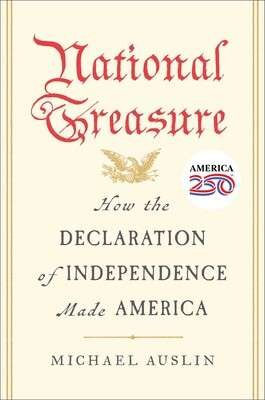
[This post is excerpted from the new book, National Treasure: How the Declaration of Independence Made America (Avid Reader Press/Simon & Schuster).]
Partisanship has plagued American society since before Independence. John Adams notably claimed that at the time of the Revolution, “one full third were averse to the Revolution,” one-third in favor, and a final third swinging between the other two.[i] Yet the idealism that inspired the main voices for Independence led them to plant their flag firmly in the soil of an American “civic friendship” that was long a living tradition in local and colonial assemblies.
In the colonial era, such a concept of civic friendship and equality was inherent in the practice of local representation. The signers of the Mayflower Compact in 1620 agreed to “covenant and combine ourselves together into a civil Body Politick, for our better Ordering and Preservation… for the general Good of the Colony.”[ii] Their bonds preceded the society they were going to build. In doing so, they reflected civic friendship as outlined by Aristotle, in which a “friendship of utility,” citizens combine to pursue their self-interest. In doing so, they work in harmony for the good of the city (polis) and their fellow citizens in it. Practically, citizens accept the political reality of ruling and being ruled in turn, as each trusts each to do the best for the community. Ultimately, such reciprocity creates the condition of civic equality.[iii]
By a century and a half later, Thomas Paine had shifted the direction of influence, writing in Common Sense that “[Society] promotes our happiness positively by uniting our affections…”[iv] On Paine’s view, it is society itself that creates feelings of civic unity by which common goals can be achieved. By the mid-1770s, self-government had come to be consciously understood as the only legitimate form of political system that can lead to both unity and shared civic goals.
This was thrown into sharp relief once the colonists found themselves in conflict with King and Parliament. The imposition of the Intolerable Acts in 1774 after the Boston Tea Party introduced a new political element that erased both self-government and reciprocity. If civic friendship, on Aristotle’s view, operated through the act of ruling and being ruled in turn, then direct British rule in Massachusetts made such a relationship and concern for the good of the colony an impossibility. Not only was self-rule removed, but the colonies could of course never hope to rule Britons in turn. The civic relationship was both transformed and made fundamentally unequal and unfair.
Despite nearly 170 years of a common culture and intimate social ties between the British American colonies and Great Britain, as well as vital economic links that benefited both societies, direct British intervention in Massachusetts both activated a sensitivity to the grounds of civic friendship (i.e., reciprocity and fair play) and an awareness that there could be no such feelings under the current conditions. This was a civic puzzle that could not be solved short of Independence, for a superior layer had been imposed on a balanced local system.
Moreover, British intervention and ultimately military action now forced the question of continental (i.e., national) solidarity, transcending age-old colonial boundaries and sovereignty. Not just individual colonial civic structures were being transformed, but the borders between them were being subjected to a new and unfamiliar stress. Generations of civic friendship within colonies were at one and the same time being made politically impotent by British intervention and mutated into a new national civic solidarity.
This unique and unprecedented historical crisis found its ultimate expression in the Declaration of Independence. Such explains Thomas Jefferson’s rhetorical approach of seeking both to unite disparate colonial Americans and permanently sever them from their “Brittish brethren.” In dealing with the British, the full flood of Jefferson’s rage was reached in his famous rough draft of the Declaration, written in mid-June 1776, in a passionate paragraph almost entirely excised by the Continental Congress.
The Americans, Jefferson wrote in his draft, had “appealed to their native justice & magnanimity, as well as to the ties of our common kindred” to oppose the depredations of the King, but these had been rejected. Thus, both justice and solidarity, critical for the health of the political community, had been violated. This betrayal had “given the last stab to agonizing affection, and manly spirit bids us to renounce for ever these unfeeling brethren. we must endeavor to forget our former love for them … we might have been a free & great people together.”[v] The impossibility of civic friendship between these now-separated two peoples could scarcely be more powerfully expressed.
Conversely, the need for a new, national civic solidarity animates the final draft of the Declaration. The document begins with an assertion of continental unity: “When in the Course of human Events, it becomes necessary for one People to dissolve the Political Bands which have connected them with another…” (emphasis added). The Americans are one community, the Declaration asserts, and the Signers instantiated that by pledging to each other their lives, fortunes, and sacred honor.
Factionalism and partisanship of course were not banished by the lofty sentiments of the Declaration. The dramatic rupture between John Adams and Thomas Jefferson is but the most famous of instances of the real world intruding upon the realm of philosophical thinkers. Yet over the centuries, the spirit of the Declaration worked its way into the body politic in powerful ways. Notably, in this most multiethnic of societies, a sense of shared natural rights that Americans had been willing to sacrifice for, was over painful decades extended to those not originally included, including women, Blacks, and immigrants from around the globe. Each of these groups sought neither separation nor enclaves, but rather to become a full part of the larger body politic and to share in the concern for the good of the country. Of course, theirs was an exercise in civic friendship that was not always repaid, most notably in the continuation of segregation and discrimination against Blacks and American Indians.
But in upholding the ideals of the Declaration of Independence, they sought only to be accepted fully as American, and not as the “hyphenated Americans” so roundly criticized by Teddy Roosevelt in his 1915 address on “Americanism.” In that speech, Roosevelt laid out a modern compact of civic friendship, asserting that immigrants “get all their rights as American citizens … and that they live up to their duties as American citizens.” The two elements were inseparable: rights and duties. It was a formulation that remains applicable to all in America, Mayflower descendant and Montenegrin arrival alike.
[i] “From John Adams to James Lloyd, 28 January 1815,” Founders Online, National Archives, https://founders.archives.gov/documents/Adams/99-02-02-6401.
[ii] https://avalon.law.yale.edu/17th_century/mayflower.asp
[iii] Aristotle identifies three types of friendship: those based on pleasure, virtue, and utility. Politics 1280b-1281a. Eudemian Ethics 1242a-1243b; Nicomachean Ethics 1157a, 1159b-1160a, 1162b-1163a,
[iv] Thomas Paine, Common Sense (1776), https://oll.libertyfund.org/pages/1776-paine-common-sense-pamphlet.
[v] “Rough Draft” https://www.loc.gov/exhibits/declara/ruffdrft.html (punctuation and orthography in original).
Read the full article here
Fact Checker
Verify the accuracy of this article using AI-powered analysis and real-time sources.