Close Menu
FSNN | Free Speech News NetworkFSNN | Free Speech News Network
  • Home
  • News
    • Politics
    • Legal & Courts
    • Tech & Big Tech
    • Campus & Education
    • Media & Culture
    • Global Free Speech
  • Opinions
    • Debates
  • Video/Live
  • Community
  • Freedom Index
  • About
    • Mission
    • Contact
    • Support
Trending

What UCLA doesn’t want you to know

15 minutes ago

Free Signal Guide

17 minutes ago

FBI Raids Office Of Dem Politician Instrumental In Redrawing Virginia Voter Maps… With Fox News In Tow

18 minutes ago
Facebook X (Twitter) Instagram
Facebook X (Twitter) Discord Telegram
FSNN | Free Speech News NetworkFSNN | Free Speech News Network
Market Data Newsletter
Friday, May 8
  • Home
  • News
    • Politics
    • Legal & Courts
    • Tech & Big Tech
    • Campus & Education
    • Media & Culture
    • Global Free Speech
  • Opinions
    • Debates
  • Video/Live
  • Community
  • Freedom Index
  • About
    • Mission
    • Contact
    • Support
FSNN | Free Speech News NetworkFSNN | Free Speech News Network
Home»News»Global Free Speech»Daughter of murdered Serbian journalist Slavko Ćuruvija on her 27-year fight for justice
Global Free Speech

Daughter of murdered Serbian journalist Slavko Ćuruvija on her 27-year fight for justice

News RoomBy News Room2 hours agoNo Comments5 Mins Read106 Views
Share Facebook Twitter Pinterest Copy Link LinkedIn Tumblr Email VKontakte Telegram
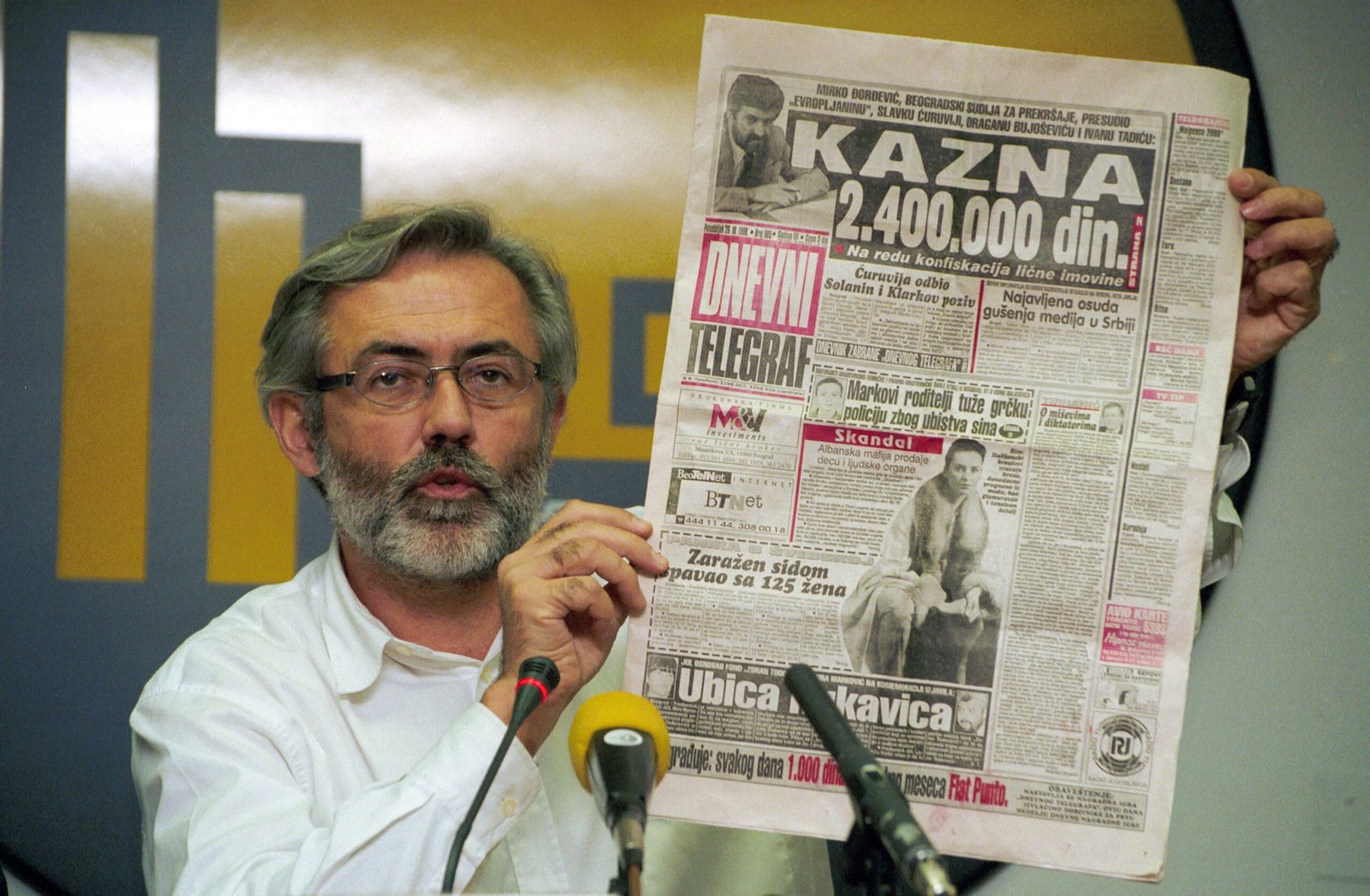
Daughter of murdered Serbian journalist Slavko Ćuruvija on her 27-year fight for justice
Share
Facebook Twitter Pinterest Email Copy Link

Listen to the article

0:00
0:00

Key Takeaways

Playback Speed

Select a Voice

On April 11, 1999, Slavko Ćuruvija, the owner of Serbia’s first private daily newspaper, Dnevni Telegraf, was assassinated outside his home in the capital, Belgrade. After a decades-long pursuit of accountability, the case reached a turning point in February 2024 when the Belgrade Court of Appeal issued a final, non-appealable acquittal for four former Slobodan Milošević-era state security officers who were previously found guilty of the murder. Although the Serbian Supreme Court ruled in January 2026 that this acquittal was based on “serious legal violations” and misrepresented evidence, the verdict remains legally binding due to procedural protections. Today, the case is stalled in a state of complete impunity. 

In this interview with CPJ, Ćuruvija’s daughter, Jelena Ćuruvija, discusses the current state of her fight for justice, what message her father’s murder sends to Serbian journalists today, and her ongoing “legal acrobatics” to find justice in Serbia and on the European level. 

The interview has been edited for length and clarity.

If you were to tell a young person about your father today, what would you want them to know about him as a journalist?

Jelena Ćuruvija: My daughter is now 11 years old, and I want to introduce her to her grandfather somehow. When I talk to her, I say that her grandfather was a very brave man who did his job with such passion, honesty, and dedication that he did not want to make any compromises. I think he was a rare person — there weren’t many of them even then, and now there are fewer. He was passionate about insisting on justice.

How much do you think his murder case changed Serbia?

He was the last beacon of free journalism in Serbia, or even a pioneer, because his newspapers were the first private newspapers in the country and, within a very short time, they had the largest circulation at that time in Serbia. His murder sent a message that there cannot be free journalism in Serbia, that there cannot be free opinion and free speech, and that people who insist on this will be punished, It was the beginning of the destruction of free journalism, and I can say that what is happening in Serbia now is actually the result of my father’s murder.

Does this mean that if your father were an editor-in-chief now, it would be a very different country?

If my father were alive, Serbia’s landscape would be really different. He would be as loud as he was back then, and I’m sure the situation in the media wouldn’t be this catastrophic. If he hadn’t been killed, I don’t think Zoran Đinđić (pro-European prime minister of Serbia from 2001 until his assassination in 2003) would have been killed, and other important political murders might not have happened. Serbia would look completely different than it does now.

Looking back over these 27 years, did you have hope that the case would be solved? Did you believe Serbia would reach a verdict?

In the beginning I didn’t, I have to admit. For the first 13 years, absolutely nothing happened with solving my dad’s murder. Then, surprisingly, at the beginning of President Aleksandar Vučić’s rule, the government established a special commission, and people who were later suspected of my dad’s murder were arrested. It indicated that there was a political decision that the murder would be solved, so I had faith. The first verdict was a guilty verdict, and I thought that the matter would end properly. 

How did you feel when the final acquittal happened? Did you expect it?

We were receiving information about six months before we officially got the verdict that the decision would be an acquittal, so I had time to emotionally prepare.  But it was certainly a shock.

In an earlier interview, you referred to your current efforts as a “marathon.” What can you do now to keep his memory alive? 

I have a foundation dedicated to his memory and we try to ensure all young people in Serbia can learn about who my father was. We make further efforts with the international press freedom community, too. And with some legal acrobatics, we are in the phase of exhausting all legal possibilities to reach justice here in Serbia before we bring the case to the European Court of Human Rights. 

What do you think of the current threats Serbian journalists are facing today?

The impunity in my father’s case sent a clear message to journalists and citizens in Serbia that they could face serious consequences if they insist on expressing their views, and to journalists if they insist on objective reporting. This kind of targeting is more or less a reality for all journalists today who try to do their job properly. However, I believe there is now greater visibility, as well as more unity and solidarity among journalists than there was in the 1990s.

On a personal level, how have you managed this 27-year journey?

That path has been very emotionally intensive for me. But the good thing that happened, if there is anything good in this case, is that I have built a whole community of people to whom this case is important for the same reasons it is important to me. Today I am the same age as my father was when he was killed, and I say what he used to say: “We will win because we are beautiful and smart.”

Read the full article here

Fact Checker

Verify the accuracy of this article using AI-powered analysis and real-time sources.

Get Your Fact Check Report

Enter your email to receive detailed fact-checking analysis

5 free reports remaining

Continue with Full Access

You've used your 5 free reports. Sign up for unlimited access!

Already have an account? Sign in here

Share. Facebook Twitter Pinterest LinkedIn Tumblr Email Telegram Copy Link
News Room
  • Website
  • Facebook
  • X (Twitter)
  • Instagram
  • LinkedIn

The FSNN News Room is the voice of our in-house journalists, editors, and researchers. We deliver timely, unbiased reporting at the crossroads of finance, cryptocurrency, and global politics, providing clear, fact-driven analysis free from agendas.

Related Articles

Global Free Speech

Tunisia court sentences journalist Zied el-Heni to 1 year in prison

3 hours ago
Global Free Speech

Rwandan YouTuber dies of alleged overdose on day of release from prison

7 hours ago
Global Free Speech

Narges Mohammadi, Iranian human rights defender and 2023 Nobel Peace Prize winner I pray that when you read this Narges Mohammadi is still alive. The Nobel Peace Prize winner is currently in an Iranian hospital in a critical condition. Her brother, who lives in Oslo, is anticipating terrible news. Mohammadi, 54, is in ill-health and is suspected of having suffered a heart attack in jail. Her move to a hospital is purely tokenistic – she is not in the right place for her condition. If she dies under these conditions, it’s a fate Mohammadi has warned about herself. In 2023 we shared a video made by Iranian filmmaker Vahid Zarezadeh of Mohammadi raising the alarm. When she gave the interview, she had just left hospital because of previous heart complications, following time in an appalling prison renowned for its punishing regime. In the video she said the “system sets up the conditions for the prisoner’s death,” and told people to not be surprised if, in the event she died in jail, the authorities blamed her death on an undiagnosed health problem. Heart attacks are common, they’d claim, downplaying their own role. Today it is even easier for them to downplay their role. The country is still in digital darkness. This Thursday marks day 69. That is 1632 hours of no connection to the global internet. There are some workarounds but they’re hard and risky. The cover of war has also seen an escalation in the execution of political prisoners, including those who took part in January’s protests. To be a dissident in Iran takes guts. To be as dedicated as Mohammadi is frankly awe-inspiring. What has made her so? Mohammadi was born in 1972 into a middle-class family with political persuasions. Following the Islamic revolution, her uncle and two cousins were arrested for activism. She studied nuclear physics at university, and it was there that she met her husband, Taghi Rahmani, who had himself spent 17 years in prison. After university, she worked for newspapers that were part of the reformist movement. In 2003 she joined the Defenders of Human Rights Center, founded by that year’s Nobel Peace Prize laureate, Shirin Ebadi. By this stage she had already been arrested and spent a year in jail. This became a pattern. According to her foundation, she’s been arrested 13 times and sentenced to a total of 31 years in prison and 154 lashes. A mother of twins — Kiana and Ali – Mohammadi has called the long years of separation from them an indescribable suffering. She has spoken about the fear and anxiety of solitary confinement and once said: “The price of the struggle is not only torture and prison, it is a heart that breaks with every regret and a pain that strikes to the marrow of your bones.” Still, she has continued to campaign for justice. Upon winning the Nobel Peace Prize in October 2023 “for her fight against the oppression of women in Iran and her fight to promote human rights and freedom for all”, she said: “I will never stop striving for the realisation of democracy, freedom and equality.” One month later she was on hunger strike to protest the delayed and neglectful medical care for sick prisoners. I’m fascinated by the anatomy of courage, though I’m unsure I’ll ever get to the bottom of it. What I do know is that Narges Mohammadi deserves every accolade and if she dies in the coming days the Iranian authorities are the culprits and not a dodgy heart. READ MORE

7 hours ago
Global Free Speech

CPJ, partners urge Maldives president to end legal action against Adhadhu News

10 hours ago
Global Free Speech

CPJ shares statement from Shireen Abu Akleh’s family 4 years after journalist’s murder

21 hours ago
Global Free Speech

CPJ and IAPA urge Mexican authorities to strengthen judicial response to crimes against the press

22 hours ago
Add A Comment
Leave A Reply Cancel Reply

Editors Picks

Free Signal Guide

17 minutes ago

FBI Raids Office Of Dem Politician Instrumental In Redrawing Virginia Voter Maps… With Fox News In Tow

18 minutes ago

The Declaration and Civic Friendship

19 minutes ago

Kraken parent goes for the OCC charter in bid to become a federal crypto bank

36 minutes ago
Latest Posts

Strategy’s MSTR May Rally 80% Despite Suffering $12.54B in Q1 Losses

38 minutes ago

Bitcoin Miner IREN Secures $3.4 Billion Nvidia AI Deal, With $2.1 Billion Share Option

45 minutes ago

Court To DOGE Bros: Asking ChatGPT ‘Yo, Is This DEI?’ Is Not Proper Legal Process & Also A First Amendment Violation

1 hour ago

Subscribe to News

Get the latest news and updates directly to your inbox.

At FSNN – Free Speech News Network, we deliver unfiltered reporting and in-depth analysis on the stories that matter most. From breaking headlines to global perspectives, our mission is to keep you informed, empowered, and connected.

FSNN.net is owned and operated by GlobalBoost Media
, an independent media organization dedicated to advancing transparency, free expression, and factual journalism across the digital landscape.

Facebook X (Twitter) Discord Telegram
Latest News

What UCLA doesn’t want you to know

15 minutes ago

Free Signal Guide

17 minutes ago

FBI Raids Office Of Dem Politician Instrumental In Redrawing Virginia Voter Maps… With Fox News In Tow

18 minutes ago

Subscribe to Updates

Get the latest news and updates directly to your inbox.

© 2026 GlobalBoost Media. All Rights Reserved.
  • Privacy Policy
  • Terms of Service
  • Our Authors
  • Contact

Type above and press Enter to search. Press Esc to cancel.

🍪

Cookies

We and our selected partners wish to use cookies to collect information about you for functional purposes and statistical marketing. You may not give us your consent for certain purposes by selecting an option and you can withdraw your consent at any time via the cookie icon.

Cookie Preferences

Manage Cookies

Cookies are small text that can be used by websites to make the user experience more efficient. The law states that we may store cookies on your device if they are strictly necessary for the operation of this site. For all other types of cookies, we need your permission. This site uses various types of cookies. Some cookies are placed by third party services that appear on our pages.

Your permission applies to the following domains:

  • https://fsnn.net
Necessary
Necessary cookies help make a website usable by enabling basic functions like page navigation and access to secure areas of the website. The website cannot function properly without these cookies.
Statistic
Statistic cookies help website owners to understand how visitors interact with websites by collecting and reporting information anonymously.
Preferences
Preference cookies enable a website to remember information that changes the way the website behaves or looks, like your preferred language or the region that you are in.
Marketing
Marketing cookies are used to track visitors across websites. The intention is to display ads that are relevant and engaging for the individual user and thereby more valuable for publishers and third party advertisers.