

 Freedom Index
Listen to the article
Senate Republicans have unveiled their plan to fund immigration enforcement and President Donald Trump’s ballroom, and the proposal might take fiscal irresponsibility to a new record high.
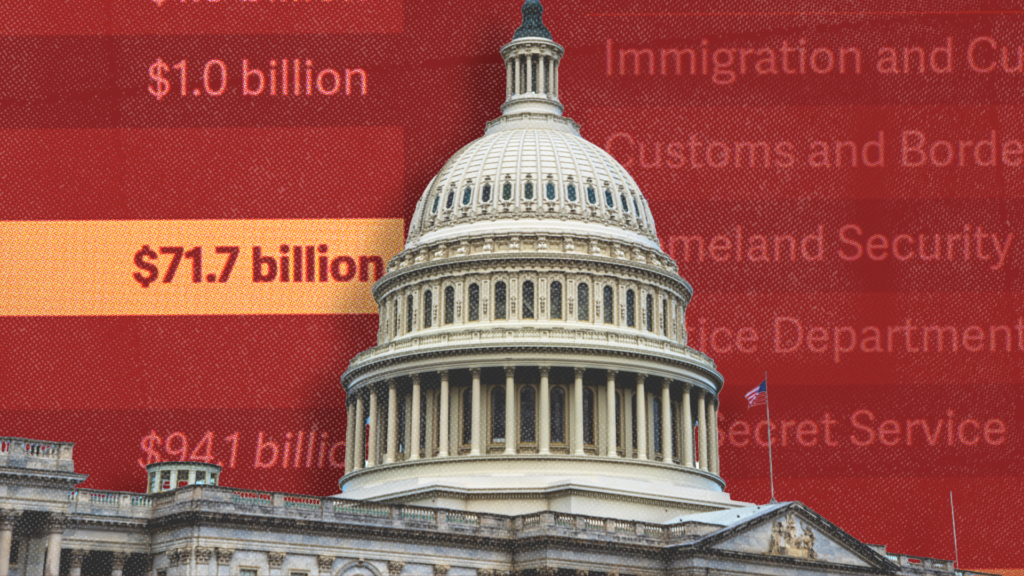
The two bills included in the package call for spending nearly $72 billion. Remarkably, every single dollar would be borrowed.
That’s according to the Congressional Budget Office’s (CBO) analysis of the bill, which was released on Wednesday morning. According to the CBO, the bill would direct $38 billion to Immigration and Customs Enforcement (ICE) and spend $26 billion on various programs run by Customs and Border Protection (CBP).
The largest share of the CBP funding is $19.1 billion to allow the agency to “hire, pay, train, and equip border patrol agents, officers, and support staff,” according to the CBO. Another $3.5 billion will fund screening efforts at the border.
The so-called reconciliation package is an attempt by Republicans to bypass Democratic opposition to funding immigration enforcement and Trump’s planned new ballroom at the White House. The Senate’s reconciliation process, which was created by the Budget and Impoundment Control Act of 1975, is supposed to give Congress a tool for controlling or reducing spending. Under the rules that typically govern reconciliation, any spending increases must be offset with cuts elsewhere.
In this case, however, reconciliation is being used to pass what is effectively a supplemental appropriation—but to do so by bypassing the filibuster, says William W. Beach, executive director of the Fiscal Lab on Capitol Hill.
“This is a precedent-setting move,” and one that will likely be repeated in the future, Beach told Reason. “I’m worried about it, because it gives almost unlimited spending authority to the majority.”
Sen. Jeff Merkley (D–Ore.), the top Democrat on the Senate Budget Committee, said in a statement that he was prepared to “vigorously challenge any provision” of the package that violates the Senate’s rule governing the reconciliation process.
That process was “originally designed to make deficit reduction easier. Republicans are using it to make deficit expansion easier,” wrote Dominik Lett, a fiscal policy analyst for the Cato Institute, in an email to Reason.
After reviewing the CBO’s assessment, Lett confirmed that every single dollar in the spending bill will be borrowed. “They don’t even attempt to include offsets,” he wrote.
In addition to the funding for ICE and CPB, the package also includes $1 billion for the Secret Service. That will cover “enhanced security and upgrades” within the new East Wing of the White House, which includes Trump’s planned ballroom.
Trump originally pitched the ballroom project as being “free” for taxpayers and promised that private donations would cover the full cost. That has swiftly changed. Last week, Sen. Lindsey Graham (R–S.C.) said taxpayers would be expected to cover about $400 million for the ballroom.
With how quickly the ballroom’s price tag is growing, it seems likely the $1 billion included in the reconciliation package will soon be deemed insufficient.
Of course, saying that “taxpayers” are paying for the ballroom is a bit inaccurate. Taxpayers aren’t directly paying for any of this, because the whole cost of the bill—the ICE funding, the ballroom, and the assorted other things included here—is simply being added to the national debt.
That is actually worse. If lawmakers believe the American people should have to pay for Trump’s ballroom or for enhanced immigration enforcement, they should have the courage to propose tax increases that will cover the cost, or cut spending in other parts of the budget as offsets.
The CBO’s analysis of the package does not include a summary of how the added borrowing will increase interest costs in future years. However, according to the CBO’s calculator, the additional spending in the reconciliation bill will add $26 billion in borrowing costs over the next 10 years.
That brings the final price tag of this package to nearly $100 billion, once the interest costs are included.
The timing is particularly galling too. Last month, America’s national debt surpassed the size of the nation’s economy for the first time since the end of World War II.
If ever there was a time for lawmakers to get serious about limiting the growth of America’s national debt, it is now. Instead, the Republican reconciliation bill is doing the exact opposite.
Read the full article here
Fact Checker
Verify the accuracy of this article using AI-powered analysis and real-time sources.