

 Freedom Index
Listen to the article
Hello and welcome to another edition of Free Agent! Keep your shirt on this week—going shirtless will not help you get out of the water.
We’ve got a jam-packed newsletter this week, starting with a record-breaking marathon performance that you should take a little bit of credit for. From there, it’s subsidies for horse racing, of all things, followed by Republicans subsidizing stadiums instead of being fiscally responsible. We’ll finish with some thoughts on Full Swing and golf. On your mark, get set, go!
Don’t miss sports coverage from Jason Russell and Reason.
- Stephen A. Smith caught heat for saying golfers and NASCAR drivers aren’t real athletes.
- “LIV Golf is dying of boredom“
- “He laughed so hard at Koo’s botched NFL kick that he had a seizure. It may have saved his life.“
- Cowboys owner Jerry Jones is worth $20 billion, but Arlington, Texas, still won’t make him pay for upgrades at the city-owned stadium.
- President Donald Trump’s executive order on college sports might make the NCAA more legally vulnerable instead of protecting it.
- If you think it’s hard to watch the NFL now, imagine how hard it will be if each team signs its own media deals instead of the NFL selling them as a package.
- NWSL team Gotham FC, which plays in New Jersey, has a promotional collaboration with New York Mayor Zohran Mamdani for $5 tickets to an upcoming match. (Seeing the words “use code MAYORMAMDANI to get 20% off” was deeply weird for me.)
- FIFA proposes that each country’s soccer league be allowed to have one game abroad each season, and Europeans are losing their minds.
- A player for Brown University became the first woman to pitch in an NCAA D-I baseball game. (A woman previously made college baseball history playing for my D-III alma mater.)
- Elsewhere in Reason: “A $33 Burger? As New York City Eyes $30 Minimum Wage, Restaurants Brace for Impact“
- Shame on all the minor league teams in Michigan for letting a Wisconsin team beat them to this:
Jersey numbers: OUT. ❌ Jersey CARDS: IN! ✅
When the Right Bowers take the field, each player will be wearing a different Euchre card on their back! ♥️♠️♦️♣️
For the first time in baseball history every jersey will have a unique design (don’t worry scorekeepers, their jersey… pic.twitter.com/UryZ9UwLE2
— Madison Mallards (@MadisonMallards) April 23, 2026
We did it, gang.
For decades, the best long-distance runners in the world have been trying to run a marathon in under two hours. As recently as 2013, some people thought it was impossible in this generation. At the time, it pretty much was. No one, even with the best nutrition, training, and equipment of the time, could have beaten the 2-hour mark in a regulation race.
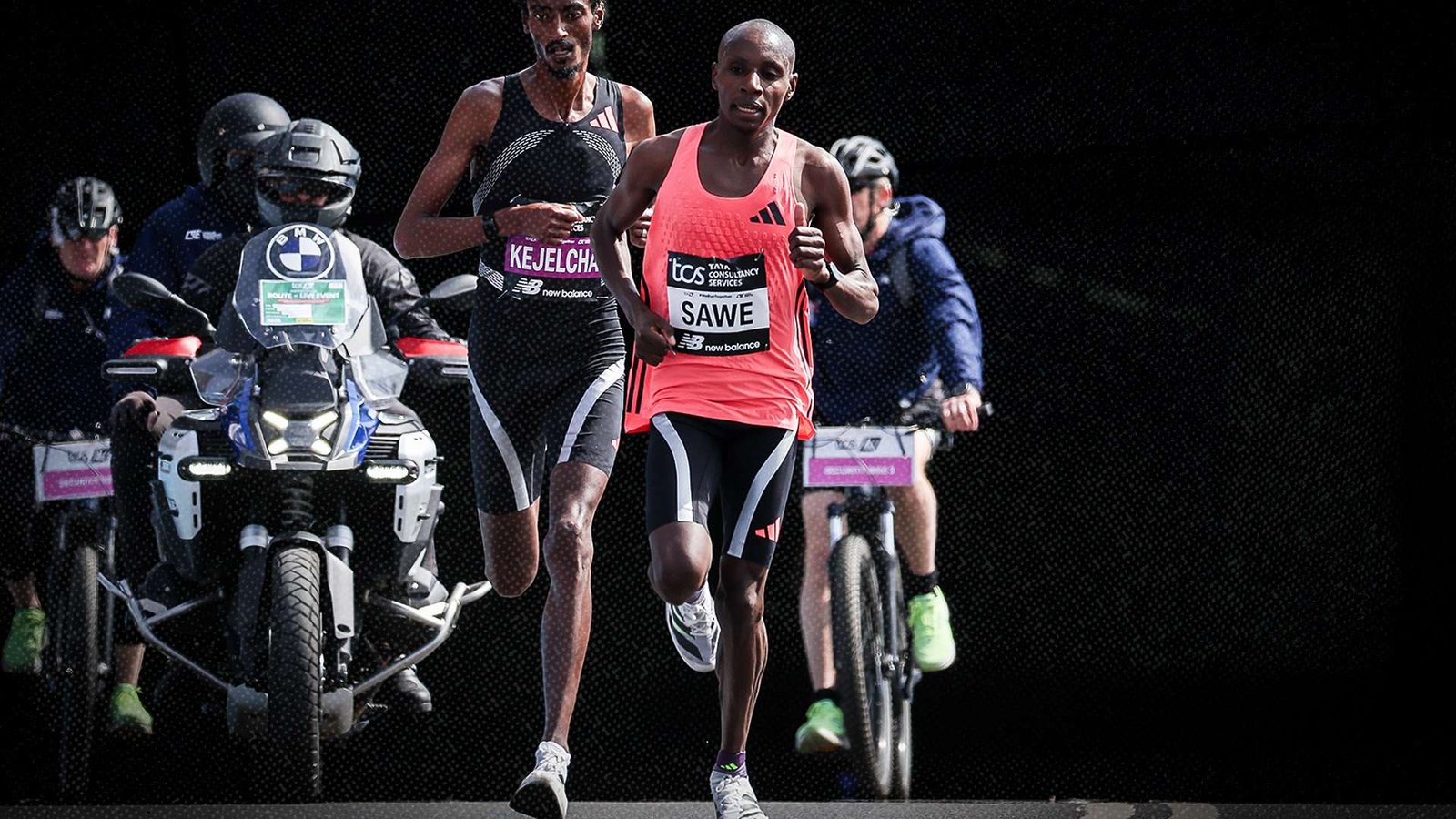
In 2019, Eliud Kipchoge showed it was possible—though with the help of aids that aren’t allowed under normal race rules. On Sunday, two runners finally broke through the 2-hour barrier, with Sabastian Sawe obliterating the world record and winning the London Marathon in 1:59:30.
OMG.
🇰🇪 Sabastian Sawe becomes the first man ever to break 2 hours in a marathon (legal conditions) in 1:59:30 at the London Marathon!
Yomif Kejelcha 🇪🇹 runs 1:59:41 in his DEBUT.
Jacob Kiplimo 🇺🇬 takes third in 2:00:28
All under the previous WR. pic.twitter.com/gckgmac5Hd
— Chris Chavez (@ChrisChavez) April 26, 2026
Send your sympathies to Yomif Kejelcha, who also beat the 2-hour mark and the previous world record but came in second place, 11 seconds behind Sawe.
Sawe and Kejelcha deserve all the praise (and sponsorship money) they have coming their way. But they also stand on the shoulders of everyone who helped them get there: every competitor who pushed them a little harder, every researcher who dug a little deeper into how human performance works, every shoemaker who strived to make a faster shoe.
The shoes are getting a lot of attention, as they well should. Sawe and Kejelcha were both wearing Adidas Adizero Adios Pro Evo 3, a brand new super shoe that weighs less than a McDonald’s quarter-pounder. “We were measuring things down to the nearest nanogram,” an Adidas manager said in a press release. Super shoes, first unleashed by Nike about a decade ago, have carbon fiber and super-light, thick foam padding in the soles.
Adidas wasn’t trying to make the fastest running shoe just for the thrill of it—it wants to make money, of course. You can buy the same shoes Sawe was wearing for $500 (or, assuming that sells out instantly, you can buy a similar pair recommended by Runner’s World for $255).
But the achievement is bigger than the shoes; it’s about all the science that went into creating the fastest marathoners ever. Consider the detailed planning that went into this fueling plan, and all the research that went into creating these products.
Details about how Sabastian Sawe fueled on race day, according to Maurten pic.twitter.com/T7wvFOwP19
— Theo Kahler (@tckahler) April 26, 2026
Thanks to wearables and GPS apps, runners and researchers have near-constant access to data on their running pace, sleep hygiene, heart rate, lactate thresholds, and other important science things that I don’t understand. This technology isn’t just for elites, it’s widely available to anyone with a smart watch and/or smart ring. Some of the biggest corporations in the world (Adidas, Nike, Garmin, Apple, etc.) push to make all of this more advanced and cheaper so they can earn your dollars over their competitors.
Sawe is awfully lucky that his running abilities are peaking at a time when decades of scientific advancement have made a sub-2-hour marathon possible. That explains why many elite runners, not just Sawe, are putting up previously unthinkable times. Sawe’s name will go down in history for being the first person to run an official marathon in under two hours, as well it should—but he owes gratitude to humanity and capitalism for helping him get there.
It’s Kentucky Derby week, so it’s time to re-up complaints about government subsidies propping up horse racing. “Horse racing must be one of the most subsidized sports in the country,” as I wrote last year.
For starters, two of the three Triple Crown racetracks are owned by their state governments. In Maryland, the state government now owns Pimlico (home of the Preakness Stakes), after the private owners decided the track’s renovation needs were too substantial. The state government doesn’t just own the track and lease out the operations; it actually runs horse racing in Maryland (kind of socialist!). The state government is also purchasing Laurel Park, where this year’s Preakness Stakes will take place while Pimlico undergoes renovations. In New York, the state government technically owns Belmont Park because the New York Racing Association racked up so much debt that its only way to stay alive was to give the state the land so that the debts would be forgiven and the association could keep running races (at least for 25 years).
Churchill Downs remains privately owned by Churchill Downs Incorporated, a company that owns 30 horsetracks or casinos (or both), plus the biggest app for betting on horse races, TwinSpires. (Oddly, they also now own the intellectual property of the name “Preakness Stakes.”)
Taxpayers have helped prop up horse racing for years, through federal tax benefits and some state sales tax exemptions. It’s traditionally been known as “the sport of kings,” although the biggest billionaires in the country are usually investing in other sports instead. Regardless, the multimillionaire power brokers of horse racing need not be subsidized by the tax dollars of everyone else.
“The obvious solution here is also the simplest: Just stop,” as Noah Shachtman wrote in an excellent New York Times essay on this topic last year. “Let the sport stand on its own and dwindle to whatever size its fan base supports. Instead, state legislatures keep funneling money to it.”
Why are so many Republicans, who are supposed to be fiscal, limited-government conservatives, wasting taxpayer money on sports stadiums?
“Republican politicians love to talk a good fiscal conservatism game, but they’ve been quick to throw out their penny-pinching playbooks when pro sports team owners come calling,” as Reason Foundation Senior Fellow (and dedicated Free Agent reader) John Mozena writes in a new Reason piece.
From Indiana to Kansas to Ohio, red-state Republicans are throwing money at billionaire team owners when they should be cutting taxes and generally limiting government involvement in economics, sports, and everything else.
Indiana, for example, is prepared to spend up to $1 billion on luring the Bears across the Illinois border, funded by tax hikes. In Kansas, Republicans have teamed up with their Democratic governor to fund 60 percent of a $3 billion stadium project (and that cost estimate will surely grow when faced with reality). They say they aren’t raising taxes for the project, but diverting sales taxes from other uses will either mean spending cuts (if only!) or tax hikes elsewhere in the budget. Ohio Republicans are spending money that wasn’t even taxed—they’re taking it from unclaimed funds that belong to people, not the government.
And that’s to spend on the Browns? Seriously? Is any sports franchise less deserving? Haven’t they hurt the taxpayers of Ohio enough already?
As Mozena points out, those Republicans “are far from alone in throwing out fiscal conservatism in favor of corporate welfare for sports team owners,” citing examples in six other mostly red states. Then there are Democrats, “who talk a good game about corporate power and standing up for the little guy have been perfectly happy to fund billionaires’ stadiums” in six other states and in Washington, D.C.
Everyone should know better, but the stadium subsidy swindle goes on.
As I got more and more interested in watching professional golf over the last year, I patiently waited to start watching the behind-the-scenes Full Swing docuseries until a few months ago. The first few seasons are great, though not quite as exciting as its Formula 1 docuseries brother, Drive to Survive (how could it be, when we’re comparing cars going 200 miles per hour with guys swinging a club at a tiny white ball?).
Full Swing‘s fourth season, however, is its most disappointing—not just because I had to relive the U.S. failure at the Ryder Cup. It comes in at just four episodes, when previous seasons had seven or eight. It goes too far in hyping up the Ryder Cup in episodes focused on other topics (like Rory McIlroy winning his first Masters), as if the Ryder Cup is the be-all championship of golf and nothing else matters. One bright spot of the season is that we get to know Ben Griffin better—someone I already liked and found more likeable as I watched him on the show.
It’s possible the show is entering a doom spiral. If it gets fewer and fewer viewers, then fewer and fewer golfers will believe it’s worthwhile to give privacy-invading access to Netflix’s cameras. As fewer golfers participate, the less the show can offer viewers, and so on. To be fair, the hope was that the show would do for golf what Drive to Survive did for Formula 1. Golf does seem to be on the rise—but a show with viewership falling to about 4 million people probably isn’t why.
Unfortunately, season four may be its last, or perhaps the show will only tape in Ryder Cup years. If you haven’t watched this season of Full Swing yet, you might be better off watching Rooster instead.
You probably already saw this one, but I want to take this opportunity to argue that this should be an out, even if it was an accident. The ball doesn’t touch the ground! (Honorable mention goes to Gritty throwing a penguin mascot off a balcony).
He literally … wore that one 🤯 pic.twitter.com/KCQyjDMEAX
— MLB (@MLB) April 22, 2026
That’s all for this week. Enjoy watching the real horse-related event of the weekend, the U.S. Open Polo Championship.
Read the full article here
Fact Checker
Verify the accuracy of this article using AI-powered analysis and real-time sources.