Close Menu
FSNN | Free Speech News NetworkFSNN | Free Speech News Network
  • Home
  • News
    • Politics
    • Legal & Courts
    • Tech & Big Tech
    • Campus & Education
    • Media & Culture
    • Global Free Speech
  • Opinions
    • Debates
  • Video/Live
  • Community
  • Freedom Index
  • About
    • Mission
    • Contact
    • Support
Trending

Yale tries to claw back public trust

18 minutes ago

DOJ Files A Truth Social Post As A Legal Brief — Which Admits To Sharing Top Secret Plans With A ‘Fake’ Organization

24 minutes ago

The Federal Minimum Wage Is Irrelevant. Good. 

27 minutes ago
Facebook X (Twitter) Instagram
Facebook X (Twitter) Discord Telegram
FSNN | Free Speech News NetworkFSNN | Free Speech News Network
Market Data Newsletter
Tuesday, April 28
  • Home
  • News
    • Politics
    • Legal & Courts
    • Tech & Big Tech
    • Campus & Education
    • Media & Culture
    • Global Free Speech
  • Opinions
    • Debates
  • Video/Live
  • Community
  • Freedom Index
  • About
    • Mission
    • Contact
    • Support
FSNN | Free Speech News NetworkFSNN | Free Speech News Network
Home»Cryptocurrency & Free Speech Finance»Crypto Projects Shut Down as Token Models Fail Under Pressure
Cryptocurrency & Free Speech Finance

Crypto Projects Shut Down as Token Models Fail Under Pressure

News RoomBy News Room3 hours agoNo Comments5 Mins Read266 Views
Share Facebook Twitter Pinterest Copy Link LinkedIn Tumblr Email VKontakte Telegram
Crypto Projects Shut Down as Token Models Fail Under Pressure
Share
Facebook Twitter Pinterest Email Copy Link

Listen to the article

0:00
0:00

Key Takeaways

Playback Speed

Select a Voice

A wave of crypto shutdowns is unfolding across the industry this year, hitting projects from trading platforms to analytics tools.

April was no exception, as decentralized email service Dmail said it is shutting down due to high infrastructure costs, failed fundraising and weak token utility.

“In prior cycles, projects could extend runway through new issuance or venture support,” Roshan Dharia, a restructuring advisor and CEO of crypto holding company Echo Base, told Cointelegraph.

“That path is largely closed, so losses are being recognized earlier, and outcomes are more often wind downs than recoveries,” he said.

Crypto built a fast way to raise capital through tokens, but still lacks a framework to unwind it when things go wrong, making it difficult to reorganize claims or coordinate stakeholders once conditions deteriorate.

Dmail’s token market cap fell below $1 million in November. Source: CoinGecko

Token funding falters as projects unwind

As market conditions have tightened in recent months, projects are drifting into slow declines instead of the abrupt collapses seen in past crypto downturns. Projects are deteriorating over time as user activity declines, treasuries weaken and funding options narrow.

“You see this in cases like Tally and Step Finance, where there is no single failure point, just a steady decline in treasury value and user activity that compresses optionality over time,” said Dharia.

DAO tooling platform Tally said it was winding down after concluding the market for governance tooling had yet to develop at scale, while Step Finance moved to shut down after a hack, saying efforts to secure financing or a sale failed to produce a viable outcome.
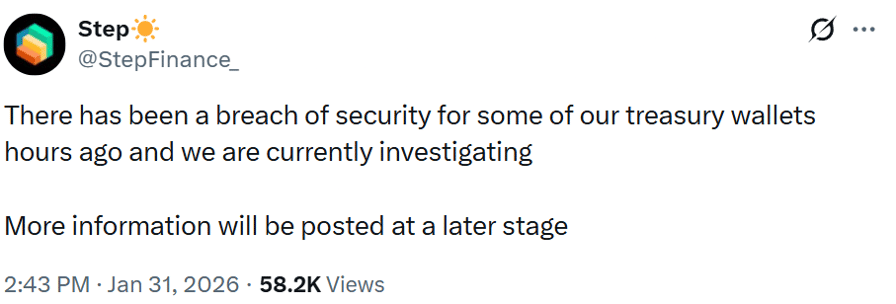
Step Finance suffered a $40 million security breach in January. Source: Step Finance

Related: Ethereum’s EEZ could pull other blockchains into its orbit

Some breakdowns still follow more familiar patterns. BlockFills filed for bankruptcy in March after freezing withdrawals. Its creditor, Dominion Capital, alleged in a lawsuit that the firm commingled customer assets to cover company losses.

Tokens once offered a fallback, allowing teams to raise capital or subsidize growth, but that mechanism is no longer as reliable, Dharia said. 

He added:

Earlier cycles treated tokens as a primary funding mechanism with an implied alignment between users, holders and operators. That alignment has proven fragile in stressed scenarios, particularly where token holders lack defined rights or recourse.”

Some are starting to treat tokens as claims that may need to be consolidated or reworked. In March, Across Protocol proposed a token-to-equity buyout. Risk Labs, the team behind Across, said the token and decentralized autonomous organization (DAO) structure limited its ability to close deals with enterprises and institutions.

Crypto lacks a playbook for restructuring

Unlike traditional companies, most crypto projects lack a clear path to restructure once conditions deteriorate. Corporate bankruptcies provide mechanisms to pause obligations, renegotiate with creditors and reorganize capital structures. 

In crypto, such avenues are often missing or poorly defined.
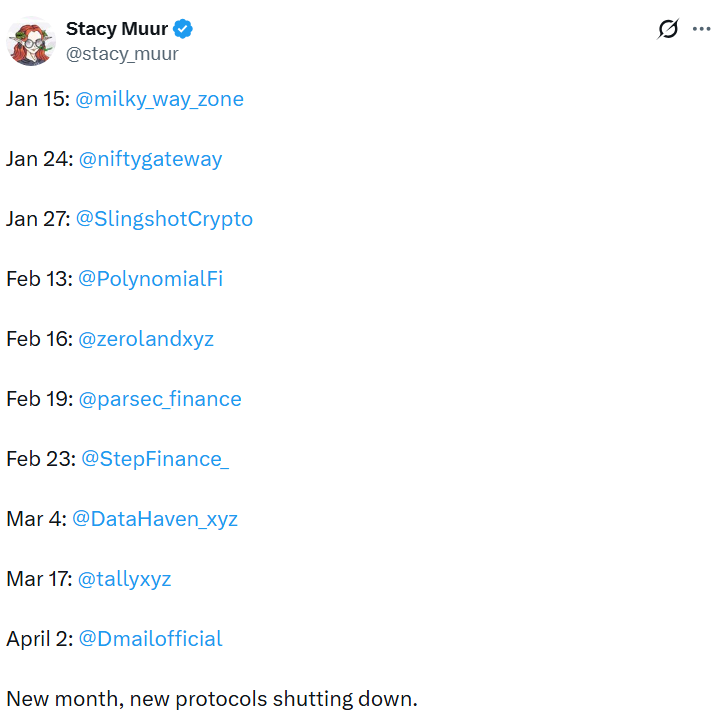
Each month in 2026 had a crypto project announcing shutdowns. Source: Stacy Muur

Related: Prediction market battle gets closer to Supreme Court

Crypto projects often operate through a mix of foundations, offshore entities and token-based communities, with no unified legal structure governing liabilities. In restructuring, token holders typically have no formal claims on assets or cash flows.

That limits what they can do under pressure. Projects are often left choosing between raising new capital on worse terms or shutting down without a clear hierarchy of claims or a way to bind stakeholders to an outcome, entirely.

“Most projects do not have access to formal restructuring tools, and their stakeholder base is fragmented across token holders, equity investors, and users with no clear hierarchy or enforcement mechanism,” said Dharia. 

“That makes it difficult to recapitalize, restructure obligations, or run a controlled process to preserve value. In that environment, once liquidity tightens, outcomes tend to default to wind downs or distressed asset sales rather than coordinated recoveries,” he said.

Limited recovery paths in token-based systems

Tokens made it easier and more accessible for crypto companies to raise capital and scale quickly, but offer limited support once conditions deteriorate.

Dharia said the current wave of shutdowns is driven by tighter capital availability and structurally weak balance sheets. Many projects entered the bear market with treasuries heavily concentrated in their own tokens or correlated assets. As prices fell, the runway contracted.

“At the same time, funding channels have narrowed, with more selective venture deployment, weaker token issuance and thinner secondary liquidity limiting both exit and financing options,” Dharia added.

So far this year, projects have more often wound down quietly than attempted formal restructuring. Without clear frameworks to reorganize claims or coordinate stakeholders, recovery paths remain limited.

Some projects have begun exploring ways to consolidate ownership and introduce more formal structures, suggesting parts of the market are starting to adapt after running into the limits of token and decentralized governance models.

Magazine: AI-driven hacks could kill DeFi — unless projects act now

Cointelegraph is committed to independent, transparent journalism. This news article is produced in accordance with Cointelegraph’s Editorial Policy and aims to provide accurate and timely information. Readers are encouraged to verify information independently.

Read the full article here

Fact Checker

Verify the accuracy of this article using AI-powered analysis and real-time sources.

Get Your Fact Check Report

Enter your email to receive detailed fact-checking analysis

5 free reports remaining

Continue with Full Access

You've used your 5 free reports. Sign up for unlimited access!

Already have an account? Sign in here

Share. Facebook Twitter Pinterest LinkedIn Tumblr Email Telegram Copy Link
News Room
  • Website
  • Facebook
  • X (Twitter)
  • Instagram
  • LinkedIn

The FSNN News Room is the voice of our in-house journalists, editors, and researchers. We deliver timely, unbiased reporting at the crossroads of finance, cryptocurrency, and global politics, providing clear, fact-driven analysis free from agendas.

Related Articles

Cryptocurrency & Free Speech Finance

Chiliz expands to Solana and Base to supercharge fan token trading

53 minutes ago
Cryptocurrency & Free Speech Finance

Canaan Lands New Tether Order as Mining Shifts to Modular Infrastructure

56 minutes ago
Cryptocurrency & Free Speech Finance

Aave, Compound Unveil Technical Plan to Address Fallout From $290M Kelp DAO Hack

57 minutes ago
Cryptocurrency & Free Speech Finance

Polymarket seeks CFTC approval to reopen main exchange to U.S. traders: Bloomberg

2 hours ago
Cryptocurrency & Free Speech Finance

Bitcoin Faces Fresh Oil Woes With a BTC Price Dip Under $76,000

2 hours ago
Cryptocurrency & Free Speech Finance

Inside Trump’s Meme Coin Bash: Foreign Guests, Iran War Riffs, and Mar-a-Lago Charm

2 hours ago
Add A Comment
Leave A Reply Cancel Reply

Editors Picks

DOJ Files A Truth Social Post As A Legal Brief — Which Admits To Sharing Top Secret Plans With A ‘Fake’ Organization

24 minutes ago

The Federal Minimum Wage Is Irrelevant. Good. 

27 minutes ago

Deaths in Detention: ICE Is Rapidly Expanding Detention Camps into Warehouses Despite Record Deaths

34 minutes ago

CPJ joins call for Turkey to repeal disinformation law for its use against journalists

38 minutes ago
Latest Posts

Chiliz expands to Solana and Base to supercharge fan token trading

53 minutes ago

Canaan Lands New Tether Order as Mining Shifts to Modular Infrastructure

56 minutes ago

Aave, Compound Unveil Technical Plan to Address Fallout From $290M Kelp DAO Hack

57 minutes ago

Subscribe to News

Get the latest news and updates directly to your inbox.

At FSNN – Free Speech News Network, we deliver unfiltered reporting and in-depth analysis on the stories that matter most. From breaking headlines to global perspectives, our mission is to keep you informed, empowered, and connected.

FSNN.net is owned and operated by GlobalBoost Media
, an independent media organization dedicated to advancing transparency, free expression, and factual journalism across the digital landscape.

Facebook X (Twitter) Discord Telegram
Latest News

Yale tries to claw back public trust

18 minutes ago

DOJ Files A Truth Social Post As A Legal Brief — Which Admits To Sharing Top Secret Plans With A ‘Fake’ Organization

24 minutes ago

The Federal Minimum Wage Is Irrelevant. Good. 

27 minutes ago

Subscribe to Updates

Get the latest news and updates directly to your inbox.

© 2026 GlobalBoost Media. All Rights Reserved.
  • Privacy Policy
  • Terms of Service
  • Our Authors
  • Contact

Type above and press Enter to search. Press Esc to cancel.

🍪

Cookies

We and our selected partners wish to use cookies to collect information about you for functional purposes and statistical marketing. You may not give us your consent for certain purposes by selecting an option and you can withdraw your consent at any time via the cookie icon.

Cookie Preferences

Manage Cookies

Cookies are small text that can be used by websites to make the user experience more efficient. The law states that we may store cookies on your device if they are strictly necessary for the operation of this site. For all other types of cookies, we need your permission. This site uses various types of cookies. Some cookies are placed by third party services that appear on our pages.

Your permission applies to the following domains:

  • https://fsnn.net
Necessary
Necessary cookies help make a website usable by enabling basic functions like page navigation and access to secure areas of the website. The website cannot function properly without these cookies.
Statistic
Statistic cookies help website owners to understand how visitors interact with websites by collecting and reporting information anonymously.
Preferences
Preference cookies enable a website to remember information that changes the way the website behaves or looks, like your preferred language or the region that you are in.
Marketing
Marketing cookies are used to track visitors across websites. The intention is to display ads that are relevant and engaging for the individual user and thereby more valuable for publishers and third party advertisers.