Close Menu
FSNN | Free Speech News NetworkFSNN | Free Speech News Network
  • Home
  • News
    • Politics
    • Legal & Courts
    • Tech & Big Tech
    • Campus & Education
    • Media & Culture
    • Global Free Speech
  • Opinions
    • Debates
  • Video/Live
  • Community
  • Freedom Index
  • About
    • Mission
    • Contact
    • Support
Trending

Only 3% of traders drive Polymarket’s accuracy, not the crowd, study finds

27 minutes ago

Litecoin gives post-attack update, but other devs doubt zero-day theory

38 minutes ago

Coachella Uses Google DeepMind AI to Test the Future of Live Entertainment

39 minutes ago
Facebook X (Twitter) Instagram
Facebook X (Twitter) Discord Telegram
FSNN | Free Speech News NetworkFSNN | Free Speech News Network
Market Data Newsletter
Sunday, April 26
  • Home
  • News
    • Politics
    • Legal & Courts
    • Tech & Big Tech
    • Campus & Education
    • Media & Culture
    • Global Free Speech
  • Opinions
    • Debates
  • Video/Live
  • Community
  • Freedom Index
  • About
    • Mission
    • Contact
    • Support
FSNN | Free Speech News NetworkFSNN | Free Speech News Network
Home»Cryptocurrency & Free Speech Finance»Why DeFi is not dead after the KelpDAO exploit
Cryptocurrency & Free Speech Finance

Why DeFi is not dead after the KelpDAO exploit

News RoomBy News Room2 hours agoNo Comments5 Mins Read1,345 Views
Share Facebook Twitter Pinterest Copy Link LinkedIn Tumblr Email VKontakte Telegram
Why DeFi is not dead after the KelpDAO exploit
Share
Facebook Twitter Pinterest Email Copy Link

Listen to the article

0:00
0:00

Key Takeaways

Playback Speed

Select a Voice

The easiest take after a $290 million exploit and a roughly $13 billion slide in DeFi total value locked is that decentralized finance is broken again. It is also probably the laziest.

The KelpDAO exploit over the weekend was serious. It appears to have started with a targeted attack on infrastructure used in LayerZero’s verification stack, not a smart contract bug as commonly seen in other exploits. LayerZero has preliminarily linked the incident to North Korea’s Lazarus Group, and said the attack succeeded because Kelp had opted for a single-verifier setup despite repeated recommendations to use a more resistant configuration. The exploit left rsETH (a liquid staking token issued by KelpDAO) unbacked and triggered fears that bad debt would spill into lending markets, especially Aave’s WETH pool (where users borrow wrapped ether against collateral).

And yet the more interesting story is not that DeFi was hit. It is that DeFi is still here.

Capital fled quickly after the breach. Aave alone experienced $8.45 billion in outflows over 48 hours, while broader DeFi TVL fell into the mid-$80 billion range, roughly back to where the sector sat around this point last year. In other words, this was a sharp repricing of risk, not as destructive as some are making out.

Aave, the largest DeFi lending market, had accumulated significant rsETH as collateral in the weeks before the exploit as users built leveraged positions. The scale of that TVL drop also warrants some context. A $292 million theft does not directly produce a $13 billion decline unless a meaningful portion of that TVL was already recycled collateral. Much of Aave’s ETH exposure heading into the weekend was concentrated in looping strategies, where users deposit liquid restaking tokens, borrow ETH against them, swap for more restaking tokens, and repeat. In other words, the same pile of assets may be counted multiple times in the TVL calculation. That leverage inflates TVL on the way up and unwinds sharply during events like this. The actual net capital loss is likely a fraction of the headline figure, though the exact amount is difficult to isolate given how deeply looping strategies are embedded in DeFi’s TVL calculations.

DeFi TVL drop

Those strategies were themselves partly a product of a yield environment that had already stopped making sense. As of early April, Aave was offering 2.61% APY on USDC deposits, below the 3.14% available on idle cash at Interactive Brokers, a traditional financial brokerage. The risk premium that historically justified DeFi’s complexity and smart contract exposure had largely disappeared. With organic yield insufficient, leverage filled the gap, and that concentration is what made the rsETH contagion as damaging as it was. Data from DefiLlama shows that reETH balances on Aave had grown rapidly in the weeks leading up to the exploit, reaching nearly 580,000 tokens ($1.3 billion), evidence that the leverage buildup made the subsequent unwind so sharp.

Crypto has survived worse

The phrase “DeFi is dead” gets wheeled out after every hack because the failures are visible and immediate, while the recovery is slower and less cinematic. But crypto has seen worse. Terra collapsed and vaporized confidence across the sector. Wormhole and Ronin lost roughly $1 billion each. Multichain unraveled.

“DeFi didn’t die when Terra collapsed and caused billions in liquidations and losses,” wrote a pseudonymous trader on X. “DeFi didn’t die when Wormhole and Ronin got drained for around $1 billion. DeFi didn’t die when Multichain bridge assets were stolen.”
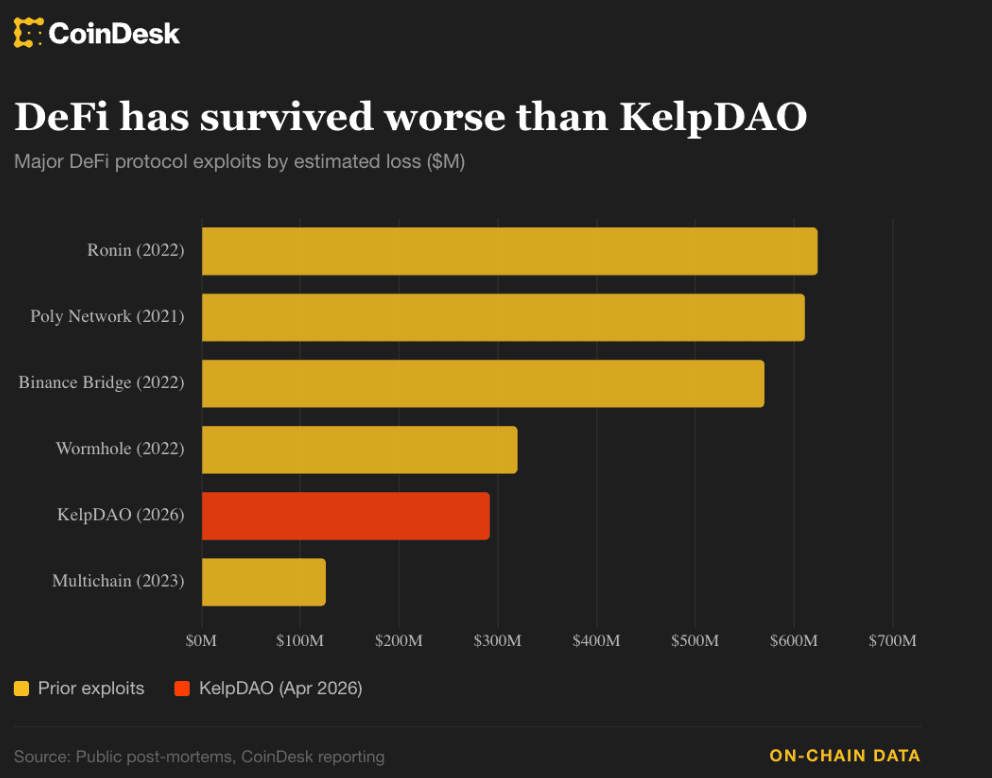
Historical DeFi hacks

More recently, Bybit suffered what was widely described as the largest crypto theft on record, losing around $1.5 billion last February, yet it continued operating, processed a surge in withdrawals, restored reserves and still handles billions of dollars in trading volume each day.

The repricing of trust

0xNGMI, founder of DefiLlama, told CoinDesk the losses are significant but unlikely to be existential. “Aave has many recourses to cover the loss, including its treasury and taking loans, and I think those will have to be used to protect the protocol,” he said. “Overall a significant loss but one that will be recovered. The biggest issue will be the impact on risk premiums that are assigned to DeFi.”

Those risk premiums are a real and lasting cost. Capital will demand more compensation for sitting in onchain systems whose attack surface now extends beyond code

Still, repricing is not the same thing as collapse. “Some of the money will come back,” 0xNGMI said. “We saw this before in Aave when rumors of a hack appeared. It’s always the best strategy to withdraw and redeposit later as the cost of that is tiny and the reward very large.” Some deposits will not return, but historically deposit outflows during stress events reverse as conditions stabilize, as evidence after Terra’s collapse in 2021.

There is also evidence that capital is not simply leaving DeFi. It is rotating. Spark offers one example. Spark’s strategy lead, who goes by monetsupply.eth, said the protocol delisted rsETH and other low-utilization assets in January, a move that may have cost it business and ETH-looping activity to Aave at the time. Under current conditions, however, SparkLend still has ample ETH withdrawal liquidity while Aave is experiencing shortages across several markets. Over the weekend Spark TVL jumped from $1.8 billion to $2.9 billion, demonstrating clear capital rotation.
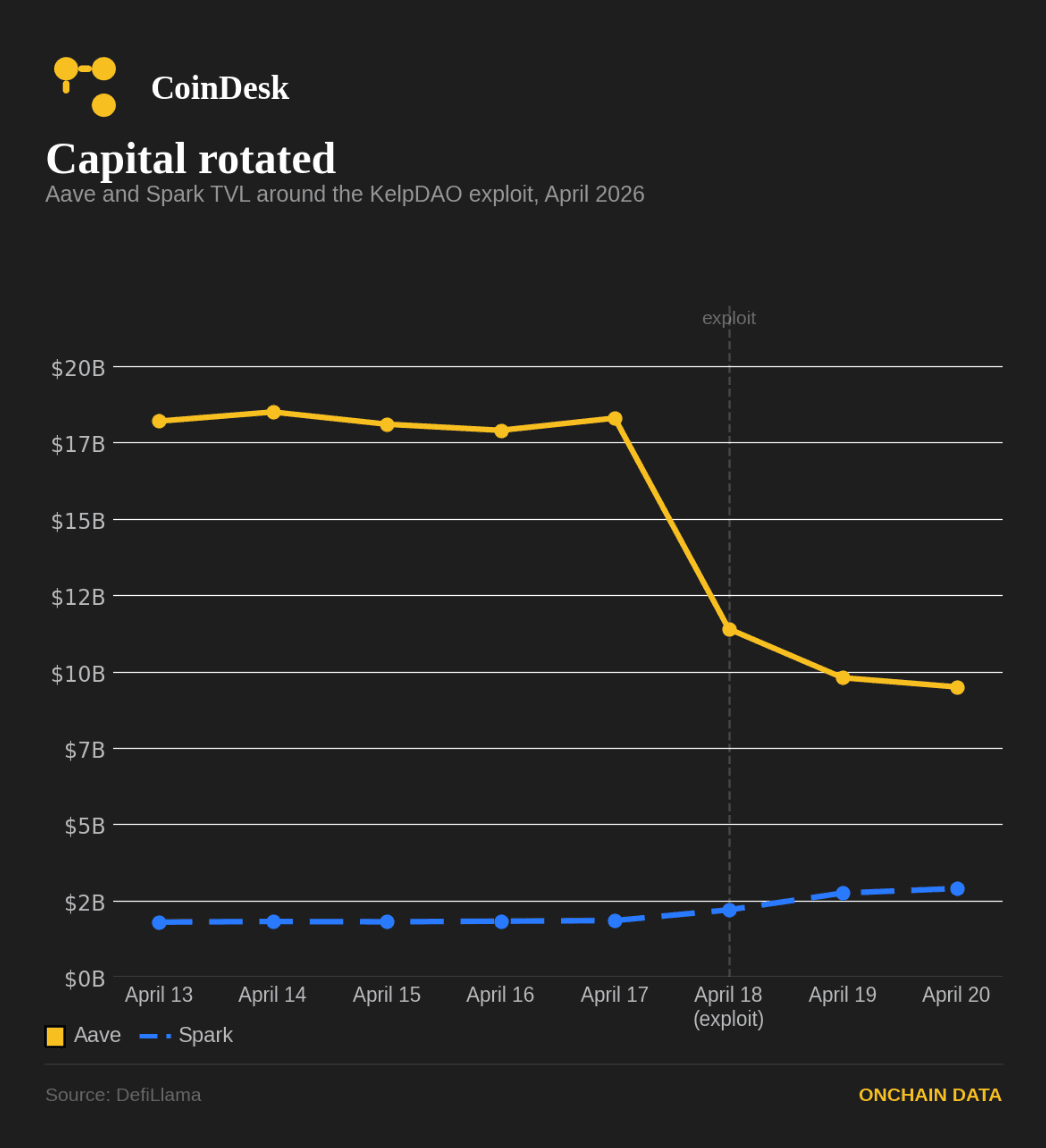
Capital rotation
Capital rotation from Aave

The more interesting critique, raised by some builders after the exploit, is not that DeFi failed but that it has become too timid. If the sector is going to ask users to bear infrastructure risk, smart contract risk and governance risk for low single-digit yields, the product set starts to look less compelling. With that in mind, Kelp is not the end of DeFi. It is a wake-up call for builders to build safer systems while continuing to offer real world use cases.

Read the full article here

Fact Checker

Verify the accuracy of this article using AI-powered analysis and real-time sources.

Get Your Fact Check Report

Enter your email to receive detailed fact-checking analysis

5 free reports remaining

Continue with Full Access

You've used your 5 free reports. Sign up for unlimited access!

Already have an account? Sign in here

Share. Facebook Twitter Pinterest LinkedIn Tumblr Email Telegram Copy Link
News Room
  • Website
  • Facebook
  • X (Twitter)
  • Instagram
  • LinkedIn

The FSNN News Room is the voice of our in-house journalists, editors, and researchers. We deliver timely, unbiased reporting at the crossroads of finance, cryptocurrency, and global politics, providing clear, fact-driven analysis free from agendas.

Related Articles

Cryptocurrency & Free Speech Finance

Only 3% of traders drive Polymarket’s accuracy, not the crowd, study finds

27 minutes ago
Cryptocurrency & Free Speech Finance

Litecoin gives post-attack update, but other devs doubt zero-day theory

38 minutes ago
Cryptocurrency & Free Speech Finance

Coachella Uses Google DeepMind AI to Test the Future of Live Entertainment

39 minutes ago
Cryptocurrency & Free Speech Finance

Running out of time on Clarity: State of Crypto

1 hour ago
Cryptocurrency & Free Speech Finance

Arkham says Aave raised $160 million of the $200 million it needs to cover exploit damage

4 hours ago
Cryptocurrency & Free Speech Finance

Freezing dormant BTC would trigger worst single day repricing in bitcoin’s history, says maximalist

5 hours ago
Add A Comment
Leave A Reply Cancel Reply

Editors Picks

Litecoin gives post-attack update, but other devs doubt zero-day theory

38 minutes ago

Coachella Uses Google DeepMind AI to Test the Future of Live Entertainment

39 minutes ago

What Do You Do With AI-Generated Legal Scholarship?: An April 2026 Question

57 minutes ago

Running out of time on Clarity: State of Crypto

1 hour ago
Latest Posts

Why DeFi is not dead after the KelpDAO exploit

2 hours ago

Justice Clarence Thomas on the Declaration of Independence

3 hours ago

Arkham says Aave raised $160 million of the $200 million it needs to cover exploit damage

4 hours ago

Subscribe to News

Get the latest news and updates directly to your inbox.

At FSNN – Free Speech News Network, we deliver unfiltered reporting and in-depth analysis on the stories that matter most. From breaking headlines to global perspectives, our mission is to keep you informed, empowered, and connected.

FSNN.net is owned and operated by GlobalBoost Media
, an independent media organization dedicated to advancing transparency, free expression, and factual journalism across the digital landscape.

Facebook X (Twitter) Discord Telegram
Latest News

Only 3% of traders drive Polymarket’s accuracy, not the crowd, study finds

27 minutes ago

Litecoin gives post-attack update, but other devs doubt zero-day theory

38 minutes ago

Coachella Uses Google DeepMind AI to Test the Future of Live Entertainment

39 minutes ago

Subscribe to Updates

Get the latest news and updates directly to your inbox.

© 2026 GlobalBoost Media. All Rights Reserved.
  • Privacy Policy
  • Terms of Service
  • Our Authors
  • Contact

Type above and press Enter to search. Press Esc to cancel.

🍪

Cookies

We and our selected partners wish to use cookies to collect information about you for functional purposes and statistical marketing. You may not give us your consent for certain purposes by selecting an option and you can withdraw your consent at any time via the cookie icon.

Cookie Preferences

Manage Cookies

Cookies are small text that can be used by websites to make the user experience more efficient. The law states that we may store cookies on your device if they are strictly necessary for the operation of this site. For all other types of cookies, we need your permission. This site uses various types of cookies. Some cookies are placed by third party services that appear on our pages.

Your permission applies to the following domains:

  • https://fsnn.net
Necessary
Necessary cookies help make a website usable by enabling basic functions like page navigation and access to secure areas of the website. The website cannot function properly without these cookies.
Statistic
Statistic cookies help website owners to understand how visitors interact with websites by collecting and reporting information anonymously.
Preferences
Preference cookies enable a website to remember information that changes the way the website behaves or looks, like your preferred language or the region that you are in.
Marketing
Marketing cookies are used to track visitors across websites. The intention is to display ads that are relevant and engaging for the individual user and thereby more valuable for publishers and third party advertisers.