

 Freedom Index
Listen to the article
“Artists given complete freedom die a horrible death. So, when you tell them what they can’t do, they get creative and say, ‘Oh yes I can,’” Peter Gabriel told music journalist Mark Blake in 2011. This was Gabriel’s reasoning for telling his former Genesis bandmate, Phil Collins, whom he had recruited to play drums on his third self-titled album (nicknamed Melt) that he did not want the album to feature any cymbals. The limitations Gabriel imposed on Collins gave birth to a great new innovation in popular music. In 1979, while Phil Collins was in the middle of drumming at London’s Townhouse Studios experimenting with finding a compelling drum sound without using cymbals, engineer Hugh Padgham accidentally turned on the microphone hanging above the drum kit, which enabled those in the studio to communicate with those in the control room. The powerful sound that emerged from Collins’s drums when the mic was switched on was unlike anything he had ever heard before. It became known as the gated reverb and it was discovered at the perfect time, just when a new sound was needed to keep popular music fresh in the new decade that was about to begin. One year later, in 1980, when Phil Collins took time away from Genesis to record his first solo album, he used the gated reverb to its full potential and changed the course of music history with one iconic drum fill.
The gated reverb, then, was created by accident. Townhouse Studios used an SSL (Solid State Logic) 4000 mixing console. “Solid State Logic console was quite new then and it had a compressor/noise gate on every single channel which before that had never happened. Before you had external compressors or external noise gates, but you had to patch them in, whereas with the SSL it was in every single channel. All you had to do was press a button and it was on,” sound engineer Hugh Padgham later recalled. The SSL 4000 also had an intercom system, which was revolutionary at the time. Previously, a separate microphone system had to be installed in studios to allow producers and engineers in the control room to communicate with musicians in the recording area. The SSL 4000’s intercom system incorporated a microphone that was installed in the recording booth, and this microphone had a powerful compressor that allowed any sound—even a whisper—to be heard loud and clear in the control room. When Padgham turned on the SSL 4000’s intercom microphone to speak to Phil Collins as he was pounding away on the drums, it created a unique sound. “The whole essence of the sound is the compression of it which makes it sound really fat and then the second that there is a lull in the sound the gate just shuts it off. The drums were in a very live room; when you compress a sound in a live room it brings up all the background noise and the echo in a room. Therefore, when you go from something sounding big to nothing, you get this feeling of massive contrast,” Padgham explains.
Peter Gabriel’s ban on the use of cymbals was crucial to the effect. “If there are cymbals at the same time it sounds like somebody hitting a giant dustbin. It completely annihilates the drums. If you want cymbals and the effect you have to overdub,” Padgham notes. Peter Gabriel was in the studio when Padgham and Collins accidentally created the gated reverb and he recognised that they were onto something special. “I remember saying: ‘This is going to revolutionise drum sounds.’ I wanted to do a track that was entirely based around that sound,” he later recalled. Phil Collins asked Gabriel to credit him in the liner notes for creating the sound. The day after they had discovered the gated reverb, Padgham and another engineer rerouted the microphone channel directly into the SSL 4000, enabling them to record the drums using the intercom system. Peter Gabriel then had Phil Collins continuously repeat the drum pattern he had been playing and wrote Melt’s opening track, “Intruder,” specifically for the new drum effect. Nobody knew it at the time, but they had just created the sound that would define the next decade of pop music.
Phil Collins was hired as Genesis’s new drummer in 1970, when he was nineteen years old. Collins knew nothing about the band when he auditioned except that they were playing concerts regularly and could therefore provide him with steady work. Genesis had had a rotating cast of drummers since their founding in 1967. Collins’s arrival not only stabilised their lineup, but his drumming and singing abilities opened up new musical possibilities and allowed Genesis to write more complex pieces like “The Musical Box” (1971) and “Supper’s Ready” (1972), a twenty-three-minute epic with numerous time signature changes. Collins’s backing vocals blended seamlessly with Peter Gabriel’s and their harmonies became the cornerstone of Genesis’s progressive rock sound, which was made more unique by Gabriel’s use of the oboe and flute. However, for a while Genesis languished in obscurity due to their bland onstage performances, so Peter Gabriel decided to dress in increasingly bizarre costumes to match the lyrics. He wore a red dress and fox mask for the Foxtrot (1972) tour, and at other times variously dressed like a bat, a flower, and a mushroom-like creature he called the Slipperman.
While Gabriel’s theatricality brought Genesis media attention and expanded their audience, it gradually alienated him from his bandmates who felt it distracted from the music. In 1975, Peter Gabriel’s vision had diverged too greatly from that of the other band members and he left Genesis after the Lamb Lies Down on Broadway tour. Genesis auditioned 400 singers to replace Gabriel. But even though Phil Collins provided backing vocals and even tutored the prospective replacements during the try-outs, no adequate candidate could be found. Collins told fellow drummer Bill Bruford that he thought he could do a better job himself. The band members agreed and the first album featuring Collins as Genesis’s full-time lead singer, A Trick of the Tail, was released in 1976. It was an easy transition for Genesis fans to accept as Collins had previously sung lead vocals on the tracks “For Absent Friends” and “More Fool Me” and his backing vocals for Peter Gabriel were a key component of Genesis’s early sound.
The loss of Peter Gabriel did not hinder Genesis. Bill Bruford was hired as the band’s first touring drummer (American jazz fusion drummer Chester Thompson would replace him on subsequent tours), while Phil Collins eschewed theatricality in favour of a more restrained stage presence. A Trick of the Tail was one of Genesis’s two highest charting albums in the UK and Europe to date and their breakthrough album in the United States and Canada. Even the departure of guitarist Steve Hackett after the 1976 Wind and Wuthering tour did not stall the band’s momentum. Bassist Mike Rutherford took up lead guitar duties in his place and his simpler playing style led the band to adopt a more pop-oriented approach in their follow-up album …And Then There Were Three… (1978). This was a smart move. Punk rock and new wave now ruled the charts and prog rock was losing its popularity.
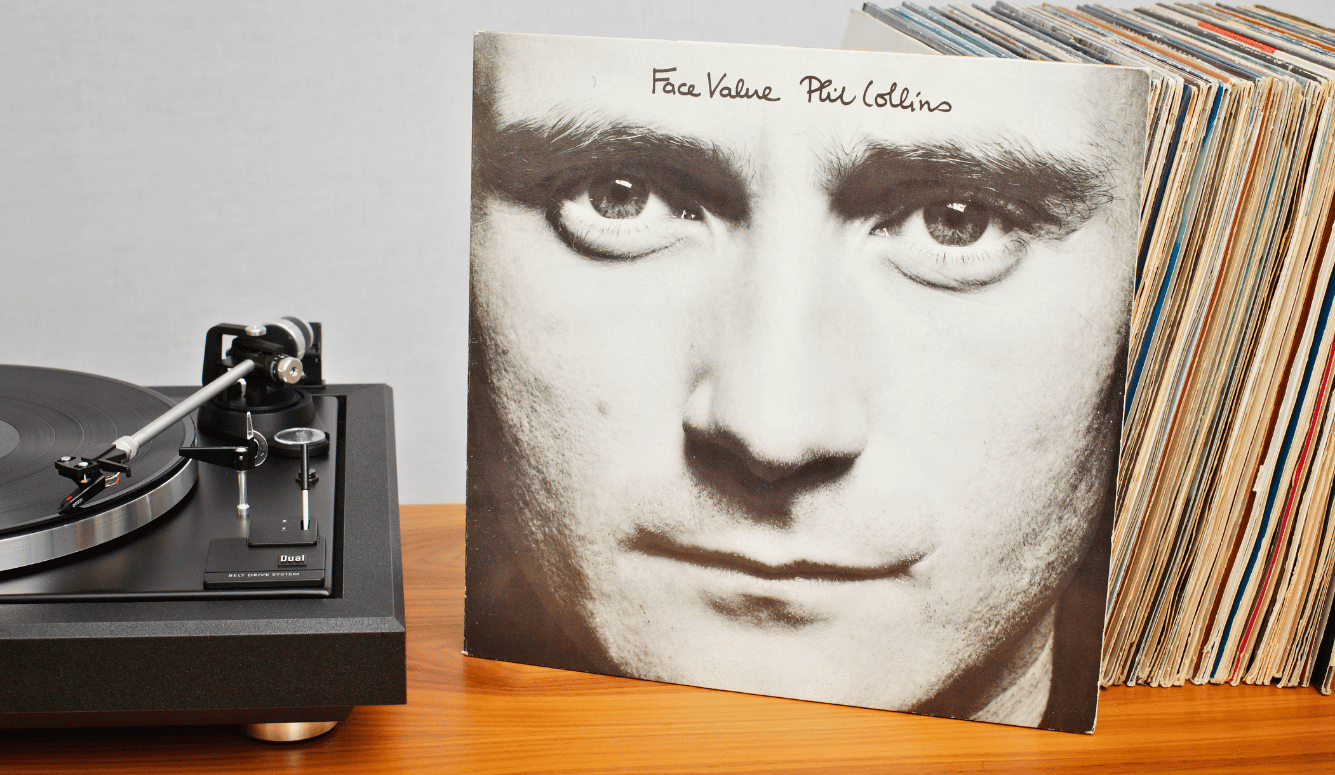
Just as Genesis was breaking into the pop charts, Phil Collins’s marriage to Andrea Bertorelli collapsed and Collins moved back to his house in Surrey where he began work on his debut studio album Face Value (1981). He recorded the demos in his bedroom, using only an 8-track recorder, a Roland CR-78 drum machine, a Prophet-5 synthesiser, a piano, and a Rhodes electric piano. He later claimed to have improvised the songs, with their sad lyrics and melancholy sound.
Meanwhile, Genesis reconvened to work on Duke (1980) and Collins played some of his demos to Ahmet Ertegun, president and co-founder of the band’s label, Atlantic Records. Ertegun was impressed by what he heard and offered to help Collins complete his solo album, using the demos as master recordings. Hugh Padgham was brought on board as co-producer. Collins rerecorded his vocals after converting the 8-track demos onto a 16-track player. The gated reverb provided the track “In the Air Tonight” with an unexpectedly thunderous finale, after nearly four minutes of calm dreamy keyboards underscored by a light beat from the drum machine. Phil Collins improvised the drum part by simply stepping on the kick drum pedal four times and striking the toms ten times. The drum fill was recorded in one take.
“In the Air Tonight” is not representative of the rest of Face Value. While Phil Collins gained his initial fame playing prog rock—a genre critic James Parker once called “The Whitest Music Ever”—the album has a sombre tone that was heavily influenced by the African-American R&B, soul, and jazz artists Collins had listened to in his youth: Otis Redding, Nina Simone, and Motown artists like Stevie Wonder, The Temptations, and Martha Reeves & The Vandellas. The brass section was played by The Phenix Horns, Earth, Wind, and Fire’s horn section. Songs like “Behind the Lines” and “I Missed Again” are particularly reminiscent of Motown.
“In the Air Tonight” shot into the Top 10 of multiple charts worldwide (with the exception of the US charts) when it was released as a single in January 1981. From then on, there was no stopping Phil Collins. Every year he released a new album, either solo or with Genesis, and every one was a hit. The years 1984–86 were particularly successful. Collins finally achieved success in the US charts with “Against All Odds (Take a Look at Me Now)” while “Easy Lover,” his collaboration with Earth, Wind, and Fire’s Philip Bailey, became one of the most iconic songs of the decade. The following year, Collins released his third solo album, No Jacket Required. Its danceable R&B-inspired songs like “Sussudio” and “Don’t Lose My Number” and ballads like “One More Night” and “Take Me Home” propelled Phil Collins into superstardom and made No Jacket Required one of the best-selling albums of all time. On 13 July 1985, Collins was the only artist to perform at both the Wembley Stadium and John F. Kennedy Stadium concerts for Live Aid. At Wembley, he performed a solo set, while at the JFK Stadium he played drums with a reformed Led Zeppelin—though the performance was much criticised for the band’s lack of preparation. In 1986, Genesis’ popularity peaked with the release of Invisible Touch. Their sound had previously straddled the line between prog rock and radio-friendly hits, but with Invisible Touch they became a full-blown pop band. The self-titled track was their only number one single in the United States. In the 1980s, Phil Collins seemed to be everywhere. He even guest-starred in an episode of Miami Vice and starred in the 1988 crime comedy Buster.
Everything was bigger in the ’80s and drums were no exception. As Phil Collins’s reputation grew, so did the gated reverb effect, which was eventually preprogrammed into every drum machine on the market. It became the default sound of the 1980s seemingly overnight. Prince’s Sign O’ The Times (1987), Michael Jackson’s Thriller (1982), and Bruce Springsteen’s Born in the USA (1984) all utilised the gated reverb; it formed the backbone of Duran Duran’s dance rock sound. Much like Phil Collins, the gated reverb could be heard on every radio station and in every club, but by the end of the decade, the effect had fallen out of fashion and artists went back to the standard dry drum sound. Phil Collins fell out of fashion around the same time, but his fall from grace was much uglier.
Re-Genesis
Nostalgia cannot rescue rock and roll.
Collins had been so ubiquitous in the 1980s that a backlash was inevitable. He was an easy target for anyone who wanted to criticise eighties pop music. “Even when I sought to escape the sounds in my head by turning on the TV, there would be Mr. Collins on MTV or Friday Night Videos mugging for the cameras—intent on showing the world just how hard he would work to sell millions of records to millions of stupid people,” Frank DiGiacomo wrote in The New York Observer in 1999. “Phil Collins made dull music that seemed almost exclusively aimed at the parent demographic,” commented Hardeep Phull in the New York Post. In 2000, Phil Collins’s “You’ll Be in My Heart” from Disney’s Tarzan (1999) won the Oscar for Best Song over “Blame Canada” from South Park: Bigger, Longer, and Uncut (1999). In an interview immediately after the Oscars, South Park co-creator Trey Parker, who was allegedly tripping on acid at the time, told a reporter, “it’s terrible to lose, to lose to Phil Collins especially.” Parker retaliated by writing and directing the South Park episode “Timmy 2000,” in which the whole town gets temporarily hooked on Ritalin and turn into Phil Collins fans—though as soon as they are cured of the addiction, they realise that “Phil Collins sucks ass” and boo his performance at a concert.
Even Phil Collins’s peers took pot-shots at him. Roger Waters said Phil Collins and other pop singers “write songs to fill the hole, rather than getting somebody else. But they might just as well get somebody else, because it’s a manufacturing process.” The harshest criticism came from Noel Gallagher of Oasis who said, “Just because you sell lots of records, it doesn’t mean to say you’re any good. Look at Phil Collins,” and “People hate fucking cunts like Phil Collins, and if they don’t, they fucking should.” When asked why he hated Phil Collins so much, Gallagher said only, “He kept the Jam off No 1 with ‘You Can’t Hurry Love.’” Meanwhile, Collins’s personal life was once more falling apart. The details of his split from his second wife, Jill Tavelman, in 1994 became tabloid fodder following the false but persistent rumour that Collins had filed for divorce via fax.
But Phil Collins’s music has become popular again over the last decade, especially among black artists and audiences. His songs— especially “In the Air Tonight”—have been widely sampled by hip-hop artists like Tupac Shakur, DMX, and Meek Mill, and referenced in lyrics by musicians like Eminem. In 2002, Collins collaborated with Bone Thugs-n-Harmony on their song “Home,” which samples “Take Me Home,” a ballad from No Jacket Required, flying to his home in Switzerland to film the music video and declaring Phil Collins an honorary member of the group with the nickname “Chrome Bone.”
The use of Collins’s song “You’ll Be in My Heart” as the theme music for Disney’s Tarzan (1999) sparked a brief resurgence of interest. He gained further influence among Millennials by licensing his music to the Grand Theft Auto video game franchise, one of the most popular media franchises that has ever existed. Both solo Collins and Genesis tracks were featured on the in-game radio stations in Grand Theft Auto: Vice City Stories (2006), Grand Theft Auto IV (2008), and Grand Theft Auto V (2013). Phil Collins also has the unique distinction of being the only celebrity to be featured in a Grand Theft Auto game, in which the player character must save him from assassins while he’s on tour. At the conclusion of the mission, the video game version of Collins plays “In the Air Tonight” in concert.
Phil Collins’s drumming has also influenced other musicians. The late Taylor Hawkins of the Foo Fighters told fans, “Anyone who wants to be good on the drums should check him out. The man is a master.” Chad Smith of the Red Hot Chili Peppers praised his “unique sound and style,” while Mike Portnoy of Dream Theater called him a “prog icon.” The late Neil Peart of Rush, whom many consider one of the greatest drummers of all time, said of Collins:
His fills were imaginative and exciting, alive with energy and variety, while the refined technique was always in the service of the music. Even within those fills, Phil applied a jazz drummer’s sense of dynamics… which also guided his ensemble playing and inspired me to try to incorporate that sensibility into my own triple-f approach. Plus, his drums sounded so good. Good-sounding drums are always the result of a good-sounding drummer and speak of the player’s touch.
Articles like “Is It Time We All Stopped Hating Phil Collins?” (2011) and “How Phil Collins Became Cool (no, really)” (2021) began to appear. A number of artists declared their admiration for Collins’s music, including indie rock band The 1975, rapper Action Bronson, Kanye West, and New Zealand pop singer Lorde. “My favorite pop males are the guys that sound like a combination of your boyfriend and your dad. That’s Phil,” Lorde told podcaster Marc Maron in 2018.
Collins has been in poor health for the last twenty years. During Genesis’ reunion tour in 2007, Collins dislocated the vertebrae in his neck—an accident that he attributed to the stresses built up over fifty years of drumming. The injury affected the nerves in his hands, ultimately forcing him to give up the drum sticks. Surgeries in 2009 and 2016 not only failed to correct the nerve problem but caused severe complications, including a dropped foot that has left Collins dependent on a cane. All this was exacerbated by years of heavy drinking, which damaged Collins’s kidneys and likely contributed to his type 2 diabetes. These health problems did not stop Phil Collins from going on two last tours: one solo and one a farewell tour with Genesis with his son Nic filling in on drums. However, Collins now requires around the clock care from a live-in nurse.
Phil Collins was an unlikely pop star. Diminutive and balding, he was very unlike the sex symbol frontmen like Robert Plant, Mick Jagger, and Jim Morrison. He created the sound that launched him into superstardom by accident. He is one of only three artists to sell over 100 million records both as a soloist and as a band member (the other two are Paul McCartney and Michael Jackson) but it took until this year for him to be nominated for induction into the Rock and Roll Hall of Fame as a solo artist; he will finally take his rightful place there in November. This is one of pop music’s highest honours, but he truly deserves it. Few artists have influenced an entire decade in the way he did. Forty-five years ago, he created a sound so powerful and iconic that to many people it seemed as if it had been there all along.
Quillette invites thoughtful responses to its essays.
Selected responses are published once per week as part of a curated Letters to the Editor feature. If selected, letters appear under the contributor’s real name and may be edited for clarity and length.
To submit a letter for consideration, please email [email protected].
Read the full article here
Fact Checker
Verify the accuracy of this article using AI-powered analysis and real-time sources.