

 Freedom Index
Listen to the article
On the eve of last year’s Earth Day, Denis Hayes—one of the original organisers of the first such event—declared:
The world is approaching irreversible tipping points. Rising global temperatures, toxic pollutants, and crashing ecosystems are pushing the planet to the brink of collapse. Yet too many global political leaders are choosing this moment to roll back critical environmental regulations and crush renewable energy sources.
That sounds alarming, but it was a relatively restrained prognosis compared to remarks from organisers in other countries. “We are experiencing an environmental collapse,” declared Greenpeace Argentina’s Agostina Rossi Serra. Not to be outdone, Jane Goodall—an icon in the sustainability community—ominously warned, “I do believe there is a window of time when we can at least slow down climate change and loss of biodiversity. But only if we get together and take action now. And without hope we will fall into apathy and do nothing. Then we are doomed.”
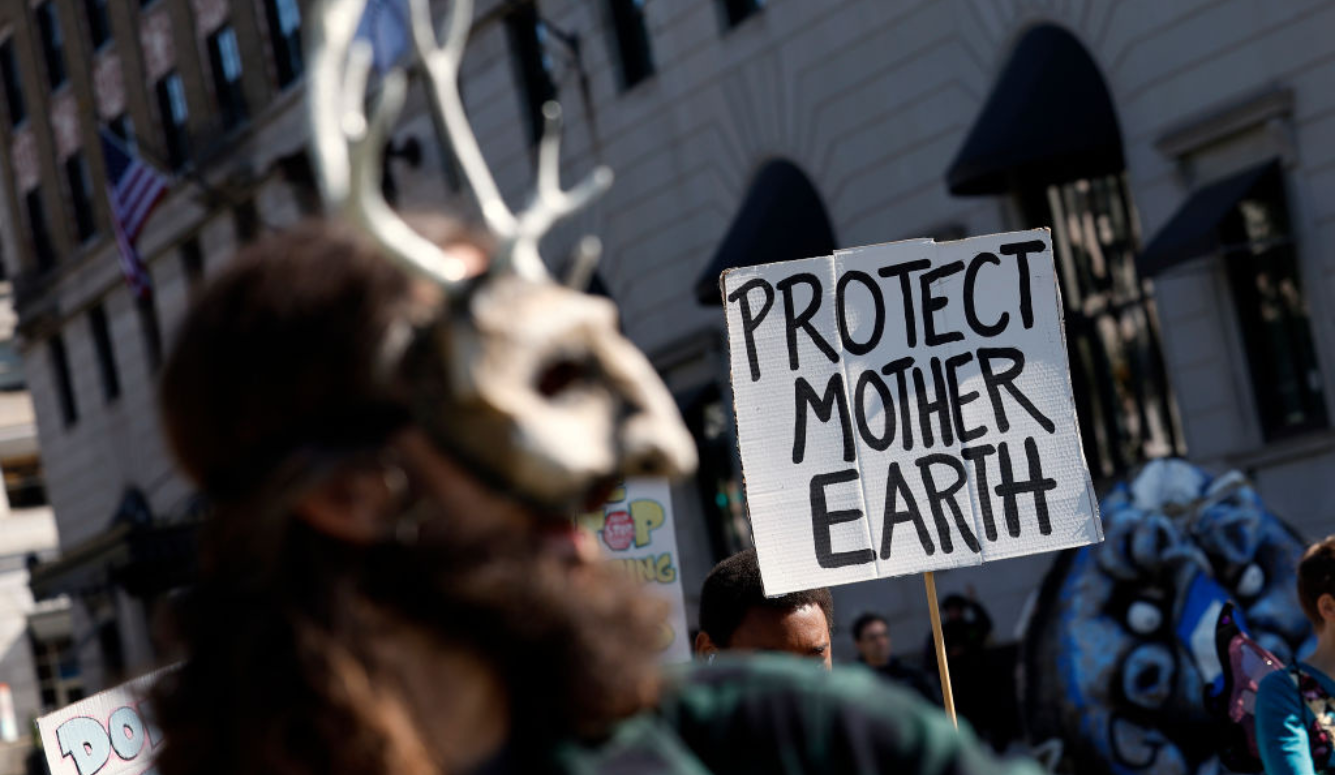
Comments like these are typical of the sweeping, apocalyptic, and morally charged rhetoric common within environmentalist circles. They are also increasingly detached from the practical spirit that animated Earth Day at its inception. The first Earth Day celebration in 1970 was established by Democratic senator Gaylord Nelson of Wisconsin as a nationwide environmental teach-in that reflected the era’s grassroots idealism and countercultural energy. But it was also a serious effort to refocus public attention on pollution, conservation, and public health. Today, the annual event is marked by hyperbole, pessimism, and the denunciation of important technologies.
This year’s Earth Day slogan—“Our Power, Our Planet”—emphasises the importance of collective action, but practical initiatives have been replaced by moral posturing and revolutionary grandstanding. “The first Earth Day,” the website announces, “started an environmental revolution. Now, we are igniting an education revolution to save the planet.” Recommended activities include the reduction of humanity’s “foodprint” (the environmental costs of growing, producing, transporting, and storing our food), but instead of asking how innovation can make agriculture more efficient and less wasteful, activists encourage people to see feeding the world through a lens of guilt and self-denial.
A similar sensibility drives enthusiasm for “regenerative agriculture,” a favourite buzzword of agricultural corporations trying to stay ahead of the zeitgeist. As Andrew Porterfield and Jon Entine of the Science Literacy Project have written:
If you read the literature generated by Regenerative International and many organic advocates, it’s a lot like a rebranding of organic farming but with more grandiose claims, akin to the replacement of the term “corporate social responsibility” with “sustainability” in the late 1990s, which allowed the concept to go mainstream. Its supporters in the organic community make a multitude of immodest representations about what organic/regenerative agriculture can do, including “reversing global warming” and “ending world hunger,” along with preserving the world’s top soil.
Soil health is obviously important, but the reality of regenerative agriculture is less appealing: lower yields, greater demands on land and water, and higher food prices, the burden of which falls on those least able to bear it.
Another of this year’s injunctions is “Go Pesticide Free.” The organisers do not spell out how we are supposed to accomplish this, which is hardly surprising since 99.99 percent of the pesticides in our diets are found naturally in our food. It is easy to denounce pesticides in the abstract, but it is much harder to explain how modern agriculture is supposed to protect crops from insects, fungi, weeds, and disease without them. But that gap between sloganeering and reality is typical of Earth Day activism.
Many of those stumping for Earth Day this year will oppose environmentally friendly advances in science and technology, such as agricultural biotechnology (“GMOs”), fracking, and nuclear power. Remarkably, the discussions of energy issues on the Earth Day website contain not a single mention of nuclear power. Are the Earth Day organisers unaware of the skyrocketing energy demands of AI-driven data centres? The International Energy Agency projects that global data-centre electricity use will more than double by 2030—equal to roughly the current electricity consumption of Japan. That would amount to about three percent of total global electricity demand. Some estimates are even higher.
Are Climate Doomers for Real?
Activists of all stripes will continue to preach that the end of the world is nigh, but that doesn’t mean that we should take them seriously.
Naturally, a pervasive meta-message at Earth Day events is disdain for the capitalist system that provides the innovation needed for effective environmental protection and conservation. It is no coincidence that low-income countries tend to be the most polluted. Wealth, technological sophistication, and strong institutions are not enemies of environmental improvement as eco-pessimists often claim; they are preconditions for it. For a previous Earth Day, seventh graders at a private school near San Francisco were asked to make a list of environmental projects that could be accomplished with Bill Gates’s fortune. This approach to environmental awareness accords with the belief that the right to private property is subordinate to undertakings that enlightened thinkers deem worthwhile. But it’s also interesting to note that the resources made “available” for the students’ thought experiment were not, say, the aggregate net worth of the members of Congress but the wealth of one of the nation’s most successful and most innovative entrepreneurs.
Those students were also asked to read Rachel Carson’s bestselling 1962 book Silent Spring, a powerful indictment of the sometimes careless spraying of chemical pesticides, and the links between pollution and animal and human ill-health. But Carson was an advocate not a scientist trying to make sense of our complex ecosystem, the reparative qualities of nature, and the need for choices that are both practical and environmentally sensitive. As a result, her book is an emotionally charged and sometimes deeply flawed and scientifically superficial work. As Roger Meiners and Andrew Morriss write in a 2012 analysis, “Silent Spring at 50: Reflections on an Environmental Classic”:
Earlier in her writing career, Carson was a well respected nature writer, but in Silent Spring, she shifted to advocating positions linked to a darker tradition in American environmental thinking: neo-Malthusian population control and anti-technology efforts. Her background as a nature writer gave credence to these views and helped build those darker themes into mainstream environmentalism today.
That judgment may be harsh but it helps to illuminate an important strain in Carson’s legacy: a tendency to treat population growth, industrial agriculture, and modern technology as irreversible dangers rather than problems in need of workable solutions.
This is particularly evident in Carson’s treatment of pesticides. She tended to blur distinctions between different chemicals, their exposure levels and their uses, moving from real abuses in large-scale agricultural spraying to broader claims that did not properly distinguish between targeted public-health uses and what she believed to be indiscriminate chemical application in agriculture. To her credit, her advocacy did increase pressure on chemical companies and farmers to abandon some of the harshest pesticides and reformulate others. But she made a significant and tragically consequential misstep with her assessment of the insecticide DDT, underweighting its vector control and overstating numerous human-health inferences. Even sympathetic retrospective assessments note that she was writing before modern environmental chemistry and risk assessment had fully matured, so many of her claims were more forceful than the evidence base in 1962 justified.
In particular, Carson failed to distinguish between indiscriminate agricultural spraying—of which there were instances at the time—and tightly targeted malaria control. That distinction mattered enormously in Africa. DDT was one of the cheapest and most effective tools for indoor residual spraying against malaria vectors in some high-burden settings. Over time, however, various factors—the anti-DDT pressure Carson stirred, policy confusion, insect resistance, weak health systems, and poor execution of malaria-control programs—combined to reduce the widespread use of a very effective tool. The movement Carson set off eventually led to sweeping bans of DDT in malarial regions of Africa.
Unfortunately, there was no effective substitute. In his stunning 1992 essay, “The Lies of Rachel Carson,” J. Gordon Edwards, a professor of entomology at San Jose State University and a fellow of the California Academy of Sciences, challenges many of her claims in detail. A 2012 Nature correspondence article by Tony Trewavas, writing on behalf of eleven co-signatories, estimates that exaggerated fears about DDT may have contributed to between 60 million and 80 million premature and unnecessary deaths over forty years, mainly among children. With infections soaring uncontrollably in the 2000s, the World Health Organisation endorsed indoor residual spraying with DDT, stating that countries could use it “for as long as necessary.” Today, there is still no effective, efficient, affordable, and locally appropriate alternative.
The lessons of the DDT episode are often lost in today’s environmental doomsday culture. Environmental arguments framed in absolute moral terms often obscure tradeoffs, discount human costs, and harden into policy long after the underlying science is clear. As Meiners and Morriss conclude, the influence of Silent Spring “encourages some of the most destructive strains within environmentalism: alarmism, technophobia, failure to consider the costs and benefits of alternatives, and the discounting of human well-being around the world.” That broader critique helps explain why the DDT fiasco still matters. The problem was not simply that some of Carson’s conclusions were wrong or overstated. It was that her mode of argument helped to normalise a style of environmental politics in which fear can outrun evidence, tradeoffs are pushed aside, and concerns about the human costs of losing useful technologies are ridiculed as cultural arrogance. Sadly, echoes of that remain a part of the Earth Day agenda today.
The late British writer and politician Dick Taverne (aka Lord Taverne) makes a similar point in his book The March of Unreason. Taverne describes a “new kind of fundamentalism” that has infiltrated many environmentalist campaigns—a broad, indiscriminate back-to-nature impulse that views science and technology with suspicion and as expressions of an exploitative, rapacious, and reductionist attitude toward nature. It is no coincidence, he writes, that such currents are strongly represented in anti-globalisation and anti-capitalism movements worldwide. In some respects, Taverne echoes the late physician and novelist Michael Crichton, who argues in his novel State of Fear that modern environmentalism resembles a secular religion with its own Edenic paradise, in which mankind lived in a state of unity with nature before the fall that resulted from technological knowledge and innovation. And now we await our secular Judgment Day, when the wages of those sins will produce an ecological collapse that will spare no one except those devoted to sustainability.
One of Crichton’s characters argues that, since the end of the Cold War, environmental alarmism in Western nations has filled the void left by the disappearance of communism and the prospect of a nuclear holocaust. Social control, he contends, is now maintained with exaggerated fears about pollution, global warming, chemicals, genetic engineering, and the like—our current politico-legal-media complex. That argument is overstated, but it does point to an authentic tendency: public debate can become distorted when worst-case scenarios crowd out rational discussion of proportionality, tradeoffs, and countervailing evidence. At its worst, that style of politics trades in fear disguised as safety. French writer and philosopher Pascal Bruckner makes a similar point when he suggests that some modern moralists seem to be less interested in balancing risks than in dwelling on catastrophe:
You’ll get what you’ve got coming! That is the death wish that our misanthropes address to us. These are not great souls who alert us to troubles but tiny minds who wish us to suffer if we have the presumption to refuse to listen to them. Catastrophe is not their fear but their joy.
In addition to pressuring the chemical industry to develop less environmentally problematic products, this outlook has helped to marginalise agricultural biotechnology in Europe and much of Africa and expanded suspicion of pharmaceutical innovation. Taverne saw these latter trends as contrary to the principles of the Enlightenment: inherited dogma and superstition can sweep evidence aside and thwart innovation. In such a climate, scientific creativity and technological innovation are constrained, even when they could improve human well-being and reduce environmental harm.
Taverne’s warning still resonates today. When you defend science and reason, you defend democracy itself. Earth Day once helped focus public attention on real environmental problems. It should aspire to do so again, without surrendering to alarmism, misanthropy, technophobia, and theatrics.
Quillette invites thoughtful responses to its essays.
Selected responses are published once per week as part of a curated Letters to the Editor feature. If selected, letters appear under the contributor’s real name and may be edited for clarity and length.
To submit a letter for consideration, please email [email protected].
Read the full article here
Fact Checker
Verify the accuracy of this article using AI-powered analysis and real-time sources.