

 Freedom Index
Listen to the article
Imagine you’re a professor who disagrees with your university’s indigenous land acknowledgement, so you write your own as a joke — and then your school investigates you for “unacceptable” and “inappropriate” speech. Or imagine you invite a controversial former Black Panther to speak on campus, so your university forces the event online.
These are real stories, and FIRE’s archives are full of plenty more just like them. But thanks to a new measure enacted in Tennessee, the university’s actions in cases like these wouldn’t just violate the First Amendment, but state law, too. The amended version of Senate Bill 1741, the “Charlie Kirk Act,” builds on the state’s existing campus free speech law to give public university students and faculty some of the most robust speech protections in the nation. FIRE provided feedback on the initial public draft and gave supportive testimony after it was amended to its current language. It now heads to the governor’s desk.
FIRE statement on Kash Patel’s $250M defamation lawsuit against The Atlantic
Kash Patel’s $250M lawsuit raises First Amendment concerns as a potential SLAPP, threatening robust, open debate on government accountability and press freedom.
Read More
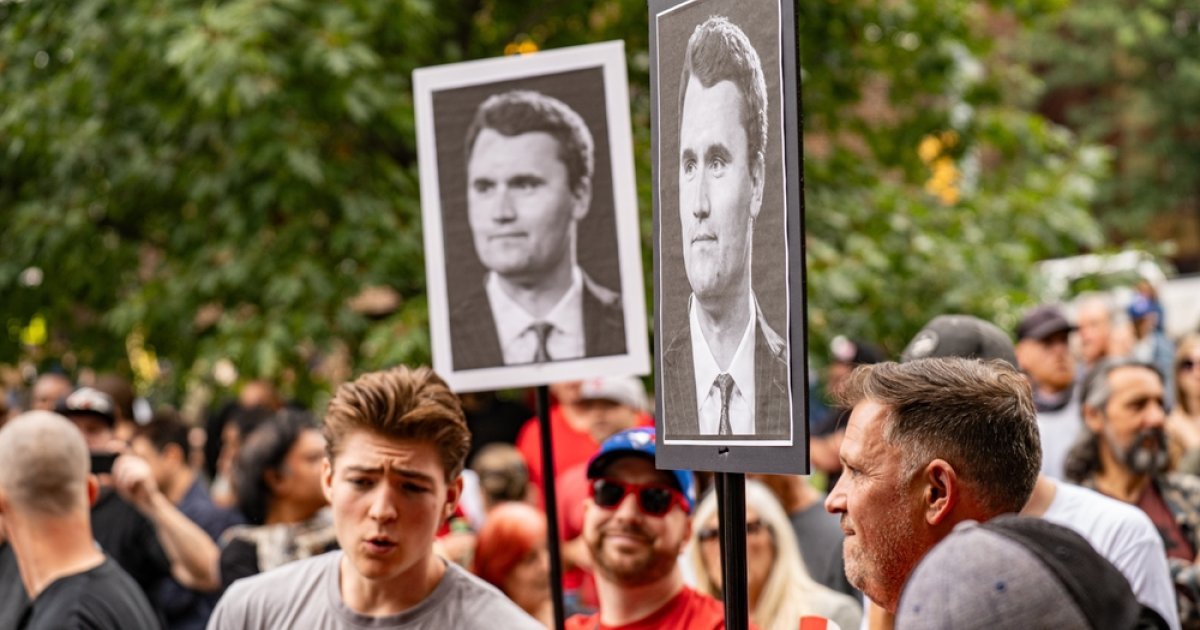
This measure has sparked controversy in part because of provisions in the initial draft that have since been amended, and in part because it’s named for Charlie Kirk, who was tragically assassinated last year. But what matters most is what the final bill as passed does, not what it’s named or what earlier drafts looked like. Let’s address some misconceptions about the Charlie Kirk Act and show why it’s a real win for both students and faculty.
Institutional commitments
The Charlie Kirk Act — introduced by Rep. Gino Bulso and Sen. Paul Rose — requires public universities to adopt two excellent free speech reports from the University of Chicago.
The first is the Chicago Statement, the gold standard for statements of commitment to free speech, which reaffirms the university’s “fundamental commitment” to the principle that debate must not be suppressed simply because others object.
The second is the Kalven Report, which plainly states the principle of institutional neutrality: “The university is the home and sponsor of critics; it is not itself the critic.” Universities that fail to remain neutral on the issues of the day prompt self-censorship by students and faculty who disagree with the institution’s official views and fear disciplinary action for dissenting from them.
If Tennessee’s state universities implement this properly — as a restraint on the institution itself and not as a restraint on students or faculty, as we’ve seen elsewhere — this will further bolster the free flow of ideas on campus.
Academic freedom and faculty speech protections
The bill’s most significant contribution may be its provision on academic freedom. The bill says:
A public institution of higher education or a faculty member or agent of the institution shall not retaliate in any way or discriminate in any manner against a faculty member on account of the viewpoints expressed in the faculty member’s scholarly work, or on account of any speech or writing protected by the First Amendment of the United States Constitution.
Over the years, FIRE has seen countless professors investigated, disciplined, or terminated — from the left and the right — for teaching controversial materials in class or sharing their views on matters of public concern. This bill addresses these unconstitutional and speech-chilling actions by prohibiting all forms of viewpoint-discriminatory retaliation against faculty for their protected speech.
Building on existing law
Other provisions of the Charlie Kirk Act supplement or clarify Tennessee’s existing campus free speech law.
Current law says public colleges cannot disinvite a speaker invited by a student, student organization, or faculty member because others find their speech offensive or disagreeable. But universities often attempt to justify disinvitations by citing potential disruptive activities, rather than the speaker’s viewpoint. This is hardly better, as it incentivizes would-be censors to threaten disruption so that their school has an excuse to shut down the speech in question (often referred to as the “heckler’s veto”). This bill clarifies that the disinvitation prohibition extends to “threatened protests or opposition.”
It also prohibits public colleges from retaliating against individuals or denying recognition to student groups for their religious views or “position concerning abortion, homosexuality, or transgender behavior.” The First Amendment and existing state law already prohibit such retaliation, regardless of whether the speech in question concerns one of the issues above, but Bulso said he wanted to highlight these particular issues given the “fierce opposition” Kirk himself often faced when speaking on them.
And importantly, this provision was amended from its original language, which would only have protected those speaking in “opposition to” those subjects. In the final version, people on all sides of these topics receive the same treatment.
Finally, the Charlie Kirk Act clarifies what it means to “substantially obstruct or otherwise substantially interfere with the freedom of others” to express their views, which is prohibited by Tennessee’s campus free speech law. This phrase is aimed at shoutdowns, a form of mob censorship where a group engages in disruptive behavior to make it impossible for an audience to hear an invited speaker’s message.
Texas Tech censors sex and gender courses
Texas Tech orders sweeping limits on sex and gender teaching, raising major academic freedom concerns and leaving faculty navigating a legal minefield.
Read More
The bill defines this language to include intentionally drowning out an invited speaker, blocking the view of an invited speaker, or physically obstructing people from attending an event. It also prohibits walkouts in the middle of an invited speaker’s remarks, but only where the walkout is intentionally, materially, and substantially disruptive to the event. The original language — erroneously quoted in some media outlets — lacked these important qualifiers.
This language protects speakers and counterprotestors alike: Students who want to hear an invited speaker will be able to do so, while protesters are free to respond in nondisruptive ways. At the same time, schools must be sure to apply this provision only to speaker events in reserved areas, not to lawful counterprotests in the generally accessible, open, outdoor areas of campus. Those areas remain traditional public forums for student expression.
The amended version also dropped both the mandatory discipline section and the private civil enforcement section, including an exception to Tennessee’s anti-SLAPP law.
Conclusion
The Charlie Kirk Act will allow members of the campus community to speak with renewed confidence. Professors can contest university positions with more protection against retaliation. Students and faculty can invite speakers without worrying that the school will shut them down because others protest.
Bottom line: that’s a significant win for free expression at Tennessee’s public universities.
Read the full article here
Fact Checker
Verify the accuracy of this article using AI-powered analysis and real-time sources.