

 Freedom Index
Listen to the article
RavenDAO’s RAVE token lost over 98% of its value over the weekend, and the hourly chart now warns of another massive drop in the coming days.
Key takeaways:
RAVE chart hints at 50%-plus drop next
On the hourly chart, RAVE continues to trade inside a descending channel, with lower highs and lower lows forming between two downward-sloping trend lines.
As of Monday, the spot price was retreating after testing the channel’s upper boundary, a sign that sellers remain active on rallies. If that rejection holds, RAVE could slide toward the channel’s lower trend line in the near term.
A Fibonacci extension drawn from the latest bounce at the lower boundary to the recent pullback from the upper boundary points to the 1.618 extension as the next bearish objective.
That level comes in near $0.30, implying a further 55%–58% decline from current prices in April or by May.
Notably, the same setup correctly anticipated Sunday’s drop toward $0.49, reinforcing the channel’s relevance.
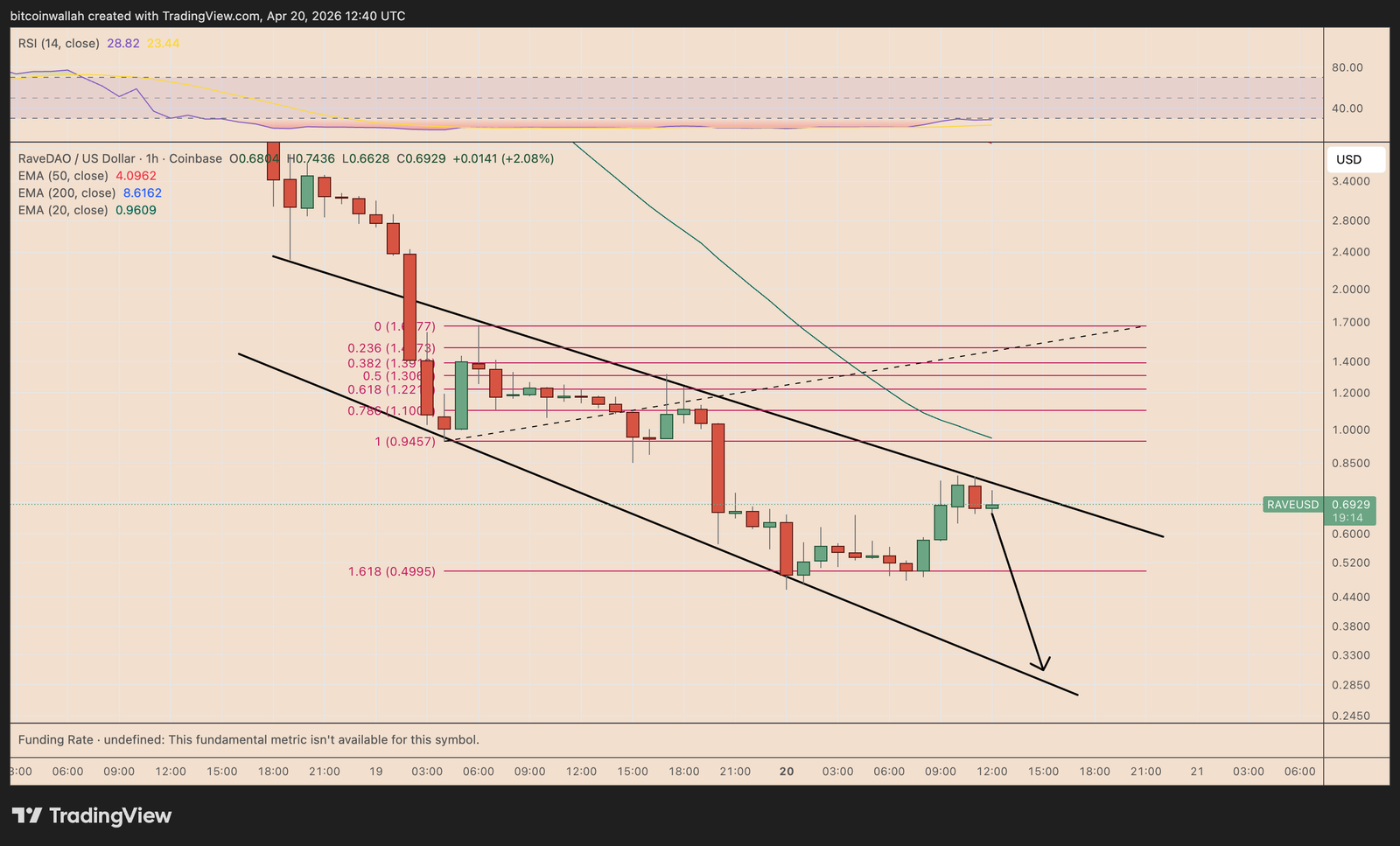
Meanwhile, the 20-hour exponential moving average at $0.96 and the 1.0 Fib line at $0.94 continue to cap upside attempts. Unless the bulls reclaim these levels decisively, the broader bias remains tilted to the downside.
Market manipulation claims add to RAVE risks
RAVE’s technical weakness is unfolding alongside mounting allegations of market manipulation, with market watchers comparing it to the LUNA and WAVES pump-and-dumps from 2022.
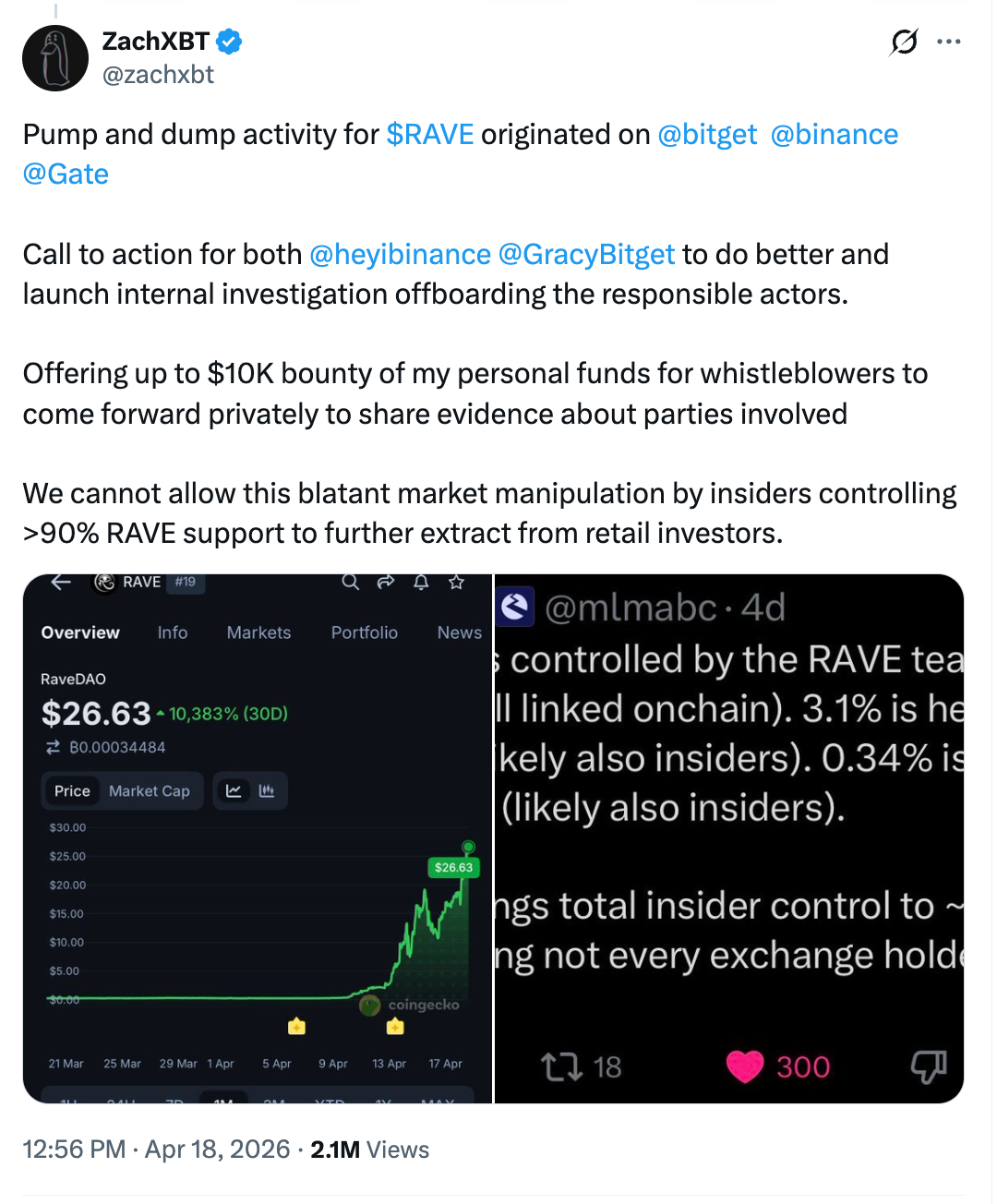
Onchain investigator ZachXBT described the token’s explosive rally and subsequent collapse as a “blatant” pump-and-dump, allegedly orchestrated across major exchanges including Binance, Bitget and Gate.io.
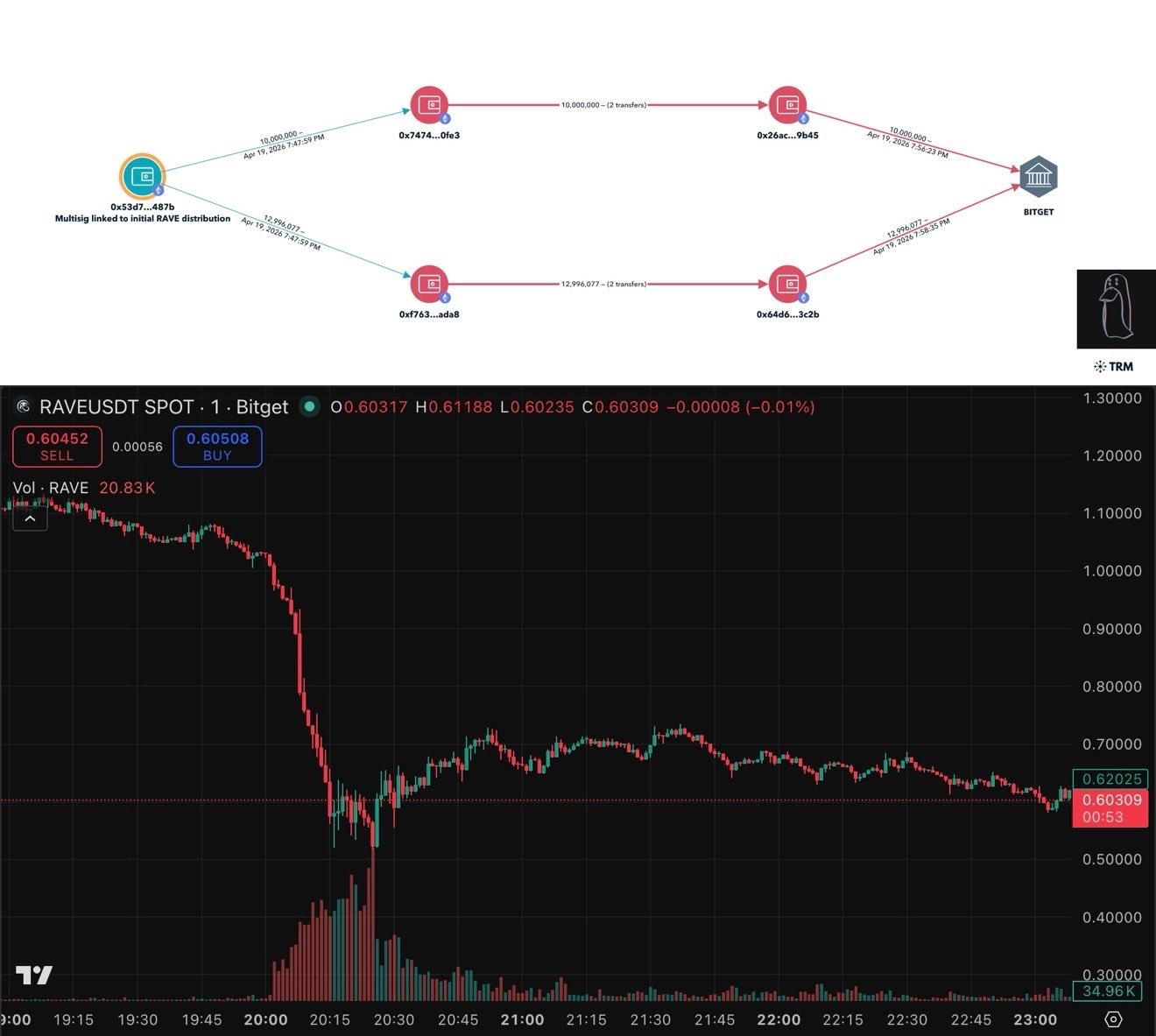
He flagged roughly 23 million RAVE tokens (worth around $23 million) moving from a team-linked multisig wallet to Bitget deposit addresses shortly before a 40% flash crash, and has since maintained a $25,000 bounty for whistleblowers.
RaveDAO has denied any involvement.
Related: FOMO, lax rules are fueling the crypto crime supercycle
Still, ZachXBT has doubled down on his claims, arguing that over 90% of the token’s supply may be controlled by insiders, raising concerns about liquidity concentration and price control.
A few days ago, RaveDAO revealed plans to sell portions of unlocked tokens to fund operations, marketing and hiring.
The team said it is considering price- or performance-based lock mechanisms to better align incentives, adding that “building a movement requires resources.”
This article is produced in accordance with Cointelegraph’s Editorial Policy and is intended for informational purposes only. It does not constitute investment advice or recommendations. All investments and trades carry risk; readers are encouraged to conduct independent research before making any decisions. Cointelegraph makes no guarantees regarding the accuracy or completeness of the information presented, including forward-looking statements, and will not be liable for any loss or damage arising from reliance on this content.
Read the full article here
Fact Checker
Verify the accuracy of this article using AI-powered analysis and real-time sources.