Close Menu
FSNN | Free Speech News NetworkFSNN | Free Speech News Network
  • Home
  • News
    • Politics
    • Legal & Courts
    • Tech & Big Tech
    • Campus & Education
    • Media & Culture
    • Global Free Speech
  • Opinions
    • Debates
  • Video/Live
  • Community
  • Freedom Index
  • About
    • Mission
    • Contact
    • Support
Trending

RaveDAO accused by ZachXBT of ties to ‘suspicious’ crypto exchange activity

11 minutes ago

JSCC Tests Japanese Government Bonds as Digital Collateral on Canton

14 minutes ago

Palantir Faces Backlash Over AI-Driven Military Doctrine

16 minutes ago
Facebook X (Twitter) Instagram
Facebook X (Twitter) Discord Telegram
FSNN | Free Speech News NetworkFSNN | Free Speech News Network
Market Data Newsletter
Monday, April 20
  • Home
  • News
    • Politics
    • Legal & Courts
    • Tech & Big Tech
    • Campus & Education
    • Media & Culture
    • Global Free Speech
  • Opinions
    • Debates
  • Video/Live
  • Community
  • Freedom Index
  • About
    • Mission
    • Contact
    • Support
FSNN | Free Speech News NetworkFSNN | Free Speech News Network
Home»News»Media & Culture»3 Disasters That Legal Weed Didn’t Unleash—Despite the Forecasts
Media & Culture

3 Disasters That Legal Weed Didn’t Unleash—Despite the Forecasts

News RoomBy News Room3 hours agoNo Comments4 Mins Read851 Views
Share Facebook Twitter Pinterest Copy Link LinkedIn Tumblr Email VKontakte Telegram
3 Disasters That Legal Weed Didn’t Unleash—Despite the Forecasts
Share
Facebook Twitter Pinterest Email Copy Link

Listen to the article

0:00
0:00

Key Takeaways

Playback Speed

Select a Voice

Happy 4/20 to the millions of people across the country who celebrate, including much of the Reason staff. As someone who’s never been interested in pot—save for one summer in college—or drugs in general, I’ve always found the day a bit strange. But as I’ve grown older (and more libertarian), I’ve come to appreciate it as a celebration of personal freedom. 

I’m not the only one who has changed his mind. In 2025, 64 percent of Americans thought marijuana should be legal for both medical and recreational use (up from 31 percent in 2000), according to Gallup. Meanwhile, 40 states have legalized medical use of cannabis, including 24 that also allow recreational use. Late last year, President Donald Trump ordered that marijuana be reclassified from Schedule I to Schedule III under the Controlled Substances Act, putting it in the same category as prescription drugs such as “ketamine, anabolic steroids, and Tylenol with codeine,” explains Reason‘s Jacob Sullum.

Prohibitionists warned that legalization would have dire consequences. Here are some of their predictions that have yet to come true. 

In the lead-up to the 2012 vote on Amendment 64, which made Colorado the first state to legalize recreational marijuana, Douglas County Sheriff David Weaver warned that voters should anticipate “many harmful consequences” should the measure pass, including “more crime.”

According to a policy brief from Reason Foundation (which publishes this magazine), “the literature covering the relationship between marijuana use and violence appears to be largely inconclusive.” While research “generally suggests that marijuana use is associated with an increase in violent behavior,” the authors write, correlation is not causation, and several studies suggest otherwise. 

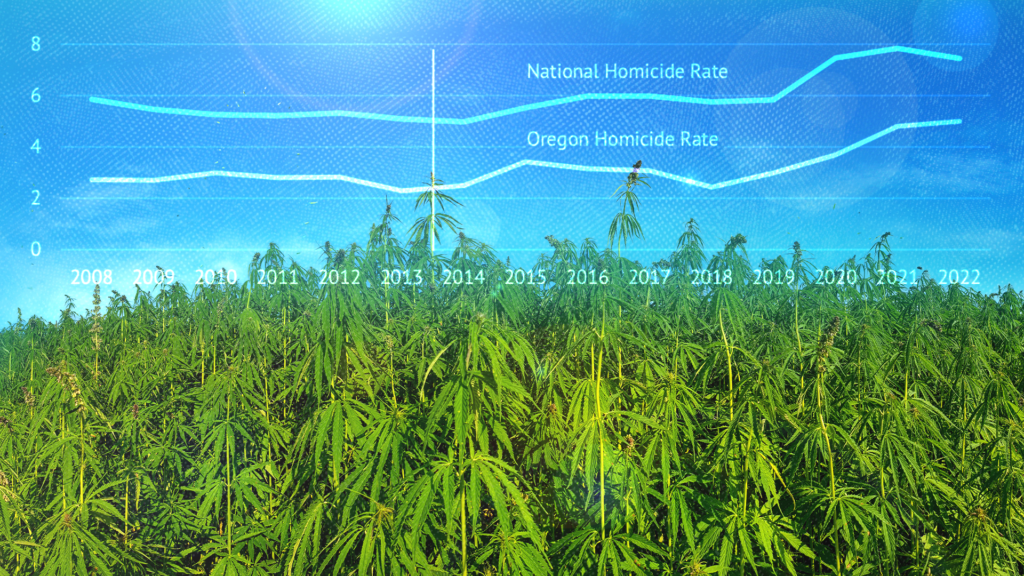
After recreational marijuana was legalized in Colorado, Washington, and Oregon, homicide rates in those states remained well below the national average (although they rose during the COVID-19 pandemic, mirroring the national trend). From 1999 through 2022, the authors of the Reason Foundation report found, “both recreational and medical marijuana legalization” were “associated with a decrease in the homicide rate.” A 2013 report from the RAND Drug Policy Research Center likewise found “little support for a contemporaneous, causal relationship between [marijuana] use and either violent or property crime.”

Yet prohibitionists stand by their forecast. In March, Ohio Speaker of the House Matt Huffman (R–Lima) defended proposed limits to THC content in the state by saying that legalization in Ohio has led to “more marijuana being available in the community,” causing “more crime.” 

Sheriff Weaver also warned that legalization would result in “more kids using marijuana.” That fear was also overblown. 

In 2022, Nora Volkow, director of the National Institute on Drug Abuse, noted that “in the United States, legalization by some states of marijuana has not been associated with an increase in adolescents’ marijuana use.” Nationwide, reported drug use among teenagers has been declining for several years. In 2024, the National Institutes of Health found that “substance use among adolescents has continued to hold steady at lowered levels for the fourth year in a row.” Volkow called these results “unprecedented” and implored the scientific community to continue investigating “factors that have contributed to this lowered risk of substance use.” 

One reason could be legalization. Pulling together the results of government surveys, the Marijuana Policy Project has found that past-month pot use by teenagers has fallen in most states where recreational use is legal. In Michigan, for instance, 17 percent of high school students reported past-month marijuana use in 2023, down from 24 percent in 2017. In Virginia, the rate fell from 17 percent in 2019 to 9.5 percent in 2023. 

While there could be several reasons why teens are smoking less pot—including increased use of other drugs—one thing seems certain: Weed legalization did not produce a generation of stoners.

There were also widespread predictons that legalization would increase traffic accidents. The data are decidedly mixed and inconclusive on this one. 

In 2021, the Insurance Institute for Highway Safety (IIHS) released a study that found traffic accidents rose by 7 percent in legalized states after legalization. The same study also concluded that traffic fatality rates did not rise by a statistically significant amount and “state-licensed recreational sales had no apparent impact on injury rates,” Reason‘s Jacob Sullum reported at the time. That same year, the IIHS found that drivers who used only cannabis were no more likely to get into car accidents than drivers who hadn’t used the drug. 

Mixed results like these are not uncommon. As Reason Foundation researchers concluded in a white paper: “There are few convincing conclusions to be drawn concerning the risk of traffic accident fatalities from marijuana legalization….All in all, no conclusive or definitive patterns related to cannabis legalization have appeared in the data or research to this point.”

Read the full article here

Fact Checker

Verify the accuracy of this article using AI-powered analysis and real-time sources.

Get Your Fact Check Report

Enter your email to receive detailed fact-checking analysis

5 free reports remaining

Continue with Full Access

You've used your 5 free reports. Sign up for unlimited access!

Already have an account? Sign in here

#IndependentMedia #NewsAnalysis #PoliticalDebate #PublicDiscourse #PublicOpinion
Share. Facebook Twitter Pinterest LinkedIn Tumblr Email Telegram Copy Link
News Room
  • Website
  • Facebook
  • X (Twitter)
  • Instagram
  • LinkedIn

The FSNN News Room is the voice of our in-house journalists, editors, and researchers. We deliver timely, unbiased reporting at the crossroads of finance, cryptocurrency, and global politics, providing clear, fact-driven analysis free from agendas.

Related Articles

Cryptocurrency & Free Speech Finance

Palantir Faces Backlash Over AI-Driven Military Doctrine

16 minutes ago
Media & Culture

Rep. Mike Johnson Tries, Fails To Sneak Clean Section 702 Re-Authorization Past The Goal Line

52 minutes ago
Media & Culture

Don’t Count on the 25th Amendment To Dethrone Donald Trump

57 minutes ago
Cryptocurrency & Free Speech Finance

NSA Is Using Anthropic’s Powerful Claude Mythos AI as CEO Meets With White House: Report

1 hour ago
Media & Culture

Court To Bondi: Demanding Platforms Censor Speech And Bragging About It On Fox News Is, In Fact, A First Amendment Violation

2 hours ago
Media & Culture

It Will Be Your Name and License on the Line, Not Chatgpt’s

2 hours ago
Add A Comment
Leave A Reply Cancel Reply

Editors Picks

JSCC Tests Japanese Government Bonds as Digital Collateral on Canton

15 minutes ago

Palantir Faces Backlash Over AI-Driven Military Doctrine

16 minutes ago

Rep. Mike Johnson Tries, Fails To Sneak Clean Section 702 Re-Authorization Past The Goal Line

52 minutes ago

Don’t Count on the 25th Amendment To Dethrone Donald Trump

57 minutes ago
Latest Posts

Bitcoin (BTC) to face near-term pressure as liquidity tightens, according to Hilbert Group CIO

1 hour ago

Ethereum Whale Opens $90M ETH Long Bet Amid 40% Price Rally Potential

1 hour ago

NSA Is Using Anthropic’s Powerful Claude Mythos AI as CEO Meets With White House: Report

1 hour ago

Subscribe to News

Get the latest news and updates directly to your inbox.

At FSNN – Free Speech News Network, we deliver unfiltered reporting and in-depth analysis on the stories that matter most. From breaking headlines to global perspectives, our mission is to keep you informed, empowered, and connected.

FSNN.net is owned and operated by GlobalBoost Media
, an independent media organization dedicated to advancing transparency, free expression, and factual journalism across the digital landscape.

Facebook X (Twitter) Discord Telegram
Latest News

RaveDAO accused by ZachXBT of ties to ‘suspicious’ crypto exchange activity

11 minutes ago

JSCC Tests Japanese Government Bonds as Digital Collateral on Canton

15 minutes ago

Palantir Faces Backlash Over AI-Driven Military Doctrine

16 minutes ago

Subscribe to Updates

Get the latest news and updates directly to your inbox.

© 2026 GlobalBoost Media. All Rights Reserved.
  • Privacy Policy
  • Terms of Service
  • Our Authors
  • Contact

Type above and press Enter to search. Press Esc to cancel.

🍪

Cookies

We and our selected partners wish to use cookies to collect information about you for functional purposes and statistical marketing. You may not give us your consent for certain purposes by selecting an option and you can withdraw your consent at any time via the cookie icon.

Cookie Preferences

Manage Cookies

Cookies are small text that can be used by websites to make the user experience more efficient. The law states that we may store cookies on your device if they are strictly necessary for the operation of this site. For all other types of cookies, we need your permission. This site uses various types of cookies. Some cookies are placed by third party services that appear on our pages.

Your permission applies to the following domains:

  • https://fsnn.net
Necessary
Necessary cookies help make a website usable by enabling basic functions like page navigation and access to secure areas of the website. The website cannot function properly without these cookies.
Statistic
Statistic cookies help website owners to understand how visitors interact with websites by collecting and reporting information anonymously.
Preferences
Preference cookies enable a website to remember information that changes the way the website behaves or looks, like your preferred language or the region that you are in.
Marketing
Marketing cookies are used to track visitors across websites. The intention is to display ads that are relevant and engaging for the individual user and thereby more valuable for publishers and third party advertisers.