

 Freedom Index
Listen to the article
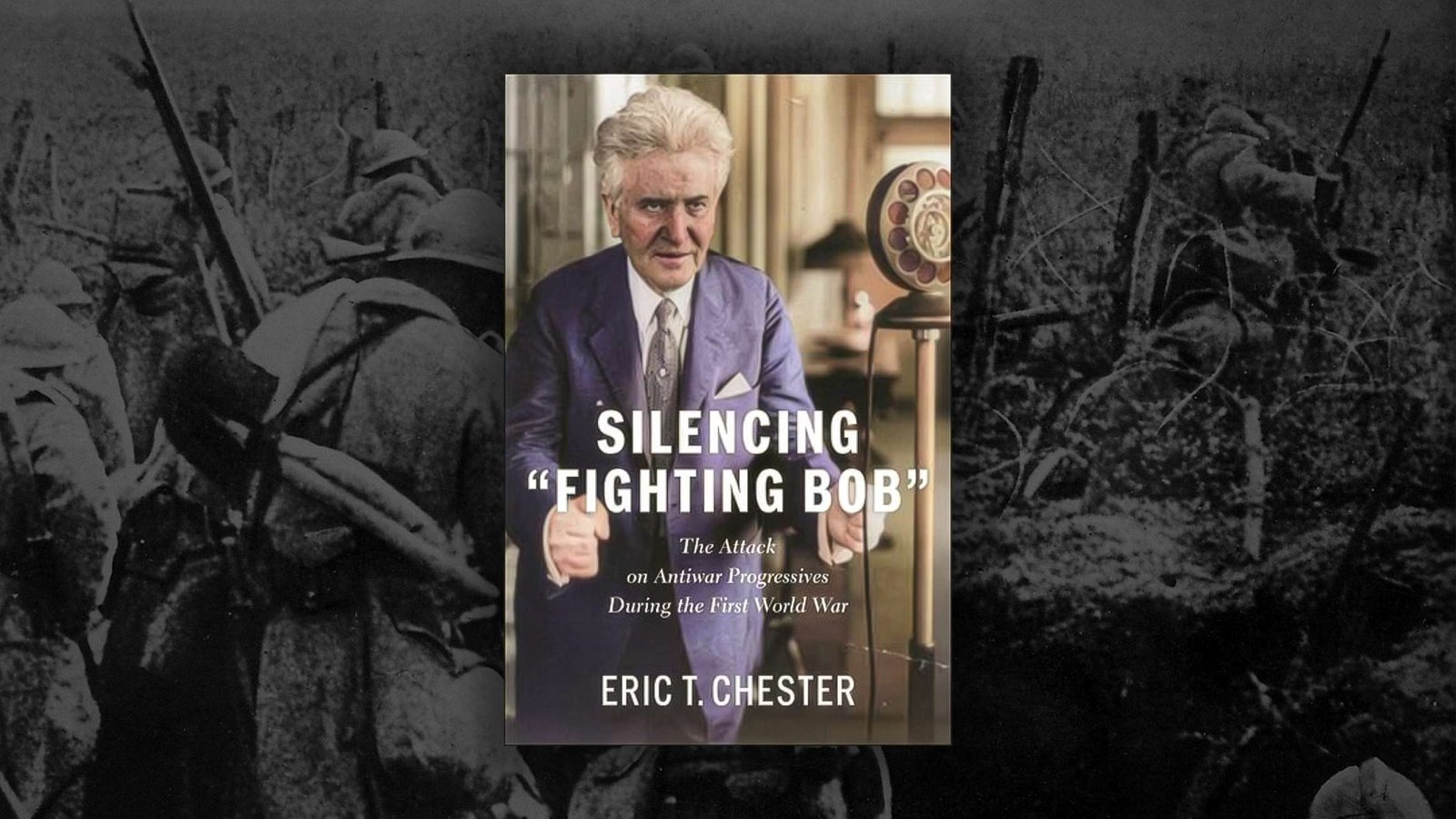
Silencing “Fighting Bob”: The Attack on Antiwar Progressives During the First World War, by Eric T. Chester, NYU Press, 216 pages, $24
When Sen. Robert “Fighting Bob” La Follette Sr. opposed American entry into the Great War, the Wisconsin Republican warned that intervention abroad would carry consequences at home. What he did not anticipate was that he himself would be the target of a government-organized propaganda campaign designed to end his political career.
Eric T. Chester’s Silencing “Fighting Bob” reconstructs how that campaign unfolded—and how it extended far beyond a single senator during the fraught months between the debate over intervention and the height of U.S. mobilization in 1918. By illustrating the reach of wartime state power, this unsettling work of history resonates in an era of both continual foreign interventions and renewed domestic dissent.
Organized into four chapters, the book examines the federal government’s campaign against three left-leaning social groups and one progressive politician. Drawing on press coverage, speeches, pamphlets, and private correspondence, Chester reconstructs what he describes as “open and covert operations directed at suppressing progressives and the social democratic left.” The book makes a valuable contribution to the literature on repression during the First World War, a period when American civil liberties contracted with remarkable speed.
The book unfolds as a story of two sides in a domestic propaganda war: those targeted by the federal government and those who carried out the targeting, principally through the Committee on Public Information (CPI), a wartime propaganda agency established by executive order, and the Bureau of Investigation, a forerunner of today’s FBI. Each chapter centers on a specific target of federal pressure: the largely antiwar Jewish community of New York’s Lower East Side, the People’s Council of America for Democracy and the Terms of Peace (PCA), the Midwestern-based Nonpartisan League (NPL), and La Follette.
While Chester’s coverage of these figures is clearly sympathetic, it is not without nuance. Progressive opinion on the war was not monolithic, and Chester shows how sectional divides within the labor movement, along with ethnic and political tensions within New York’s Jewish community, complicated antiwar organizing and offered openings for government exploitation. Nor are his protagonists portrayed as figures of unbending courage. Once intervention became a political reality, many toned down their rhetoric or outright supported the war effort while redirecting their energies toward shaping the postwar peace.
A prime example is La Follette himself. When legal avenues for silencing him proved limited, Chester writes, the government “opted to discredit La Follette by initiating a coordinated effort to malign him through a covert operation of psychological warfare,” carried out through the CPI and nominally private allied organizations. The CPI worked through a prowar advocacy group, the American Defense Society, by providing them access to confidential government documents, consulted with the group on its fundraising efforts, and coordinated with them on their anti–La Follette messaging—for example, getting The New York Times to publish the group’s claim that the senator’s stance on negotiated peace with the Germans meant he was “disloyal to the government” and “giving aid and comfort to the public enemy.”
Chester contends that the campaign succeeded. “Under the impact of this assault, La Follette retreated into silence,” he argues. The episode serves as a chilling example of how even elected officials operating at the highest levels of government can be pushed into self-censorship.
While the targets of Chester’s study were largely on the political left, so too were many of those directing the repression. Power, not partisanship, drove the state’s abuses. A recurring figure in the book is George Creel, the progressive muckraking journalist who headed the CPI. Chester shows how Creel directed—and often micromanaged—the propaganda campaign against the war’s opponents.
One question the book leaves underexplored is why figures such as Creel and Wilson supported American intervention while many of their fellow progressives did not. This would have been a good opportunity to grapple with progressivism’s internal divide over war and empire—an intriguing if imperfect preface to the modern intra-left struggles over foreign policy.
Chester’s trim volume concentrates on the mechanics of repression—how the federal government and the CPI waged a campaign of legal prosecution and propaganda against the antiwar left. Chester provides the nuts and bolts of how the federal government infiltrated and co-opted these groups, and of how CPI officials went offense shopping to its limits to justify federal charges or to get targets to self-censor. While the Espionage Act was already egregious, as it criminalized First Amendment–protected speech in the name of the war effort, federal officials stretched it still further, using the threat of the law to target broader critiques.
In one telling example, Chester recounts how, during its pressure campaign against the Nonpartisan League, CPI officials fixated on a pamphlet titled War Program. As one agent conceded, it contained merely “one paragraph which is rather close to the line”—yet that was deemed sufficient to justify possible charges under the Espionage Act. (The offending line? The pamphlet said the war supported an “economic system based upon exploitation” and “a deadly game for commercial supremacy.”) The CPI’s behind-the-scenes pressure was enough to coerce the NPL into recalling and destroying the offending literature. An unjust law was compounded by capricious enforcement.
The authorities did not merely suppress dissent; they strategically exploited fissures within the progressive movement—labor rivalries and ideological splits—to isolate and neutralize the opposition. The CPI became adept at identifying pro-war progressives within targeted populations and organizations. Chester catalogues how the federal government then financially subsidized those voices while working to suppress those opposed to American involvement in the war. At one point, the CPI set up what was in effect a front organization called the American Alliance for Labor and Democracy (AALD) to undermine the PCA. Government allies within the AALD, including labor leader Samuel Gompers, used the organization to marginalize labor rivals aligned with the PCA—an effort reinforced when the state of Illinois deployed its militia to break up PCA meetings.
This proliferation of acronyms can sometimes overwhelm the reader. But Chester demonstrates how propaganda worked most effectively when government agencies operated through nominally private intermediaries—blurring the line between state power and civil society to the detriment of free expression.
No subsequent era in American history witnessed such sweeping curtailments of constitutional liberty as World War I, but the federal government’s impulse to shape and manage public opinion has hardly disappeared. The common thread is not the ideology of the warmakers; it is the reliance on discretionary executive power and public-private partnerships to narrow the bounds of acceptable dissent. One of the more striking parallels with the present is the renewed use of selective deportation as a means of disciplining foreign policy dissent. Other continuities include the cultivation of sympathetic journalists to advance interventionist narratives, the routing of public funds through nominally private media or advocacy organizations, and state-level policies designed to penalize certain forms of foreign policy activism. While these parallels can be taken only so far—America in 2026 has not endured the worst of World War I excesses, such as routine pro-war vigilante violence—the persistent presence of government information operations should still put those who value civil liberties on guard.
Chester’s story has a hopeful coda. The government’s civil rights abuses on the home front prompted Americans to raise their expectations of individual rights, leading to a postwar backlash against government propaganda, the pardoning of wartime prosecutions, and the eventual easing of the First Red Scare. Unfortunately, we sometimes take such victories for granted. If the past teaches anything, it is that American liberties were won—and, through vigilance and effort, must be maintained.
Read the full article here
Fact Checker
Verify the accuracy of this article using AI-powered analysis and real-time sources.