

 Freedom Index
Listen to the article
The Firearm Revolution: From Renaissance Italy to the European Empires, by Catherine Fletcher, Princeton University Press, 352 pages, $35
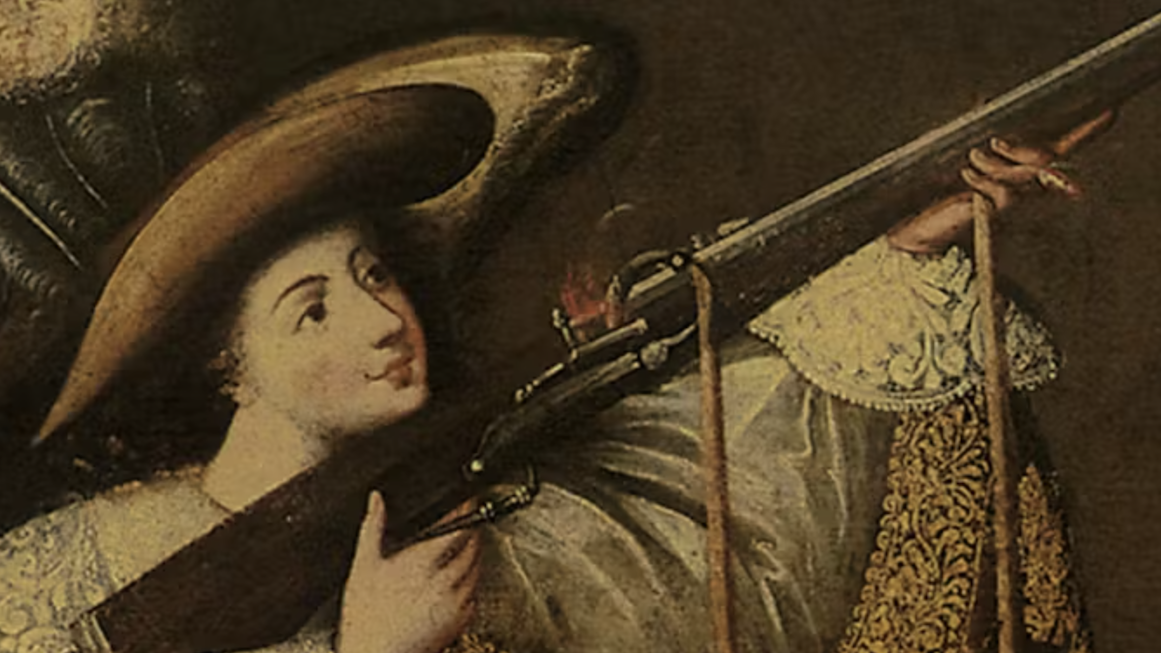
The introduction of firearms was as important as that of the printing press. Or so argues the author of The Firearm Revolution, a fascinating book on the social impact of guns in Europe. Firearms empowered relatively untrained commoners to challenge aristocrats who’d spent their lives mastering expensive arms and armor. Guns enriched skilled artisans, leveled the playing field between the weak and the strong, and disrupted the established order. In the process, they sparked modern-sounding debates over whether the government could effectively regulate such weapons.
The author, Catherine Fletcher, teaches history at Manchester Metropolitan University. Her specialty is early modern Italy—a focus that lends itself well to this subject, given that peninsula’s fractured political landscape at the time. Italy’s mutually hostile republics, principalities, and possessions coveted the advantages that firearms offered over competing powers. So those states encouraged gunmakers to produce new weapons, they trained troops to use firearms and deployed them in seemingly endless conflicts, and then they found themselves trying and largely failing to curtail the resulting social transformations.
“Many of the arguments raised today in relation to gun control are to be found in sixteenth-century sources,” Fletcher notes. “These include calls for restrictions on the ownership of those weapons judged most dangerous, demands from users that they be allowed to keep guns for self-defence,” and so on.
Thanks to firearms, a farmer or part-time militiaman could shoot an armored knight off a horse. Fletcher quotes a 16th century critic complaining that “it is very often the case that a manly and brave hero is brought down by a pathetic little brat with a gun.”

Firearms weren’t entirely unique in this regard. Bows—especially crossbows—had long been viewed with suspicion for similar reasons. An 1139 papal decree attempted to ban them as “hateful to God.” That decree turned out to be as impotent as modern bans on “assault weapons.” And guns were even more democratizing than bows: That brat could put paid to an aristocratic hero because, as Fletcher observes, guns “may well have been cheaper than the crossbow and certainly required less physical strength to shoot than the longbow.” They also punched through expensive armor at a distance, and mastering their use required less training than did swords. Political assassins quickly adopted them as tools of the trade.
The hero-cidal “brat” described above acquired his firearm from a burgeoning and soon powerful industry that depended to an extent on government contracts but acquired significant leverage of its own. “Arms control was only ever as strong as the state, and the Renaissance states were often rather weak, which gave arms producers considerable clout,” comments Fletcher.
Part of that weakness lay in governments’ need to maintain viable arms industries. Occasional contract purchases for guards and militia left fallow times between orders. If producers were to make a living, rulers had to allow exports and, often to their chagrin, civilian sales. Venice attempted to restrict emigration by master firearms artisans who sought greater opportunity elsewhere. These restrictions were often evaded, as we can see from 1548 records of threats by the city-state to confiscate the left-behind property and goods of firearms artisans who had moved to Florence.
One way members of the public became familiar with firearms was through militia service. Militias were well-established by the time arquebuses and other firearms joined the pikes and halberds traditionally issued to militiamen, and the utility of the new weapons was soon apparent. “A gun would more reliably kill the fox eating your chickens than the alternatives,” Fletcher writes. It would also put food on the table, defend your home from bandits, and protect yourself from thugs in city streets. Familiar with firearms through militia service, regular people purchased them on their own or pilfered them from armories.
Matchlock arquebuses were handy for killing predators of all sorts, but the smoldering cord needed to ignite a charge didn’t make such weapons easy to carry for self-defense. The development of the clockwork mechanism of the wheel lock allowed the transport of weapons that were ready to fire, particularly pistols. Officials responded like modern politicians panicking over “high-capacity” semiautomatic weapons: with restrictions.
“An explicit ban on small wheellocks was in place in Sicily by 1530,” reports Fletcher. “Milan…had prohibited wheellocks by 1538.”
Weapons control measures were not new to firearms. Even when blades dominated, many places limited where and when weapons could be carried within city walls—with the level of restriction dependent on social class. Carrying weapons of any sort often required licenses, though the frequency with which decrees were issued and reissued suggests that many people ignored such rules. Then as now, the rulers attempting to disarm members of the public were themselves well-protected by guards armed at state expense. Among those who carried weapons were people suspicious of the state, including the growing ranks of Protestants in mostly Catholic Italy.
“In 1553, the Venetian rector Cattarino Zen observed that in Gardone (among other places) ‘everyone carries an arquebus and…they’re not content with one, but even the women carry two, one in their hand and the other in their belt, both wheellocks, and they’re a bad breed, untameable overbearing Lutherans.'”
The references to “everyone” and “even the women” carrying firearms underlines the equalizing power of the new technology. Fletcher doesn’t cite the Georgetown historian Carroll Quigley, whose posthumously published Weapons Systems and Political Stability argued that power dynamics between people and the state are largely determined by available weapons. “Only with the arrival of a cheap and convenient hand gun in the nineteenth century and the economic revolution to mass production did men (and women) become equal in power,” Quigley wrote in the 1983 book. But Fletcher’s extensive research reinforces the point while suggesting that the rebalance of power began centuries earlier than Quigley believed.
“If we can speak of a print revolution in early modern Europe, then we can speak of a firearm revolution, too,” Fletcher writes. Both industries enriched new breeds of manufacturers and merchants who had little in common with titled aristocrats. The new technologies enabled ideas to spread (via print) and protected those who adopted such ideas from repression (with guns). And both challenged the old order and the power of those who had once exercised relatively unchallenged dominance.
Unlike many academics, Fletcher produces prose that is engaging and generally easy to read. My only real complaint is that she uses the term handgun in a somewhat unusual way to describe any human-portable firearm rather than a one-handed weapon. But it’s easy enough to become accustomed to her meaning, and she’s generally careful to differentiate between one- and two-handed firearms, especially as that distinction becomes important with the introduction of wheel locks.
A somewhat surprising omission is any mention of the Second Amendment to the U.S. Constitution and its protection for the right to bear arms. That amendment, of course, was a product of a culture that fully came down on one side of the arguments over the role firearms play in the eternal power struggle between individuals and the state—to the point where British attempts to disarm colonists helped spark the American Revolution.
Perhaps the American experience could feature in a follow-up book. There’s plenty of room for sequels: The social and economic revolutions sparked by firearms are still playing out, with no end in sight.
Read the full article here
Fact Checker
Verify the accuracy of this article using AI-powered analysis and real-time sources.