

 Freedom Index
Listen to the article
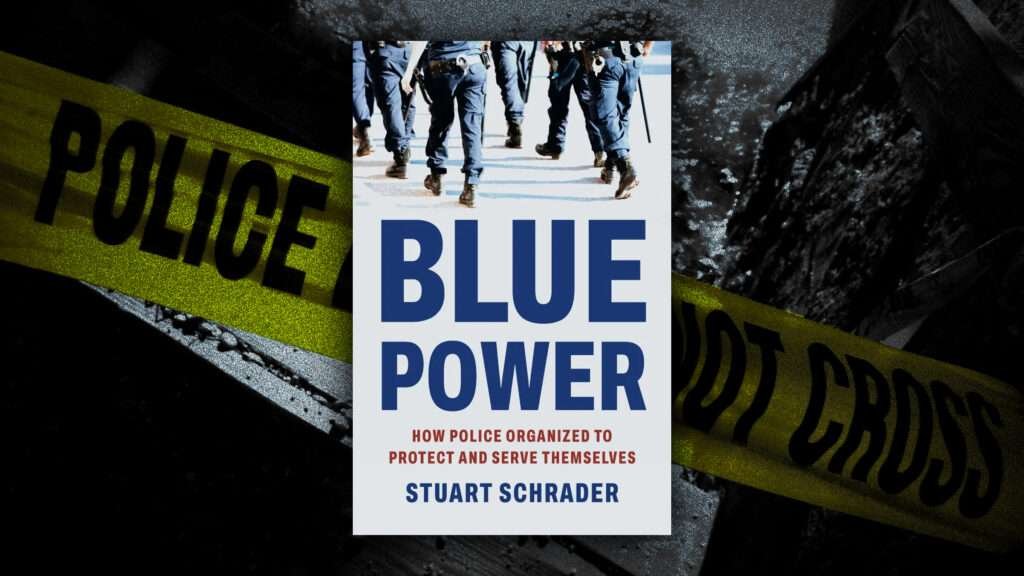
Blue Power: How Police Organized to Protect and Serve Themselves, by Stuart Schrader. Basic Books, 432 pages, $34
“Everybody else can indulge in politics—every black group, every political party group, every church group,” groused Carl Parsell, then president of the Detroit Police Officers Association, in 1969. “Why are police officers so different?”
The question goes to the heart of Stuart Schrader’s Blue Power, a new book charting how police unions accreted and cemented power in the decades following Parsell’s query.
It’s a ripe subject for review: Police officers’ savvy use of public sector unions and lobbying to largely immunize themselves from oversight is one of the greatest political coups in recent American history. In under four decades, police unions evolved from beer-drinking clubs to organized bargaining units to potent political forces at the local, state, and national levels.
The idea that those empowered to enforce law and order could also leverage their position to gain more power has always sat uncomfortably in a democratic republic. “Who is going to uphold this order?” a San Francisco judge wondered in the 1970s, when striking officers defied his commands to stop picketing while carrying guns. Schrader argues that law enforcement’s victories at the bargaining table and in statehouses have hurt “the very public safety and security that are to be democracy’s police-enforced guarantors.”
Police misconduct settlements cost cities such as New York, Chicago, and Los Angeles hundreds of millions of dollars a year. Arbitration makes it hard to fire officers, even for gross misconduct. At their most militant, police unions threaten to remove departments from any external democratic control, and to capriciously withdraw or overapply their power to punish anyone who would oppose them.
Several recent books have explored the history of individual police departments in major cities and the battles to reform them. The Minneapolis Reckoning covered the Minneapolis Police Department both before and after the killing of George Floyd. The Oakland Police Department’s long history of corruption was the subject of The Riders Come Out at Night. Both The Highest Law in the Land and The Power of the Badge examined the unusually powerful office of the county sheriff in American policing and local politics.
But Schrader, an associate professor of history at Johns Hopkins University, gives a national perspective, from the birth of police organizing in the 1960s through law enforcement’s emergence on the national political stage in the 1980s, the passage of the 1994 crime bill, and the turbulent Black Lives Matter years. What’s remarkable is how much the police achieved without a national union or top-down campaign.
Police used the titular phrase blue power in the 1960s as a direct response to the Black Power movement. One 1968 assessment called blue power “the political force by which radicalism, student demonstration, and Black Power can be blocked.” (There were less successful efforts to co-opt the language of the Black Power movement, such as when striking Minneapolis officers called for “Pig Power.” ) But police organizing was not simply a backlash. One of Schrader’s insights, and one of the more interesting threads of the book, is that rank-and-file police organizations stoked public fears of radicals and crime as a tactic in a more concrete fight against administrators.
At the end of the Progressive Era, cities began to untangle their police departments from machine politics and turn them into independent agencies focused on crime control. When the Los Angeles Police Department unveiled a new slogan in 1955, “To Protect and to Serve,” it was intended to signal a new era of professionalism. Officers soon discovered that being independent meant having to advocate for their own interests in what they saw as an increasingly hostile world, besieged by radicals on the streets, clueless liberals in Washington, and hostile bosses on the floors above them.
Officers had genuine grievances. Patronage still governed hiring and promotions at several major police departments. In Baltimore in the 1960s, it was normal for police officers to do maintenance and sanitation work around the city while on duty. “Some had been painting walls for so many years they couldn’t remember how to write a ticket,” Schrader writes.
When Detroit police officers began a ticket-writing slowdown in 1967—supported by the United Auto Workers, the Teamsters, and the Detroit chapter of the American Federation of State, County and Municipal Employees— they were protesting a much-hated quota for traffic tickets, which city officials wanted to raise to generate more revenue. The slowdown cost Detroit an estimated $583,000.
Police chiefs were autocrats, and officers had no formal grievance or disciplinary processes to turn to. In Baltimore, Commissioner Donald Pomerlau had an intelligence unit that kept tabs on officers and civilians who were of interest to him. (Asked by a reporter if his intelligence unit spied on elected officials, Pomerleau responded, “Just the blacks. Just the blacks.”) Meanwhile, police chiefs used the frequent bribery scandals of the 1960s and 1970s to press for more powerful internal affairs departments.
Schrader’s labor-vs.-management framing shows these competing forces as sophisticated political actors in a multifront battle. Police unions learned early on that they could sell relatively dry policies to the public by presenting them as life-and-death matters. For example, when New York City’s police unions launched a signature drive in 1966 for a referendum to abolish the mayor’s newly created police review board—which would have had no investigative authority or power to make disciplinary recommendations—-the union’s public ad campaign was so effective that conservative columnist William F. Buckley Jr. personally delivered 40,000 signed petitions to the city clerk’s desk. (“The civilian review board proposed by Mayor Lindsay is an emotional artifact, designed primarily to soothe the unrealistic fears of a small minority of New York voters who worry without objective justification that the police are regularly guilty of the abuse of their powers,” Buckley said.)
Collective bargaining rights and forced arbitration for officers tilted the balance of power away from police chiefs. As police officer unions grew in influence over the 1970s, so did their ambitions and tactics: political lobbying and campaigning, litigation, and retaliatory work actions.
Schrader documents some of police unions’ forays into the culture war, such as when the Houston Police Officers’ Union sued the Houston punk band AK-47 in 1980 for its single, “The Badge Means You Suck,” which listed the names of several people who’d been killed by Houston police in recent years.
But it’s the strikes, riots, and other actions that are the most controversial. In addition to sick-outs (waves of what’s known as the “blue flu”), officers engaged in malicious compliance or noncompliance to punish cities that refused to meet their demands. In the 1970s, the day after San Francisco voters approved a proposition to cut police wages, police issued three times the normal number of traffic citations.
In one notorious 1992 incident, thousands of New York officers, many of them drunk, surrounded City Hall to protest Mayor David Dinkins’ plan to create a civilian review board. They were egged on by future Mayor Rudy Giuliani, and they later marched down the Brooklyn Bridge, blocking traffic. A New York councilwoman said that cops refused to let her enter City Hall and called her the n-word.
Left-wing labor activists have never been quite sure how to square their principles with the existence of right-wing police unions, and Schrader also struggles with this a bit.
“Many public sector unions were militant, but police maintained this militancy long after it had crested among other public employees,” he writes. “Most public sector unions experienced setbacks or stasis beginning in the 1980s, but police unions continued to succeed. To this day, with around 7 million unionized public employees in the United States, it is difficult in most cities to consider other unions as part of the same movement as police unions—only one type of union representative approaches the bargaining table or meeting of a city’s central labor council packing a pistol.”
Of course, other public sector unions such as teachers and sanitation workers know how to apply particular and unpleasant pressure to have their demands met. But the Punisher bumper stickers aren’t the only difference; there’s another one resting in a holster on most cops’ belts. Schrader argues that what makes police different is that they are able to augment their political power—the use of political tactics and channels to advance their interests—with their “operational power,” officers’ authority to use violence and the discretion over when to use it.
At one point, Schrader notes that police unions have saddled municipalities with huge unfunded pension liabilities and other pernicious perks. Sadly, he thinks the problem is that every other public employee doesn’t have the same benefits. “Although all workers should have access to the types of compensations and benefits available to police with powerful unions, the underlying alteration that must occur is to keep this one particular profession from holding primacy in our politics, distorting and dominating the entire sphere.”
Still, Blue Power is a detailed and often interesting history of police organizing that rightly recognizes what officers have known for years: Policing is politics.
Read the full article here
Fact Checker
Verify the accuracy of this article using AI-powered analysis and real-time sources.