The new MiniMax M2.7 matches top closed models in benchmarks.
The model underwent a quite license shift to restrict commercial use post-release.
The move was justified as a way to prevent service providers from “nerfing” the model when offering it to developers.
MiniMax M2.7 is here, the weights are on Hugging Face, and it’s legitimately competing with the best closed models out right now.
The numbers: 56.22% on SWE-Pro (a benchmark for software engineering tasks), nearly matching Claude Opus 4.6; 57.0% on Terminal Bench 2. An ELO of 1495 on GDPval-AA (a benchmark for real-world knowledge work tasks across jobs). For context: This is the highest among open-weight models, only slightly below Opus 4.6, Sonnet 4.6, and GPT-5.4.
Image: Minimax
It’s a 230B-parameter Mixture of Experts model with only 10B active per inference pass, so you get frontier-level output without paying frontier-level compute. MiniMax said it was the first model to participate in its own development—an internal version ran 100+ autonomous rounds of self-optimization, rewrote its own scaffold, and came out 30% better. No human in the loop.
Then the license changed, and the community lost it
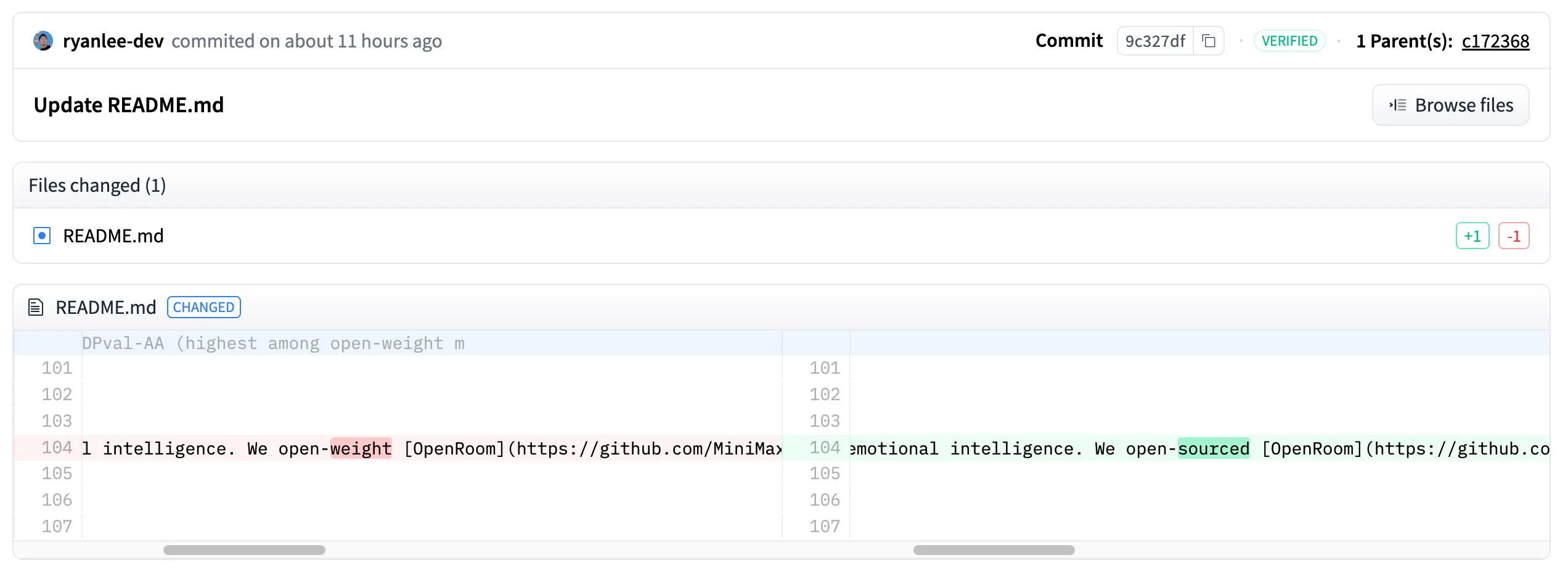
But shortly after the weights dropped, the Chinese AI lab MiniMax quietly updated the terms: commercial use now requires written authorization from MiniMax.
Non-commercial use stays free and unrestricted. Research, personal projects, fine-tuning for your own setup—none of that changed. But if you’re running a hosted service or building a commercial product, you’re in “needs authorization” territory now.
Hacker News and a Hugging Face discussion thread filled up fast with developers calling it out. The specific friction point is this: MiniMax is labeling the license “MIT-style,” but MIT permits commercial use by definition. Calling it “Modified-MIT” while restricting commercial use is, to put it charitably, confusing.
Ryan Lee, MiniMax’s Head of Developer Relations, posted a detailed response rather than the usual corporate non-answer. His explanation: bad-faith hosting providers had been deploying degraded versions of previous MiniMax models—wrong templates, aggressive quantization, sometimes not even MiniMax’s actual model—then letting users walk away thinking MiniMax ships mediocre work.
“They walk away thinking MiniMax is mid,” Lee wrote. “We get the reputational bill, the user gets a bad experience, and the serious hosting providers who do the work properly get drowned out in the noise.”
“A fully permissive license meant we had no way to push back on any of that,” he added. “If the license has edge cases that hurt legitimate community use, tell us. We’d rather fix the text than defend it.”
This fits a wider pattern. MiniMax built its developer reputation on fully open releases—M2 under MIT in October 2025, M2.5 under the same terms in February 2026. M2.7 is the first break from that streak, and it came just months after the company listed on the Hong Kong Stock Exchange in January 2026, raising around $620M with Alibaba and Abu Dhabi’s sovereign wealth fund among its backers.
Other Chinese companies, which dominate the open-source space, are also testing the waters of close-sourcing AI. Alibaba’s Qwen team reportedly shifted toward proprietary development after senior leadership departures, according to the Financial Times, Xiaomi also released its new MiMo v2 models under a close source license. The shorthand that Chinese labs are open and U.S. labs are closed no longer holds.
For those interested in using it commercially, Lee says the authorization process will be fast and reasonable.
Daily Debrief Newsletter
Start every day with the top news stories right now, plus original features, a podcast, videos and more.
The FSNN News Room is the voice of our in-house journalists, editors, and researchers. We deliver timely, unbiased reporting at the crossroads of finance, cryptocurrency, and global politics, providing clear, fact-driven analysis free from agendas.
We and our selected partners wish to use cookies to collect information about you for functional purposes and statistical marketing. You may not give us your consent for certain purposes by selecting an option and you can withdraw your consent at any time via the cookie icon.
Cookies are small text that can be used by websites to make the user experience more efficient. The law states that we may store cookies on your device if they are strictly necessary for the operation of this site. For all other types of cookies, we need your permission. This site uses various types of cookies. Some cookies are placed by third party services that appear on our pages.
Your permission applies to the following domains:
https://fsnn.net
Necessary
Necessary cookies help make a website usable by enabling basic functions like page navigation and access to secure areas of the website. The website cannot function properly without these cookies.
Statistic
Statistic cookies help website owners to understand how visitors interact with websites by collecting and reporting information anonymously.
Preferences
Preference cookies enable a website to remember information that changes the way the website behaves or looks, like your preferred language or the region that you are in.
Marketing
Marketing cookies are used to track visitors across websites. The intention is to display ads that are relevant and engaging for the individual user and thereby more valuable for publishers and third party advertisers.


 Freedom Index