Close Menu
FSNN | Free Speech News NetworkFSNN | Free Speech News Network
  • Home
  • News
    • Politics
    • Legal & Courts
    • Tech & Big Tech
    • Campus & Education
    • Media & Culture
    • Global Free Speech
  • Opinions
    • Debates
  • Video/Live
  • Community
  • Freedom Index
  • About
    • Mission
    • Contact
    • Support
Trending

Iran war oil shock revives inflation trade and a new stablecoin play

2 minutes ago

New Tools Aim to Make AI ‘Vibe Coding’ Safer for Crypto

17 minutes ago

Crypto TradFi perpetuals are predicting the direct of Wall Street’s Monday open with 89% accuracy

1 hour ago
Facebook X (Twitter) Instagram
Facebook X (Twitter) Discord Telegram
FSNN | Free Speech News NetworkFSNN | Free Speech News Network
Market Data Newsletter
Saturday, April 11
  • Home
  • News
    • Politics
    • Legal & Courts
    • Tech & Big Tech
    • Campus & Education
    • Media & Culture
    • Global Free Speech
  • Opinions
    • Debates
  • Video/Live
  • Community
  • Freedom Index
  • About
    • Mission
    • Contact
    • Support
FSNN | Free Speech News NetworkFSNN | Free Speech News Network
Home»News»Media & Culture»Wisconsin Reined in Public Sector Unions. Now Those Reforms Are in Jeopardy.
Media & Culture

Wisconsin Reined in Public Sector Unions. Now Those Reforms Are in Jeopardy.

News RoomBy News Room3 hours agoNo Comments4 Mins Read1,119 Views
Share Facebook Twitter Pinterest Copy Link LinkedIn Tumblr Email VKontakte Telegram
Wisconsin Reined in Public Sector Unions. Now Those Reforms Are in Jeopardy.
Share
Facebook Twitter Pinterest Email Copy Link

Listen to the article

0:00
0:00

Key Takeaways

Playback Speed

Select a Voice

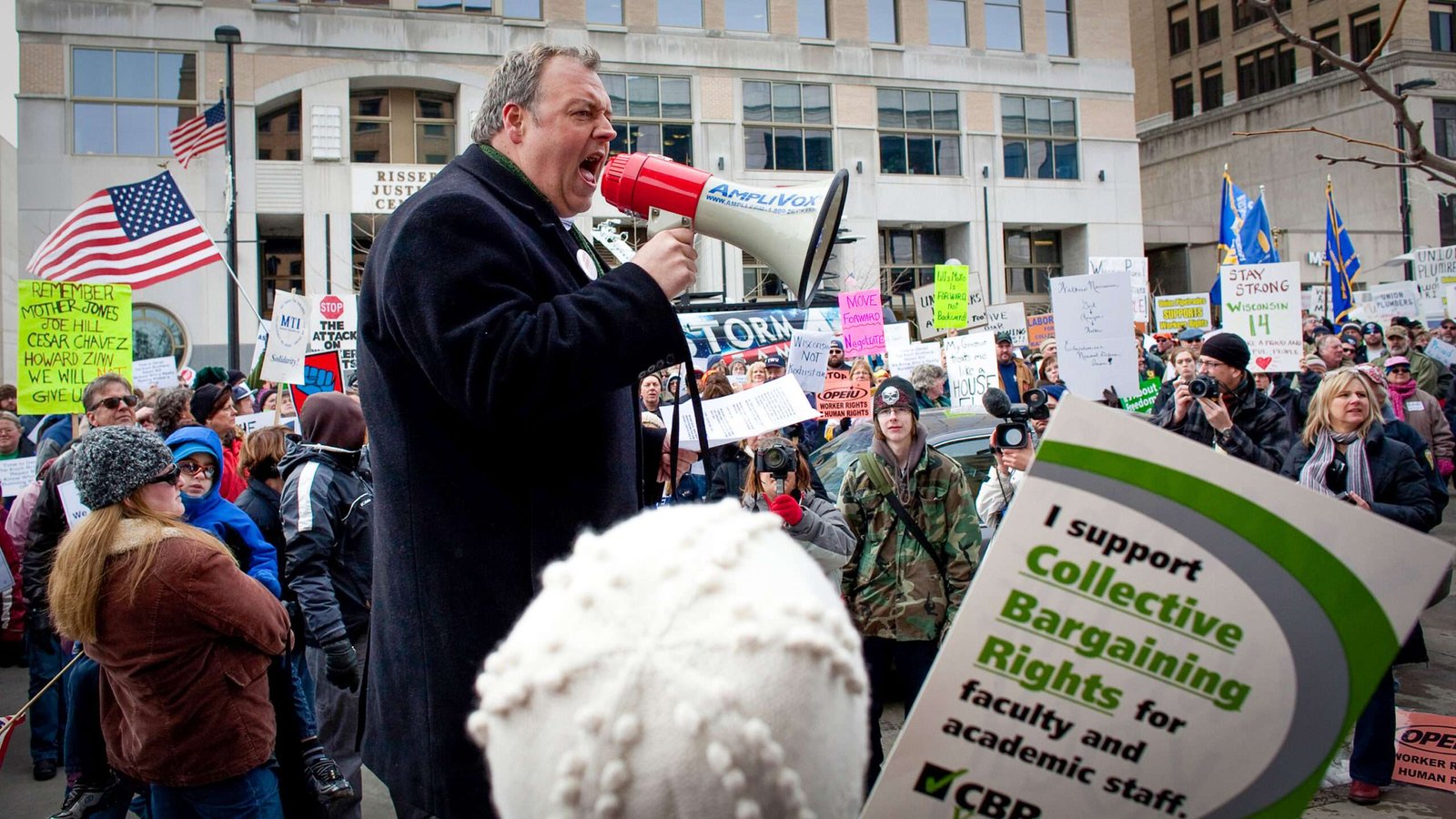
In 2011, Wisconsin made national news headlines when then-Gov. Scott Walker attempted to reform public sector collective bargaining as a part of his push for fiscal responsibility. At the height of the Tea Party movement, what became known as Act 10—which restricted the areas public sector employees could collectively bargain over—quickly transformed into a political hornet’s nest.

Democratic state lawmakers infamously fled the state for Chicago in an effort to block a vote on the bill as it was winding its way through the legislature, and Walker eventually faced a recall election.

He survived. This year, Act 10 turns 15. By all available evidence, it has worked exactly as intended. But despite the law’s positive impact for Wisconsin taxpayers and the state fisc, it is facing a questionable legal challenge that may finally doom it.

When Walker took office in 2010, Wisconsin was staring down the barrel of a $3.6 billion budget deficit. One of Walker’s primary responses was to push Act 10; the law allowed bargaining over wages but not things like pensions and health insurance. It also put state government employees on the hook for covering 12 percent of the premium costs for their government-provided health insurance plans, in addition to mandating more employee contributions to pensions.

While it’s difficult to calculate the exact cost savings to Wisconsin from Act 10, the MacIver Institute has estimated $35.6 billion in savings through 2025. But beyond dollars and cents, Act 10 also succeeded in cutting back on union power in Wisconsin—thus helping the government run more efficiently.

According to a recent analysis by the Center for Economic Policy and Research (CEPR), Wisconsin has seen the sharpest decline in union membership rates of any state in the country over the past 40 years. While the number of union members has declined nationwide in recent decades as America has transitioned to a more service-based economy, Wisconsin’s decrease has been particularly notable, especially since it historically had been one of America’s most unionized states.

Act 10 played a large role in the drop. Wisconsin’s public sector union membership rates saw “by far” the largest decline—at close to 29 percent—of any state, according to CEPR’s report. “Wisconsin’s steepest losses,” the report notes, “coincided with the 2011 passage of Wisconsin Act 10.”

“There was definitely a national trend of gradual union decline, but Wisconsin fell faster and further than almost anywhere else, and it had further to fall,” said Hayley Brown, the author of the report, in an interview with Wisconsin Public Radio. The law’s success has also prompted other states to follow suit with collective bargaining reforms in recent years.

Yet its future is far from certain. In December 2024, a county judge declared the law unconstitutional for allegedly violating the state constitution’s equal protection clause. The judge’s reasoning was based on the fact that public safety employees (like police and firefighters) were exempt from the law’s reach, while other government employees (like teachers) were not.

The U.S. Court of Appeals for the 7th Circuit effectively rejected this argument in a 2013 case—albeit one that involved an equal protection claim under the federal constitution, rather than Wisconsin’s constitution. Because collective bargaining does not involve a “fundamental right,” the court said, the law withstood scrutiny since it “further[ed] a legitimate government objective.” Other legal challenges to Act 10—including another 7th Circuit case and a 2014 decision by the Wisconsin Supreme Court—have also upheld the law.

But this most recent litigation poses the gravest threat yet. The December 2024 decision is now pending before the Wisconsin Court of Appeals. Once that court issues its ruling, the case will make its way back to the state’s highest court. Recent judicial elections swung the Wisconsin Supreme Court to a liberal majority, leading many to predict the law’s demise.

Act 10’s potential death would come at a real cost. The Wisconsin Institute for Law & Liberty (WILL) has estimated that striking it down would cost school districts in the state $1.6 billion annually, on top of $440 million annually in new costs to local government units. Meanwhile, for the average taxpayer who owns a $300,000 home—the average cost of a house in Wisconsin—overturning the law would result in a $624 hike in annual property taxes, according to WILL.

Both budgetary math and declining union power show that Act 10 worked exactly as Walker promised. Unfortunately, Wisconsinites may not be able to enjoy the law’s benefits for very much longer.

Read the full article here

Fact Checker

Verify the accuracy of this article using AI-powered analysis and real-time sources.

Get Your Fact Check Report

Enter your email to receive detailed fact-checking analysis

5 free reports remaining

Continue with Full Access

You've used your 5 free reports. Sign up for unlimited access!

Already have an account? Sign in here

#IndependentMedia #InformationWar #Journalism #MediaAndPolitics #MediaBias
Share. Facebook Twitter Pinterest LinkedIn Tumblr Email Telegram Copy Link
News Room
  • Website
  • Facebook
  • X (Twitter)
  • Instagram
  • LinkedIn

The FSNN News Room is the voice of our in-house journalists, editors, and researchers. We deliver timely, unbiased reporting at the crossroads of finance, cryptocurrency, and global politics, providing clear, fact-driven analysis free from agendas.

Related Articles

Cryptocurrency & Free Speech Finance

New Tools Aim to Make AI ‘Vibe Coding’ Safer for Crypto

17 minutes ago
Cryptocurrency & Free Speech Finance

Economists Said AI Wouldn’t Take Jobs—Some Now Admit They Got It Wrong

2 hours ago
Media & Culture

Follow-Up to “Reproducing Controversial Tweet in News Story = Fair Use” Post

4 hours ago
Media & Culture

Today in Supreme Court History: April 11, 1862

5 hours ago
Media & Culture

Democrats and Republicans Both Want To Regulate AI. They Just Can’t Agree on How.

6 hours ago
Debates

Can Grokipedia Dethrone Wikipedia?

8 hours ago
Add A Comment
Leave A Reply Cancel Reply

Editors Picks

New Tools Aim to Make AI ‘Vibe Coding’ Safer for Crypto

17 minutes ago

Crypto TradFi perpetuals are predicting the direct of Wall Street’s Monday open with 89% accuracy

1 hour ago

Crypto Clarity bill has 30% chance of passing this year, Wintermute’s Hammond says

2 hours ago

AI’s Impact on Employment Clashes With C-suite Optimism

2 hours ago
Latest Posts

Economists Said AI Wouldn’t Take Jobs—Some Now Admit They Got It Wrong

2 hours ago

Wisconsin Reined in Public Sector Unions. Now Those Reforms Are in Jeopardy.

3 hours ago

Paying Iran in Crypto Could Put Shippers at Sanctions Risk: Analyst

3 hours ago

Subscribe to News

Get the latest news and updates directly to your inbox.

At FSNN – Free Speech News Network, we deliver unfiltered reporting and in-depth analysis on the stories that matter most. From breaking headlines to global perspectives, our mission is to keep you informed, empowered, and connected.

FSNN.net is owned and operated by GlobalBoost Media
, an independent media organization dedicated to advancing transparency, free expression, and factual journalism across the digital landscape.

Facebook X (Twitter) Discord Telegram
Latest News

Iran war oil shock revives inflation trade and a new stablecoin play

2 minutes ago

New Tools Aim to Make AI ‘Vibe Coding’ Safer for Crypto

17 minutes ago

Crypto TradFi perpetuals are predicting the direct of Wall Street’s Monday open with 89% accuracy

1 hour ago

Subscribe to Updates

Get the latest news and updates directly to your inbox.

© 2026 GlobalBoost Media. All Rights Reserved.
  • Privacy Policy
  • Terms of Service
  • Our Authors
  • Contact

Type above and press Enter to search. Press Esc to cancel.

🍪

Cookies

We and our selected partners wish to use cookies to collect information about you for functional purposes and statistical marketing. You may not give us your consent for certain purposes by selecting an option and you can withdraw your consent at any time via the cookie icon.

Cookie Preferences

Manage Cookies

Cookies are small text that can be used by websites to make the user experience more efficient. The law states that we may store cookies on your device if they are strictly necessary for the operation of this site. For all other types of cookies, we need your permission. This site uses various types of cookies. Some cookies are placed by third party services that appear on our pages.

Your permission applies to the following domains:

  • https://fsnn.net
Necessary
Necessary cookies help make a website usable by enabling basic functions like page navigation and access to secure areas of the website. The website cannot function properly without these cookies.
Statistic
Statistic cookies help website owners to understand how visitors interact with websites by collecting and reporting information anonymously.
Preferences
Preference cookies enable a website to remember information that changes the way the website behaves or looks, like your preferred language or the region that you are in.
Marketing
Marketing cookies are used to track visitors across websites. The intention is to display ads that are relevant and engaging for the individual user and thereby more valuable for publishers and third party advertisers.