

 Freedom Index
Listen to the article
Hours after the Supreme Court rejected President Donald Trump’s “emergency” tariffs on February 20, he revealed a backup plan. Instead of relying on the International Emergency Economic Powers Act (IEEPA), which the justices held does not authorize import taxes at all, Trump invoked Section 122 of the Trade Act of 1974, which allows tariffs in response to “fundamental international payments problems” caused by “serious United States balance-of-payments deficits.” The main issue raised by that new legal rationale is whether Trump is right in asserting that the United States faces such a situation.
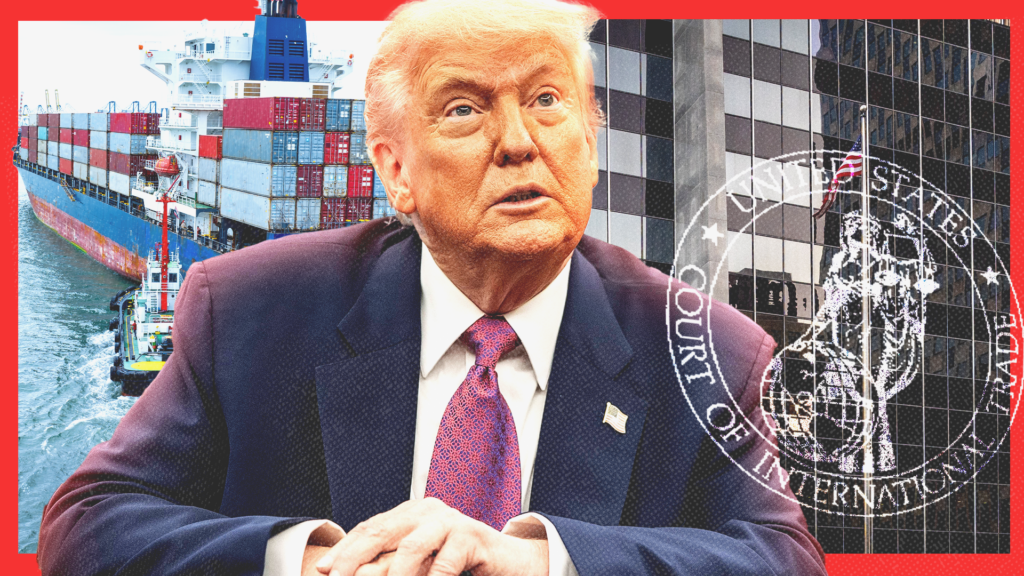
On Friday, the U.S. Court of International Trade (CIT) considered that question during oral argument in two cases challenging Trump’s Section 122 tariffs, which he initially set at 10 percent before saying they would be raised to 15 percent—the maximum rate allowed by the statute. One lawsuit was filed on March 5 by the governors and attorneys general of 24 states, while the other was filed on March 9 by the Liberty Justice Center (LJC) on behalf of two small U.S. businesses. Both sets of plaintiffs argue that the circumstances described by Section 122 not only do not exist but cannot exist under the current monetary system.
In response to the lawsuits, Assistant Attorney General Brett Shumate notes that the plaintiffs who opposed Trump’s IEEPA tariffs, which likewise included a bunch of blue states along with small businesses represented by the LJC, suggested that Section 122 was the appropriate vehicle for tariffs aimed at addressing the purported problem posed by the longstanding U.S. trade deficit in goods. “Plaintiffs repeatedly argued that the President’s tariffs were unlawful under IEEPA but would be justified under Section 122,” Shumate writes. He adds that federal courts, including the CIT, “relied on plaintiffs’ counsel’s arguments and agreed that Section 122 was the proper authority for imposing such tariffs.”
Shumate does not mention that the Trump administration has also changed its tune. In defense of the IEEPA tariffs, the government’s lawyers rejected the idea that the president should instead rely on Section 122. That provision, Shumate and his colleagues said, does not have “any obvious application here, where the concerns the President identified in declaring an emergency arise from trade deficits, which are conceptually distinct from balance-of-payments deficits.”
The Trump administration wants the CIT to forget about that concession, which goes to the heart of the president’s asserted authority under Section 122. The government’s lawyers are now contradicting their prior position, saying a trade deficit is enough to establish “fundamental international payments problems.” Citing the official “balance of payments” numbers from the U.S. Bureau of Economic Analysis, Shumate urges the CIT to focus on the “current account,” which consists mainly of the trade deficit, and ignore the other accounts that figure in the calculation. Those countervailing accounts include foreign investment in the United States and borrowing via U.S. government bonds.
“The balance of payments is recorded [by] a ‘double entry’ bookkeeping method, whereby every transaction recorded will have two entries, marked as either a debit or a credit, each in the same amount,” Shumate notes. “Because every transaction has two offsetting entries, the overall balance of payments will always be zero.” If the balance of payments is understood to mean the result of that calculation, he complains, no president could ever use Section 122 to impose tariffs.
“The government conflates the economic concept of balance of payments with an
accounting statement bearing the same name,” 48 economists, including two Nobel Prize winners and several former advisers to Republican presidents, argue in a brief supporting the LJC plaintiffs. “It is implausible that Section 122(a)(1) could be referring to the Balance of Payments in this sense. As the government acknowledges, as an accounting statement, the Balance of Payments necessarily balances.”
To address that difficulty, the government wants to “pick and choose some individual entries from the accounting statement,” such as “the current account balance,” the economists note. “This would effectively render Section 122(a)(1) an invitation to arbitrary government action because some components of the Balance of Payments will always be in deficit.”
If Trump misunderstands “balance-of-payments deficits,” what does that term mean in the context of Section 122? Given the history of that provision, the economists say, it was clearly aimed at a problem that no longer exists because it stemmed from a monetary system that was abandoned half a century ago.
The Bretton Woods system, established in 1944, prescribed fixed exchange rates and made the dollar convertible to gold at $35 per ounce, meaning revenue from exports to the United States could be exchanged for gold reserves held by the U.S. government. That system “was vulnerable to balance-of-payment imbalances, especially for the United States,” the economists note. “By the late 1960s, more dollars were circulating internationally than the U.S. Treasury could convert to gold at the peg, while the dollar was overvalued: its pegged value was greater than it would have been had the market prices of the dollar and gold floated freely against each other. As the Nobel Laureate Paul Samuelson explained in the 1973 edition of the leading economics textbook of the era, this ‘[c]hronic overvaluation of [the] dollar caused [a] hemorrhage of gold and reserves, [a] soaring balance-of-payments deficit.'”
In the early 1970s, President Richard Nixon responded to dwindling gold reserves and large, persistent balance-of-payments deficits by suspending the conversion of U.S. currency to gold and imposing temporary tariffs. A federal appeals court ultimately upheld those tariffs under the Trading With the Enemy Act of 1917. But when Congress considered the Trade Act of 1974, the legality of Nixon’s tariffs, which a lower court had deemed unlawful, was uncertain. Section 122 was aimed at constraining the president’s authority to deal with “fundamental international payments problems” like those Nixon had faced.
Section 122 capped the temporary import surcharge at 15 percent and limited its duration to 150 days, which could be extended only with congressional approval. It prohibited tariffs that discriminate against particular countries or distinguish between product categories without special justification, and it ruled out tariffs “for the purpose of protecting individual domestic industries from import competition.”
When Congress referred to “large and serious United States balance-of-payment deficits,” the economists say, it had in mind the sort of situation that Nixon had confronted. “But the Bretton Woods system was abolished in 1976 through the Jamaica Accords—and along with that, the possibility that there could be a ‘balance-of-payment deficit’ as used in Section 122,” they add. “Indeed, it was precisely the U.S. balance-of-payment deficits just described that precipitated the end of Bretton Woods.”
In 1971, “the United States ended its commitment to exchange dollars for gold, followed in 1976 by the formal end of the Bretton Woods system,” the economists note. “That no agreement was reached on a new international monetary regime until 1976 explains why Section 122, signed into law a year before, is predicated on problems generated by the ‘old’ regime, quite apart from the possibility that the regime might be reinstituted.”
Since dollars were no longer convertible to gold at the point when Congress enacted Section 122, Shumate argues, it makes no sense to interpret the provision as a response to the problem of dwindling gold reserves. “According to plaintiffs, Congress passed a law that has been useless since the day it was enacted,” he says. “That theory flouts the strong presumption against ineffectiveness.” But as the economists note, Bretton Woods was not formally abandoned until 1976, and uncertainty about the future of monetary arrangements could explain why Congress still saw a need for Section 122.
Under the current system of floating exchange rates, the “serious United States balance-of-payment deficits” described by Section 122 “cannot exist,” the economists say. “As Nobel Laureate Milton Friedman had explained in 1967, ‘a system of floating exchange rates completely eliminates the balance-of-payments problem—just as in a free market there cannot be a surplus or a shortage in the sense of eager sellers unable to find buyers or eager buyers unable to find sellers. The price may fluctuate but there cannot be a deficit or a surplus threatening an exchange crisis.'”
The argument that Section 122 does not apply under a system of floating exchange rates is consistent with the provision’s history prior to February, when Trump became the first president to invoke it as a justification for tariffs. That pattern of inaction would be hard to understand if Trump’s interpretation of Section 122 were correct, since the United States has been running trade deficits in goods since 1976.
The novelty of Trump’s tariffs also figured in the litigation over his reading of IEEPA. That 1977 statute does not even mention import taxes and had never before been used to impose them. Trump nevertheless claimed to have discovered a hitherto unnoticed power to completely rewrite the tariff schedule approved by Congress.
The power Trump is claiming under Section 122 is less sweeping. But he still maintains that he has wide discretion to declare a crisis that supposedly justifies tariffs. Trump’s perception of “a large and serious balance-of-payments deficit,” Shumate argues, “constitutes an unreviewable exercise of the President’s judgment.”
Read the full article here
Fact Checker
Verify the accuracy of this article using AI-powered analysis and real-time sources.