

 Freedom Index
Listen to the article
President Donald Trump is threatening Greenland again. “REMEMBER GREENLAND, THAT BIG, POORLY RUN, PIECE OF ICE!!!” he wrote in a social media rant about European allies’ failure to join his war on Iran. Earlier this year, Trump had made such intense threats to annex the island that Denmark, its owner, deployed troops with live ammunition, emergency blood supplies, and orders to blow up the airports in case of a U.S. invasion.
“It is our task to ensure that [Trump’s ambitions] are not realized,” Denmark’s Acting Foreign Minister Lars Løkke Rasmussen told Danish television in response to a question about Greenland. Greenlandic Prime Minister Jens-Frederik Nielsen warned about the threat to “international law” and “the world community.” Naaja H. Nathanielsen, a member of Danish parliament for Greenland, denounced the disrespect to Greenlanders’ national pride.
But some Greenlanders have a much more mundane concern: If Americans took over, would they let us keep hunting? “I hunt whales and seals,” Greenlandic villager Kunuk Abelsen tells The New York Times. “In the United States they think whales and seals are cute and shouldn’t be hunted. That’s what I’m afraid of.”
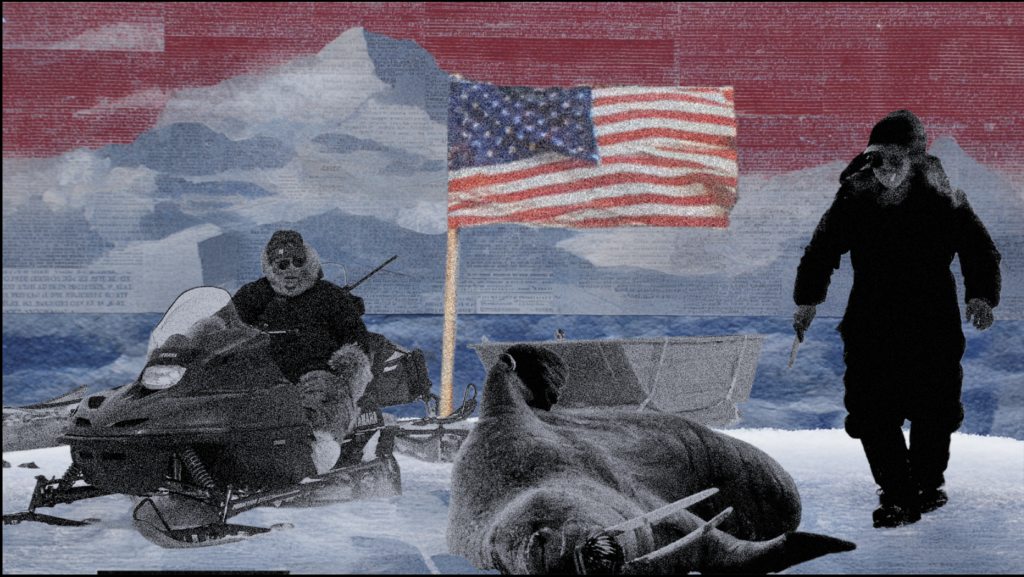
Most Greenlanders are Inuit, the descendants of hunters who survived off of whales, seals, walruses, polar bears, reindeer, and muskoxen in the frozen northern wasteland. A boy’s first seal catch is still a major rite of passage for children in Greenland. It’s also a federal crime under U.S. law. The Endangered Species Act and Marine Mammal Protection Act ban the hunting of many animals that Inuit rely on for meat and skin. An American conquest would turn most Greenlanders into criminals overnight.
“Picking up a gun or harpoon and going after seal or bear isn’t really work for an Inuk,” the hunter Kutsikitsoq told the French anthropologist Jean Malaurie in The Last Kings of Thule, his study of life in Thule, the northernmost village of Greenland, in the 1950s. “And anyway, it’s Gutip, God, who puts them there…the seals, great seals, bears, walruses, birds—all of them. They’ve got to be there in the first place or else you couldn’t hunt them—right?”
Modern Greenland is not quite as free-spirited as it was when Kutsikitsoq chased polar bears on the plains of Thule. Since Greenland gained autonomy from Denmark in 1979, the Greenlandic government has required residents to get hunting permits and report their catch. (The Scottish journalist Gavin Francis, visiting in the early 2000s, noted that “to many Greenlanders the concept of paying the government for the right to shoot caribou was like taxing the air.”) Still, Greenlanders are allowed to hunt many species that are outright banned under American law.
That makes hunting and animal conservation one of the many issues that would have “to be negotiated and addressed as part of any hypothetical acquisition of the sovereign nation of Greenland,” says Murray Feldman, a partner at the law firm Holland & Hart specializing in wildlife law. If it’s any consolation to Greenlanders, the Endangered Species Act would not automatically apply to them; the law was written with specific geographic boundaries, so it would not include Greenland unless Congress amended it.
The Marine Mammal Protection Act, on the other hand, applies to all people under U.S. jurisdiction, rather than specific territories. That’s because it was written to prevent things such as American whaling on the high seas. There is an exemption for Alaska Natives—many of whom, like Greenlanders, are Inuit—but that would also require an act of Congress to extend to native Greenlanders. Otherwise, Greenlanders would have to get waivers from the Fish and Wildlife Service or the National Marine Fisheries Services, depending on the species of animal hunted.
And these waivers “would likely be heavily regulated and not available at the mere request of a tribe,” Feldman says. For example, the Makah Tribe of the Pacific Northwest is in the middle of a decades-long legal battle to resume its traditional whale hunt. In a precedent that might be worrying for Greenlanders, federal wildlife law and pressure from environmentalists ended up overriding an 1855 treaty that guaranteed Makah whaling and sealing rights.
Even if hunting is allowed, regulations could make it harder for Greenlandic hunters to make a living. In 2009, the European Union banned seal products in response to animal rights activism. The Greenlandic government called it an act of “eco-colonialism.” Although the ban included an exemption for seals harvested by Inuit hunters, the legal headaches it created destroyed Greenland’s sealskin market. Exports fell by 90 percent, nearly wiping out the sealing industry, and ironically, causing environmental damage due to seal overpopulation.
In America, the Endangered Species Act and Marine Mammal Protection Act both ban the sale of certain animal products, even ones harvested outside the territory of the Endangered Species Act’s hunting ban. There are exemptions for “authentic native article of handicrafts” from Alaska, but again, expanding that exemption to Greenland would require an act of Congress. American rule might leave the Great Greenland Furhouse on legally thin ice, no pun intended.
Earlier this year, Trump backed down from his call for full U.S. “right, title, and ownership” of Greenland, instead settling for an expanded U.S. military presence on the island. The U.S. Space Force currently has a base in Thule, the area where Malaurie conducted his anthropology, which has now been renamed Pituffik.
Malaurie witnessed the construction of that base firsthand. At first, the interactions between the Americans and the Greenlanders were filled with curiosity, as sailors and native hunters bartered cigarettes for ivory. The locals, however, soon learned that they would not be allowed to stay on—let alone hunt in—the land of Thule anymore. Visiting northern Greenland years after his original expedition, Malaurie found hunters complaining that their way of life was being destroyed.
“All the foxes are attracted by the smell of refuse at the Americans’ Dump Dundas, in Thule,” a Greenlander told him. “Last year there were so many foxes that they killed them with machine guns and Danish police burned them. What does that mean? Here we work hard to trap and sell foxes in good condition, and down there where the qallunaat [foreigners] are, the foxes are drawn by their refuse dumps and people burn them! That’s disgusting, and it’ll come to no good end.”
Read the full article here
Fact Checker
Verify the accuracy of this article using AI-powered analysis and real-time sources.