Close Menu
FSNN | Free Speech News NetworkFSNN | Free Speech News Network
  • Home
  • News
    • Politics
    • Legal & Courts
    • Tech & Big Tech
    • Campus & Education
    • Media & Culture
    • Global Free Speech
  • Opinions
    • Debates
  • Video/Live
  • Community
  • Freedom Index
  • About
    • Mission
    • Contact
    • Support
Trending

More War

20 minutes ago

Lido DAO proposes $20 million LDO buyback as token trades at 70% discount to two-year median

32 minutes ago

Women Creators Reclaim Ownership Through Web3 Payment Rails

35 minutes ago
Facebook X (Twitter) Instagram
Facebook X (Twitter) Discord Telegram
FSNN | Free Speech News NetworkFSNN | Free Speech News Network
Market Data Newsletter
Monday, March 30
  • Home
  • News
    • Politics
    • Legal & Courts
    • Tech & Big Tech
    • Campus & Education
    • Media & Culture
    • Global Free Speech
  • Opinions
    • Debates
  • Video/Live
  • Community
  • Freedom Index
  • About
    • Mission
    • Contact
    • Support
FSNN | Free Speech News NetworkFSNN | Free Speech News Network
Home»News»Global Free Speech»Mourners carry the body of Al Jazeera correspondent Anas al-Sharif, who was killed alongside other journalists in an overnight Israeli strike on their tent in Gaza City, during his funeral in Gaza City on August 11, 2025. Photo: IMAGO/Omar Ashtawy apaimages/Alamy JAMES CAMERON MEMORIAL LECTURE 2026 – MARCH 4, 2026 – LONDON It is January 2000; an aspiring student journalist is on a two-week work placement in Plymouth. She writes stories on local music concerts, mix-ups over the introduction of the metric system for selling fruit and vegetables, clashes between local school sports teams, the building of a new community centre. She interviews strangers in the street about their favourite books as part of a nationwide survey and for their views on dentists. She covers sports, politics, arts, charity, business. And she knows, as she has known since she was six years old, that all she wants to be is a journalist. It is January 2026. A photographer heads to cover protests in Minneapolis in the United States. As he tries to live stream and take photos of the crowd that has gathered to protest immigration enforcement in which a protestor was shot dead, he is tackled to the ground by immigration officers and pepper sprayed. He is handcuffed and arrested. And in that moment, the moment when he is hurled to the ground by officials in combat gear, clutching a face mask he’d bought in a local hardware store to protect himself from tear gas, the photographer thinks only of one thing. He must protect the images he has captured of these events – and he throws his camera out from under him in the hope someone will save it. The journalist in Plymouth, on a two-week placement with the Evening Herald, was me. Then a postgraduate diploma student here at this very university. The photographer is John Abernathy, one of hundreds of journalists in the United States now grappling with a surge in violence against the profession. We dreamed a lot of dreams when we were at City. I dreamed of being the Director General of the BBC. A friend of being the Editor of The Sun. Some wanted to be political reporters, others sports, some wanted to write about arts and culture, others economics and finance. We knew that over the years many would leave the profession. Some went on to great success in the very careers they envisaged, others took unexpected turns into academia, the civil service, and entertainment. But what none of us could have predicted was how radically the environment would change for the profession itself. That the kinds of preparations journalists used to undertake to cover war zones would be needed to cover protests in North America. That journalists covering Westminster or the White House would regularly receive death threats. That a journalist in a European Union country might be killed for their investigative reporting. But that is what has happened. Now, this moment, is the most dangerous time in recent history to be a journalist. Last year, a record 129 journalists and media workers were killed worldwide, the highest number ever in the more than 30 years that the Committee to Protect Journalists has been documenting such data. For the past three years, more than 300 journalists were in jail at the end of the year – including in countries that are supposed democracies. Journalists are subjected to daily online harassment, including threats of death and rape. They are smeared by those in power and mistrusted by those without it. And yet – although this is the worst time in the world to be a journalist – it is also the most important time. Today, I want to examine why journalism has become so devalued, why journalists have become so demeaned, and why those whose job it is to deliver facts, to speak truth to power, to expose corruption and injustice, are now in greater peril than at any time in recent history. I also want to share what we can do about it. And why – if we want to live in anything approaching fair and just societies, ones that uphold rights and freedoms for all – it is essential that we step up to defend a free press — in deeds not just in words. First, let me tell you a little bit about the Committee to Protect Journalists, the organisation I now lead. Based in New York, the Committee to Protect Journalists was founded in 1981 to defend press freedom and journalist safety worldwide. One of our first advocacy campaigns was in support of three British journalists arrested in Argentina while covering the Falklands War. A letter from then CPJ Honorary Chairman Walter Cronkite helped spring them from prison. Sadly, the days when a letter and a stern word could provoke such a result are long gone, so CPJ now works in three ways: • We research and document threats to press freedom globally, • We provide direct assistance to journalists at risk, • And we advocate on behalf of those targeted for their work. Last year, we provided more than $1.3 million in direct financial assistance to journalists needing emergency support, covering everything from the cost of legal fees for reporters wrongfully imprisoned for their work, to medical bills and trauma support for journalists attacked and harassed in retaliation for their reporting, to exile assistance. We reached an unprecedented total of 3,877 journalists last year – more than 5 times the number of the previous year. It’s no surprise those numbers have grown – because attacks on the press have grown exponentially in the past decade. In 1992, when CPJ first started systematically documenting attacks on the press, 56 journalists and media workers were killed. Last year’s number is more than double that. In 1992, there were 113 journalists in jail. Last year’s number is more than triple that. In 1992, Mark Zuckerberg was 8 years old, the launch of Google was still six years away, and Facebook and Twitter would not emerge for more than another decade. Now, the internet and social media dominate communications, and online harassment – especially of women and those from marginalised communities – is rife. Let me give you one recent example. In 2023, Sabrina Schnur, a young female reporter at the Las Vegas-Review Journal in the United States wrote about the hit-and-run killing of a retired police chief. Schnur was the first journalist at the scene after the killing and also the first local reporter to talk to the police chief’s family. But after screenshots of a month-old obituary sparked accusations the Review-Journal was downplaying the death, Schnur was subjected to a slew of hate-filled abuse. Her email inbox and social media mentions were flooded with personal attacks. She was accused of being anti-white. Her photo was shared, and her office phone number circulated. The attackers hurled antisemitic abuse at Schnur, told her they hoped she would get cancer, that she would die. They found her private social media accounts and unearthed posts she’d made as a teenager, going as far back as 2015. Schnur and her colleagues had more reasons than most to be concerned about online threats. A year earlier one of the Review-Journal’s leading reporters – Jeff German – was stabbed to death by a local official who was the subject of German’s reporting. The suspect first targeted German with attacks on social media. How did we get here? Not by accident. The decline in press freedom and journalism safety is directly tied to a decline in democratic norms and a rise in authoritarianism that we are experiencing worldwide. And no wonder. Autocrats and demagogues have long known that to control a population, you need to control the flow of information to that population. Targeting the press is the first step to stifling dissent. If we want to tackle this, we need to understand the playbook for attacking the media, which in essence goes something like this: Smear, Harass, Criminalise, Kill. Let’s start with smearing. This is one you may be familiar with. Name calling may feel like the petulant act of the playground bully but it’s remarkably effective. Hungary’s leader Viktor Orbán does it, smearing the press as “fake news,” former Filipino President Rodrigo Duterte did it, calling them “presstitutes”, US President Donald Trump does it, calling journalists “enemies of the people” and most recently calling one journalist “piggy” and telling another who asked him about his ties to Epstein to “smile”. More insidiously, we are increasingly seeing a tendency to smear journalism itself as a nefarious act – think of the way in which the US Secretary of Defence conjured images of journalists roaming the Pentagon as a security risk. What Pete Hegseth of course conveniently forgot was that journalists have operated successfully from the Pentagon for decades, while it was Hegseth himself who shared secure information about military plans on a Signal chat group in which a journalist had been mistakenly added. Rather than be seen as critical work in the public interest to expose abuses of power, journalism itself is being rebranded as a subversive act. Smears escalate. By setting the tone at the top, those in power create a permission structure for harassment. Sometimes that might be formally orchestrated by those in power, more often it develops organically, among their supporters and sympathisers. Diaspora news outlet, The Haitian Times, for example, received a slew of racist abuse after it reported on the false claims made during the US presidential campaign about Haitians eating pets. In a demonstration of the online to offline risks, one reporter even had police show up at her house after a false report was made about a crime being committed there – a practice known as swatting. Harassment does not just take the form of online or even physical abuse. It can be legal and regulatory as well. This includes the use of so-called SLAPPs – vexatious lawsuits that are designed to drain journalists and media organisations of money and morale. At the time of her murder in 2017, investigative Maltese journalist Daphne Caruana Galizia was facing 47 such suits. In July last year, CBS owner Paramount settled a case that legal experts widely agreed was spurious for $16 million – a case brought by none other than the US President himself. Weeks later the US broadcast regulator, the Federal Communications Commission, approved a multi billion dollar merger involving Paramount. Harassment can also take financial form. Cutting funding or using public money to favour political friends and punish political enemies has long been a tactic of autocrats but we increasingly see this in democracies. Since Trump took office, his administration has all but eliminated funding for publicly funded media, mostly impacting local, regional broadcasters serving rural communities, as well as effectively shuttering Voice of America, Radio Free Europe and Radio Free Asia – all services that provided information to and about countries where media freedom is severely curtailed. So, smearing, then harassment. These are steps one and two. But it does not stop there. Because mud sticks. Demeaning journalists, branding them as cheats and liars paves the way for the third factor that is common to this playbook: actually criminalising journalism and journalists. Nobel laureate Maria Ressa has spoken extensively about the way branding of journalists as criminals by those in power helps soften the public up for subsequent actual criminalisation and arrest – and of course even killing. Years before the state launched lawsuits against her, the Philippines was readying the public to believe she was an actual criminal by painting her as one. Dubbing journalists as criminals is a deliberate strategy intended to sow doubt in the mind of the public about their trustworthiness – and therefore about the trustworthiness of their information. It’s a means to control the narrative. But criminalising journalists is not just about controlling public perception. It’s also used as a means to silence individual journalists – and to send a warning to other reporters and news outlets. It is a tactic used increasingly, even in supposed democratic regimes. Take the example of Hong Kong where 78-year-old British citizen Jimmy Lai, founder of the independent Apple Daily newspaper, was given a 20 year jail sentence. Lai has been in jail in Hong Kong. Largely in solitary confinement, since 2020 on numerous charges, including sedition and collusion with foreign forces for having the temerity to publish a newspaper that covered pro-democracy protests. In Guatemala, José Rubén Zamora, who for decades has exposed government corruption in his country, was recently released from jail in Guatemala where he faced trumped up charges of money laundering. In both cases, the legal teams for these journalists have themselves faced targeted harassment and threats – and in both cases the newspapers they founded have been forced to shutter as a result of legal action. And, of course, we have seen this over and over again in Gaza, where Israel repeatedly smears journalists as terrorists and militants, without providing evidence – as a way to justify subsequently killing them. Killing journalists is the ultimate form of censorship. And no discussion of journalist safety in the current moment can avoid what has been the deadliest assault on journalists since CPJ began. Of the 129 journalists and media workers killed last year, 86 were killed by Israel. The majority of them were Palestinians. Israel has now killed more journalists than any other government since CPJ began collecting records in 1992, making the Israel-Gaza war the deadliest on record for journalists. And let’s be clear. These are not the ordinary casualties of war. In at least 38 cases documented by CPJ last year alone, we believe journalists were deliberately targeted. This includes Al Jazeera reporter Anas al-Sharif, whose life CPJ publicly warned was in danger after repeated, unsubstantiated smears by Israel against him. Following years of such threats, Al-Sharif was murdered on August 10, alongside three other Al Jazeera staff journalists and two freelancers in a strike on a tent housing reporters. Journalists are civilians. Deliberately targeting them constitutes a war crime. The magnitude of Israel’s killings is exceptional, but – worldwide – the killing of journalists, the smearing of journalists, the harassment, the legal threats, the financial punishments – these are no longer an exception. Ok. So at this point, you may be shrugging your shoulders and saying, “Who cares?” Maybe you think the media brought it on themselves. Maybe you hate the “lamestream” media and think we all deserve to be smeared, harassed and attacked. I want to tell you why it matters. It matters because information is a prerequisite for free and open societies. Attacks on journalists are the first sign of democratic decline. Study after study shows that attacks on journalists matter because they are a clear indicator that attacks on other rights, our rights, will follow. It matters because journalism is essential for our everyday lives. Without it, we don’t have the information about the decisions being made by governments in our name or how our taxes are being spent. We don’t have information that might help keep us safer or healthier or might help stop abusive practices. It matters because journalism is essential if we want to understand the world. In Gaza, it is Palestinian journalists who have been our eyes and ears for two and a half years so that we can understand what is happening there. With no independent international access allowed since October 7, it is local journalists who are bearing witness to the genocide that they are also living through. Journalism is essential if we want to understand our own country. In the UK, it is journalists who have repeatedly uncovered government scandals. Journalists like my friend, former City alum, and multi award winning journalist Pippa Crerar, who – among other things – exposed the Partygate scandal. Harriet Harman, who chaired the parliamentary investigation into Partygate praised Pippa’s journalism in the Commons, saying: “This episode has shown that wrongdoing has not gone undiscovered and attempts to cover it up have failed, but it would have been undiscovered had not the press doggedly investigated.” Journalism is essential because reliable, fact-based information can save lives. When wildfires broke out in California at the start of the year, local residents turned to local media for information about the outbreaks: about where was safe, how the fires were moving, what precautions to take. In many rural parts of the United States, there is no reliable internet. Local radio is the most important source of information, especially in an emergency. In rural Alaska, it is the local independent radio stations who are tasked with providing early warnings of tsunamis and extreme weather – stations whose funding has been gutted by federal cuts. In the absence of independent, reliable fact-based media, a vacuum is created. One that is easily filled with lies, half-truths and propaganda. We cannot afford to be complacent. Journalism has value, it has impact – and yet journalists are being killed at a faster rate than in any other time in recent history, journalists are being jailed in higher numbers than at any other moment in recent history. News deserts – places with no access to credible news and information about their local community – are spreading. Funding for independent journalism in and about countries with little or no media freedom has been slashed. So, if we know journalism has value and if we know that it is under attack like never before, what are we going to do about it? Well, firstly, we need to accept that current ways of operating are failing and we need to look for new ones. One example of this is impunity. It is widely recognised that impunity – a failure to punish those responsible for attacks on journalists – creates environments that allows further attacks – more egregious, more violent attacks – to persist and flourish. More than a decade ago, the United Nations established the International Day to End Impunity for Crimes Against Journalists as an effort to draw attention to this fact. Each year for more than a decade we at the Committee to Protect Journalists would publish a report on the worst offenders – the countries where most journalist murders had gone unpunished. And yet the numbers remained stubbornly and persistently high. So, instead of thinking about what everyone else needed to do to address this, this year we took a look at ourselves. And that’s why on International Day to End Impunity this year, CPJ decided to drop our annual Impunity Index. Measuring which governments were – literally – getting away with murder was a useful way to shed light on the issue a decade ago, but it’s no longer enough. We are overhauling our approach to focus where we know we can have impact and on new initiatives that hold promise. These initiatives include: Firstly, pursuit of justice in key cases. Our experience in the past decade has shown that one of the most effective mechanisms for tackling impunity is a relentless pursuit of justice in individual cases. Going forward, CPJ is dedicating increased resources to a select number of such emblematic cases, supporting families and local communities in their often-lengthy fights to continue investigations and prosecutions. Secondly, we are pushing for the establishment of a standing independent international investigative task force focused on violent crimes against journalists. Relying on perpetrators of crimes against journalists to lead investigations into those crimes and hold those responsible accountable will always make ending impunity an uphill if not impossible battle. We need an independent global body readily available to support investigations – local, regional or international – into attacks. Thirdly, we need to see increased accountability from companies. Businesses play a key role in enabling attacks on journalists. CPJ is stepping up its focus on investigating and seeking accountability over the use of companies’ technology in cases where journalists are targeted or harmed. The increased use of drones is likely to be a particular focus in 2026. We asked ourselves, “What can and should we be doing in this moment?” and it is a question we must all ask ourselves. So here are some things you can do as an individual: 1. Spend money! Invest in local media The evisceration of local media has been credibly linked to worsening outcomes for communities, including loss of community cohesion, lack of oversight and accountability leading to poor spending decisions, increased corruption, and even rising local taxes. If you don’t already, do it, go out today and subscribe to your local news outlet. Or someone else’s. When the Kansan local newspaper the Marion Country Record in the US was wrongfully raided by police a few years ago, subscribers flooded to support the outlet – including many who lived hundreds of miles away. One Florida man told the Record’s editor he subscribed because he’d read local newspapers as a boy and missed the sense of community (2,500 kms away). 2. Lobby your local authorities and governments, and your employers! It is not enough for governments to say they support a free press. They need to demonstrate this in practice, both at home, and in their dealings with governments abroad – and they need to know their constituent’s care. As voters, we can ask our elected representatives to make these issues a priority. As employees, we can ask our employers to make this a priority. If you are an academic, does your university have programs for exiled journalists/ journalists at risk? Do your professional journalism courses include safety modules as standard? If you are a journalist, does your employer provide digital health checks or privacy tools? If the answer to these questions is no, ask for them. I can help you… 3. Let’s do our jobs as journalists. When I started at CPJ three and a half years ago, the motto of the organisation was “using the tools of journalism to protect journalists.” To be honest, as a former reporter, I somewhat scoffed at this description. After all, we are not a news agency. We are not a newspaper of record. We are an advocacy organisation. But over the past three years, as I have watched our profession fail over and over again in its coverage of Gaza, I have come to realise how important it is for all of us to recommit to, and publicly champion, the core principles of good journalism. It is the very essence of good journalism – the ruthless pursuit and public dissemination of facts – that will be our strongest defence. Recentring facts means explaining how we got them and why they matter. One of the reasons I would argue that journalists have suffered such a loss of trust in recent years – quite apart from some clear and obvious failures, including illegal phone hacking here in the UK – is that we assumed people understood what we did and what value we had. But as more and more individuals claim to be journalists or news outlets claim to be conducting journalism, those who are engaged in actual journalism – reporting to establish facts – need to do more to show how they arrived at the information and why they should be trusted. Recentring facts also means celebrating your impact. When I became a reporter, I was told time and again that journalists didn’t like to report on ourselves. That reporting on issues facing the industry could be considered self-indulgent. But if we want people to understand the worth of journalism, we must report not just the news, but how and when our reporting has effected change. Let’s be half as brave as our colleagues who risk everything to report the truth. I was asked in a recent interview what message I had for Western journalists covering Gaza. My response – although in slightly more colourful language – was “Do your job.” The job of a journalist is not that of a parrot – it is not simply to ask questions and rehearse what we are told. That’s not fact finding. That’s stenography. Our job is to dig deeper, to see with our own eyes and hear with our own ears where possible, and – if not possible – to gather as much information from as many sources as possible to establish the truth. Instead of worrying about being perceived to take sides, our responsibility is to report the facts. It requires courage. Cowardice is the enemy of good journalism. George Orwell had this right back in his original proposed preface to Animal Farm. “Obviously,” Orwell wrote, “it is not desirable that a government department should have any power of censorship… But the chief danger to freedom of thought and speech at this moment is not the direct interference of the MOI or any official body. If publishers and editors exert themselves to keep certain topics out of print, it is not because they are frightened of prosecution but because they are frightened of public opinion. In this country intellectual cowardice is the worst enemy a writer or journalist has to face, and that fact does not seem to me to have had the discussion it deserves.” Animal Farm was published in 1945. What Orwell wrote then is as true today: our job as journalists is to stand up to the bullies – not to bow to them. That’s what CPJ wrote to Shari Redstone, former chair of Paramount, when we urged her not to settle with Trump over his lawsuit against CBS. Capitulation creates a precedent – and each individual capitulation weakens the entire ecosystem. I am by no means saying this is easy. Journalism will always be risky as will defending it. It takes a certain level of defiance – a willingness to speak truth to power, to report things as they are, as we see them, and to place them in context – even, and perhaps especially, when it’s not what people want to hear. Doing it well takes courage and conviction. In 2009, prominent Sri Lankan journalist Lasantha Wickrematunge was murdered by a group of men on motorcycles. He had been receiving threats for months but refused to stay silent about the injustices in his country. For the last decade, Filipino journalist – now Nobel Laureate, Maria Ressa has been subject to a relentless legal campaign intended to discredit, bankrupt, and ultimately silence the critical reporting coming from both her and her newsroom, Rappler. At one point, she faced a possible sentence of more than a hundred years behind bars. But Maria knows that the job of a journalist is to report the facts, not to bend to those who benefit from their burial. She refuses to stay silent. More than 200 Palestinian journalists have been killed by Israel since the start of the Israel-Gaza war. Many have been deliberately threatened and warned explicitly by Israel to stop their reporting. All know the risks they take in wielding cameras when Israel has repeatedly targeted journalists even when wearing press vests and working from known press zones. They know that in the end facts are our superpower. They know that killing the messenger does not kill the message. So, they refused to stop. They refused to be silent. If we want to save journalists, if we want to save journalism, we all must do the same. BY JODIE GINSBERG CEO, COMMITTEE TO PROTECT JOURNALISTS Editors note: This is the alert that the CPJ put out over the weekend in response to an Israeli strike on a media car which killed three journalists in Southern Lebanon. READ MORE
Global Free Speech

Mourners carry the body of Al Jazeera correspondent Anas al-Sharif, who was killed alongside other journalists in an overnight Israeli strike on their tent in Gaza City, during his funeral in Gaza City on August 11, 2025. Photo: IMAGO/Omar Ashtawy apaimages/Alamy JAMES CAMERON MEMORIAL LECTURE 2026 – MARCH 4, 2026 – LONDON It is January 2000; an aspiring student journalist is on a two-week work placement in Plymouth. She writes stories on local music concerts, mix-ups over the introduction of the metric system for selling fruit and vegetables, clashes between local school sports teams, the building of a new community centre. She interviews strangers in the street about their favourite books as part of a nationwide survey and for their views on dentists. She covers sports, politics, arts, charity, business. And she knows, as she has known since she was six years old, that all she wants to be is a journalist. It is January 2026. A photographer heads to cover protests in Minneapolis in the United States. As he tries to live stream and take photos of the crowd that has gathered to protest immigration enforcement in which a protestor was shot dead, he is tackled to the ground by immigration officers and pepper sprayed. He is handcuffed and arrested. And in that moment, the moment when he is hurled to the ground by officials in combat gear, clutching a face mask he’d bought in a local hardware store to protect himself from tear gas, the photographer thinks only of one thing. He must protect the images he has captured of these events – and he throws his camera out from under him in the hope someone will save it. The journalist in Plymouth, on a two-week placement with the Evening Herald, was me. Then a postgraduate diploma student here at this very university. The photographer is John Abernathy, one of hundreds of journalists in the United States now grappling with a surge in violence against the profession. We dreamed a lot of dreams when we were at City. I dreamed of being the Director General of the BBC. A friend of being the Editor of The Sun. Some wanted to be political reporters, others sports, some wanted to write about arts and culture, others economics and finance. We knew that over the years many would leave the profession. Some went on to great success in the very careers they envisaged, others took unexpected turns into academia, the civil service, and entertainment. But what none of us could have predicted was how radically the environment would change for the profession itself. That the kinds of preparations journalists used to undertake to cover war zones would be needed to cover protests in North America. That journalists covering Westminster or the White House would regularly receive death threats. That a journalist in a European Union country might be killed for their investigative reporting. But that is what has happened. Now, this moment, is the most dangerous time in recent history to be a journalist. Last year, a record 129 journalists and media workers were killed worldwide, the highest number ever in the more than 30 years that the Committee to Protect Journalists has been documenting such data. For the past three years, more than 300 journalists were in jail at the end of the year – including in countries that are supposed democracies. Journalists are subjected to daily online harassment, including threats of death and rape. They are smeared by those in power and mistrusted by those without it. And yet – although this is the worst time in the world to be a journalist – it is also the most important time. Today, I want to examine why journalism has become so devalued, why journalists have become so demeaned, and why those whose job it is to deliver facts, to speak truth to power, to expose corruption and injustice, are now in greater peril than at any time in recent history. I also want to share what we can do about it. And why – if we want to live in anything approaching fair and just societies, ones that uphold rights and freedoms for all – it is essential that we step up to defend a free press — in deeds not just in words. First, let me tell you a little bit about the Committee to Protect Journalists, the organisation I now lead. Based in New York, the Committee to Protect Journalists was founded in 1981 to defend press freedom and journalist safety worldwide. One of our first advocacy campaigns was in support of three British journalists arrested in Argentina while covering the Falklands War. A letter from then CPJ Honorary Chairman Walter Cronkite helped spring them from prison. Sadly, the days when a letter and a stern word could provoke such a result are long gone, so CPJ now works in three ways: • We research and document threats to press freedom globally, • We provide direct assistance to journalists at risk, • And we advocate on behalf of those targeted for their work. Last year, we provided more than $1.3 million in direct financial assistance to journalists needing emergency support, covering everything from the cost of legal fees for reporters wrongfully imprisoned for their work, to medical bills and trauma support for journalists attacked and harassed in retaliation for their reporting, to exile assistance. We reached an unprecedented total of 3,877 journalists last year – more than 5 times the number of the previous year. It’s no surprise those numbers have grown – because attacks on the press have grown exponentially in the past decade. In 1992, when CPJ first started systematically documenting attacks on the press, 56 journalists and media workers were killed. Last year’s number is more than double that. In 1992, there were 113 journalists in jail. Last year’s number is more than triple that. In 1992, Mark Zuckerberg was 8 years old, the launch of Google was still six years away, and Facebook and Twitter would not emerge for more than another decade. Now, the internet and social media dominate communications, and online harassment – especially of women and those from marginalised communities – is rife. Let me give you one recent example. In 2023, Sabrina Schnur, a young female reporter at the Las Vegas-Review Journal in the United States wrote about the hit-and-run killing of a retired police chief. Schnur was the first journalist at the scene after the killing and also the first local reporter to talk to the police chief’s family. But after screenshots of a month-old obituary sparked accusations the Review-Journal was downplaying the death, Schnur was subjected to a slew of hate-filled abuse. Her email inbox and social media mentions were flooded with personal attacks. She was accused of being anti-white. Her photo was shared, and her office phone number circulated. The attackers hurled antisemitic abuse at Schnur, told her they hoped she would get cancer, that she would die. They found her private social media accounts and unearthed posts she’d made as a teenager, going as far back as 2015. Schnur and her colleagues had more reasons than most to be concerned about online threats. A year earlier one of the Review-Journal’s leading reporters – Jeff German – was stabbed to death by a local official who was the subject of German’s reporting. The suspect first targeted German with attacks on social media. How did we get here? Not by accident. The decline in press freedom and journalism safety is directly tied to a decline in democratic norms and a rise in authoritarianism that we are experiencing worldwide. And no wonder. Autocrats and demagogues have long known that to control a population, you need to control the flow of information to that population. Targeting the press is the first step to stifling dissent. If we want to tackle this, we need to understand the playbook for attacking the media, which in essence goes something like this: Smear, Harass, Criminalise, Kill. Let’s start with smearing. This is one you may be familiar with. Name calling may feel like the petulant act of the playground bully but it’s remarkably effective. Hungary’s leader Viktor Orbán does it, smearing the press as “fake news,” former Filipino President Rodrigo Duterte did it, calling them “presstitutes”, US President Donald Trump does it, calling journalists “enemies of the people” and most recently calling one journalist “piggy” and telling another who asked him about his ties to Epstein to “smile”. More insidiously, we are increasingly seeing a tendency to smear journalism itself as a nefarious act – think of the way in which the US Secretary of Defence conjured images of journalists roaming the Pentagon as a security risk. What Pete Hegseth of course conveniently forgot was that journalists have operated successfully from the Pentagon for decades, while it was Hegseth himself who shared secure information about military plans on a Signal chat group in which a journalist had been mistakenly added. Rather than be seen as critical work in the public interest to expose abuses of power, journalism itself is being rebranded as a subversive act. Smears escalate. By setting the tone at the top, those in power create a permission structure for harassment. Sometimes that might be formally orchestrated by those in power, more often it develops organically, among their supporters and sympathisers. Diaspora news outlet, The Haitian Times, for example, received a slew of racist abuse after it reported on the false claims made during the US presidential campaign about Haitians eating pets. In a demonstration of the online to offline risks, one reporter even had police show up at her house after a false report was made about a crime being committed there – a practice known as swatting. Harassment does not just take the form of online or even physical abuse. It can be legal and regulatory as well. This includes the use of so-called SLAPPs – vexatious lawsuits that are designed to drain journalists and media organisations of money and morale. At the time of her murder in 2017, investigative Maltese journalist Daphne Caruana Galizia was facing 47 such suits. In July last year, CBS owner Paramount settled a case that legal experts widely agreed was spurious for $16 million – a case brought by none other than the US President himself. Weeks later the US broadcast regulator, the Federal Communications Commission, approved a multi billion dollar merger involving Paramount. Harassment can also take financial form. Cutting funding or using public money to favour political friends and punish political enemies has long been a tactic of autocrats but we increasingly see this in democracies. Since Trump took office, his administration has all but eliminated funding for publicly funded media, mostly impacting local, regional broadcasters serving rural communities, as well as effectively shuttering Voice of America, Radio Free Europe and Radio Free Asia – all services that provided information to and about countries where media freedom is severely curtailed. So, smearing, then harassment. These are steps one and two. But it does not stop there. Because mud sticks. Demeaning journalists, branding them as cheats and liars paves the way for the third factor that is common to this playbook: actually criminalising journalism and journalists. Nobel laureate Maria Ressa has spoken extensively about the way branding of journalists as criminals by those in power helps soften the public up for subsequent actual criminalisation and arrest – and of course even killing. Years before the state launched lawsuits against her, the Philippines was readying the public to believe she was an actual criminal by painting her as one. Dubbing journalists as criminals is a deliberate strategy intended to sow doubt in the mind of the public about their trustworthiness – and therefore about the trustworthiness of their information. It’s a means to control the narrative. But criminalising journalists is not just about controlling public perception. It’s also used as a means to silence individual journalists – and to send a warning to other reporters and news outlets. It is a tactic used increasingly, even in supposed democratic regimes. Take the example of Hong Kong where 78-year-old British citizen Jimmy Lai, founder of the independent Apple Daily newspaper, was given a 20 year jail sentence. Lai has been in jail in Hong Kong. Largely in solitary confinement, since 2020 on numerous charges, including sedition and collusion with foreign forces for having the temerity to publish a newspaper that covered pro-democracy protests. In Guatemala, José Rubén Zamora, who for decades has exposed government corruption in his country, was recently released from jail in Guatemala where he faced trumped up charges of money laundering. In both cases, the legal teams for these journalists have themselves faced targeted harassment and threats – and in both cases the newspapers they founded have been forced to shutter as a result of legal action. And, of course, we have seen this over and over again in Gaza, where Israel repeatedly smears journalists as terrorists and militants, without providing evidence – as a way to justify subsequently killing them. Killing journalists is the ultimate form of censorship. And no discussion of journalist safety in the current moment can avoid what has been the deadliest assault on journalists since CPJ began. Of the 129 journalists and media workers killed last year, 86 were killed by Israel. The majority of them were Palestinians. Israel has now killed more journalists than any other government since CPJ began collecting records in 1992, making the Israel-Gaza war the deadliest on record for journalists. And let’s be clear. These are not the ordinary casualties of war. In at least 38 cases documented by CPJ last year alone, we believe journalists were deliberately targeted. This includes Al Jazeera reporter Anas al-Sharif, whose life CPJ publicly warned was in danger after repeated, unsubstantiated smears by Israel against him. Following years of such threats, Al-Sharif was murdered on August 10, alongside three other Al Jazeera staff journalists and two freelancers in a strike on a tent housing reporters. Journalists are civilians. Deliberately targeting them constitutes a war crime. The magnitude of Israel’s killings is exceptional, but – worldwide – the killing of journalists, the smearing of journalists, the harassment, the legal threats, the financial punishments – these are no longer an exception. Ok. So at this point, you may be shrugging your shoulders and saying, “Who cares?” Maybe you think the media brought it on themselves. Maybe you hate the “lamestream” media and think we all deserve to be smeared, harassed and attacked. I want to tell you why it matters. It matters because information is a prerequisite for free and open societies. Attacks on journalists are the first sign of democratic decline. Study after study shows that attacks on journalists matter because they are a clear indicator that attacks on other rights, our rights, will follow. It matters because journalism is essential for our everyday lives. Without it, we don’t have the information about the decisions being made by governments in our name or how our taxes are being spent. We don’t have information that might help keep us safer or healthier or might help stop abusive practices. It matters because journalism is essential if we want to understand the world. In Gaza, it is Palestinian journalists who have been our eyes and ears for two and a half years so that we can understand what is happening there. With no independent international access allowed since October 7, it is local journalists who are bearing witness to the genocide that they are also living through. Journalism is essential if we want to understand our own country. In the UK, it is journalists who have repeatedly uncovered government scandals. Journalists like my friend, former City alum, and multi award winning journalist Pippa Crerar, who – among other things – exposed the Partygate scandal. Harriet Harman, who chaired the parliamentary investigation into Partygate praised Pippa’s journalism in the Commons, saying: “This episode has shown that wrongdoing has not gone undiscovered and attempts to cover it up have failed, but it would have been undiscovered had not the press doggedly investigated.” Journalism is essential because reliable, fact-based information can save lives. When wildfires broke out in California at the start of the year, local residents turned to local media for information about the outbreaks: about where was safe, how the fires were moving, what precautions to take. In many rural parts of the United States, there is no reliable internet. Local radio is the most important source of information, especially in an emergency. In rural Alaska, it is the local independent radio stations who are tasked with providing early warnings of tsunamis and extreme weather – stations whose funding has been gutted by federal cuts. In the absence of independent, reliable fact-based media, a vacuum is created. One that is easily filled with lies, half-truths and propaganda. We cannot afford to be complacent. Journalism has value, it has impact – and yet journalists are being killed at a faster rate than in any other time in recent history, journalists are being jailed in higher numbers than at any other moment in recent history. News deserts – places with no access to credible news and information about their local community – are spreading. Funding for independent journalism in and about countries with little or no media freedom has been slashed. So, if we know journalism has value and if we know that it is under attack like never before, what are we going to do about it? Well, firstly, we need to accept that current ways of operating are failing and we need to look for new ones. One example of this is impunity. It is widely recognised that impunity – a failure to punish those responsible for attacks on journalists – creates environments that allows further attacks – more egregious, more violent attacks – to persist and flourish. More than a decade ago, the United Nations established the International Day to End Impunity for Crimes Against Journalists as an effort to draw attention to this fact. Each year for more than a decade we at the Committee to Protect Journalists would publish a report on the worst offenders – the countries where most journalist murders had gone unpunished. And yet the numbers remained stubbornly and persistently high. So, instead of thinking about what everyone else needed to do to address this, this year we took a look at ourselves. And that’s why on International Day to End Impunity this year, CPJ decided to drop our annual Impunity Index. Measuring which governments were – literally – getting away with murder was a useful way to shed light on the issue a decade ago, but it’s no longer enough. We are overhauling our approach to focus where we know we can have impact and on new initiatives that hold promise. These initiatives include: Firstly, pursuit of justice in key cases. Our experience in the past decade has shown that one of the most effective mechanisms for tackling impunity is a relentless pursuit of justice in individual cases. Going forward, CPJ is dedicating increased resources to a select number of such emblematic cases, supporting families and local communities in their often-lengthy fights to continue investigations and prosecutions. Secondly, we are pushing for the establishment of a standing independent international investigative task force focused on violent crimes against journalists. Relying on perpetrators of crimes against journalists to lead investigations into those crimes and hold those responsible accountable will always make ending impunity an uphill if not impossible battle. We need an independent global body readily available to support investigations – local, regional or international – into attacks. Thirdly, we need to see increased accountability from companies. Businesses play a key role in enabling attacks on journalists. CPJ is stepping up its focus on investigating and seeking accountability over the use of companies’ technology in cases where journalists are targeted or harmed. The increased use of drones is likely to be a particular focus in 2026. We asked ourselves, “What can and should we be doing in this moment?” and it is a question we must all ask ourselves. So here are some things you can do as an individual: 1. Spend money! Invest in local media The evisceration of local media has been credibly linked to worsening outcomes for communities, including loss of community cohesion, lack of oversight and accountability leading to poor spending decisions, increased corruption, and even rising local taxes. If you don’t already, do it, go out today and subscribe to your local news outlet. Or someone else’s. When the Kansan local newspaper the Marion Country Record in the US was wrongfully raided by police a few years ago, subscribers flooded to support the outlet – including many who lived hundreds of miles away. One Florida man told the Record’s editor he subscribed because he’d read local newspapers as a boy and missed the sense of community (2,500 kms away). 2. Lobby your local authorities and governments, and your employers! It is not enough for governments to say they support a free press. They need to demonstrate this in practice, both at home, and in their dealings with governments abroad – and they need to know their constituent’s care. As voters, we can ask our elected representatives to make these issues a priority. As employees, we can ask our employers to make this a priority. If you are an academic, does your university have programs for exiled journalists/ journalists at risk? Do your professional journalism courses include safety modules as standard? If you are a journalist, does your employer provide digital health checks or privacy tools? If the answer to these questions is no, ask for them. I can help you… 3. Let’s do our jobs as journalists. When I started at CPJ three and a half years ago, the motto of the organisation was “using the tools of journalism to protect journalists.” To be honest, as a former reporter, I somewhat scoffed at this description. After all, we are not a news agency. We are not a newspaper of record. We are an advocacy organisation. But over the past three years, as I have watched our profession fail over and over again in its coverage of Gaza, I have come to realise how important it is for all of us to recommit to, and publicly champion, the core principles of good journalism. It is the very essence of good journalism – the ruthless pursuit and public dissemination of facts – that will be our strongest defence. Recentring facts means explaining how we got them and why they matter. One of the reasons I would argue that journalists have suffered such a loss of trust in recent years – quite apart from some clear and obvious failures, including illegal phone hacking here in the UK – is that we assumed people understood what we did and what value we had. But as more and more individuals claim to be journalists or news outlets claim to be conducting journalism, those who are engaged in actual journalism – reporting to establish facts – need to do more to show how they arrived at the information and why they should be trusted. Recentring facts also means celebrating your impact. When I became a reporter, I was told time and again that journalists didn’t like to report on ourselves. That reporting on issues facing the industry could be considered self-indulgent. But if we want people to understand the worth of journalism, we must report not just the news, but how and when our reporting has effected change. Let’s be half as brave as our colleagues who risk everything to report the truth. I was asked in a recent interview what message I had for Western journalists covering Gaza. My response – although in slightly more colourful language – was “Do your job.” The job of a journalist is not that of a parrot – it is not simply to ask questions and rehearse what we are told. That’s not fact finding. That’s stenography. Our job is to dig deeper, to see with our own eyes and hear with our own ears where possible, and – if not possible – to gather as much information from as many sources as possible to establish the truth. Instead of worrying about being perceived to take sides, our responsibility is to report the facts. It requires courage. Cowardice is the enemy of good journalism. George Orwell had this right back in his original proposed preface to Animal Farm. “Obviously,” Orwell wrote, “it is not desirable that a government department should have any power of censorship… But the chief danger to freedom of thought and speech at this moment is not the direct interference of the MOI or any official body. If publishers and editors exert themselves to keep certain topics out of print, it is not because they are frightened of prosecution but because they are frightened of public opinion. In this country intellectual cowardice is the worst enemy a writer or journalist has to face, and that fact does not seem to me to have had the discussion it deserves.” Animal Farm was published in 1945. What Orwell wrote then is as true today: our job as journalists is to stand up to the bullies – not to bow to them. That’s what CPJ wrote to Shari Redstone, former chair of Paramount, when we urged her not to settle with Trump over his lawsuit against CBS. Capitulation creates a precedent – and each individual capitulation weakens the entire ecosystem. I am by no means saying this is easy. Journalism will always be risky as will defending it. It takes a certain level of defiance – a willingness to speak truth to power, to report things as they are, as we see them, and to place them in context – even, and perhaps especially, when it’s not what people want to hear. Doing it well takes courage and conviction. In 2009, prominent Sri Lankan journalist Lasantha Wickrematunge was murdered by a group of men on motorcycles. He had been receiving threats for months but refused to stay silent about the injustices in his country. For the last decade, Filipino journalist – now Nobel Laureate, Maria Ressa has been subject to a relentless legal campaign intended to discredit, bankrupt, and ultimately silence the critical reporting coming from both her and her newsroom, Rappler. At one point, she faced a possible sentence of more than a hundred years behind bars. But Maria knows that the job of a journalist is to report the facts, not to bend to those who benefit from their burial. She refuses to stay silent. More than 200 Palestinian journalists have been killed by Israel since the start of the Israel-Gaza war. Many have been deliberately threatened and warned explicitly by Israel to stop their reporting. All know the risks they take in wielding cameras when Israel has repeatedly targeted journalists even when wearing press vests and working from known press zones. They know that in the end facts are our superpower. They know that killing the messenger does not kill the message. So, they refused to stop. They refused to be silent. If we want to save journalists, if we want to save journalism, we all must do the same. BY JODIE GINSBERG CEO, COMMITTEE TO PROTECT JOURNALISTS Editors note: This is the alert that the CPJ put out over the weekend in response to an Israeli strike on a media car which killed three journalists in Southern Lebanon. READ MORE

News RoomBy News Room4 hours agoNo Comments23 Mins Read579 Views
Share Facebook Twitter Pinterest Copy Link LinkedIn Tumblr Email VKontakte Telegram
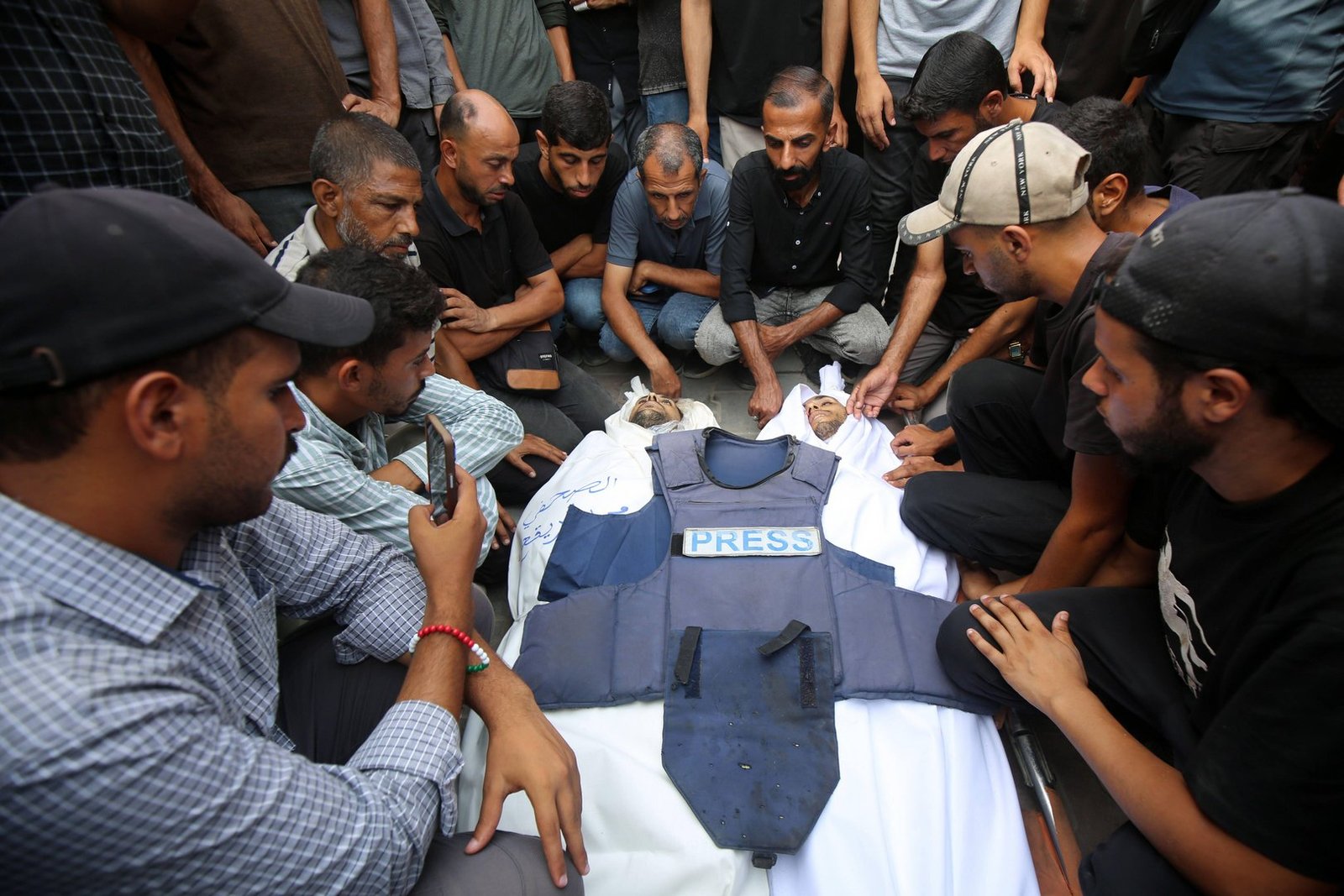
Mourners carry the body of Al Jazeera correspondent Anas al-Sharif, who was killed alongside other journalists in an overnight Israeli strike on their tent in Gaza City, during his funeral in Gaza City on August 11, 2025. Photo: IMAGO/Omar Ashtawy apaimages/Alamy


				JAMES CAMERON MEMORIAL LECTURE 2026 – MARCH 4, 2026 – LONDON
It is January 2000; an aspiring student journalist is on a two-week work placement in Plymouth.
She writes stories on local music concerts, mix-ups over the introduction of the metric system for selling fruit and vegetables, clashes between local school sports teams, the building of a new community centre. She interviews strangers in the street about their favourite books as part of a nationwide survey and for their views on dentists. She covers sports, politics, arts, charity, business. And she knows, as she has known since she was six years old, that all she wants to be is a journalist.
It is January 2026. A photographer heads to cover protests in Minneapolis in the United States. As he tries to live stream and take photos of the crowd that has gathered to protest immigration enforcement in which a protestor was shot dead, he is tackled to the ground by immigration officers and pepper sprayed. He is handcuffed and arrested. And in that moment, the moment when he is hurled to the ground by officials in combat gear, clutching a face mask he’d bought in a local hardware store to protect himself from tear gas, the photographer thinks only of one thing. He must protect the images he has captured of these events – and he throws his camera out from under him in the hope someone will save it.
The journalist in Plymouth, on a two-week placement with the Evening Herald, was me. Then a postgraduate diploma student here at this very university. The photographer is John Abernathy, one of hundreds of journalists in the United States now grappling with a surge in violence against the profession.
We dreamed a lot of dreams when we were at City. I dreamed of being the Director General of the BBC. A friend of being the Editor of The Sun. Some wanted to be political reporters, others sports, some wanted to write about arts and culture, others economics and finance. We knew that over the years many would leave the profession. Some went on to great success in the very careers they envisaged, others took unexpected turns into academia, the civil service, and entertainment.
But what none of us could have predicted was how radically the environment would change for the profession itself. That the kinds of preparations journalists used to undertake to cover war zones would be needed to cover protests in North America. That journalists covering Westminster or the White House would regularly receive death threats. That a journalist in a European Union country might be killed for their investigative reporting.
But that is what has happened. Now, this moment, is the most dangerous time in recent history to be a journalist. Last year, a record 129 journalists and media workers were killed worldwide, the highest number ever in the more than 30 years that the Committee to Protect Journalists has been documenting such data. For the past three years, more than 300 journalists were in jail at the end of the year – including in countries that are supposed democracies. Journalists are subjected to daily online harassment, including threats of death and rape. They are smeared by those in power and mistrusted by those without it.
And yet – although this is the worst time in the world to be a journalist – it is also the most important time.
Today, I want to examine why journalism has become so devalued, why journalists have become so demeaned, and why those whose job it is to deliver facts, to speak truth to power, to expose corruption and injustice, are now in greater peril than at any time in recent history. I also want to share what we can do about it.
And why – if we want to live in anything approaching fair and just societies, ones that uphold rights and freedoms for all – it is essential that we step up to defend a free press — in deeds not just in words.
First, let me tell you a little bit about the Committee to Protect Journalists, the organisation I now lead. Based in New York, the Committee to Protect Journalists was founded in 1981 to defend press freedom and journalist safety worldwide. One of our first advocacy campaigns was in support of three British journalists arrested in Argentina while covering the Falklands War. A letter from then CPJ Honorary Chairman Walter Cronkite helped spring them from prison.
Sadly, the days when a letter and a stern word could provoke such a result are long gone, so CPJ now works in three ways:
• We research and document threats to press freedom globally,
• We provide direct assistance to journalists at risk,
• And we advocate on behalf of those targeted for their work.
Last year, we provided more than .3 million in direct financial assistance to journalists needing emergency support, covering everything from the cost of legal fees for reporters wrongfully imprisoned for their work, to medical bills and trauma support for journalists attacked and harassed in retaliation for their reporting, to exile assistance. We reached an unprecedented total of 3,877 journalists last year – more than 5 times the number of the previous year.
It’s no surprise those numbers have grown – because attacks on the press have grown exponentially in the past decade. In 1992, when CPJ first started systematically documenting attacks on the press, 56 journalists and media workers were killed. Last year’s number is more than double that. In 1992, there were 113 journalists in jail. Last year’s number is more than triple that.
In 1992, Mark Zuckerberg was 8 years old, the launch of Google was still six years away, and Facebook and Twitter would not emerge for more than another decade.
Now, the internet and social media dominate communications, and online harassment – especially of women and those from marginalised communities – is rife. Let me give you one recent example. In 2023, Sabrina Schnur, a young female reporter at the Las Vegas-Review Journal in the United States wrote about the hit-and-run killing of a retired police chief. Schnur was the first journalist at the scene after the killing and also the first local reporter to talk to the police chief’s family. But after screenshots of a month-old obituary sparked accusations the Review-Journal was downplaying the death, Schnur was subjected to a slew of hate-filled abuse. Her email inbox and social media mentions were flooded with personal attacks. She was accused of being anti-white. Her photo was shared, and her office phone number circulated. The attackers hurled antisemitic abuse at Schnur, told her they hoped she would get cancer, that she would die. They found her private social media accounts and unearthed posts she’d made as a teenager, going as far back as 2015.
Schnur and her colleagues had more reasons than most to be concerned about online threats. A year earlier one of the Review-Journal’s leading reporters – Jeff German – was stabbed to death by a local official who was the subject of German’s reporting. The suspect first targeted German with attacks on social media.
How did we get here? Not by accident.
The decline in press freedom and journalism safety is directly tied to a decline in democratic norms and a rise in authoritarianism that we are experiencing worldwide. And no wonder. Autocrats and demagogues have long known that to control a population, you need to control the flow of information to that population. Targeting the press is the first step to stifling dissent.
If we want to tackle this, we need to understand the playbook for attacking the media, which in essence goes something like this: Smear, Harass, Criminalise, Kill.
Let’s start with smearing. This is one you may be familiar with. Name calling may feel like the petulant act of the playground bully but it’s remarkably effective. Hungary’s leader Viktor Orbán does it, smearing the press as “fake news,” former Filipino President Rodrigo Duterte did it, calling them “presstitutes”, US President Donald Trump does it, calling journalists “enemies of the people” and most recently calling one journalist “piggy” and telling another who asked him about his ties to Epstein to “smile”.
More insidiously, we are increasingly seeing a tendency to smear journalism itself as a nefarious act – think of the way in which the US Secretary of Defence conjured images of journalists roaming the Pentagon as a security risk. What Pete Hegseth of course conveniently forgot was that journalists have operated successfully from the Pentagon for decades, while it was Hegseth himself who shared secure information about military plans on a Signal chat group in which a journalist had been mistakenly added. Rather than be seen as critical work in the public interest to expose abuses of power, journalism itself is being rebranded as a subversive act.
Smears escalate. By setting the tone at the top, those in power create a permission structure for harassment. Sometimes that might be formally orchestrated by those in power, more often it develops organically, among their supporters and sympathisers. Diaspora news outlet, The Haitian Times, for example, received a slew of racist abuse after it reported on the false claims made during the US presidential campaign about Haitians eating pets. In a demonstration of the online to offline risks, one reporter even had police show up at her house after a false report was made about a crime being committed there – a practice known as swatting.
Harassment does not just take the form of online or even physical abuse. It can be legal and regulatory as well. This includes the use of so-called SLAPPs – vexatious lawsuits that are designed to drain journalists and media organisations of money and morale. At the time of her murder in 2017, investigative Maltese journalist Daphne Caruana Galizia was facing 47 such suits. In July last year, CBS owner Paramount settled a case that legal experts widely agreed was spurious for  million – a case brought by none other than the US President himself. Weeks later the US broadcast regulator, the Federal Communications Commission, approved a multi billion dollar merger involving Paramount.
Harassment can also take financial form. Cutting funding or using public money to favour political friends and punish political enemies has long been a tactic of autocrats but we increasingly see this in democracies. Since Trump took office, his administration has all but eliminated funding for publicly funded media, mostly impacting local, regional broadcasters serving rural communities, as well as effectively shuttering Voice of America, Radio Free Europe and Radio Free Asia – all services that provided information to and about countries where media freedom is severely curtailed.
So, smearing, then harassment. These are steps one and two.
But it does not stop there. Because mud sticks. Demeaning journalists, branding them as cheats and liars paves the way for the third factor that is common to this playbook: actually criminalising journalism and journalists. Nobel laureate Maria Ressa has spoken extensively about the way branding of journalists as criminals by those in power helps soften the public up for subsequent actual criminalisation and arrest – and of course even killing. Years before the state launched lawsuits against her, the Philippines was readying the public to believe she was an actual criminal by painting her as one.
Dubbing journalists as criminals is a deliberate strategy intended to sow doubt in the mind of the public about their trustworthiness – and therefore about the trustworthiness of their information. It’s a means to control the narrative.
But criminalising journalists is not just about controlling public perception. It’s also used as a means to silence individual journalists – and to send a warning to other reporters and news outlets.
It is a tactic used increasingly, even in supposed democratic regimes. Take the example of Hong Kong where 78-year-old British citizen Jimmy Lai, founder of the independent Apple Daily newspaper, was given a 20 year jail sentence. Lai has been in jail in Hong Kong. Largely in solitary confinement, since 2020 on numerous charges, including sedition and collusion with foreign forces for having the temerity to publish a newspaper that covered pro-democracy protests. In Guatemala, José Rubén Zamora, who for decades has exposed government corruption in his country, was recently released from jail in Guatemala where he faced trumped up charges of money laundering. In both cases, the legal teams for these journalists have themselves faced targeted harassment and threats – and in both cases the newspapers they founded have been forced to shutter as a result of legal action.
And, of course, we have seen this over and over again in Gaza, where Israel repeatedly smears journalists as terrorists and militants, without providing evidence – as a way to justify subsequently killing them.
Killing journalists is the ultimate form of censorship. And no discussion of journalist safety in the current moment can avoid what has been the deadliest assault on journalists since CPJ began. Of the 129 journalists and media workers killed last year, 86 were killed by Israel. The majority of them were Palestinians. Israel has now killed more journalists than any other government since CPJ began collecting records in 1992, making the Israel-Gaza war the deadliest on record for journalists. And let’s be clear. These are not the ordinary casualties of war. In at least 38 cases documented by CPJ last year alone, we believe journalists were deliberately targeted. This includes Al Jazeera reporter Anas al-Sharif, whose life CPJ publicly warned was in danger after repeated, unsubstantiated smears by Israel against him. Following years of such threats, Al-Sharif was murdered on August 10, alongside three other Al Jazeera staff journalists and two freelancers in a strike on a tent housing reporters. Journalists are civilians. Deliberately targeting them constitutes a war crime.
The magnitude of Israel’s killings is exceptional, but – worldwide – the killing of journalists, the smearing of journalists, the harassment, the legal threats, the financial punishments – these are no longer an exception.
Ok. So at this point, you may be shrugging your shoulders and saying, “Who cares?” Maybe you think the media brought it on themselves. Maybe you hate the “lamestream” media and think we all deserve to be smeared, harassed and attacked.
I want to tell you why it matters.
It matters because information is a prerequisite for free and open societies. Attacks on journalists are the first sign of democratic decline. Study after study shows that attacks on journalists matter because they are a clear indicator that attacks on other rights, our rights, will follow.
It matters because journalism is essential for our everyday lives. Without it, we don’t have the information about the decisions being made by governments in our name or how our taxes are being spent. We don’t have information that might help keep us safer or healthier or might help stop abusive practices.
It matters because journalism is essential if we want to understand the world. In Gaza, it is Palestinian journalists who have been our eyes and ears for two and a half years so that we can understand what is happening there. With no independent international access allowed since October 7, it is local journalists who are bearing witness to the genocide that they are also living through.
Journalism is essential if we want to understand our own country. In the UK, it is journalists who have repeatedly uncovered government scandals. Journalists like my friend, former City alum, and multi award winning journalist Pippa Crerar, who – among other things – exposed the Partygate scandal. Harriet Harman, who chaired the parliamentary investigation into Partygate praised Pippa’s journalism in the Commons, saying: “This episode has shown that wrongdoing has not gone undiscovered and attempts to cover it up have failed, but it would have been undiscovered had not the press doggedly investigated.”
Journalism is essential because reliable, fact-based information can save lives. When wildfires broke out in California at the start of the year, local residents turned to local media for information about the outbreaks: about where was safe, how the fires were moving, what precautions to take. In many rural parts of the United States, there is no reliable internet. Local radio is the most important source of information, especially in an emergency. In rural Alaska, it is the local independent radio stations who are tasked with providing early warnings of tsunamis and extreme weather – stations whose funding has been gutted by federal cuts.
In the absence of independent, reliable fact-based media, a vacuum is created. One that is easily filled with lies, half-truths and propaganda.
We cannot afford to be complacent. Journalism has value, it has impact – and yet journalists are being killed at a faster rate than in any other time in recent history, journalists are being jailed in higher numbers than at any other moment in recent history. News deserts – places with no access to credible news and information about their local community – are spreading. Funding for independent journalism in and about countries with little or no media freedom has been slashed.
So, if we know journalism has value and if we know that it is under attack like never before, what are we going to do about it?
Well, firstly, we need to accept that current ways of operating are failing and we need to look for new ones.
One example of this is impunity. It is widely recognised that impunity – a failure to punish those responsible for attacks on journalists – creates environments that allows further attacks – more egregious, more violent attacks – to persist and flourish.
More than a decade ago, the United Nations established the International Day to End Impunity for Crimes Against Journalists as an effort to draw attention to this fact. Each year for more than a decade we at the Committee to Protect Journalists would publish a report on the worst offenders – the countries where most journalist murders had gone unpunished. And yet the numbers remained stubbornly and persistently high.
So, instead of thinking about what everyone else needed to do to address this, this year we took a look at ourselves.
And that’s why on International Day to End Impunity this year, CPJ decided to drop our annual Impunity Index. Measuring which governments were – literally – getting away with murder was a useful way to shed light on the issue a decade ago, but it’s no longer enough.
We are overhauling our approach to focus where we know we can have impact and on new initiatives that hold promise.
These initiatives include:
Firstly, pursuit of justice in key cases. Our experience in the past decade has shown that one of the most effective mechanisms for tackling impunity is a relentless pursuit of justice in individual cases. Going forward, CPJ is dedicating increased resources to a select number of such emblematic cases, supporting families and local communities in their often-lengthy fights to continue investigations and prosecutions.
Secondly, we are pushing for the establishment of a standing independent international investigative task force focused on violent crimes against journalists. Relying on perpetrators of crimes against journalists to lead investigations into those crimes and hold those responsible accountable will always make ending impunity an uphill if not impossible battle. We need an independent global body readily available to support investigations – local, regional or international – into attacks.
Thirdly, we need to see increased accountability from companies. Businesses play a key role in enabling attacks on journalists. CPJ is stepping up its focus on investigating and seeking accountability over the use of companies’ technology in cases where journalists are targeted or harmed. The increased use of drones is likely to be a particular focus in 2026.
We asked ourselves, “What can and should we be doing in this moment?” and it is a question we must all ask ourselves.
So here are some things you can do as an individual:
1. Spend money! Invest in local media
The evisceration of local media has been credibly linked to worsening outcomes for communities, including loss of community cohesion, lack of oversight and accountability leading to poor spending decisions, increased corruption, and even rising local taxes.
If you don’t already, do it, go out today and subscribe to your local news outlet. Or someone else’s. When the Kansan local newspaper the Marion Country Record in the US was wrongfully raided by police a few years ago, subscribers flooded to support the outlet – including many who lived hundreds of miles away. One Florida man told the Record’s editor he subscribed because he’d read local newspapers as a boy and missed the sense of community (2,500 kms away).
2. Lobby your local authorities and governments, and your employers!
It is not enough for governments to say they support a free press. They need to demonstrate this in practice, both at home, and in their dealings with governments abroad – and they need to know their constituent’s care.
As voters, we can ask our elected representatives to make these issues a priority.
As employees, we can ask our employers to make this a priority. If you are an academic, does your university have programs for exiled journalists/ journalists at risk? Do your professional journalism courses include safety modules as standard? If you are a journalist, does your employer provide digital health checks or privacy tools? If the answer to these questions is no, ask for them. I can help you…
3. Let’s do our jobs as journalists.
When I started at CPJ three and a half years ago, the motto of the organisation was “using the tools of journalism to protect journalists.” To be honest, as a former reporter, I somewhat scoffed at this description. After all, we are not a news agency. We are not a newspaper of record. We are an advocacy organisation. But over the past three years, as I have watched our profession fail over and over again in its coverage of Gaza, I have come to realise how important it is for all of us to recommit to, and publicly champion, the core principles of good journalism. It is the very essence of good journalism – the ruthless pursuit and public dissemination of facts – that will be our strongest defence.
Recentring facts means explaining how we got them and why they matter. One of the reasons I would argue that journalists have suffered such a loss of trust in recent years – quite apart from some clear and obvious failures, including illegal phone hacking here in the UK – is that we assumed people understood what we did and what value we had. But as more and more individuals claim to be journalists or news outlets claim to be conducting journalism, those who are engaged in actual journalism – reporting to establish facts – need to do more to show how they arrived at the information and why they should be trusted.
Recentring facts also means celebrating your impact. When I became a reporter, I was told time and again that journalists didn’t like to report on ourselves. That reporting on issues facing the industry could be considered self-indulgent. But if we want people to understand the worth of journalism, we must report not just the news, but how and when our reporting has effected change.
Let’s be half as brave as our colleagues who risk everything to report the truth. I was asked in a recent interview what message I had for Western journalists covering Gaza. My response – although in slightly more colourful language – was “Do your job.” The job of a journalist is not that of a parrot – it is not simply to ask questions and rehearse what we are told. That’s not fact finding. That’s stenography. Our job is to dig deeper, to see with our own eyes and hear with our own ears where possible, and – if not possible – to gather as much information from as many sources as possible to establish the truth.
Instead of worrying about being perceived to take sides, our responsibility is to report the facts. It requires courage. Cowardice is the enemy of good journalism. George Orwell had this right back in his original proposed preface to Animal Farm. “Obviously,” Orwell wrote, “it is not desirable that a government department should have any power of censorship… But the chief danger to freedom of thought and speech at this moment is not the direct interference of the MOI or any official body. If publishers and editors exert themselves to keep certain topics out of print, it is not because they are frightened of prosecution but because they are frightened of public opinion. In this country intellectual cowardice is the worst enemy a writer or journalist has to face, and that fact does not seem to me to have had the discussion it deserves.” Animal Farm was published in 1945. What Orwell wrote then is as true today: our job as journalists is to stand up to the bullies – not to bow to them. That’s what CPJ wrote to Shari Redstone, former chair of Paramount, when we urged her not to settle with Trump over his lawsuit against CBS. Capitulation creates a precedent – and each individual capitulation weakens the entire ecosystem.
I am by no means saying this is easy. Journalism will always be risky as will defending it. It takes a certain level of defiance – a willingness to speak truth to power, to report things as they are, as we see them, and to place them in context – even, and perhaps especially, when it’s not what people want to hear. Doing it well takes courage and conviction. In 2009, prominent Sri Lankan journalist Lasantha Wickrematunge was murdered by a group of men on motorcycles. He had been receiving threats for months but refused to stay silent about the injustices in his country. For the last decade, Filipino journalist – now Nobel Laureate, Maria Ressa has been subject to a relentless legal campaign intended to discredit, bankrupt, and ultimately silence the critical reporting coming from both her and her newsroom, Rappler. At one point, she faced a possible sentence of more than a hundred years behind bars. But Maria knows that the job of a journalist is to report the facts, not to bend to those who benefit from their burial. She refuses to stay silent.
More than 200 Palestinian journalists have been killed by Israel since the start of the Israel-Gaza war. Many have been deliberately threatened and warned explicitly by Israel to stop their reporting. All know the risks they take in wielding cameras when Israel has repeatedly targeted journalists even when wearing press vests and working from known press zones. They know that in the end facts are our superpower. They know that killing the messenger does not kill the message. So, they refused to stop. They refused to be silent. If we want to save journalists, if we want to save journalism, we all must do the same.
BY JODIE GINSBERG
CEO, COMMITTEE TO PROTECT JOURNALISTS
Editors note:
This is the alert that the CPJ put out over the weekend in response to an Israeli strike on a media car which killed three journalists in Southern Lebanon.


				READ MORE
Share
Facebook Twitter Pinterest Email Copy Link

Listen to the article

0:00
0:00

Key Takeaways

Playback Speed

Select a Voice

JAMES CAMERON MEMORIAL LECTURE 2026 – MARCH 4, 2026 – LONDON

It is January 2000; an aspiring student journalist is on a two-week work placement in Plymouth.

She writes stories on local music concerts, mix-ups over the introduction of the metric system for selling fruit and vegetables, clashes between local school sports teams, the building of a new community centre. She interviews strangers in the street about their favourite books as part of a nationwide survey and for their views on dentists. She covers sports, politics, arts, charity, business. And she knows, as she has known since she was six years old, that all she wants to be is a journalist.

It is January 2026. A photographer heads to cover protests in Minneapolis in the United States. As he tries to live stream and take photos of the crowd that has gathered to protest immigration enforcement in which a protestor was shot dead, he is tackled to the ground by immigration officers and pepper sprayed. He is handcuffed and arrested. And in that moment, the moment when he is hurled to the ground by officials in combat gear, clutching a face mask he’d bought in a local hardware store to protect himself from tear gas, the photographer thinks only of one thing. He must protect the images he has captured of these events – and he throws his camera out from under him in the hope someone will save it.

The journalist in Plymouth, on a two-week placement with the Evening Herald, was me. Then a postgraduate diploma student here at this very university. The photographer is John Abernathy, one of hundreds of journalists in the United States now grappling with a surge in violence against the profession.

We dreamed a lot of dreams when we were at City. I dreamed of being the Director General of the BBC. A friend of being the Editor of The Sun. Some wanted to be political reporters, others sports, some wanted to write about arts and culture, others economics and finance. We knew that over the years many would leave the profession. Some went on to great success in the very careers they envisaged, others took unexpected turns into academia, the civil service, and entertainment.

But what none of us could have predicted was how radically the environment would change for the profession itself. That the kinds of preparations journalists used to undertake to cover war zones would be needed to cover protests in North America. That journalists covering Westminster or the White House would regularly receive death threats. That a journalist in a European Union country might be killed for their investigative reporting.

But that is what has happened. Now, this moment, is the most dangerous time in recent history to be a journalist. Last year, a record 129 journalists and media workers were killed worldwide, the highest number ever in the more than 30 years that the Committee to Protect Journalists has been documenting such data. For the past three years, more than 300 journalists were in jail at the end of the year – including in countries that are supposed democracies. Journalists are subjected to daily online harassment, including threats of death and rape. They are smeared by those in power and mistrusted by those without it.

And yet – although this is the worst time in the world to be a journalist – it is also the most important time.

Today, I want to examine why journalism has become so devalued, why journalists have become so demeaned, and why those whose job it is to deliver facts, to speak truth to power, to expose corruption and injustice, are now in greater peril than at any time in recent history. I also want to share what we can do about it.

And why – if we want to live in anything approaching fair and just societies, ones that uphold rights and freedoms for all – it is essential that we step up to defend a free press — in deeds not just in words.

First, let me tell you a little bit about the Committee to Protect Journalists, the organisation I now lead. Based in New York, the Committee to Protect Journalists was founded in 1981 to defend press freedom and journalist safety worldwide. One of our first advocacy campaigns was in support of three British journalists arrested in Argentina while covering the Falklands War. A letter from then CPJ Honorary Chairman Walter Cronkite helped spring them from prison.

Sadly, the days when a letter and a stern word could provoke such a result are long gone, so CPJ now works in three ways:
• We research and document threats to press freedom globally,
• We provide direct assistance to journalists at risk,
• And we advocate on behalf of those targeted for their work.

Last year, we provided more than $1.3 million in direct financial assistance to journalists needing emergency support, covering everything from the cost of legal fees for reporters wrongfully imprisoned for their work, to medical bills and trauma support for journalists attacked and harassed in retaliation for their reporting, to exile assistance. We reached an unprecedented total of 3,877 journalists last year – more than 5 times the number of the previous year.

It’s no surprise those numbers have grown – because attacks on the press have grown exponentially in the past decade. In 1992, when CPJ first started systematically documenting attacks on the press, 56 journalists and media workers were killed. Last year’s number is more than double that. In 1992, there were 113 journalists in jail. Last year’s number is more than triple that.

In 1992, Mark Zuckerberg was 8 years old, the launch of Google was still six years away, and Facebook and Twitter would not emerge for more than another decade.

Now, the internet and social media dominate communications, and online harassment – especially of women and those from marginalised communities – is rife. Let me give you one recent example. In 2023, Sabrina Schnur, a young female reporter at the Las Vegas-Review Journal in the United States wrote about the hit-and-run killing of a retired police chief. Schnur was the first journalist at the scene after the killing and also the first local reporter to talk to the police chief’s family. But after screenshots of a month-old obituary sparked accusations the Review-Journal was downplaying the death, Schnur was subjected to a slew of hate-filled abuse. Her email inbox and social media mentions were flooded with personal attacks. She was accused of being anti-white. Her photo was shared, and her office phone number circulated. The attackers hurled antisemitic abuse at Schnur, told her they hoped she would get cancer, that she would die. They found her private social media accounts and unearthed posts she’d made as a teenager, going as far back as 2015.

Schnur and her colleagues had more reasons than most to be concerned about online threats. A year earlier one of the Review-Journal’s leading reporters – Jeff German – was stabbed to death by a local official who was the subject of German’s reporting. The suspect first targeted German with attacks on social media.

How did we get here? Not by accident.

The decline in press freedom and journalism safety is directly tied to a decline in democratic norms and a rise in authoritarianism that we are experiencing worldwide. And no wonder. Autocrats and demagogues have long known that to control a population, you need to control the flow of information to that population. Targeting the press is the first step to stifling dissent.

If we want to tackle this, we need to understand the playbook for attacking the media, which in essence goes something like this: Smear, Harass, Criminalise, Kill.

Let’s start with smearing. This is one you may be familiar with. Name calling may feel like the petulant act of the playground bully but it’s remarkably effective. Hungary’s leader Viktor Orbán does it, smearing the press as “fake news,” former Filipino President Rodrigo Duterte did it, calling them “presstitutes”, US President Donald Trump does it, calling journalists “enemies of the people” and most recently calling one journalist “piggy” and telling another who asked him about his ties to Epstein to “smile”.

More insidiously, we are increasingly seeing a tendency to smear journalism itself as a nefarious act – think of the way in which the US Secretary of Defence conjured images of journalists roaming the Pentagon as a security risk. What Pete Hegseth of course conveniently forgot was that journalists have operated successfully from the Pentagon for decades, while it was Hegseth himself who shared secure information about military plans on a Signal chat group in which a journalist had been mistakenly added. Rather than be seen as critical work in the public interest to expose abuses of power, journalism itself is being rebranded as a subversive act.

Smears escalate. By setting the tone at the top, those in power create a permission structure for harassment. Sometimes that might be formally orchestrated by those in power, more often it develops organically, among their supporters and sympathisers. Diaspora news outlet, The Haitian Times, for example, received a slew of racist abuse after it reported on the false claims made during the US presidential campaign about Haitians eating pets. In a demonstration of the online to offline risks, one reporter even had police show up at her house after a false report was made about a crime being committed there – a practice known as swatting.

Harassment does not just take the form of online or even physical abuse. It can be legal and regulatory as well. This includes the use of so-called SLAPPs – vexatious lawsuits that are designed to drain journalists and media organisations of money and morale. At the time of her murder in 2017, investigative Maltese journalist Daphne Caruana Galizia was facing 47 such suits. In July last year, CBS owner Paramount settled a case that legal experts widely agreed was spurious for $16 million – a case brought by none other than the US President himself. Weeks later the US broadcast regulator, the Federal Communications Commission, approved a multi billion dollar merger involving Paramount.

Harassment can also take financial form. Cutting funding or using public money to favour political friends and punish political enemies has long been a tactic of autocrats but we increasingly see this in democracies. Since Trump took office, his administration has all but eliminated funding for publicly funded media, mostly impacting local, regional broadcasters serving rural communities, as well as effectively shuttering Voice of America, Radio Free Europe and Radio Free Asia – all services that provided information to and about countries where media freedom is severely curtailed.

So, smearing, then harassment. These are steps one and two.

But it does not stop there. Because mud sticks. Demeaning journalists, branding them as cheats and liars paves the way for the third factor that is common to this playbook: actually criminalising journalism and journalists. Nobel laureate Maria Ressa has spoken extensively about the way branding of journalists as criminals by those in power helps soften the public up for subsequent actual criminalisation and arrest – and of course even killing. Years before the state launched lawsuits against her, the Philippines was readying the public to believe she was an actual criminal by painting her as one.

Dubbing journalists as criminals is a deliberate strategy intended to sow doubt in the mind of the public about their trustworthiness – and therefore about the trustworthiness of their information. It’s a means to control the narrative.

But criminalising journalists is not just about controlling public perception. It’s also used as a means to silence individual journalists – and to send a warning to other reporters and news outlets.

It is a tactic used increasingly, even in supposed democratic regimes. Take the example of Hong Kong where 78-year-old British citizen Jimmy Lai, founder of the independent Apple Daily newspaper, was given a 20 year jail sentence. Lai has been in jail in Hong Kong. Largely in solitary confinement, since 2020 on numerous charges, including sedition and collusion with foreign forces for having the temerity to publish a newspaper that covered pro-democracy protests. In Guatemala, José Rubén Zamora, who for decades has exposed government corruption in his country, was recently released from jail in Guatemala where he faced trumped up charges of money laundering. In both cases, the legal teams for these journalists have themselves faced targeted harassment and threats – and in both cases the newspapers they founded have been forced to shutter as a result of legal action.

And, of course, we have seen this over and over again in Gaza, where Israel repeatedly smears journalists as terrorists and militants, without providing evidence – as a way to justify subsequently killing them.

Killing journalists is the ultimate form of censorship. And no discussion of journalist safety in the current moment can avoid what has been the deadliest assault on journalists since CPJ began. Of the 129 journalists and media workers killed last year, 86 were killed by Israel. The majority of them were Palestinians. Israel has now killed more journalists than any other government since CPJ began collecting records in 1992, making the Israel-Gaza war the deadliest on record for journalists. And let’s be clear. These are not the ordinary casualties of war. In at least 38 cases documented by CPJ last year alone, we believe journalists were deliberately targeted. This includes Al Jazeera reporter Anas al-Sharif, whose life CPJ publicly warned was in danger after repeated, unsubstantiated smears by Israel against him. Following years of such threats, Al-Sharif was murdered on August 10, alongside three other Al Jazeera staff journalists and two freelancers in a strike on a tent housing reporters. Journalists are civilians. Deliberately targeting them constitutes a war crime.

The magnitude of Israel’s killings is exceptional, but – worldwide – the killing of journalists, the smearing of journalists, the harassment, the legal threats, the financial punishments – these are no longer an exception.

Ok. So at this point, you may be shrugging your shoulders and saying, “Who cares?” Maybe you think the media brought it on themselves. Maybe you hate the “lamestream” media and think we all deserve to be smeared, harassed and attacked.

I want to tell you why it matters.

It matters because information is a prerequisite for free and open societies. Attacks on journalists are the first sign of democratic decline. Study after study shows that attacks on journalists matter because they are a clear indicator that attacks on other rights, our rights, will follow.

It matters because journalism is essential for our everyday lives. Without it, we don’t have the information about the decisions being made by governments in our name or how our taxes are being spent. We don’t have information that might help keep us safer or healthier or might help stop abusive practices.

It matters because journalism is essential if we want to understand the world. In Gaza, it is Palestinian journalists who have been our eyes and ears for two and a half years so that we can understand what is happening there. With no independent international access allowed since October 7, it is local journalists who are bearing witness to the genocide that they are also living through.

Journalism is essential if we want to understand our own country. In the UK, it is journalists who have repeatedly uncovered government scandals. Journalists like my friend, former City alum, and multi award winning journalist Pippa Crerar, who – among other things – exposed the Partygate scandal. Harriet Harman, who chaired the parliamentary investigation into Partygate praised Pippa’s journalism in the Commons, saying: “This episode has shown that wrongdoing has not gone undiscovered and attempts to cover it up have failed, but it would have been undiscovered had not the press doggedly investigated.”

Journalism is essential because reliable, fact-based information can save lives. When wildfires broke out in California at the start of the year, local residents turned to local media for information about the outbreaks: about where was safe, how the fires were moving, what precautions to take. In many rural parts of the United States, there is no reliable internet. Local radio is the most important source of information, especially in an emergency. In rural Alaska, it is the local independent radio stations who are tasked with providing early warnings of tsunamis and extreme weather – stations whose funding has been gutted by federal cuts.

In the absence of independent, reliable fact-based media, a vacuum is created. One that is easily filled with lies, half-truths and propaganda.

We cannot afford to be complacent. Journalism has value, it has impact – and yet journalists are being killed at a faster rate than in any other time in recent history, journalists are being jailed in higher numbers than at any other moment in recent history. News deserts – places with no access to credible news and information about their local community – are spreading. Funding for independent journalism in and about countries with little or no media freedom has been slashed.

So, if we know journalism has value and if we know that it is under attack like never before, what are we going to do about it?

Well, firstly, we need to accept that current ways of operating are failing and we need to look for new ones.

One example of this is impunity. It is widely recognised that impunity – a failure to punish those responsible for attacks on journalists – creates environments that allows further attacks – more egregious, more violent attacks – to persist and flourish.

More than a decade ago, the United Nations established the International Day to End Impunity for Crimes Against Journalists as an effort to draw attention to this fact. Each year for more than a decade we at the Committee to Protect Journalists would publish a report on the worst offenders – the countries where most journalist murders had gone unpunished. And yet the numbers remained stubbornly and persistently high.

So, instead of thinking about what everyone else needed to do to address this, this year we took a look at ourselves.

And that’s why on International Day to End Impunity this year, CPJ decided to drop our annual Impunity Index. Measuring which governments were – literally – getting away with murder was a useful way to shed light on the issue a decade ago, but it’s no longer enough.

We are overhauling our approach to focus where we know we can have impact and on new initiatives that hold promise.

These initiatives include:

Firstly, pursuit of justice in key cases. Our experience in the past decade has shown that one of the most effective mechanisms for tackling impunity is a relentless pursuit of justice in individual cases. Going forward, CPJ is dedicating increased resources to a select number of such emblematic cases, supporting families and local communities in their often-lengthy fights to continue investigations and prosecutions.

Secondly, we are pushing for the establishment of a standing independent international investigative task force focused on violent crimes against journalists. Relying on perpetrators of crimes against journalists to lead investigations into those crimes and hold those responsible accountable will always make ending impunity an uphill if not impossible battle. We need an independent global body readily available to support investigations – local, regional or international – into attacks.

Thirdly, we need to see increased accountability from companies. Businesses play a key role in enabling attacks on journalists. CPJ is stepping up its focus on investigating and seeking accountability over the use of companies’ technology in cases where journalists are targeted or harmed. The increased use of drones is likely to be a particular focus in 2026.

We asked ourselves, “What can and should we be doing in this moment?” and it is a question we must all ask ourselves.

So here are some things you can do as an individual:

1. Spend money! Invest in local media

The evisceration of local media has been credibly linked to worsening outcomes for communities, including loss of community cohesion, lack of oversight and accountability leading to poor spending decisions, increased corruption, and even rising local taxes.

If you don’t already, do it, go out today and subscribe to your local news outlet. Or someone else’s. When the Kansan local newspaper the Marion Country Record in the US was wrongfully raided by police a few years ago, subscribers flooded to support the outlet – including many who lived hundreds of miles away. One Florida man told the Record’s editor he subscribed because he’d read local newspapers as a boy and missed the sense of community (2,500 kms away).

2. Lobby your local authorities and governments, and your employers!

It is not enough for governments to say they support a free press. They need to demonstrate this in practice, both at home, and in their dealings with governments abroad – and they need to know their constituent’s care.

As voters, we can ask our elected representatives to make these issues a priority.

As employees, we can ask our employers to make this a priority. If you are an academic, does your university have programs for exiled journalists/ journalists at risk? Do your professional journalism courses include safety modules as standard? If you are a journalist, does your employer provide digital health checks or privacy tools? If the answer to these questions is no, ask for them. I can help you…

3. Let’s do our jobs as journalists.

When I started at CPJ three and a half years ago, the motto of the organisation was “using the tools of journalism to protect journalists.” To be honest, as a former reporter, I somewhat scoffed at this description. After all, we are not a news agency. We are not a newspaper of record. We are an advocacy organisation. But over the past three years, as I have watched our profession fail over and over again in its coverage of Gaza, I have come to realise how important it is for all of us to recommit to, and publicly champion, the core principles of good journalism. It is the very essence of good journalism – the ruthless pursuit and public dissemination of facts – that will be our strongest defence.

Recentring facts means explaining how we got them and why they matter. One of the reasons I would argue that journalists have suffered such a loss of trust in recent years – quite apart from some clear and obvious failures, including illegal phone hacking here in the UK – is that we assumed people understood what we did and what value we had. But as more and more individuals claim to be journalists or news outlets claim to be conducting journalism, those who are engaged in actual journalism – reporting to establish facts – need to do more to show how they arrived at the information and why they should be trusted.

Recentring facts also means celebrating your impact. When I became a reporter, I was told time and again that journalists didn’t like to report on ourselves. That reporting on issues facing the industry could be considered self-indulgent. But if we want people to understand the worth of journalism, we must report not just the news, but how and when our reporting has effected change.

Let’s be half as brave as our colleagues who risk everything to report the truth. I was asked in a recent interview what message I had for Western journalists covering Gaza. My response – although in slightly more colourful language – was “Do your job.” The job of a journalist is not that of a parrot – it is not simply to ask questions and rehearse what we are told. That’s not fact finding. That’s stenography. Our job is to dig deeper, to see with our own eyes and hear with our own ears where possible, and – if not possible – to gather as much information from as many sources as possible to establish the truth.

Instead of worrying about being perceived to take sides, our responsibility is to report the facts. It requires courage. Cowardice is the enemy of good journalism. George Orwell had this right back in his original proposed preface to Animal Farm. “Obviously,” Orwell wrote, “it is not desirable that a government department should have any power of censorship… But the chief danger to freedom of thought and speech at this moment is not the direct interference of the MOI or any official body. If publishers and editors exert themselves to keep certain topics out of print, it is not because they are frightened of prosecution but because they are frightened of public opinion. In this country intellectual cowardice is the worst enemy a writer or journalist has to face, and that fact does not seem to me to have had the discussion it deserves.” Animal Farm was published in 1945. What Orwell wrote then is as true today: our job as journalists is to stand up to the bullies – not to bow to them. That’s what CPJ wrote to Shari Redstone, former chair of Paramount, when we urged her not to settle with Trump over his lawsuit against CBS. Capitulation creates a precedent – and each individual capitulation weakens the entire ecosystem.

I am by no means saying this is easy. Journalism will always be risky as will defending it. It takes a certain level of defiance – a willingness to speak truth to power, to report things as they are, as we see them, and to place them in context – even, and perhaps especially, when it’s not what people want to hear. Doing it well takes courage and conviction. In 2009, prominent Sri Lankan journalist Lasantha Wickrematunge was murdered by a group of men on motorcycles. He had been receiving threats for months but refused to stay silent about the injustices in his country. For the last decade, Filipino journalist – now Nobel Laureate, Maria Ressa has been subject to a relentless legal campaign intended to discredit, bankrupt, and ultimately silence the critical reporting coming from both her and her newsroom, Rappler. At one point, she faced a possible sentence of more than a hundred years behind bars. But Maria knows that the job of a journalist is to report the facts, not to bend to those who benefit from their burial. She refuses to stay silent.

More than 200 Palestinian journalists have been killed by Israel since the start of the Israel-Gaza war. Many have been deliberately threatened and warned explicitly by Israel to stop their reporting. All know the risks they take in wielding cameras when Israel has repeatedly targeted journalists even when wearing press vests and working from known press zones. They know that in the end facts are our superpower. They know that killing the messenger does not kill the message. So, they refused to stop. They refused to be silent. If we want to save journalists, if we want to save journalism, we all must do the same.

BY JODIE GINSBERG
CEO, COMMITTEE TO PROTECT JOURNALISTS

Editors note:

This is the alert that the CPJ put out over the weekend in response to an Israeli strike on a media car which killed three journalists in Southern Lebanon.

Read the full article here

Fact Checker

Verify the accuracy of this article using AI-powered analysis and real-time sources.

Get Your Fact Check Report

Enter your email to receive detailed fact-checking analysis

5 free reports remaining

Continue with Full Access

You've used your 5 free reports. Sign up for unlimited access!

Already have an account? Sign in here

Share. Facebook Twitter Pinterest LinkedIn Tumblr Email Telegram Copy Link
News Room
  • Website
  • Facebook
  • X (Twitter)
  • Instagram
  • LinkedIn

The FSNN News Room is the voice of our in-house journalists, editors, and researchers. We deliver timely, unbiased reporting at the crossroads of finance, cryptocurrency, and global politics, providing clear, fact-driven analysis free from agendas.

Related Articles

Global Free Speech

Daughter of slain Peruvian journalist Hugo Bustíos calls release of convicted mastermind “an insult” to justice 

2 hours ago
Global Free Speech

Israeli strike on media car targets, kills 3 journalists in south Lebanon

2 days ago
Global Free Speech

Nigerian police beat journalist Muhammad Sani Adamu during Eid celebrations

3 days ago
Global Free Speech

Journalist Anna Kalyuzhna harassed over Facebook post on Ukraine assault regiments

3 days ago
Global Free Speech

Becoming by Michelle Obama was among the targeted titles. Photo: Patti McConville/Alamy When a school librarian from Greater Manchester came to Index with a shocking story about nearly 200 books being hauled from her shelves and losing her career to a “safeguarding” complaint, we promised to conceal her identity. At her request, we renamed her Emily and we did not name the school. She was terrified about the repercussions if her name was known, both from the school and from other people who might target her online. We kept our promise. Now, a local media outlet has uncovered and published the name of the school. Emily’s identity remains hidden. The school in question is the Lowry Academy in Salford, part of the United Learning Trust. There were extra details Index could not reveal when the name of the school was concealed. We can now address these issues, which are in the public interest. We can reveal how the local authority upheld the safeguarding complaint that destroyed a librarian’s career, the evidence that contradicts the school’s response and the bigger concerns for both Greater Manchester and the United Learning Trust. Initially, Emily told Index, she thought the situation “was a sick joke”. She first heard of the threat to her job when the Lowry Academy’s headteacher took umbrage at Laura Bates’ book Men Who Hate Women in the school library. The nonfiction title, where Bates goes undercover to expose vast misogynist networks and communities, had been ordered by Emily for the Life 101 section for older students, after training she had received about incel culture. The school launched an investigation into both the library and Emily. She was soon reported to the local authority as a safeguarding risk, simply for stocking books. Nearly 200 books were removed and AI was used to categorise the reasons for each book’s removal. You can read more about what happened to Emily in our investigation. While the name Lowry Academy is new, the public might be more familiar with it as the former Harrop Fold School, featured on the Channel 4 documentary Educating Greater Manchester. The school, whose leadership changed after it was fully academised in 2020, had a “good” Ofsted rating in 2024, but it was noted that pupils in key stage 4 had limited time devoted to personal, social and health education. The academy is now part of the United Learning Trust, which says on its website that its ethos “is our expression of our Christian roots, in schools which are fully inclusive and both welcome and respect students and staff of all faiths and none”. A former student from Lowry Academy got in contact with Index, after the name of the school was revealed. He studied at the school until 2024, and said he spent all of his break times in the library. He described the vast and inclusive set of books, spanning across genres. He said he found the library purge and the way Emily was treated “quite grotesque.” “It was disgusting how it was all handled,” he added. He was shocked by the list of targeted books, and said he’d read a few of the biographies. He also read a lot of George Orwell, while he has friends who read many of the manga books. He believes the loss of titles from the library will have a big impact on current students who, like him, find a safe space in the library. “They won’t have the freedom of reading what they want to read,” he said. While the Lowry Academy did not respond to Index for comment, the Manchester Mill reported that the school told them: “It is not the case that books have been ‘banned’ by the school. Following concerns that a number of books within the library were neither age nor content appropriate, an audit was conducted. Following this, books have been placed into age-appropriate categories and returned to the shelves. A very small number of books were deemed inappropriate even for older children due to their content and have been removed.” It may be true some books have now been returned, but they were undoubtedly removed in the first instance. Lowry Academy refused to engage with Index or other organisations to explain what had happened to the books. Index has documentary evidence to support the claim that the books were indeed initially removed from the library during an “audit”. In an email from the school to Emily during the investigation, she was told: “Attached is the list of books [the designated safeguarding lead] has removed from the library. Please note that the audit is still ongoing, and the DSL has confirmed that she is alleging these books are not suitable to remain in the library. The investigation will be based on the attached list.” Further to this, in the school’s investigation report, they concluded with the recommendation: “Continue the audit of all library resources until the Designated Safeguarding Lead (DSL) is satisfied that any material deemed inappropriate for a school setting has been removed.” In an email from the school to Emily during the investigation, she was told: “Attached is the list of books [the designated safeguarding lead] has removed from the library. Please note that the audit is still ongoing, and the DSL has confirmed that she is alleging these books are not suitable to remain in the library. The investigation will be based on the attached list.” Further to this, in the school’s investigation report, they concluded with the recommendation: “Continue the audit of all library resources until the Designated Safeguarding Lead (DSL) is satisfied that any material deemed inappropriate for a school setting has been removed.” Index has seen extensive documentary evidence proving Emily’s claims. These documents have also been seen by the Chartered Institute of Library and Information Professionals (CILIP) and their School Libraries Group (SLG), who have both been supporting Emily. During their investigation, evidenced in these documents, the school shared examples of the removed books with the trust’s safeguarding lead, who said: “The school should ensure that library materials reflect the values and ethos of the school”. The values described on the school website are “aspiration, respect, confidence, creativity and resilience”. The investigation report said that the trust’s safeguarding lead had stated: “Some of these books would be indefensible to parents and expressed concern that the material does not represent a balanced view aligned with the values the trust seeks to promote.” During the investigation, the school also showed concern for their reputation, writing in a report: “I believe there has been a failure to prevent students accessing inappropriate books, this constitutes a serious safeguarding breach under KCSIE 2025. Had parents been aware of this, the school’s reputation could have been brought into significant disrepute.” The Lowry Academy story is not simply a case of one overzealous headteacher. Not only have several senior members of staff been involved, but the trust and the local authority have also played key roles. Margaret Woodhouse, the chair of the school’s governing body, is also the independent chair of the Greater Manchester Learning Partnership, where school leaders across the region work together. Emily was reported to the local authority as a safeguarding risk on 9 December 2025 and her hearing was held on 5 January 2026, after she had resigned. When the committee, known as a LADO, made their decision in January 2026, they substantiated the allegation, stating that Emily had not caused direct harm but that she had failed to follow safeguarding procedures. Index has seen redacted minutes of the meeting. The meeting was held by Salford City Council, and there were four people in attendance. Two were from the school, one was the LADO chair and one was the LADO administration officer. The allegations against Emily were specifically around “introducing inappropriate material into the school library” and nothing else. No previous concerns about her had been raised. In the meeting, the school’s senior vice-principal explained that the referral was made “after discovering multiple books in the school library containing inappropriate content. These books had been loaned to children and did not align with the school’s curriculum”. They confirmed that the investigation was prompted by their discovery of Men Who Hate Women, saying: “the content was inappropriate for children and even challenging for adults to access”. At one point, the LADO chair asked why Emily “began ordering controversial titles and whether this was a recent development”. She later “confirmed several books were adult literature and therefore unsuitable for a school setting”. Some of the books removed include Michelle Obama’s Becoming, Dan Brown’s The Da Vinci Code and Andrew Flintoff’s autobiography Second Innings. As Caroline Roche, chair of the School Libraries Group (SLG) told Index, librarians all make different decisions about which books to stock based on their students and communities, and are ready to defend their collections. Indeed, many GCSE English set texts were not written for children, including Mary Shelley’s Frankenstein, William Shakespeare’s Macbeth and To Kill A Mockingbird by Harper Lee. They contain challenging topics, as do many others. In Salford City Council’s decision, there appears to have been a lack of understanding of the role of a school library – an increasing occurrence when it comes to school leadership, when there is an absence of statutory guidance for school libraries. The Lowry Academy boasts on its website that “reading is central to the development of our students”, and talks of how students can read all kinds of genres – horror, graphic novels and classics among them. Students will “be exposed to unfamiliar topics to broaden their understanding of the world around them,” the school writes. Many titles in these genres were indeed removed from the school library during the purge. The school’s investigation discussed the removal of a Nineteen-Eighty-Four graphic novel. And mere paragraphs later described how a senior staff member felt the library’s ‘Life 101’ section (where Emily kept books for school leavers) was inappropriate, “based on the association with the television program Room 101, where undesirable items are symbolically discarded”. They were seemingly oblivious to Room 101’s origins in Orwell’s Nineteen-Eighty-Four. The day Index published our investigation, the Lowry Academy posted a Facebook video promoting a The Traitors-style game, where staff would be “banished”. It was filmed in the school library.  “It has come to our attention that among our staff we have some traitors,” one staff member says on the video, without an ounce of irony. Not for the fact that one of their staff has already been “banished”, not for the fact that books have been banished and not for the fact that The Traitors is a programme about murder and deception, not made exclusively for young people. Although, of course, enjoyed by many. Index believes this story is of huge public interest. Not only because the freedom to read and intellectual freedom are under attack in a school setting, but also because important safeguarding procedures appear to have been misused by multiple people. We fear we will see more stories like this if changes are not made, and that school librarians will self-censor through fear. Index has approached the Lowry Academy, United Learning Trust and Salford City Council for comment. United Learning acknowledged the request but did not provide a comment before publication. The others have not replied. READ MORE

3 days ago
Global Free Speech

Photo: Janine Wiedel Photolibrary/Alamy Disney’s 2025 release Elio was a flop. Some believe they self-censored and that contributed to its commercial failure. The central character was initially portrayed as queer-coded, reflecting original director Adrian Molina’s identity as an openly gay filmmaker. There was then a change of director, audience testing, feedback from leadership and any hint of gay was removed. Standard editing procedure? Perhaps. Changes to a film from test stage to release aren’t unusual and Index doesn’t cry censorship just because something gets cut. Pixar’s chief creative officer Pete Docter recently justified the removal of Elio’s LGBTQ+ plot elements, saying Pixar is “not [making] therapy” and that parents should be in the driving seat when it comes to these conversations. Again fine. We don’t need everything our kids watch to be learning opportunities or “therapy”. It’s OK for some stuff to simply be about entertainment, though I’d argue the two need not be in conflict. But context is everything. Disney’s 2026 offering, Hoppers, was accused of dialling down themes of environmentalism, while the director of a movie in early development apparently said there shouldn’t be divorce in it. Whatever was included or not in the film – and we will never know the reasons for certain edits – Hoppers was still not nearly conservative enough for MAGA influencer Alex Clark, who dubbed it “non-Biblical” and unsuitable for children under 10. Children aged 10 to 13 should only watch it if they could discuss it with their parents afterwards, she opined. Concerns that Hollywood is being asked to bow to an increasingly censorious conservative right, rather than embracing artistic freedom, are demonstrably not the idle musings of the ultra-paranoid conspiracy theorist – and that’s when we do pay attention. The topic of what’s appropriate for children to see and read is hot right now. Last week we reported on a Manchester school that had targeted close to 200 books from its library over “safeguarding” concerns. Where book banning occurs, it’s pretty much always justified by the same line – the titles aren’t age-appropriate – often with little to no explanation given beyond that. Why, for example, is it ok for children to study racist depictions in Othello, as they routinely do at secondary school, and yet not read Michelle Obama’s biography, the latter being on the Manchester cull list? The conversation around age-gating online has a similar flavour, albeit with more understandable origins; kids can now fairly easily access porn online that is more extreme than anything available in Soho’s seediest licensed sex shops back in the day and a trial that concluded yesterday in California found Meta and Google liable for mental harm caused to a young woman who became hooked on the platforms as a child (they look set to appeal the ruling). We should be able to discuss and address issues with the online world (as I do here) and acknowledge that not everything is fine to show to children and young people. Age classifications are there for a reason. But we should also be wary. The language of “safeguarding” and “age-appropriateness” can and is easily co-opted by those with an agenda that goes far beyond genuine concern for children and young people’s well-being. Taken to its extreme this agenda lands you in a place like Hungary, where children’s books with LGBTQ+ themes are routinely wrapped in plastic, lest a kid leaf through one in a bookshop. Or worse still Russia, which passed a law aimed at protecting children from “harmful information” back in 2012 and has since then been removing books with abandon, jailing queer people (who’ve been cast as the central propagators of harm) and creating an internet that more closely resembles Beijing’s. Protect our most vulnerable, yes, just avoid throwing free expression to the wolves in the process. READ MORE

3 days ago
Add A Comment
Leave A Reply Cancel Reply

Editors Picks

Lido DAO proposes $20 million LDO buyback as token trades at 70% discount to two-year median

32 minutes ago

Women Creators Reclaim Ownership Through Web3 Payment Rails

35 minutes ago

Dems Urge Probe Of Saudi, Chinese Money Backing The Ellisons’ Warner Bros Acquisition

1 hour ago

Maryland Lawyer/Ex-Legislator Again Rebuffed in Attempt to Seal Alleged Libel

1 hour ago
Latest Posts

BTC price rises as Trump says U.S. in talks with ‘new regime’ in Iran, threatens oil infrastructure if deal fails

2 hours ago

Naver Pushes Dunamu Share Swap to September 2026

2 hours ago

Today in Supreme Court History: March 30, 1875

2 hours ago

Subscribe to News

Get the latest news and updates directly to your inbox.

At FSNN – Free Speech News Network, we deliver unfiltered reporting and in-depth analysis on the stories that matter most. From breaking headlines to global perspectives, our mission is to keep you informed, empowered, and connected.

FSNN.net is owned and operated by GlobalBoost Media
, an independent media organization dedicated to advancing transparency, free expression, and factual journalism across the digital landscape.

Facebook X (Twitter) Discord Telegram
Latest News

More War

20 minutes ago

Lido DAO proposes $20 million LDO buyback as token trades at 70% discount to two-year median

32 minutes ago

Women Creators Reclaim Ownership Through Web3 Payment Rails

35 minutes ago

Subscribe to Updates

Get the latest news and updates directly to your inbox.

© 2026 GlobalBoost Media. All Rights Reserved.
  • Privacy Policy
  • Terms of Service
  • Our Authors
  • Contact

Type above and press Enter to search. Press Esc to cancel.

🍪

Cookies

We and our selected partners wish to use cookies to collect information about you for functional purposes and statistical marketing. You may not give us your consent for certain purposes by selecting an option and you can withdraw your consent at any time via the cookie icon.

Cookie Preferences

Manage Cookies

Cookies are small text that can be used by websites to make the user experience more efficient. The law states that we may store cookies on your device if they are strictly necessary for the operation of this site. For all other types of cookies, we need your permission. This site uses various types of cookies. Some cookies are placed by third party services that appear on our pages.

Your permission applies to the following domains:

  • https://fsnn.net
Necessary
Necessary cookies help make a website usable by enabling basic functions like page navigation and access to secure areas of the website. The website cannot function properly without these cookies.
Statistic
Statistic cookies help website owners to understand how visitors interact with websites by collecting and reporting information anonymously.
Preferences
Preference cookies enable a website to remember information that changes the way the website behaves or looks, like your preferred language or the region that you are in.
Marketing
Marketing cookies are used to track visitors across websites. The intention is to display ads that are relevant and engaging for the individual user and thereby more valuable for publishers and third party advertisers.