

 Freedom Index
Listen to the article
If you ask the Trump administration, the war in Iran is going as well as anyone could have hoped. The U.S. military has struck over 10,000 Iranian targets. Ayatollah Ali Khamenei, Supreme National Security Council chief Ali Larijani, and Defense Minister Aziz Nasirzadeh have all been killed. Iran is in such pitiful shape, President Donald Trump alleged on March 26, that the leadership in Tehran is “begging to make a deal.”
Iran is bloodied but resolute. The Strait of Hormuz is effectively shuttered, with daily traffic reduced by at least 94 percent since the war began. Iran’s asymmetric strategy of attacking Gulf Arab energy facilities and tankers has forced production cuts, leading to the world’s largest swing in oil prices. Americans are feeling it in their wallets, with a gallon of regular gas costing about a dollar more than it did a month ago.
Yet as the war approaches the one-month mark, its ramifications are beginning to grate on Trump’s larger foreign policy agenda. If the conflict with Iran holds any lessons at all, it’s that a single decision, if not fully thought through or sufficiently debated, can hamper a country’s entire foreign policy by creating more problems than it solves.
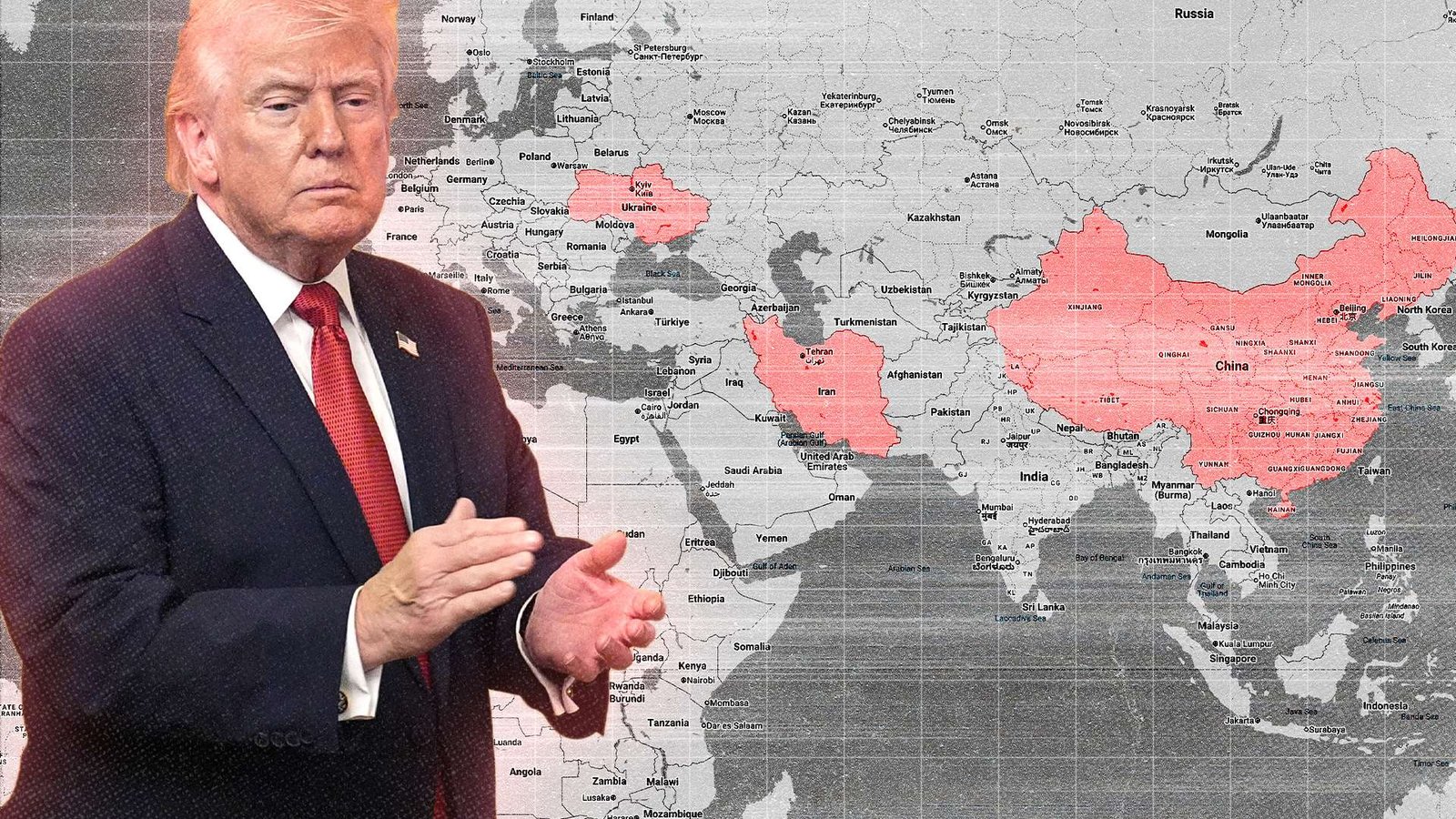
The Trump administration’s attempt to negotiate a settlement in Ukraine is a case in point. From the moment Trump campaigned for a second term, he has pointed to the war in Ukraine as the epitome of a feckless, wasteful U.S. foreign policy. Whether or not one believes this assertion, it motivated Trump to push for a diplomatic endgame to the yearslong war. Those efforts have had little success. Despite at least 1.1 million Russian casualties over four years of the war, Russian President Vladimir Putin still believes he can subjugate Ukraine by force.
Trump’s attempt to manage the consequences of the Iran war is adding another wrinkle to his diplomatic goals in Ukraine. Tehran’s decision to retaliate by targeting the Middle East’s oil supply has caused the biggest tremor in the oil market to date. The International Energy Agency assesses that global supply is projected to lose 8 million barrels of oil per day this month, a consequence of countries like Iraq, the United Arab Emirates, and Kuwait slashing their own production due to a lack of storage space. Concerned about fuel price increases during an election year, the Trump administration is seeking to do whatever it can to tamp down some of the supply disruptions. One of those measures includes allowing buyers to purchase Russian oil, which was previously sanctioned.
For the Trump administration, this temporary move is necessary to ensure stability for consumers. For Putin, the sanctions waiver is a gift that could not come at a better time. Russia’s oil revenue, which finances approximately 25 percent of Russia’s budget, declined by a quarter last year as Washington and its European allies toughened enforcement against Moscow’s so-called “shadow fleet” of unregistered oil tankers. Yet with the oil market squeezed and U.S. policymakers scrambling to reduce prices, Putin is breathing a little easier. Russia could now earn an additional $150 million a day thanks to the Treasury Department’s new rules, which over a 30-day span could net it another $4.5 billion. And with more cash on hand to pay for the war, Putin’s incentives for cooperating in any Trump-facilitated peace process are even lower than they would normally be. Trump, in other words, has in effect sacrificed his Ukraine peace initiative to fight a conflict whose objectives and time frame are open-ended.
Europe is not the only area of the world where Trump’s foreign policy agenda is feeling the heat. Far from weakening Chinese power in the Middle East or hurting Beijing’s ability to force Taiwan’s reunification with the mainland, as some analysts have argued, the war with Iran is disrupting Washington’s China policy.
This was exhibited most clearly in Trump postponing his summit with Chinese President Xi Jinping. At first, Trump implied his visit to China this month might be called off if Beijing refused to heed his demands for Chinese assistance in reopening the Strait of Hormuz. While the administration has since played down the notion of a link, the fact that Trump’s high-stakes summit will have to wait until another day is indicative of just how distracted Washington presently is in the Middle East, a region the president and many of his senior national security advisers have long sought to deprioritize in U.S. grand strategy.
Now, the precise opposite is occurring. The U.S. military currently boasts the largest presence in the Middle East since the 2003 Iraq War, and the region is soaking up the bulk of the U.S. foreign policy apparatus to the detriment of other priorities. One estimate finds that more than 40 percent of the U.S. Navy’s working ships are currently stationed in the Middle East, including an aircraft carrier as well as dozens of fighter and bomber aircraft and high-precision munitions that would normally be reserved for a potential wartime contingency in East Asia. Even more warships will be tied down if the administration elects to seize Kharg Island and clear the Strait of Hormuz militarily or opts to escort civilian tankers.
Some U.S. air defense systems are being rerouted from South Korea as well, causing public consternation in Seoul and raising questions in the minds of South Korean officials about Washington’s commitment to the alliance. The U.S. National Security Strategy, unveiled in November, which outlined the necessity of maintaining a favorable balance of power in Asia to deter China in the First Island Chain, now seems like a mere aspiration. More U.S. military hardware and personnel are headed to the Persian Gulf; a Marine Expeditionary Unit of 2,500 Marines will soon be in place, raising speculation about various scenarios, including a possible U.S. seizure of Iranian territory.
Viewed from Beijing, none of these moves is especially worrisome. In fact, they’re applauded. The longer the U.S. military is bogged down in the Middle East, the less time, attention, and resources it can bestow on China’s near-abroad. The U.S. military may be the world’s most superior, but it still has limits and can’t possibly be everywhere at all times. For Chinese defense planners, having a growing number of U.S. defense assets in the Persian Gulf is a better alternative than seeing them stationed in the South China Sea.
Nor is Xi likely concerned about Trump’s postponement of the summit. After all, the delay will provide China with more time to prepare an agenda on its terms. Trump groveling for Chinese aid in the Strait of Hormuz, which Beijing has already ruled out, is likely causing chuckles within the Chinese Communist Party too. It was only last year when the Trump administration tried to pressure Saudi Arabia to cut investment ties with China in return for a stronger U.S. security guarantee. Now, that very same administration is begging China to become more involved in the region.
Policy should be judged solely by results. Using this as a benchmark, Trump’s gamble with Iran is still waiting for a verdict. However, the initial signs—strategic distraction, a mismatch of priorities, and poor diplomatic prospects—don’t look promising.
Read the full article here
Fact Checker
Verify the accuracy of this article using AI-powered analysis and real-time sources.