

 Freedom Index
Listen to the article
A small logging contractor in upstate New York had a truck empty and needed someone with experience, and I needed a job. At that point I’d been trucking for nearly 20 years in four different countries and had done a fair bit of logging. It seemed like a natural pairing, and when I went to meet the man behind this small outfit—we’ll call him Travis—he expressed optimism.
“I think you’ll like this old Kenworth we’ve got here,” said Travis. “My uncle was driving it until he got sick, and we’ve been having a hell of a time finding a decent driver for it. The last two clowns we had didn’t work out: One guy wouldn’t show up for work every day—I think he might have been a meth-head—and the other guy kept running into shit and breaking things.”
The unit happened to have a load on it, and I offered to run it to whatever mill the wood was bound for.
“Nah, let’s go for a little drive around the neighborhood with it on. I can’t take it anywhere yet, but it will work for now to let me see you handle a load.”
So away we went. Driving along, moving through the gears with the grace and oneness with the machine I had developed over two decades of driving, I discussed with Travis my experiences; the differences between the United States, Australia, and my original home of Canada; and the nuances of harvesting softwood lumber in New Zealand vs. harvesting the hardwoods most of the Northeast U.S. is known for. After a while, we returned to his yard and parked the truck.
“When should I book you for a pee test?” asked Travis.
“I mean, I can go whenever you like. We haven’t discussed any other terms or money or anything though.”
“I’ll have a discussion with my business partner about that this evening, and in the meantime, I can get you in for a urine test tomorrow morning. Sound good?”
I agreed and left it at that.
The next day, as I was heading to a clinic to “produce a sample,” my phone rang. It was Travis.
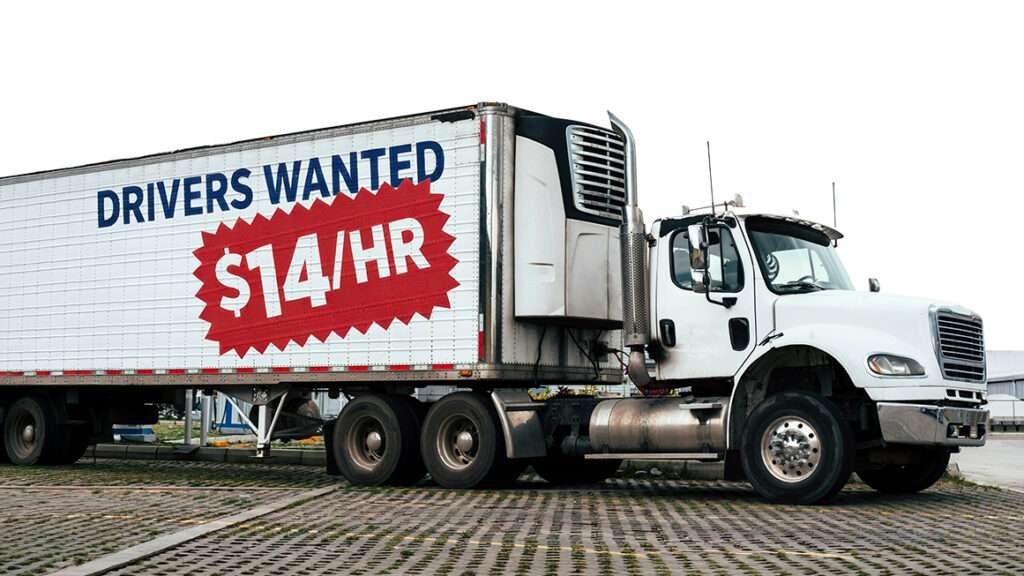
“My partner and I have decided we can start you at $14 an hour and revisit this number in the new year.”
It took me quite a bit of restraint to not burst out laughing.
“Um, no offense, sir, but that’s not enough. I’m making $16 an hour cash under the table now helping my contractor buddy schlep gear and run a chop box. I have to be able to at least move laterally, not backward.”
“Well, what did you expect? You’re just a truck driver. We can revisit in the new year, but I can’t pay you more than $14.”
“Sir, with all due respect, I just got back from driving road trains in Australia and I was being paid $42 an hour down there. I have 20 years of experience, and that has to count for something.”
“You could have been making all of that up.”
Despite sending this guy a full list of references, emails, and phone numbers of previous employers, and photos of rigs I had driven, this was the offer I got to work at one of the most dangerous and economically critical jobs in the country. It was less than the “Fight for $15” minimum wage envisioned by my Bernie-supporting in-laws. I couldn’t believe what I was hearing.
“Well, thanks anyway. And now you know why the last two guys you had didn’t work out—$14 an hour doesn’t buy what you want it to buy. Good luck.”
This gentleman wasn’t an anomaly. A local gravel quarry that had its own dump trucks and flatbeds for local work was also advertising for drivers. I went to see them, did the drive with one of their old boys, and a few days later got a call.
“Hi there. So we are prepared to offer you $18 an hour as our special summer seasonal rate, but if you stick around and go full-time in the fall, that drops to $15.”
Again, I had to fight back laughter.
“Ma’am, it’s awfully difficult to raise a family on the money you guys are offering.”
“It is what it is. We usually hire old guys who are retired from driving snowplows or construction for the county or [New York State Department of Transportation] who already have a pension and are just trying to keep busy and out of the house.”
Something about my experiences here didn’t make sense.
For years we have been told that the American economy is at risk of total collapse if the American Trucking Associations (ATA) can’t find another 60,000 or 70,000 or 160,000 truckers. If there were an actual shortage of truckers, trucking companies wouldn’t get away with barely paying minimum wage, would they? If the market for drivers were this hot and this desperate, maybe a guy with two decades of experience and a near-perfect driving record would get offers more befitting his profile? In a properly functioning market economy, wouldn’t the shortage boost the price of truckers’ labor a little higher than what one might expect at a fast-food restaurant? What are we missing here?
After the Motor Carrier Act of 1980, under the pressure of increased competition, companies sliced driver salaries as a belt-tightening strategy. Many drivers chose greener pastures as a result, and for a brief period in the 1980s there may actually have been a shortage of truckers. But now?
The ATA is a corporate lobby that claims to represent the interests of massive trucking companies with thousands of trucks. It really represents the interests of the customers of those large carriers—nearly every corporation in America that produces material product. The ATA does not represent a single truck driver, anywhere.
When the ATA hit on the phrase truck driver shortage, it found a messaging tool that has helped them line their pockets with oodles of taxpayer money. In the process, it stymied wage growth—to the advantage of trucking-fleet owners and the Fortune 500 companies that are their customers.
***
In the wildly popular 1986 film Top Gun, one character says: “Maybe I can learn how to be a truck driver. Mav, you have the number of that truck-driving school we saw on TV?” Trucking was portrayed as a job of last resort, a place for washed-up fighter pilots, felons, and luckless losers.
But those truck-driving schools were a convenient method for large trucking companies to off-load the cost of training new recruits onto the taxpayer, if not onto the recruits themselves.
“The cost of training new drivers presents significant risk to firms if they cannot ensure that these drivers will remain with the company long enough to make the firm’s investment worthwhile,” wrote the sociologist Steve Viscelli in his landmark 2016 investigation The Big Rig. “In 2007 Ray Kuntz, then president of the ATA, said that the ‘biggest problem our industry has always faced is training new drivers.’ As ATA president, Kuntz sought to defray the cost to carriers of training drivers by seeking more state and federal funding, such as the $315,000 grant his own firm received in 2007 from the Montana Department of Commerce to train sixty-three new drivers.”
Three hundred thousand and change doled out to one company might not sound like much, but an entire system of stealth corporate welfare masked as a jobs program has sprung up around the training of new truckers. And its cost is in the tens if not hundreds of millions of dollars annually.
Scratch beneath the surface of the ad copy for any truck-driver training school or retraining program, and the government grants and subsidies become immediately apparent. From funds doled out by the Workforce Innovation and Opportunity Act to Pell Grants to $47 million in extra funding from the Biden administration, the industry is awash in taxpayer largesse. Unless we recognize this corporate welfare program for exactly what it is, the money will continue to flow.
“Whether or not they operate a CDL [commercial driver’s license] school,” Viscelli wrote, “a few dozen large companies serve as gatekeepers for the industry’s labor force, because they are the only place new drivers can complete the last stages of training and initial employment.” That statement is not 100 percent correct—some rare small companies will get rookie drivers over the finish line—but the megacarriers are dominant, and the corporate welfare scam they are running imposes an artificial wage ceiling and particular standards on trucking as a whole.
If truckers want to know who is primarily to blame for their wages being stuck in the 1970s, look no further than the ATA and the taxpayer who pumps money into its capacious tank. And the taxpayer ought to ask about the bang for the buck he is getting from paying for all these CDLs, because America sure does produce a lot of them. In 2021, NPR reported that “state governments issue more than 450,000 new commercial driver’s licenses every year. A large fraction of those drivers enter the long-haul trucking industry.”
Depending on who you believe (the U.S. Census Bureau, the Bureau of Labor Statistics, or the ATA), the rough number of jobs requiring a CDL in the United States is about 3.5 million. Between 1.8 million and 2.2 million of those are truckers. Of the other 1.3 million jobs requiring a CDL, many are in local delivery or the types of jobs in which having a CDL is ancillary to the primary task: say, a job with an electrical utility that requires bucket trucks for tending to power lines or thinning trees. I’ve been told it’s difficult to capture single-truck owner-operators in any statistics outside of active CDLs.
For the sake of argument, let’s assume there are 2.5 million active truck driving jobs any given year. If the U.S. CDL training and license-issuing system produces roughly 450,000 CDLs a year, where are all these drivers going? The system produces 20 percent of the annual number of required CDLs annually. Are we completely replacing the entire trucking workforce every five years?
In 2019, economist Stephen V. Burks did a study with Kristen Monaco of the U.S. Bureau of Labor Statistics that demonstrated pretty conclusively that the market for truck drivers functions about as well as any other labor market. If prices rise to signal demand for drivers’ services, the market should respond. Burks and Monaco also found that the dysfunction in the trucking labor market is almost completely isolated to the long-haul truckload sector, where turnover is very high relative to other parts of trucking. And what do you know? That is the market whose players are represented by the ATA. “Surprisingly, the occupational attachment of truck drivers is actually a bit higher than that of some other blue-collar occupations,” write Burks and Monaco. “This finding suggests that the market for truck drivers works about as well as that for other blue-collar occupations, and that, broadly speaking, we should expect that if wages rise when the labor market for truck drivers is too tight, the potential for any long-term shortages will be ameliorated” (emphasis mine).
The large fleets that have captured a great deal of the American truckload market are not interested in raising wages or adjusting any of the Big Brother intrusiveness of the job. What they will do, and have done, is complain endlessly about a shortage of drivers and demand that the government do something to produce more of them. Many truckers fancy themselves believers in the free market, yet major players in their own industry have effectively allied with the state in a mass wage-suppression operation.
***
Viscelli, with co-author Eric Balcom, recently did another study to investigate why prices for shipping produce spiked in 2021. They put the “driver shortage” theory to bed, and in the process showed us that the trucking industry does nothing to retain good truckers while constantly begging the government for money to train new ones. They also found that the same old culprits were causing the problem: “We did not find evidence of a shortage of people interested in becoming truck drivers, but we did find strong evidence of a retention problem. That problem is concentrated in the long-haul segment of the industry.”
Most of the long-haul refrigerated truckers don’t stay. Viscelli concludes that the training money is wasted because the training programs start by throwing newbies off the deep end into long-haul trucking before they even know what they’re doing.
Even former Secretary of Transportation Pete Buttigieg admitted, “My department estimates that 300,000 people leave that career every year, and we just can’t afford that.”
Neither can the taxpayers, but we keep throwing money at this problem anyway, because as Viscelli has written elsewhere, “It is cheaper to keep churning through drivers than it is to pay them more.”
One interesting complaint in Viscelli and Balcom’s study was lodged by one of the shippers for whom it was written. “We are used to rates from California to New York of around $6,500 to $8,000,” the shipper said in 2021. “I swore I would never pay more than $10,000. But we are looking at $13,000 right now. We can’t stay competitive for long at that price.”
I guarantee you that not a single employee driver who worked for a company marking up its rates that much saw a penny of the extra $5,000 this guy was paying to move his stuff, and that right there is part of the problem. An owner-operator probably made out like a bandit, but one of these kids who works for a mega-fleet? Not a chance he saw any meaningful increase in pay during the COVID-19 pandemic, and certainly nothing reflective of what shippers were paying at the time. Cents-per-mile rates for company drivers are almost always locked in, especially at big fleets, where such things as bonuses, at least those derived from hot market conditions, are nonexistent.
Our friends at the ATA gave away their own dishonest game in a 2019 report. You have to dig into this tedious tome, but on page 6, footnote 10, we are given some interesting numbers to ponder: “Of the 7.8 million people employed throughout the economy in jobs related to trucking activity, 3.5 million were truck drivers in 2018. There are over 10 million CDL (Commercial Driver’s License) holders in the U.S., but most are not current drivers and not all are truck drivers.”
Could it be, maybe, that these millions of “not current drivers” were budding truckers that ATA members chewed up and spit out?
This article is adapted from End of the Road: Inside the War on Truckers by permission of Creed & Culture.
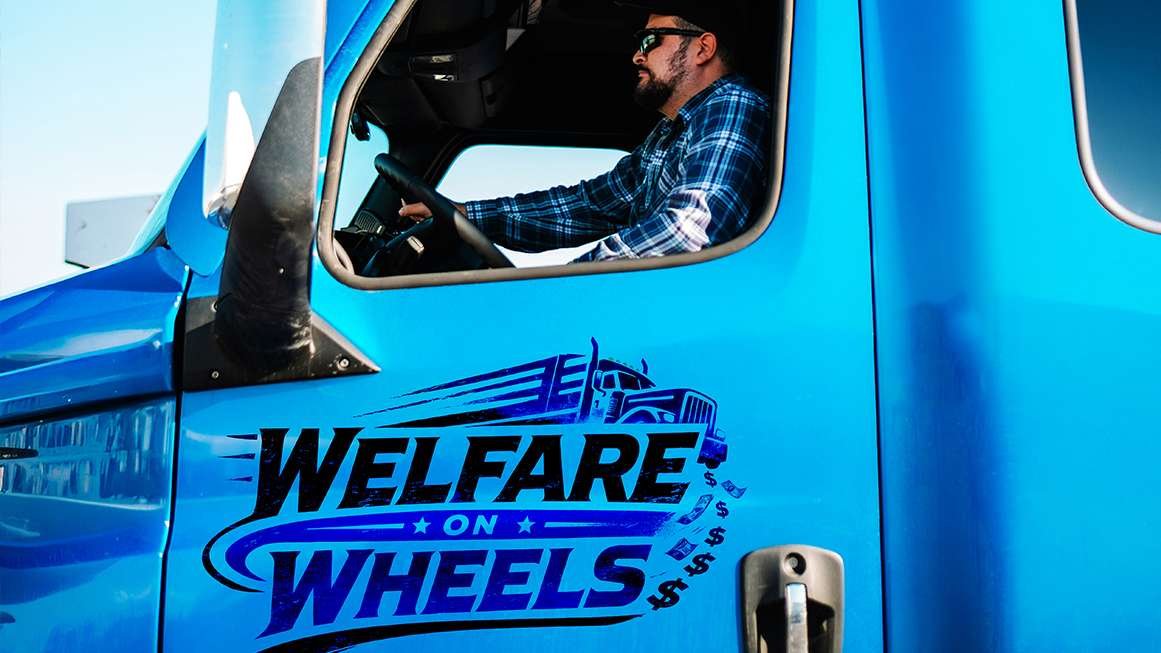
This article originally appeared in print under the headline “Welfare on Wheels.”
Read the full article here
Fact Checker
Verify the accuracy of this article using AI-powered analysis and real-time sources.