Close Menu
FSNN | Free Speech News NetworkFSNN | Free Speech News Network
  • Home
  • News
    • Politics
    • Legal & Courts
    • Tech & Big Tech
    • Campus & Education
    • Media & Culture
    • Global Free Speech
  • Opinions
    • Debates
  • Video/Live
  • Community
  • Freedom Index
  • About
    • Mission
    • Contact
    • Support
Trending

Bitcoin (BTC) funds capture $700 million as institutions place their bets: Crypto Daily

7 minutes ago

Ethics Remains Sticking Point as Crypto Market Structure Bill Goes to Senate Markup

19 minutes ago

Binance Says AI Defenses Blocked $10.5 Billion in Crypto Fraud Over 15 Months

20 minutes ago
Facebook X (Twitter) Instagram
Facebook X (Twitter) Discord Telegram
FSNN | Free Speech News NetworkFSNN | Free Speech News Network
Market Data Newsletter
Tuesday, May 12
  • Home
  • News
    • Politics
    • Legal & Courts
    • Tech & Big Tech
    • Campus & Education
    • Media & Culture
    • Global Free Speech
  • Opinions
    • Debates
  • Video/Live
  • Community
  • Freedom Index
  • About
    • Mission
    • Contact
    • Support
FSNN | Free Speech News NetworkFSNN | Free Speech News Network
Home»News»Global Free Speech»The Russian messenger app MAX has been castigated for its aggressive gathering of metadata and wide-ranging requests for permissions. Photo: Imago/Bode/Alamy The fifth year of Russia’s full-scale war against Ukraine grinds on, with its unvarying backdrop of devastated Ukrainian cities and extensive casualties among the non-combatant population. Meanwhile the Russian authorities exploit the war as justification for constantly tightening the screws of their repressive policies at home. In the last few years, criminal prosecutions for speaking out have become common, everyday occurrences. The definitions of “extremism” have become increasingly vague, and the pressure applied to the independent media and civil society initiatives has become systemic. Alongside these developments, another, less visible, but equally significant process has been gathering momentum: the restructuring of the digital environment in such a way as to induce people to modify their own behaviour themselves – frequently without even realising. Six months ago a law came into force in Russia making it an offence punishable by law to search for extremist materials online. This law, which was widely publicised in the media, functions as a “bogeyman”. That is, the security men’s little lamp won’t light up if you have entered “Navalny” in Google, but if they confiscate your computer and discover a search query like that in it, you can be charged with a crime. In the news, however, they don’t tell you about fine details like that. In the news they simply say that those who search for extremist materials online will be punished and that is what remains imprinted on people’s minds – that googling anything against the authorities is prohibited. For a long time, the Russian state’s approach to control of the internet was overt and unsubtle: ban a site, block a platform, restrict access. This didn’t work well. It annoyed people, provoked resistance and rapidly spawned solutions that bypassed restrictions. But in the fifth year of a war which, in regions under attack by drones, is accompanied by constant interruptions to mobile internet services, a solution has been found. Whitelisting. The implications of the whitelist model are simple: stable access is only assured to services approved in advance by the state. All the rest can operate, but with outages or restrictions, and without any guarantees. At the same time, Roscomnadzor (the Federal Supervisory Agency for Information and Communications Technologies) has decided to block calls via WhatsApp and Telegram – and this affects everybody. WhatsApp is the most popular messenger app in Russia, with 96 million users. People, especially the older generation, like it because it is simple. It’s good for everyday and family use, for off-the-cuff calling. Telegram is good for other things: it’s a connection to a field of information, news, politics and alternative points of view. They tried to block it as early as 2018, but when it became clear that direct prohibitions don’t work, the strategy changed. They no longer block apps completely but simply render them inconvenient. And to replace them they offer the “national messenger app” MAX. Celebrities who are loyal to the authorities advertise it on TV and urban billboards. “Great reception even in the car park,” a pro-government female rapper declares as she posts a MAX advertising video in stories, while the other apps beside it can no longer provide any access at all. MAX is rapidly becoming the compulsory communications channel in schools and nursery schools, universities and colleges, state and municipal institutions, as well as in “house chats” for residents of apartment blocks, facilitated by the management companies. Its introduction is only rarely achieved by means of public command: in most instances it is a case of word-of-mouth instructions and surreptitious pressure – from warnings about “unpleasantness” to threats of disciplinary reprimands or dismissal. MAX is whitelisted by definition. It is stable in situations where other applications are “temporarily unavailable”. MAX has to be preinstalled on all the mobile devices offered for sale in the country. But MAX is not attempting to become everyone’s “favourite” all at once. It is enough for it to become compulsory. There is no attempt to persuade people – they are simply transferred under the pretext of “convenience”. MAX’s most crucial characteristic is its profound integration with the platform Gosuslugi (State Services). This is an individual’s digital profile: passport, taxes, fines, medical record, welfare payments. MAX can be used to confirm a person’s identity or age, and it can be used as a digital document – for instance when purchasing alcohol. This changes the very nature of the messenger app. It ceases to be a space for networking and socialising and becomes part of an ID system. MAX’s very interface suggests that it is the Russian equivalent of the Chinese app WeChat. The Russian authorities are looking to China more and more nowadays – not as a model that can be copied point for point, but as proof that control can be built into everyday reality. The Chinese system doesn’t work by means of incessant prohibitions, but by virtue of people’s habituation to limits. They know in advance what the boundaries are and they act within them. And Russia’s digital policy is gradually leading people in the same direction. However, WeChat was never designated a “national messenger app”, and people were not herded into it by the threat of being sacked: it defeated the competition on its own terms – thanks to its convenience, ecosystem of services and the early effect of scale. Initially it was simply a messenger app, then a payment instrument, and then a portal to municipal amenities, the media, taxis and state services. The process of habituation was organic, and the infrastructure of control was only constructed around already familiar elements. MAX was immediately castigated for its aggressive gathering of metadata and wide-ranging requests for permissions – access to contacts, photos, call history, screen – and the absence of end-to-end encryption (E2EE) by default: this means that all messages are saved on servers in readable form, creating the risk of their being accessed by third parties or state agencies. But it is not the technical details that are most important. The most important thing is the effect: the individual becomes accustomed to the idea that risk, not privacy, is the norm. That it is safer not to discuss anything superfluous. That it is simpler not to ask questions. In this way a new model of social behaviour is taking shape. Despite the official declarations, MAX has not become massively popular by choice. People use it because they need to. Because otherwise it’s impossible to manage. This is a fundamental difference from messenger apps that have become integrated into life in an organic fashion. And this is the point at which the most disturbing question of all arises. The war might come to an end, but will the blocking of the mobile internet also end? An infrastructure of social control is rarely temporary. When public money has been invested in it, when it has been built into schools, state institutions and people’s everday activities, it starts living a life of its own. New justifications for it will always be found: security, stability, new threats. Not coercion, but habituation. When social interaction becomes cautious, there is no longer any need for constant intervention by the censor. Censorship is already built into daily life. In this sense, what is happening now resembles ever more closely Michel Foucault’s theory of the Panopticon – an “open prison” in which control is effected, not by means of constant surveillance, but by the possibility of surveillance. Individuals do not need to know that they are being observed at this moment. It is sufficient for them to be uncertain whether they are. In this system the walls become invisible and discipline becomes internal. A digital infrastructure organised.around whitelists, identification and unstable means of communication reproduces precisely the same logic:  individuals start behaving cautiously, not because they are being punished, but because it’s simply safer that way. It is also important to note that this behaviour does not remain within the ambit of the application. It is inevitably extrapolated to life offline – to conversations in public spaces, to spontaneous discussion, to the way in which people speak out loud. When communication in digital space becomes cautious and functional, the same model is gradually carried over into ordinary life. The open prison has no need of bars or guards: it inculcates the habit of self-limitation. And that is precisely why such systems remain stable long after the formal reason for their appearance disappears. READ MORE
Global Free Speech

The Russian messenger app MAX has been castigated for its aggressive gathering of metadata and wide-ranging requests for permissions. Photo: Imago/Bode/Alamy The fifth year of Russia’s full-scale war against Ukraine grinds on, with its unvarying backdrop of devastated Ukrainian cities and extensive casualties among the non-combatant population. Meanwhile the Russian authorities exploit the war as justification for constantly tightening the screws of their repressive policies at home. In the last few years, criminal prosecutions for speaking out have become common, everyday occurrences. The definitions of “extremism” have become increasingly vague, and the pressure applied to the independent media and civil society initiatives has become systemic. Alongside these developments, another, less visible, but equally significant process has been gathering momentum: the restructuring of the digital environment in such a way as to induce people to modify their own behaviour themselves – frequently without even realising. Six months ago a law came into force in Russia making it an offence punishable by law to search for extremist materials online. This law, which was widely publicised in the media, functions as a “bogeyman”. That is, the security men’s little lamp won’t light up if you have entered “Navalny” in Google, but if they confiscate your computer and discover a search query like that in it, you can be charged with a crime. In the news, however, they don’t tell you about fine details like that. In the news they simply say that those who search for extremist materials online will be punished and that is what remains imprinted on people’s minds – that googling anything against the authorities is prohibited. For a long time, the Russian state’s approach to control of the internet was overt and unsubtle: ban a site, block a platform, restrict access. This didn’t work well. It annoyed people, provoked resistance and rapidly spawned solutions that bypassed restrictions. But in the fifth year of a war which, in regions under attack by drones, is accompanied by constant interruptions to mobile internet services, a solution has been found. Whitelisting. The implications of the whitelist model are simple: stable access is only assured to services approved in advance by the state. All the rest can operate, but with outages or restrictions, and without any guarantees. At the same time, Roscomnadzor (the Federal Supervisory Agency for Information and Communications Technologies) has decided to block calls via WhatsApp and Telegram – and this affects everybody. WhatsApp is the most popular messenger app in Russia, with 96 million users. People, especially the older generation, like it because it is simple. It’s good for everyday and family use, for off-the-cuff calling. Telegram is good for other things: it’s a connection to a field of information, news, politics and alternative points of view. They tried to block it as early as 2018, but when it became clear that direct prohibitions don’t work, the strategy changed. They no longer block apps completely but simply render them inconvenient. And to replace them they offer the “national messenger app” MAX. Celebrities who are loyal to the authorities advertise it on TV and urban billboards. “Great reception even in the car park,” a pro-government female rapper declares as she posts a MAX advertising video in stories, while the other apps beside it can no longer provide any access at all. MAX is rapidly becoming the compulsory communications channel in schools and nursery schools, universities and colleges, state and municipal institutions, as well as in “house chats” for residents of apartment blocks, facilitated by the management companies. Its introduction is only rarely achieved by means of public command: in most instances it is a case of word-of-mouth instructions and surreptitious pressure – from warnings about “unpleasantness” to threats of disciplinary reprimands or dismissal. MAX is whitelisted by definition. It is stable in situations where other applications are “temporarily unavailable”. MAX has to be preinstalled on all the mobile devices offered for sale in the country. But MAX is not attempting to become everyone’s “favourite” all at once. It is enough for it to become compulsory. There is no attempt to persuade people – they are simply transferred under the pretext of “convenience”. MAX’s most crucial characteristic is its profound integration with the platform Gosuslugi (State Services). This is an individual’s digital profile: passport, taxes, fines, medical record, welfare payments. MAX can be used to confirm a person’s identity or age, and it can be used as a digital document – for instance when purchasing alcohol. This changes the very nature of the messenger app. It ceases to be a space for networking and socialising and becomes part of an ID system. MAX’s very interface suggests that it is the Russian equivalent of the Chinese app WeChat. The Russian authorities are looking to China more and more nowadays – not as a model that can be copied point for point, but as proof that control can be built into everyday reality. The Chinese system doesn’t work by means of incessant prohibitions, but by virtue of people’s habituation to limits. They know in advance what the boundaries are and they act within them. And Russia’s digital policy is gradually leading people in the same direction. However, WeChat was never designated a “national messenger app”, and people were not herded into it by the threat of being sacked: it defeated the competition on its own terms – thanks to its convenience, ecosystem of services and the early effect of scale. Initially it was simply a messenger app, then a payment instrument, and then a portal to municipal amenities, the media, taxis and state services. The process of habituation was organic, and the infrastructure of control was only constructed around already familiar elements. MAX was immediately castigated for its aggressive gathering of metadata and wide-ranging requests for permissions – access to contacts, photos, call history, screen – and the absence of end-to-end encryption (E2EE) by default: this means that all messages are saved on servers in readable form, creating the risk of their being accessed by third parties or state agencies. But it is not the technical details that are most important. The most important thing is the effect: the individual becomes accustomed to the idea that risk, not privacy, is the norm. That it is safer not to discuss anything superfluous. That it is simpler not to ask questions. In this way a new model of social behaviour is taking shape. Despite the official declarations, MAX has not become massively popular by choice. People use it because they need to. Because otherwise it’s impossible to manage. This is a fundamental difference from messenger apps that have become integrated into life in an organic fashion. And this is the point at which the most disturbing question of all arises. The war might come to an end, but will the blocking of the mobile internet also end? An infrastructure of social control is rarely temporary. When public money has been invested in it, when it has been built into schools, state institutions and people’s everday activities, it starts living a life of its own. New justifications for it will always be found: security, stability, new threats. Not coercion, but habituation. When social interaction becomes cautious, there is no longer any need for constant intervention by the censor. Censorship is already built into daily life. In this sense, what is happening now resembles ever more closely Michel Foucault’s theory of the Panopticon – an “open prison” in which control is effected, not by means of constant surveillance, but by the possibility of surveillance. Individuals do not need to know that they are being observed at this moment. It is sufficient for them to be uncertain whether they are. In this system the walls become invisible and discipline becomes internal. A digital infrastructure organised.around whitelists, identification and unstable means of communication reproduces precisely the same logic:  individuals start behaving cautiously, not because they are being punished, but because it’s simply safer that way. It is also important to note that this behaviour does not remain within the ambit of the application. It is inevitably extrapolated to life offline – to conversations in public spaces, to spontaneous discussion, to the way in which people speak out loud. When communication in digital space becomes cautious and functional, the same model is gradually carried over into ordinary life. The open prison has no need of bars or guards: it inculcates the habit of self-limitation. And that is precisely why such systems remain stable long after the formal reason for their appearance disappears. READ MORE

News RoomBy News Room2 months agoNo Comments8 Mins Read1,999 Views
Share Facebook Twitter Pinterest Copy Link LinkedIn Tumblr Email VKontakte Telegram
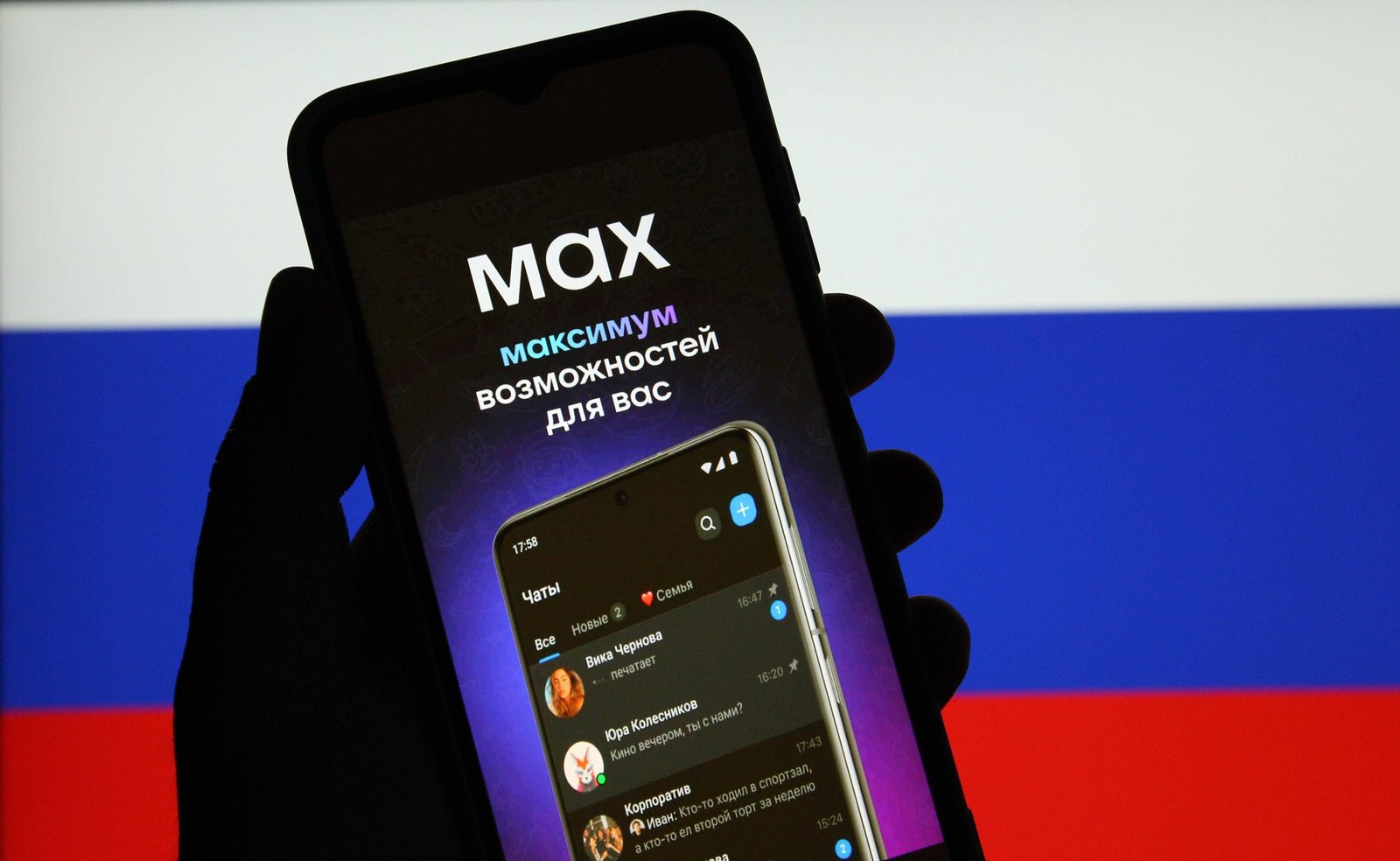
The Russian messenger app MAX has been castigated for its aggressive gathering of metadata and wide-ranging requests for permissions. Photo: Imago/Bode/Alamy 


				The fifth year of Russia’s full-scale war against Ukraine grinds on, with its unvarying backdrop of devastated Ukrainian cities and extensive casualties among the non-combatant population. Meanwhile the Russian authorities exploit the war as justification for constantly tightening the screws of their repressive policies at home.
In the last few years, criminal prosecutions for speaking out have become common, everyday occurrences. The definitions of “extremism” have become increasingly vague, and the pressure applied to the independent media and civil society initiatives has become systemic. Alongside these developments, another, less visible, but equally significant process has been gathering momentum: the restructuring of the digital environment in such a way as to induce people to modify their own behaviour themselves – frequently without even realising.
Six months ago a law came into force in Russia making it an offence punishable by law to search for extremist materials online. This law, which was widely publicised in the media, functions as a “bogeyman”. That is, the security men’s little lamp won’t light up if you have entered “Navalny” in Google, but if they confiscate your computer and discover a search query like that in it, you can be charged with a crime. In the news, however, they don’t tell you about fine details like that. In the news they simply say that those who search for extremist materials online will be punished and that is what remains imprinted on people’s minds – that googling anything against the authorities is prohibited.
For a long time, the Russian state’s approach to control of the internet was overt and unsubtle: ban a site, block a platform, restrict access. This didn’t work well. It annoyed people, provoked resistance and rapidly spawned solutions that bypassed restrictions.
But in the fifth year of a war which, in regions under attack by drones, is accompanied by constant interruptions to mobile internet services, a solution has been found. Whitelisting. The implications of the whitelist model are simple: stable access is only assured to services approved in advance by the state. All the rest can operate, but with outages or restrictions, and without any guarantees.
At the same time, Roscomnadzor (the Federal Supervisory Agency for Information and Communications Technologies) has decided to block calls via WhatsApp and Telegram – and this affects everybody. WhatsApp is the most popular messenger app in Russia, with 96 million users. People, especially the older generation, like it because it is simple. It’s good for everyday and family use, for off-the-cuff calling. Telegram is good for other things: it’s a connection to a field of information, news, politics and alternative points of view. They tried to block it as early as 2018, but when it became clear that direct prohibitions don’t work, the strategy changed. They no longer block apps completely but simply render them inconvenient. And to replace them they offer the “national messenger app” MAX. Celebrities who are loyal to the authorities advertise it on TV and urban billboards. “Great reception even in the car park,” a pro-government female rapper declares as she posts a MAX advertising video in stories, while the other apps beside it can no longer provide any access at all.
MAX is rapidly becoming the compulsory communications channel in schools and nursery schools, universities and colleges, state and municipal institutions, as well as in “house chats” for residents of apartment blocks, facilitated by the management companies. Its introduction is only rarely achieved by means of public command: in most instances it is a case of word-of-mouth instructions and surreptitious pressure – from warnings about “unpleasantness” to threats of disciplinary reprimands or dismissal.
MAX is whitelisted by definition. It is stable in situations where other applications are “temporarily unavailable”. MAX has to be preinstalled on all the mobile devices offered for sale in the country. But MAX is not attempting to become everyone’s “favourite” all at once. It is enough for it to become compulsory. There is no attempt to persuade people – they are simply transferred under the pretext of “convenience”.
MAX’s most crucial characteristic is its profound integration with the platform Gosuslugi (State Services). This is an individual’s digital profile: passport, taxes, fines, medical record, welfare payments. MAX can be used to confirm a person’s identity or age, and it can be used as a digital document – for instance when purchasing alcohol. This changes the very nature of the messenger app. It ceases to be a space for networking and socialising and becomes part of an ID system.
MAX’s very interface suggests that it is the Russian equivalent of the Chinese app WeChat. The Russian authorities are looking to China more and more nowadays – not as a model that can be copied point for point, but as proof that control can be built into everyday reality. The Chinese system doesn’t work by means of incessant prohibitions, but by virtue of people’s habituation to limits. They know in advance what the boundaries are and they act within them. And Russia’s digital policy is gradually leading people in the same direction.
However, WeChat was never designated a “national messenger app”, and people were not herded into it by the threat of being sacked: it defeated the competition on its own terms – thanks to its convenience, ecosystem of services and the early effect of scale. Initially it was simply a messenger app, then a payment instrument, and then a portal to municipal amenities, the media, taxis and state services. The process of habituation was organic, and the infrastructure of control was only constructed around already familiar elements.
MAX was immediately castigated for its aggressive gathering of metadata and wide-ranging requests for permissions – access to contacts, photos, call history, screen – and the absence of end-to-end encryption (E2EE) by default: this means that all messages are saved on servers in readable form, creating the risk of their being accessed by third parties or state agencies.
But it is not the technical details that are most important. The most important thing is the effect: the individual becomes accustomed to the idea that risk, not privacy, is the norm. That it is safer not to discuss anything superfluous. That it is simpler not to ask questions. In this way a new model of social behaviour is taking shape.
Despite the official declarations, MAX has not become massively popular by choice. People use it because they need to. Because otherwise it’s impossible to manage. This is a fundamental difference from messenger apps that have become integrated into life in an organic fashion.
And this is the point at which the most disturbing question of all arises. The war might come to an end, but will the blocking of the mobile internet also end? An infrastructure of social control is rarely temporary. When public money has been invested in it, when it has been built into schools, state institutions and people’s everday activities, it starts living a life of its own. New justifications for it will always be found: security, stability, new threats. Not coercion, but habituation. When social interaction becomes cautious, there is no longer any need for constant intervention by the censor. Censorship is already built into daily life.
In this sense, what is happening now resembles ever more closely Michel Foucault’s theory of the Panopticon – an “open prison” in which control is effected, not by means of constant surveillance, but by the possibility of surveillance. Individuals do not need to know that they are being observed at this moment. It is sufficient for them to be uncertain whether they are. In this system the walls become invisible and discipline becomes internal. A digital infrastructure organised.around whitelists, identification and unstable means of communication reproduces precisely the same logic:  individuals start behaving cautiously, not because they are being punished, but because it’s simply safer that way.
It is also important to note that this behaviour does not remain within the ambit of the application. It is inevitably extrapolated to life offline – to conversations in public spaces, to spontaneous discussion, to the way in which people speak out loud. When communication in digital space becomes cautious and functional, the same model is gradually carried over into ordinary life. The open prison has no need of bars or guards: it inculcates the habit of self-limitation. And that is precisely why such systems remain stable long after the formal reason for their appearance disappears.


				READ MORE
Share
Facebook Twitter Pinterest Email Copy Link

Listen to the article

0:00
0:00

Key Takeaways

Playback Speed

Select a Voice

The fifth year of Russia’s full-scale war against Ukraine grinds on, with its unvarying backdrop of devastated Ukrainian cities and extensive casualties among the non-combatant population. Meanwhile the Russian authorities exploit the war as justification for constantly tightening the screws of their repressive policies at home.

In the last few years, criminal prosecutions for speaking out have become common, everyday occurrences. The definitions of “extremism” have become increasingly vague, and the pressure applied to the independent media and civil society initiatives has become systemic. Alongside these developments, another, less visible, but equally significant process has been gathering momentum: the restructuring of the digital environment in such a way as to induce people to modify their own behaviour themselves – frequently without even realising.

Six months ago a law came into force in Russia making it an offence punishable by law to search for extremist materials online. This law, which was widely publicised in the media, functions as a “bogeyman”. That is, the security men’s little lamp won’t light up if you have entered “Navalny” in Google, but if they confiscate your computer and discover a search query like that in it, you can be charged with a crime. In the news, however, they don’t tell you about fine details like that. In the news they simply say that those who search for extremist materials online will be punished and that is what remains imprinted on people’s minds – that googling anything against the authorities is prohibited.

For a long time, the Russian state’s approach to control of the internet was overt and unsubtle: ban a site, block a platform, restrict access. This didn’t work well. It annoyed people, provoked resistance and rapidly spawned solutions that bypassed restrictions.

But in the fifth year of a war which, in regions under attack by drones, is accompanied by constant interruptions to mobile internet services, a solution has been found. Whitelisting. The implications of the whitelist model are simple: stable access is only assured to services approved in advance by the state. All the rest can operate, but with outages or restrictions, and without any guarantees.

At the same time, Roscomnadzor (the Federal Supervisory Agency for Information and Communications Technologies) has decided to block calls via WhatsApp and Telegram – and this affects everybody. WhatsApp is the most popular messenger app in Russia, with 96 million users. People, especially the older generation, like it because it is simple. It’s good for everyday and family use, for off-the-cuff calling. Telegram is good for other things: it’s a connection to a field of information, news, politics and alternative points of view. They tried to block it as early as 2018, but when it became clear that direct prohibitions don’t work, the strategy changed. They no longer block apps completely but simply render them inconvenient. And to replace them they offer the “national messenger app” MAX. Celebrities who are loyal to the authorities advertise it on TV and urban billboards. “Great reception even in the car park,” a pro-government female rapper declares as she posts a MAX advertising video in stories, while the other apps beside it can no longer provide any access at all.

MAX is rapidly becoming the compulsory communications channel in schools and nursery schools, universities and colleges, state and municipal institutions, as well as in “house chats” for residents of apartment blocks, facilitated by the management companies. Its introduction is only rarely achieved by means of public command: in most instances it is a case of word-of-mouth instructions and surreptitious pressure – from warnings about “unpleasantness” to threats of disciplinary reprimands or dismissal.

MAX is whitelisted by definition. It is stable in situations where other applications are “temporarily unavailable”. MAX has to be preinstalled on all the mobile devices offered for sale in the country. But MAX is not attempting to become everyone’s “favourite” all at once. It is enough for it to become compulsory. There is no attempt to persuade people – they are simply transferred under the pretext of “convenience”.

MAX’s most crucial characteristic is its profound integration with the platform Gosuslugi (State Services). This is an individual’s digital profile: passport, taxes, fines, medical record, welfare payments. MAX can be used to confirm a person’s identity or age, and it can be used as a digital document – for instance when purchasing alcohol. This changes the very nature of the messenger app. It ceases to be a space for networking and socialising and becomes part of an ID system.

MAX’s very interface suggests that it is the Russian equivalent of the Chinese app WeChat. The Russian authorities are looking to China more and more nowadays – not as a model that can be copied point for point, but as proof that control can be built into everyday reality. The Chinese system doesn’t work by means of incessant prohibitions, but by virtue of people’s habituation to limits. They know in advance what the boundaries are and they act within them. And Russia’s digital policy is gradually leading people in the same direction.

However, WeChat was never designated a “national messenger app”, and people were not herded into it by the threat of being sacked: it defeated the competition on its own terms – thanks to its convenience, ecosystem of services and the early effect of scale. Initially it was simply a messenger app, then a payment instrument, and then a portal to municipal amenities, the media, taxis and state services. The process of habituation was organic, and the infrastructure of control was only constructed around already familiar elements.

MAX was immediately castigated for its aggressive gathering of metadata and wide-ranging requests for permissions – access to contacts, photos, call history, screen – and the absence of end-to-end encryption (E2EE) by default: this means that all messages are saved on servers in readable form, creating the risk of their being accessed by third parties or state agencies.

But it is not the technical details that are most important. The most important thing is the effect: the individual becomes accustomed to the idea that risk, not privacy, is the norm. That it is safer not to discuss anything superfluous. That it is simpler not to ask questions. In this way a new model of social behaviour is taking shape.

Despite the official declarations, MAX has not become massively popular by choice. People use it because they need to. Because otherwise it’s impossible to manage. This is a fundamental difference from messenger apps that have become integrated into life in an organic fashion.

And this is the point at which the most disturbing question of all arises. The war might come to an end, but will the blocking of the mobile internet also end? An infrastructure of social control is rarely temporary. When public money has been invested in it, when it has been built into schools, state institutions and people’s everday activities, it starts living a life of its own. New justifications for it will always be found: security, stability, new threats. Not coercion, but habituation. When social interaction becomes cautious, there is no longer any need for constant intervention by the censor. Censorship is already built into daily life.

In this sense, what is happening now resembles ever more closely Michel Foucault’s theory of the Panopticon – an “open prison” in which control is effected, not by means of constant surveillance, but by the possibility of surveillance. Individuals do not need to know that they are being observed at this moment. It is sufficient for them to be uncertain whether they are. In this system the walls become invisible and discipline becomes internal. A digital infrastructure organised.around whitelists, identification and unstable means of communication reproduces precisely the same logic:  individuals start behaving cautiously, not because they are being punished, but because it’s simply safer that way.

It is also important to note that this behaviour does not remain within the ambit of the application. It is inevitably extrapolated to life offline – to conversations in public spaces, to spontaneous discussion, to the way in which people speak out loud. When communication in digital space becomes cautious and functional, the same model is gradually carried over into ordinary life. The open prison has no need of bars or guards: it inculcates the habit of self-limitation. And that is precisely why such systems remain stable long after the formal reason for their appearance disappears.

Read the full article here

Fact Checker

Verify the accuracy of this article using AI-powered analysis and real-time sources.

Get Your Fact Check Report

Enter your email to receive detailed fact-checking analysis

5 free reports remaining

Continue with Full Access

You've used your 5 free reports. Sign up for unlimited access!

Already have an account? Sign in here

Share. Facebook Twitter Pinterest LinkedIn Tumblr Email Telegram Copy Link
News Room
  • Website
  • Facebook
  • X (Twitter)
  • Instagram
  • LinkedIn

The FSNN News Room is the voice of our in-house journalists, editors, and researchers. We deliver timely, unbiased reporting at the crossroads of finance, cryptocurrency, and global politics, providing clear, fact-driven analysis free from agendas.

Related Articles

Global Free Speech

Bukele administration freezes Salvadoran news outlet’s assets in latest act of retaliation

3 days ago
Global Free Speech

Colombian journalist reported missing following capture by rebels

3 days ago
Global Free Speech

Daughter of murdered Serbian journalist Slavko Ćuruvija on her 27-year fight for justice

3 days ago
Global Free Speech

Tunisia court sentences journalist Zied el-Heni to 1 year in prison

3 days ago
Global Free Speech

Rwandan YouTuber dies of alleged overdose on day of release from prison

4 days ago
Global Free Speech

Narges Mohammadi, Iranian human rights defender and 2023 Nobel Peace Prize winner I pray that when you read this Narges Mohammadi is still alive. The Nobel Peace Prize winner is currently in an Iranian hospital in a critical condition. Her brother, who lives in Oslo, is anticipating terrible news. Mohammadi, 54, is in ill-health and is suspected of having suffered a heart attack in jail. Her move to a hospital is purely tokenistic – she is not in the right place for her condition. If she dies under these conditions, it’s a fate Mohammadi has warned about herself. In 2023 we shared a video made by Iranian filmmaker Vahid Zarezadeh of Mohammadi raising the alarm. When she gave the interview, she had just left hospital because of previous heart complications, following time in an appalling prison renowned for its punishing regime. In the video she said the “system sets up the conditions for the prisoner’s death,” and told people to not be surprised if, in the event she died in jail, the authorities blamed her death on an undiagnosed health problem. Heart attacks are common, they’d claim, downplaying their own role. Today it is even easier for them to downplay their role. The country is still in digital darkness. This Thursday marks day 69. That is 1632 hours of no connection to the global internet. There are some workarounds but they’re hard and risky. The cover of war has also seen an escalation in the execution of political prisoners, including those who took part in January’s protests. To be a dissident in Iran takes guts. To be as dedicated as Mohammadi is frankly awe-inspiring. What has made her so? Mohammadi was born in 1972 into a middle-class family with political persuasions. Following the Islamic revolution, her uncle and two cousins were arrested for activism. She studied nuclear physics at university, and it was there that she met her husband, Taghi Rahmani, who had himself spent 17 years in prison. After university, she worked for newspapers that were part of the reformist movement. In 2003 she joined the Defenders of Human Rights Center, founded by that year’s Nobel Peace Prize laureate, Shirin Ebadi. By this stage she had already been arrested and spent a year in jail. This became a pattern. According to her foundation, she’s been arrested 13 times and sentenced to a total of 31 years in prison and 154 lashes. A mother of twins — Kiana and Ali – Mohammadi has called the long years of separation from them an indescribable suffering. She has spoken about the fear and anxiety of solitary confinement and once said: “The price of the struggle is not only torture and prison, it is a heart that breaks with every regret and a pain that strikes to the marrow of your bones.” Still, she has continued to campaign for justice. Upon winning the Nobel Peace Prize in October 2023 “for her fight against the oppression of women in Iran and her fight to promote human rights and freedom for all”, she said: “I will never stop striving for the realisation of democracy, freedom and equality.” One month later she was on hunger strike to protest the delayed and neglectful medical care for sick prisoners. I’m fascinated by the anatomy of courage, though I’m unsure I’ll ever get to the bottom of it. What I do know is that Narges Mohammadi deserves every accolade and if she dies in the coming days the Iranian authorities are the culprits and not a dodgy heart. READ MORE

4 days ago
Add A Comment

Comments are closed.

Editors Picks

Ethics Remains Sticking Point as Crypto Market Structure Bill Goes to Senate Markup

19 minutes ago

Binance Says AI Defenses Blocked $10.5 Billion in Crypto Fraud Over 15 Months

20 minutes ago

Brendan Carr’s ‘Equal Time’ Threat Against The View Is Blatantly Unconstitutional, ABC Says

44 minutes ago

Strategy adds 535 bitcoin days after outlining potential sale scenarios

1 hour ago
Latest Posts

Circle Stock Rallies 15% as Wall Street Bets on Stablecoin Adoption

1 hour ago

Circle Gives AI Agents USDC Stablecoin Powers Alongside $222M Arc Token Sale

1 hour ago

A Modest Uptick in Supreme Court Popularity

2 hours ago

Subscribe to News

Get the latest news and updates directly to your inbox.

At FSNN – Free Speech News Network, we deliver unfiltered reporting and in-depth analysis on the stories that matter most. From breaking headlines to global perspectives, our mission is to keep you informed, empowered, and connected.

FSNN.net is owned and operated by GlobalBoost Media
, an independent media organization dedicated to advancing transparency, free expression, and factual journalism across the digital landscape.

Facebook X (Twitter) Discord Telegram
Latest News

Bitcoin (BTC) funds capture $700 million as institutions place their bets: Crypto Daily

7 minutes ago

Ethics Remains Sticking Point as Crypto Market Structure Bill Goes to Senate Markup

19 minutes ago

Binance Says AI Defenses Blocked $10.5 Billion in Crypto Fraud Over 15 Months

20 minutes ago

Subscribe to Updates

Get the latest news and updates directly to your inbox.

© 2026 GlobalBoost Media. All Rights Reserved.
  • Privacy Policy
  • Terms of Service
  • Our Authors
  • Contact

Type above and press Enter to search. Press Esc to cancel.

🍪

Cookies

We and our selected partners wish to use cookies to collect information about you for functional purposes and statistical marketing. You may not give us your consent for certain purposes by selecting an option and you can withdraw your consent at any time via the cookie icon.

Cookie Preferences

Manage Cookies

Cookies are small text that can be used by websites to make the user experience more efficient. The law states that we may store cookies on your device if they are strictly necessary for the operation of this site. For all other types of cookies, we need your permission. This site uses various types of cookies. Some cookies are placed by third party services that appear on our pages.

Your permission applies to the following domains:

  • https://fsnn.net
Necessary
Necessary cookies help make a website usable by enabling basic functions like page navigation and access to secure areas of the website. The website cannot function properly without these cookies.
Statistic
Statistic cookies help website owners to understand how visitors interact with websites by collecting and reporting information anonymously.
Preferences
Preference cookies enable a website to remember information that changes the way the website behaves or looks, like your preferred language or the region that you are in.
Marketing
Marketing cookies are used to track visitors across websites. The intention is to display ads that are relevant and engaging for the individual user and thereby more valuable for publishers and third party advertisers.